

May 21, 2026, 3:27 PM CT


Share
Sitting down to talk with Francesca Hong, the third-term state representative from Madison now running for governor, it’s striking how normal the conversation feels.
Considering all the narratives swirling around Hong’s candidacy, “normal” might not be the first word many people would use to describe her campaign. She doesn’t come across as the firebrand leftist insurgent that her critics and political opponents have painted her as.
In person, she’s deliberate. She’s thoughtful. She demonstrates a nuanced understanding of the issues facing Wisconsin. She’s even sort of quiet, or at least soft-spoken, in her own way — not quite the brashness of her perceived persona.
We get into a discussion on policy priorities, on how she might seek to balance certain bills that have stalled for years under a Republican legislative majority with some of the more ambitious elements of the lengthy agenda her campaign has posted online, and she slices through the noise.
“Public education, shared revenue, and health care,” she says, explaining that these issues would essentially serve as the foundation of her governing agenda.
Those are hardly unusual priorities for a Wisconsin Democrat. Yet Hong herself is an undeniably unconventional candidate. The 37-year-old former chef and restaurant owner is running a campaign that looks and feels different from anything else in the Democratic primary field. And while these might not be uncommon priorities for a Democratic candidate, her approach is unabashedly bold.
People need to “feel material conditions changing in their lives within the first two years of us governing,” she said. “I see local government, public education, and healthcare as a way for us to enact both short-term, stop-the-bleeding, smaller items while keeping a big vision — moving towards a full public option and cheaper healthcare for everyone, making sure that every municipality is able to meet budgets…and that through investing in public education, we’re lowering property taxes and making sure that people are able to keep their schools open.”
Look beyond the noise — the “Democratic Socialist” label; the four-letter words she drops on social media; the endless screeching attacks from the right on matters real and imagined — and it becomes easier to understand why her campaign is gaining traction. This is not a traditional Democratic campaign, nor is it a copy-and-paste progressive movement campaign. It is something distinct.
When I wrote a piece last year offering a “too-early” assessment of the potential field of candidates for governor following Tony Evers’ decision not to seek a third term, I characterized Hong’s campaign as a “wildcard.” Seven months later, her candidacy has grown from wildcard to contender, with the Aug. 11 primary fast approaching.
“We’ve grown confident,” Hong says. “I’m still approaching the campaign with humility and making sure that I’m out-working and out-hustling every candidate.”
The work ethic from this longtime service and hospitality industry worker has become a defining feature of her campaign.
Hong has been among the most visible candidates in the race, flooding social media feeds, hosting unconventional events, and traveling aggressively across the state.
At the same time, perhaps part of why the Hong campaign is standing out is that others have floundered or kept relatively quiet. With spending starting to ramp up — groups connected to Lt. Gov. Sara Rodriguez and Milwaukee County Executive David Crowley, respectively, have placed television ad buys within the last week — things are not going to stay as quiet for long.
Part of the Hong campaign’s ubiquitous visibility online, though, comes from an early investment in digital outreach — “We had to meet communities where they are, and folks are online,” she said — but part of it is simply Hong’s mentality. It is not just a campaign centered on working-class politics; it is one fueled by working-class energy. The big question, then, is whether that energy can translate into electoral success.
So, how real is this? Could a Democratic Socialist who represents one of the bluest Assembly districts in Wisconsin actually win a statewide primary? Could she defeat presumptive Republican nominee Tom Tiffany in a general election?
That’s not at all clear. Early results from the Marquette University Law School Poll showed her atop the field in a pair of polls, but only with 14% of the vote in the most recent edition in March, which also showed that two-thirds of voters were undecided and about one third of voters weren’t even aware of the primary. That poll is most likely a bit of a mirage, and ascending from wildcard to contender does not mean she’s in the lead in this race.
Questions about electability will continue to hover over her candidacy. Republicans clearly seem to believe she would be an easier opponent to contend with in a general election. The Tiffany camp leaking a campaign memo saying Hong’s candidacy needs to be taken “seriously,” highlighted in a recent Milwaukee Journal Sentinel feature story on Hong’s buzzy campaign, suggests the Northwoods Republican would not-so-secretly prefer to take on the Madison socialist in November.
It’s not difficult to see why. Hong has given political opponents plenty of fodder to be used in attacks — from summer of 2020 calls to “defund the police” to use of “woke” language (“birthing bodies,” being one example) to sponsoring legislation to decriminalize prostitution.
Still, a general election against Hong would not look like a typical Wisconsin governor’s race. Battlegrounds could be more centered on turnout and participation among lower-propensity voters who often feel disconnected from politics altogether than among your typical moderate swing voters.
Whatever happens in November, one thing has become increasingly clear: Hong currently has momentum.
After the April Supreme Court election, many expected the governor’s race to finally accelerate. Yet while several campaigns remained quiet or struggled to break through, Hong became the candidate everyone seemed to be talking about.
So what exactly is happening with this campaign? What would Francesca Hong seek to do as governor? Could she actually wind up winning this primary?
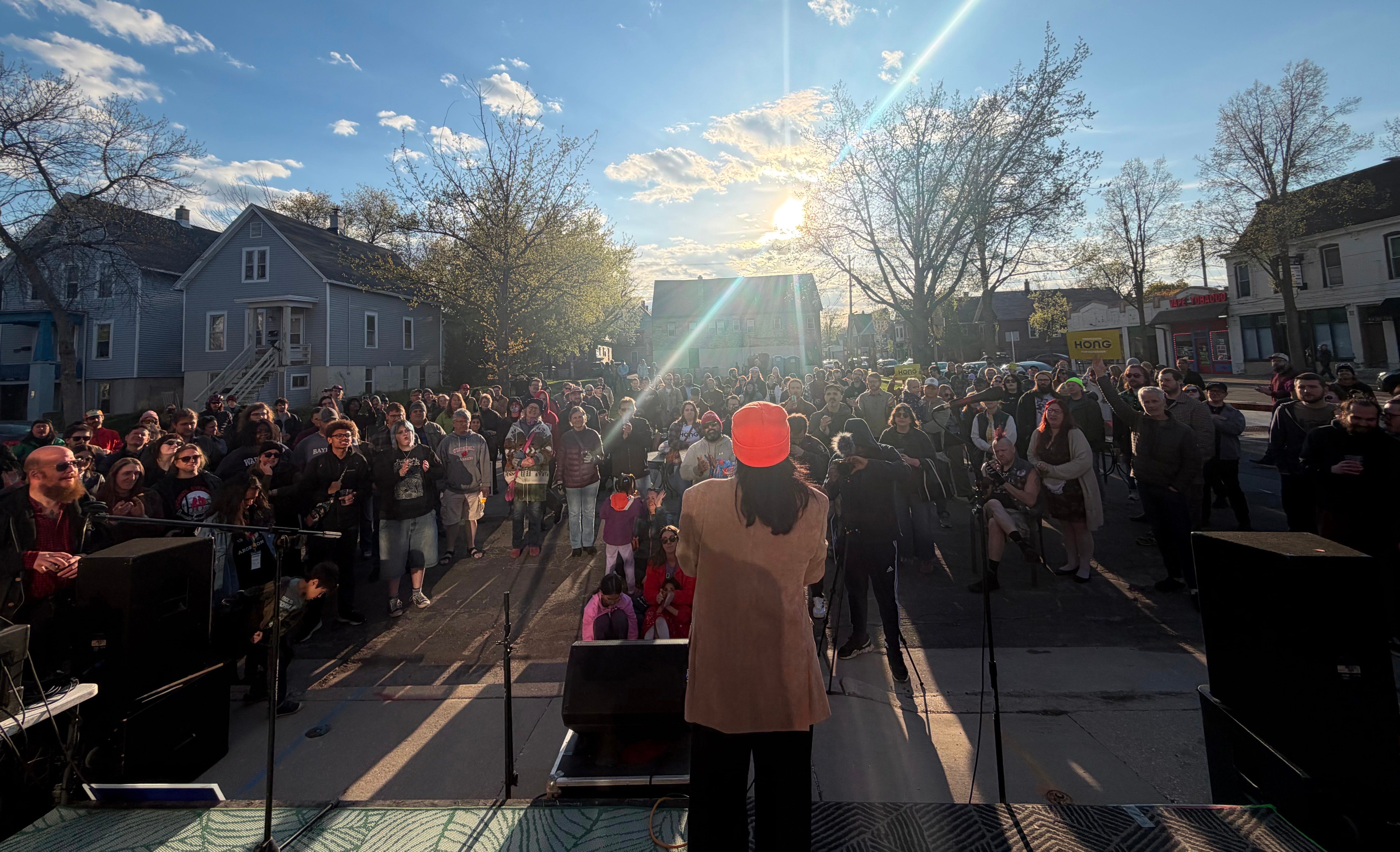
It’s a Saturday night, and the venue is packed. It’s an earlier start time for a Milwaukee area show, and the band is already onstage. But the headliner for this event is not one of the three cover bands set to perform that evening, the headliner is a politician and this show is a fundraiser. Toward the end of the first band’s set, the singer says the event has already raised nearly $4,000.
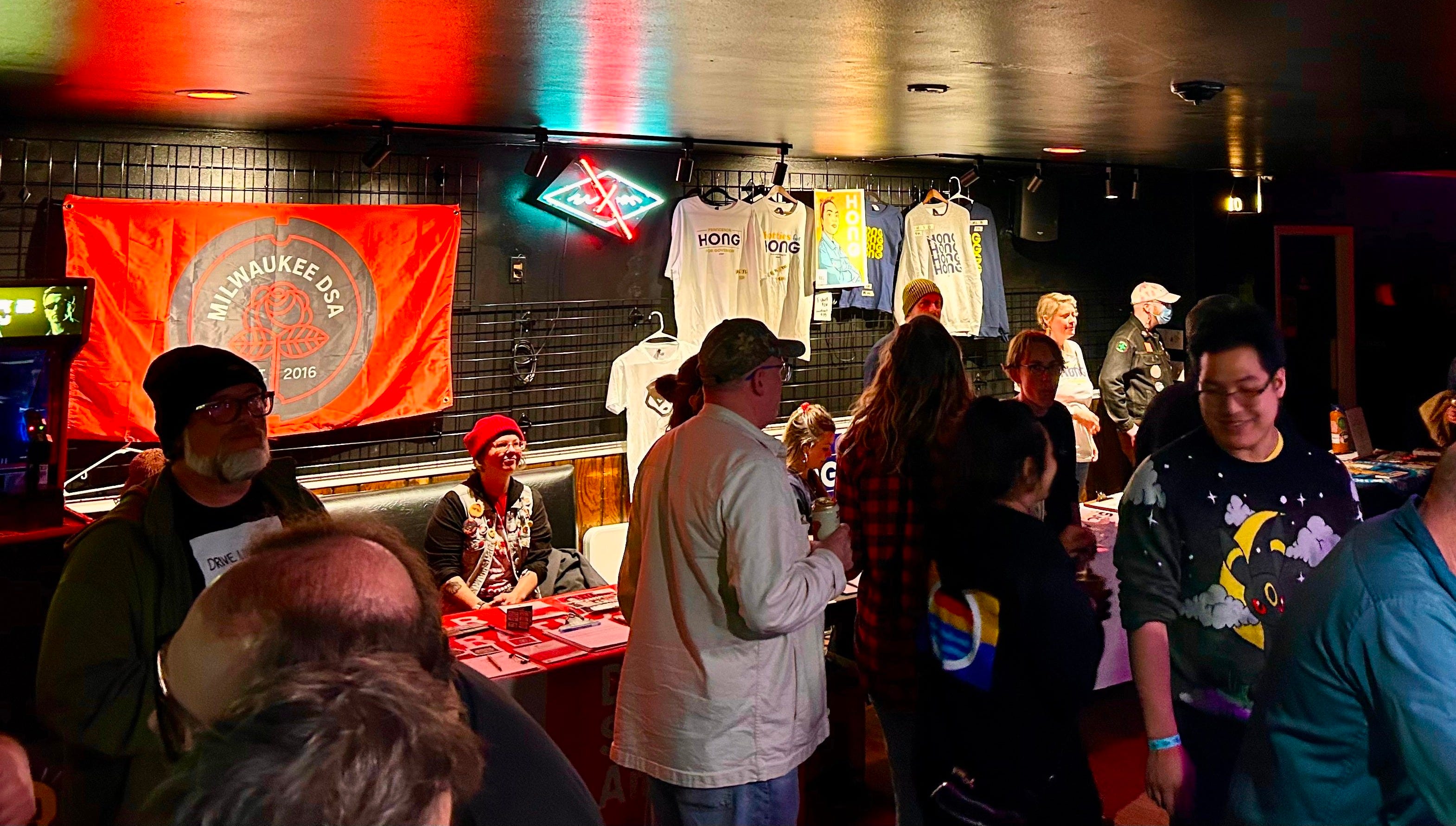
At X-Ray Arcade in Cudahy, volunteers circulate through the crowd collecting signatures for ballot access. Campaign merchandise sits next to tables staffed by members of Milwaukee’s Democratic Socialists of America (DSA) chapter, which has endorsed Hong’s campaign.
Toward the back of the venue, I run into a friend who I hadn’t seen in a while, and we chat and catch up for a few minutes, and then I ask if she’s there mostly for the music or there to support the campaign. She’s there because of Francesca Hong.
“I haven’t been this excited about a campaign in 15 years,” said Ryan Findley.
That enthusiasm is impossible to ignore.

Hong’s campaign has built a sizable volunteer network throughout the campaign. Harry Walton, campaign advisor who oversees volunteers, said, “We have 5,548 people who have taken part in a campaign event so far, (in) 62 of 72 Wisconsin Counties. They come from more than 350 towns, cities, and villages across Wisconsin.”
Many supporters describe Hong not simply as a candidate they agree with politically, but as someone who feels authentic in a political environment that often seems manufactured.
“I don’t normally volunteer for politicians,” said Brittney Neidhardt, a Milwaukee social worker volunteering with the campaign. “She is a very genuine person, and I think that is so rare. She really does care.”
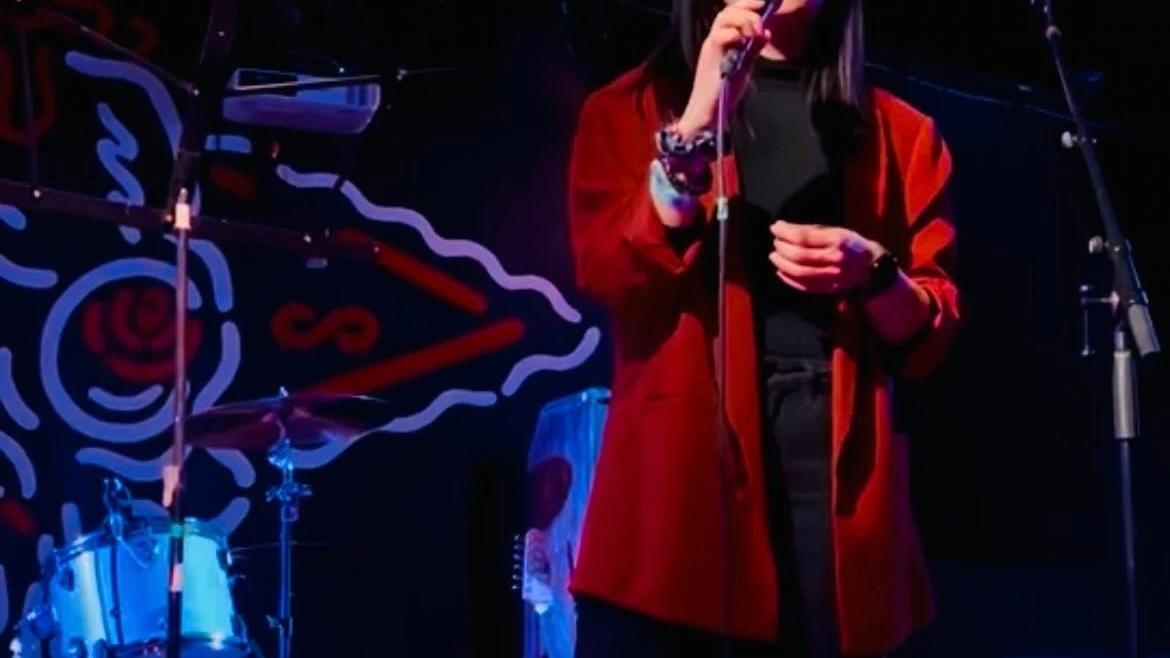
Later in the evening, Hong takes the stage and delivers a speech. She’s also joined by the band onstage, where she sings Gloria Gaynor’s “I Will Survive.” This is becoming her go-to karaoke song to sing on the campaign trail.
“Songs about perseverance and moving forward are always fun for everyone,” she said, and the song choice feels fitting.
Hong’s campaign events are intentionally unconventional, and the campaign is hosting all kinds of different events all over the state — more than 230, to date.
“We have to be organizing in spaces that we don’t think about as political organizing,” Hong said.
They’re all part of a “community building” emphasis that’s central to her campaign strategy. These events are designed not only to promote their message, but to offer a “gateway into being involved politically” for those who might be disengaged from the process.
“Building community is what authoritarians don’t want us to do,” she said. “And (we host) these types of events where people can have fun, can bring their families, can bring new friends who maybe haven’t heard of our campaign or just don’t want anything to do with politics.”
The approach extends online as well. Hong’s campaign has worked to rapidly increase her name recognition while cultivating a style that’s “more accessible, transparent and fun” than traditional political messaging, Hong said.
“We knew we had to spark curiosity,” she said. “It’s hard to make people curious about a campaign from just reading about it in the paper.”
Perhaps part of Hong’s nontraditional and unconventional campaign approach stems from her own unique path to politics.
Born and raised in Madison, Hong is the daughter of Korean immigrants who came to Wisconsin in the late 1980s to pursue educational opportunities. Her father is a sociologist and researcher at the Waisman Center, and her mother is a music teacher.
“In her first year of student teaching, that was Act 10, and that was our first protest together,” she said. “For me, being interested in politics is with your family, with your community.”
After graduating from Madison West High School, she went to college initially intending to be a sports journalist — “following the Erin Andrews path, if you will.” But around that time, she also started working part-time in restaurants, and “fell in love with it.”
“I think the chaos and camaraderie is what drew me,” she said.
Eventually, she dropped out of college to cook full-time. Beginning in 2009, Hong began working “as many part time cooking jobs as I could,” she said, mostly at restaurants in downtown Madison, and also moonlighting at Red Light Ramen and Ardent in Milwaukee. She eventually became the executive chef at 43 North in Madison, and then in 2016, she and then-husband Matt Morris opened Morris Ramen in Madison.
Politics became part of the restaurant’s ethos early on. One of their first events was a fundraiser for Planned Parenthood, and Hong got involved with organizations and events around Madison through the restaurant.
“I learned that organizing looks like bringing people together around a table,” she said.
From the archives:
It was in March of 2020 when I was first introduced to Francesca Hong. I was working on a piece on Wisconsin’s restaurant industry dealing with the initial onset of the covid-19 pandemic. Restaurants and bars around the state were beginning to speak out about what they would need to navigate this crisis, and Hong was among those leading the charge, posting a letter addressed to Gov. Evers on the Morris Ramen Facebook page, eventually having the letter co-signed by more than 50 restaurant industry leaders in Madison.
Not long afterward, she decided to run for State Assembly in the 76th District. Her campaign’s theme was “Share the Table.” Running for political office was not something she had ever planned to do, but her response to the pandemic prompted others to encourage her to run for the open seat.
“Spite and crisis and exhaustion can spark some crazy decisions,” Hong said. “And one of mine was to run for office.”
She won a crowded Democratic primary in August 2020 and would become the first Asian American elected to the Wisconsin State Legislature when she took office in January of the following year.
Her years in the restaurant industry continue to shape how she talks about politics.
“Being in service industry work means that you always put other people first,” she said. “Every public servant should come with that mentality.”
Morris Ramen ultimately closed in 2024 amid rising rents and costs, an experience Hong says reinforced her belief that economic pressures are squeezing working-class people from every direction. This helped shape her view of the working class in Wisconsin, too.
“I think working-class people right now have to make tougher and tougher choices,” she said. “In restaurants, you work so hard and it doesn’t feel like enough. And right now, everyone is feeling that…I don’t think folks realize that the working class right now is basically everyone who isn’t a multimillionaire.”
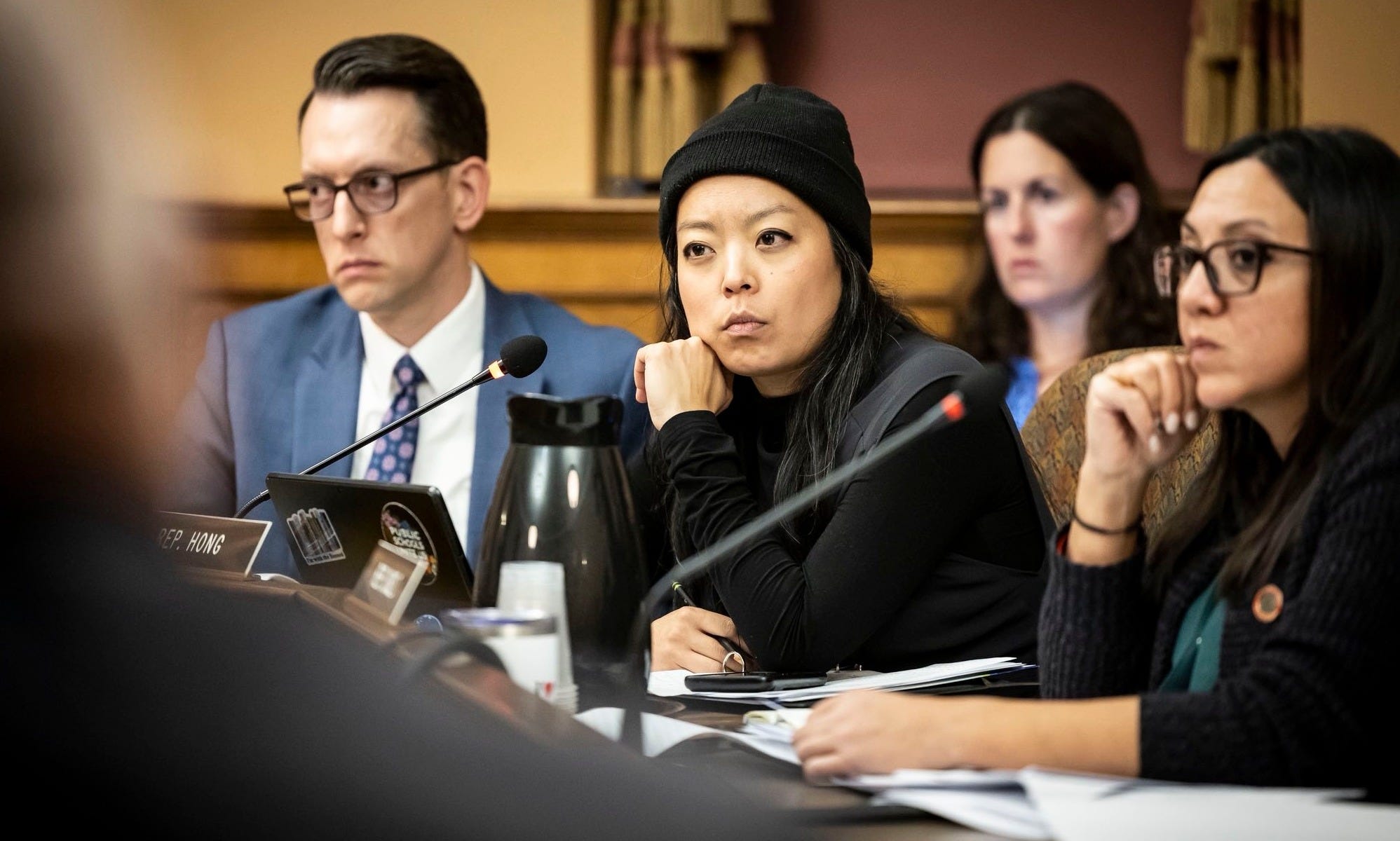
While Hong did not originally run for office explicitly as a Democratic Socialist, she had been a DSA member in Madison prior to running and does not shy away from the label, eventually joining the Assembly’s Socialist Caucus, which was revived in 2023.
“Democratic socialism is democracy, fairness, and human rights,” she said. “I want policies that I prioritize to be working towards more democratic control of the economy. Because the economy right now is controlled by corporations, billionaires, and oligarchs. I want the economy to be controlled by people — and actually work for working class people.”
Hong sees Republicans like President Donald Trump or Assembly Speaker Robin Vos to be the true “villains” in the larger context of national and state politics, but has been frustrated by a “problem of elitism” within the Democratic Party.
“We appealed to the college educated, the folks who are our donor base, and we lost working class people,” she said. “We didn’t diversify — and I’m not just talking about ethnic or racial backgrounds — I don’t think we diversified in how we were approaching voters to talk about and engage them in politics. When I say elitism, you can’t have a party feel like a special club, even though in politics, your job with voters is to make them feel special. And I think we only made a certain group of voters feel special.”
While the Democratic Party might be in an advantageous position going into this year’s midterm elections — the latest poll of the generic ballot from The New York Times shows a Democrat +10 environment — voters still do not hold the Democratic Party in particularly high regard. This same poll showing Democrats in good position for the midterms also showed just 26% of voters are satisfied with the Democratic Party.
Similar numbers have appeared in Wisconsin, too, where the latest Marquette poll showed that only 35% of voters have a favorable view of the Democratic Party. That dissatisfaction with the Democratic establishment has manifested in certain primaries and elections across the country, like in Maine, where Graham Platner has become the presumptive nominee in a key U.S. Senate race, and Zohran Mamdani, also a Democratic Socialist, toppled Andrew Cuomo on his way to becoming mayor of New York City.
“This is a movement moment that demands taking on the establishment, talking about everyday cost of living issues that move people and standing up for human rights unapologetically,” Hong said, praising Platner’s campaign. “Like me and our campaign, dude is trying to talk to everyone everywhere and building organizing infrastructure that brings in new people to the movement.”
The comparisons to the New York mayor are inevitable for someone running as a Democratic Socialist in 2026, and Hong has good things to say about Mamdani’s campaign, too, particularly his “accessibility” approach to social media, saying they’re using it to show “why it’s important to have a government that is a force for good.”
But New York City is not exactly Wisconsin, and the “Socialist” label still carries enormous baggage for a statewide election — even as progressives like Hong will often remind you that Bernie Sanders won 71 of 72 counties in Wisconsin during the 2016 primary. Hong also wants to change the perceptions associated with the label.
“Right now, I’m running as a Democratic Socialist on the Democratic ticket because it signals to people that I am ready for change and for Democratic socialism not to be seen as something that’s scary or radical,” she said. “I think it’s radical that we have kids who are hungry in schools and can’t learn. I think it’s unacceptable that we have small businesses that are paying more in taxes than some of the largest corporations that know how to access loopholes, and that it’s easier to get a corporate subsidy (than) it is for a working mom to get food share benefits to feed her kids, that there’s more bureaucracy in lessening suffering than there is in the wealthiest gaining more wealth.”
Not all issues cut along traditional political lines or fit neatly into the labels of “socialist” or “liberal” or “moderate” or “conservative.” One issue she’s found significant traction on is in her opposition to large-scale AI data centers. In January, her campaign called for a moratorium on new data centers until stronger ratepayer protections and environmental regulations are in place. This position landed her on the cover of TIME magazine, which featured her alongside other activists and elected officials pushing back against these developments.
In Wisconsin, this has become a burgeoning issue where both liberals and conservatives have shown significant opposition to AI data centers. As comedian Charlie Berens has put it in his own advocacy against data centers, “This is the most bipartisan issue since beer.”
This could serve as an example of where the Hong campaign could find traction and trust with voters in unforeseen ways. Because a traditional approach would not work for this campaign — and might not be what voters want right now.
This is part of why people need to start viewing her campaign through a different lens.
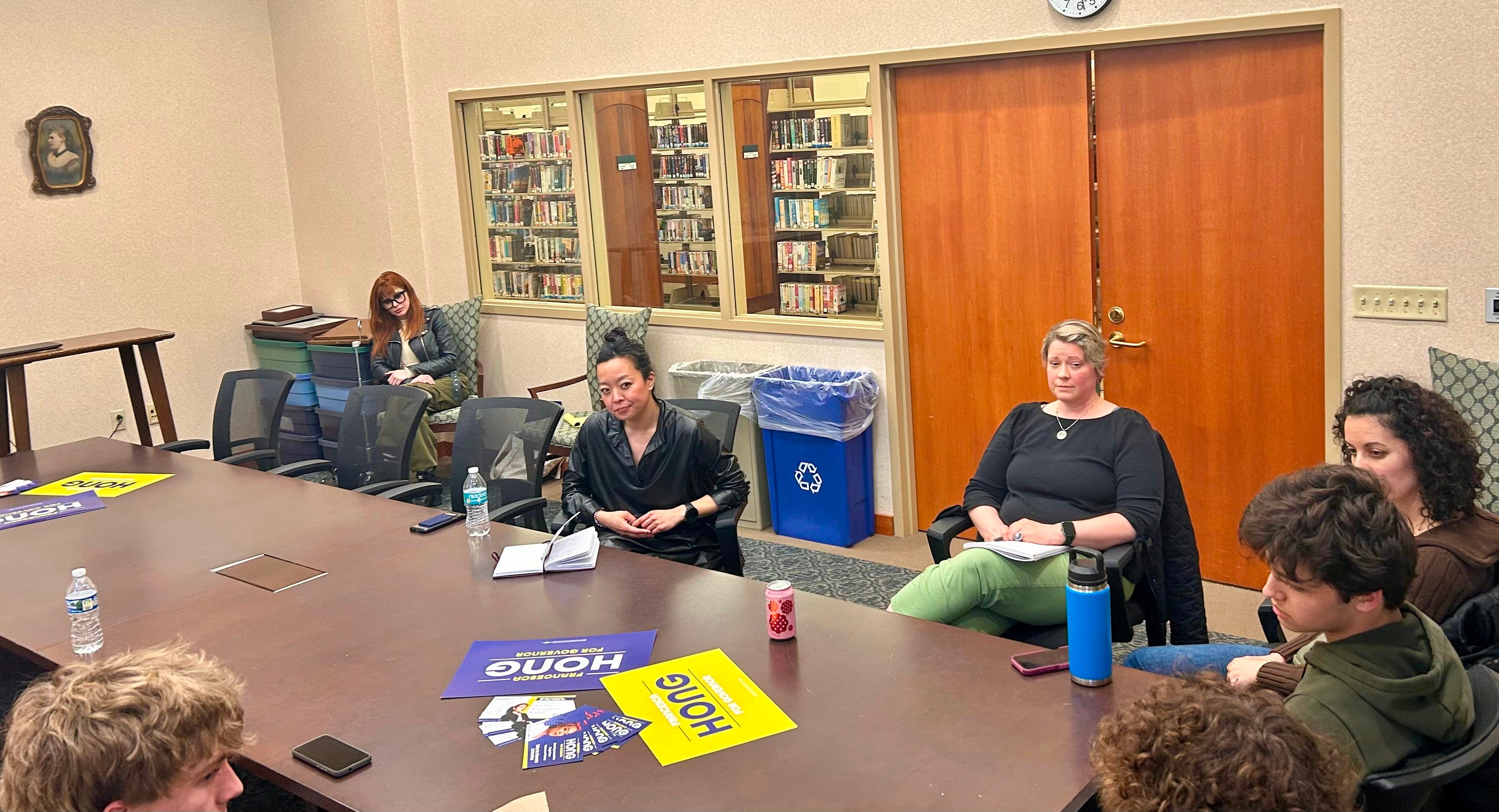
In a gathering space tucked away at the West Bend Community Memorial Library, Francesca Hong sits listening to a group of students, parents and supporters as part of a roundtable discussion campaign event. This is not Hong on stage for a raucous crowd at a concert fundraiser or going direct-to-camera on social media with a fired-up take. But the candidate’s authenticity shines through here, too. At a fundamental level, the message is the same — Hong is the same.
“I’m running for governor for working class people to have a say and more control of their government,” she said. “But I’m also running because I truly love this state and all that it has provided my family.”
She’s at this library in Washington County to discuss mental health. The group is not large, but she’s taking this just as seriously as being on stage in front of hundreds at a candidate forum.
She talks about her own experience dealing with mental health challenges and being in therapy, and how the personal becomes political when “people don’t have their basic needs met” and epidemics of loneliness and isolation are being exacerbated by Big Tech.
She talks about what the state government could do to better fund mental health care, prioritize incorporating it into public institutions, and govern the issue differently. She talks about using her platform to “destigmatize” mental health, answers questions on the impacts of recent public policy decisions on health care, and has conversations about the way technology has warped experiences and eroded connections in younger generations. Beyond the purely political, she talks about connection and community and wanting to rebuild what’s been lost.
Hong does not talk in soundbytes. She is bold without being preachy. She’s more interested in the dialogue of the event than it being another campaign soapbox. She seems more comfortable listening than speaking. The assembled group comes away impressed, and people find her refreshing, authentic and genuine. One of the students says she has a “presence” that’s almost like a “quiet gravity.”
The question lingers, though — especially as we sit in the middle of one of the state’s most conservative counties: Can she win?
There’s a pause in the room when I ask that question to those in attendance, after Hong has left to go to her next campaign event. There’s optimism, but uncertainty. Hope, but caution. A desire to stand aside an unconventional candidate who wants to go big and bold and do things differently, but a tacit acknowledgement that such an approach might not be successful.
It’s that very tension that will define this particularly unique campaign as the Democratic field hurtles toward the Aug. 11 primary.
Electing Hong to be the Democratic nominee for the first open governor’s race in 16 years would carry a great deal of risk. Going from being an Assembly representative in a safe blue district to a statewide candidate is a massive jump, one that she might not be able to land.
But this campaign has earned the right to be taken seriously, and — perhaps more importantly — to be considered on its merits and on the issues and policies it is advocating for, and not simply by the labels or narratives assigned to it.
This campaign is succeeding in ways others are not. There’s something to be learned from a campaign that eschews message-testing and might be grasping the authenticity that voters are craving. Because Francesca Hong and her campaign have worked their way into contention in an unconventional and genuinely compelling manner, and now we’ll see if this wildcard can play a winning hand.

Dan Shafer is a journalist from Milwaukee who writes and publishes The Recombobulation Area. In 2024, he and the publication joined Civic Media, where he is currently a Contributing Editor. He’s written for The New York Times, The Daily Beast, Heartland Signal, Belt Magazine, WisPolitics, and Milwaukee Record. He previously worked at Seattle Magazine, Seattle Business Magazine, the Milwaukee Business Journal, Milwaukee Magazine, and BizTimes Milwaukee. He’s won 24 Milwaukee Press Club Excellence in Journalism Awards. He’s on Twitter at @DanRShafer.
Subscribe to The Recombobulation newsletter here and follow us on Facebook and Instagram at @ therecombobulationarea.
Already subscribe? Get a gift subscription for a friend.
Part of a group who might want to subscribe together? Get a group subscription for 30% off!
Follow Dan Shafer on Twitter at @DanRShafer, at BlueSky at @danshafer.bsky.social, and on Threads at @danshafer.