
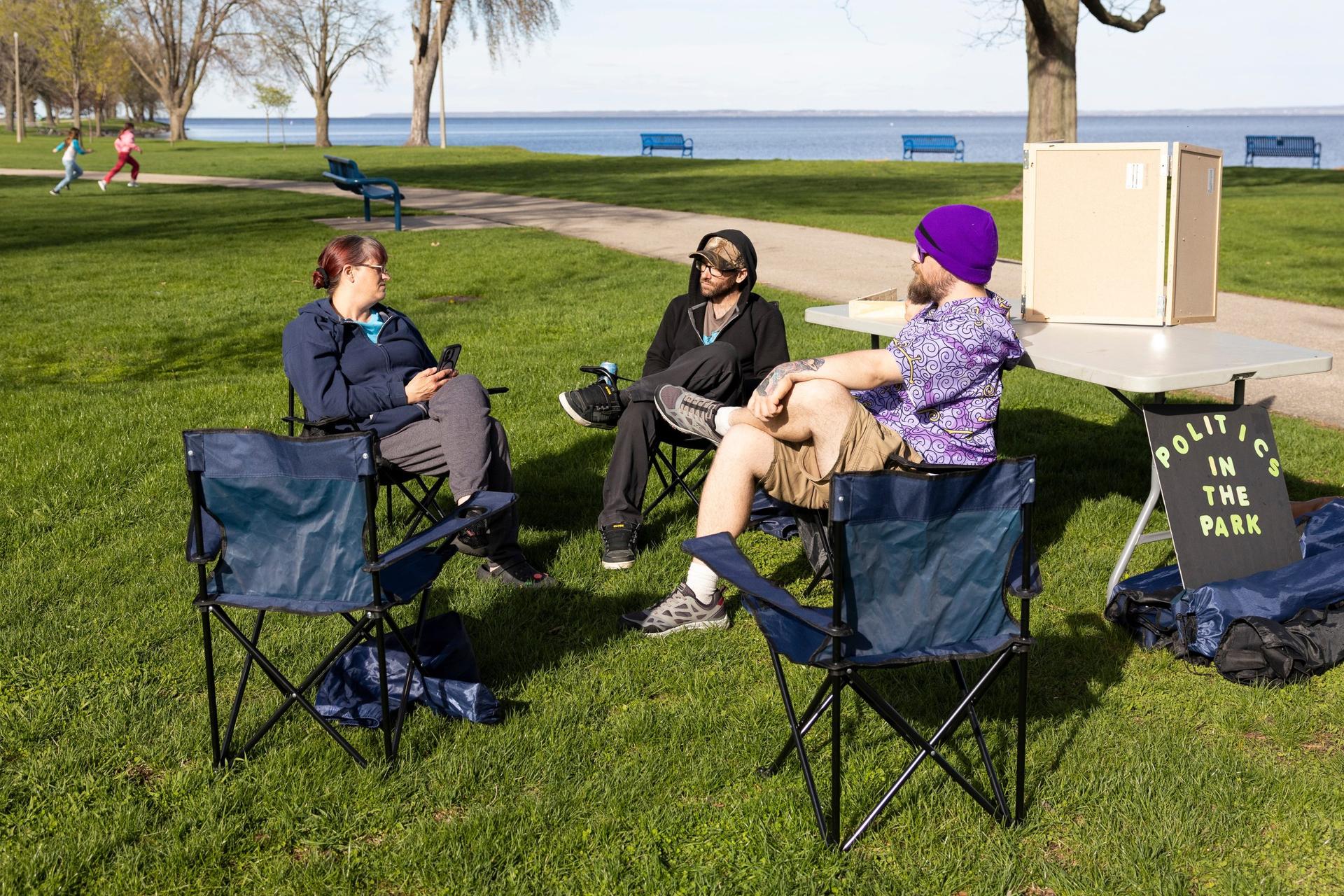


On a late April evening, in an Oshkosh park bordering the shores of Lake Winnebago, Nikolas DeGroot and Elaine Koch arranged four fabric lawn chairs in a circle. They unfolded a small table and used it to prop up posterboard reading “POLITICS IN THE PARK” in bubble letters. Then they sat down and waited for curious passersby to notice.
During a time when Americans are increasingly polarized and politics can feel too tense a topic to broach in conversation, Oshkosh resident DeGroot wants to inspire his neighbors to tackle the topic head on — and handle disagreements thoughtfully.
“There’s a disconnect in the way that we relate to one another, on many different levels. I think that the internet has kind of become the public commons, and it does it really badly,” DeGroot said. “We all know it’s terrible. We all hate it, and yet that’s still like the place where the most discussion is happening.”
The antidote, he thinks, is simple: bring conversation about shared issues back in the flesh, in a public place neighbors frequent, and make sure it stays respectful.
That’s the gist of “Politics in the Park,” an event series where DeGroot and several helpers invite people to have civil conversations about politics and local issues at a public park. Through this, he hopes his neighbors can learn to connect again and chip away at the polarization driving people away from each other.
Perhaps unsurprisingly, getting people to take part in the initiative has proven difficult. Still in its infancy, the twice-weekly events this spring mark the series’ second year. Turnout has been sparse — typically, a handful of people stop by each event. The group, dubbed Groundfloor Democracy, hosted about 10 attendees at once at its peak.
But the conversations they’ve had have been encouraging, and they hope it’ll catch on soon.
“I want people to see that there is a big difference between debate and just regular conversation, and that we can get back to conversation,” said Emmy Carrick, who helps put on the events. “We want people to take away that regular conversation without yelling, without debate, without cameras — it’s possible.”
‘We’ll pull up some chairs, and we’ll just see’
As a political science student at the University of Wisconsin-Oshkosh, DeGroot was eager to attend political and academic events on campus. But when he looked around the room at donors, university administrators, professors or students required to be present for a class, he felt out of place.
“As somebody who comes from a working-class background, I don’t see any people like me at events like this,” said DeGroot, who works two part-time jobs.
He started looking for other community organizations he’d be more aligned with. But he didn’t see any addressing his biggest concern: “How do we get people off of their devices and speaking in person again?”

He decided to take matters into his own hands.
“I was taking my son to the park every day after school anyway, for like two hours. So I was like, … ‘We’ll just set up a sign, we’ll pull up some chairs, and we’ll just see. We’ll just see what happens,’” he said.
He made Facebook posts to tell people when he was going to be outside and wanted to facilitate conversation. He let people talk about what was on their minds. A few visitors came the first couple times, but they sometimes struggled with what to discuss.
He started asking questions to guide discussion:
“If you could change one thing about your government (local, state or federal), what would it be?”
“What’s something you think we could fix if we just talked about it more honestly?”
“What’s one thing you’d like politicians to stop doing?”
“What gives you hope when it comes to politics or your community?”
“What do you think people get wrong about folks who vote differently than them?”
Meanwhile, DeGroot posted a callout for people to help him with the endeavor. Four board members now help him organize events, post on social media and try to grow Groundfloor Democracy’s turnout.
That includes Carrick, who discovered the project while surfing Reddit. She wanted to get involved because she feels like “we’ve never been more disconnected from our neighbors.”
“I like the premise of it because it was just something so low-stakes,” Carrick said. “With how polarized things are, it feels like any political conversation that you have is very high-stakes. I liked that this was just informal and welcoming.”
By the end of last spring, they’d had enough turnout to feel encouraged to continue. This year, the events are guided by a one-word prompt, such as “local,” “education” or “justice.” They ask participants what topics the words bring to mind and let attendees steer the conversation.
Continuing the conversation
Carrick’s favorite Politics in the Park event took place on an early April evening, when about 10 people attended. Two teens on their way to the bus stopped briefly to learn about the initiative. Another man wanted to discuss the Trump administration’s policies — an exchange that ended with him and Koch praying together.
“Nobody ever said whether they were a Democrat or Republican. We just talked,” Carrick said. “That was so refreshing to me. We didn’t talk about parties at all. We just talked about us and our lives and local issues and more of what brought us together.”
While discussion at the events has stayed civil to date, conversations about politics can often slide off the rails.
Their goal isn’t to avoid debate, but to encourage handling disagreements respectfully. For that reason, DeGroot took a 40-hour mediation training at the Winnebago Conflict Resolution Center to learn how to handle and dissolve conflict.

“A big part of that training was getting from the thing that somebody is saying to the underlying feeling that’s connected to what they’re saying,” DeGroot said. “It’s just trying to get to that little crumb at the center of like, why does this person feel so strongly about this particular thing?”
If needed, he will intervene to help the person see how those “big feelings” at the root of their argument overlap with the values of the people sitting with them, to help them see the similarities they share. Though he’s prepared, he hasn’t yet needed to interrupt a conversation.
Since it is a nonpartisan organization, DeGroot and other members are careful not to advocate for specific candidates, parties or policy positions. That’ll become especially important as they look to become an official nonprofit. The federal government prohibits these types of organizations from engaging in political campaign activity.
As time goes on, they also want to grow the initiative by hosting conversations in more Wisconsin cities or partnering with other local civic organizations.
They also want to find ways to raise funds — right now, everyone who helps out is a volunteer.
Mostly, though, they want more people to come talk about politics with them in the park.
“We can’t delete social media from the world, heal our nation’s politics overnight or anything like that,” Carrick said. “But we can set up some lawn chairs in a park and have a couple neighbors come out and just chat and get to know each other more.”
Learn about Groundfloor Democracy’s upcoming events here.