


Democrats seeking the party’s nomination for governor talk about many of the same goals when it comes to Wisconsin’s health care system: expanding access, reducing costs and ensuring quality.
Some of their proposals to those ends are almost identical. But key details vary.
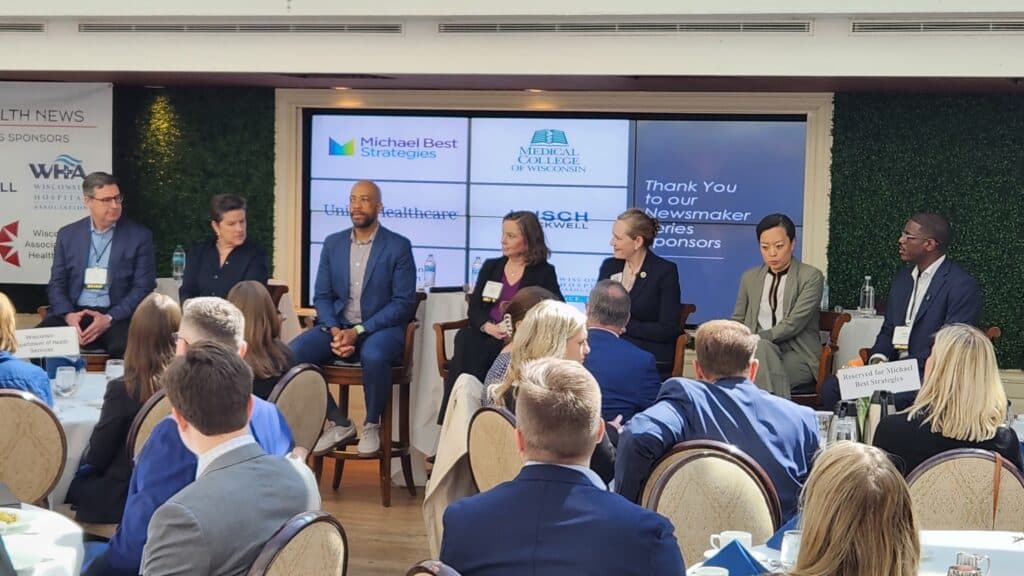
“If there’s one thing that’s a certainty, the context will change between now and when one of us takes office and has a Legislature that hopefully is going to work with us,” said Joel Brennan, former secretary of the Department of Administration, at a forum Wednesday conducted by Wisconsin Health News. “That context will change in the next nine to 10 months and we better be ready to change with it too.”
Brennan said his campaign’s health care policy will rest on four principles: broadening access to health care, particularly in rural areas; reducing costs; fostering a pathway to increase the health care workforce; and ensuring that mental health is “a basic part of health care.”
Other candidates have issued more detailed plans.
Former Wisconsin Economic Development Corp. CEO Missy Hughes announced a list of 10 proposals Wednesday.
“I’m really wanting to make sure that we’re addressing a very, very complicated problem in every different way,” Hughes said at the Wednesday forum.
Expanding Medicaid
Almost all of the seven major Democratic hopefuls have endorsed expanding Medicaid under the Affordable Care Act — opening up the health insurance plan for low-income Americans to people with incomes up to 138% of the federal poverty guideline. When the ACA was enacted the federal government paid states that accepted expansion 90% of the additional cost.
Democratic Gov. Tony Evers made repeated attempts to enact expansion after he took office in 2019, but couldn’t do it without the support of the Republican majority in the state Legislature because of a law passed the month before Evers was sworn in.
Former Lt. Gov. Mandela Barnes has made Medicaid expansion the central focus of his health care policy pitch. He has promised to veto the state budget if it doesn’t include Medicaid expansion.
“The fact that so many folks aren’t covered right now is a problem for everybody,” Barnes said at a forum Monday, because health care providers pass the cost of uncompensated care on to other patients or their insurance companies. The Monday forum was conducted by ABC for Health, a nonprofit law firm that assists low-income Wisconsinites trying to navigate health care coverage and medical debt.
Hughes also lists expanding Medicaid — referred to as BadgerCare in Wisconsin — among her 10 proposals. She would connect BadgerCare expansion to the creation of a public option health insurance plan that Wisconsinites could purchase through the ACA marketplace, HealthCare.gov.
Milwaukee County Executive David Crowley also favors combining expanded Medicaid with a public option for people to buy into the plan. “We already have the BadgerCare infrastructure that is already in place,” Crowley said at the Wednesday forum. “So I think it’s our responsibility to expand the people’s ability to actually pay into a BadgerCare public option.”
Lt. Gov. Sara Rodriguez favors BadgerCare expansion as well as a public option health plan. Rather than combining them, however, she lists them as two of three health care initiatives she would pursue as governor. The third initiative is to institute a stabilization fund program to support struggling rural providers.
The public option plan, to be sold on the ACA marketplace, “would be able to put downward pressure on costs across Wisconsin and have some price transparency within that,” Rodriguez said at the Monday forum. She pointed to examples in other states, including Colorado, where a public option health plan is also required to reduce its premium costs by 5% each year.
“Secondly, I do think that we should expand Medicaid in the state of Wisconsin,” Rodriguez said, noting Wisconsin is one of just 10 states that have not done so.
Rodriguez also observed that the 2025 “big, beautiful” tax and spending bill enacted by the Republican majority in Congress and signed by President Donald Trump on July 4, 2025, “makes it a little harder” for the state to expand Medicaid.
State Rep. Francesca Hong also included BadgerCare expansion and “a robust public option” health plan in a longer list of priorities during the Monday forum. Along with those, she called for lowering prescription drug costs, acting to “crack down on private insurers,” among other goals.
A Medicaid expansion dissent
An exception on Medicaid expansion is Sen. Kelda Roys. Although she has advocated Medicaid expansion going back to her years in the Assembly a decade ago, she argues now that it’s no longer practical.
An August 28 memo from the Wisconsin Department of Health Services declares that the 2025 tax and spending law includes “several traps making it cost and policy prohibitive for Wisconsin to expand Medicaid.”
The law requires Medicaid participants to prove they’re eligible every six months instead of annually as now — which advocates argue will lead more qualified recipients to be kicked out of the program. In addition, a $1.3 billion boost that Wisconsin would get for expanding Medicaid will end Dec. 31.
Expansion “is not feasible given the changes that the Trump administration has made right now,” Roys said Wednesday.
Instead, she has proposed allowing the general public to buy into the state health insurance plan that covers state employees. Wisconsin employers could buy into the plan to cover their workers, or individual Wisconsin residents could buy into it as an alternative to other private health insurance plans.
“We can lower costs, reduce uncompensated care, expand access to coverage, especially for small businesses,” Roys said.
Brennan has also proposed opening the state plan to the public, because it has broad participation as well as higher reimbursement rates for health providers, he said Wednesday.
But he added that he thinks details on the public option should wait until the next governor takes office, so that experts in the state as well as from other states that have instituted a public option “can be part of that conversation.”


