
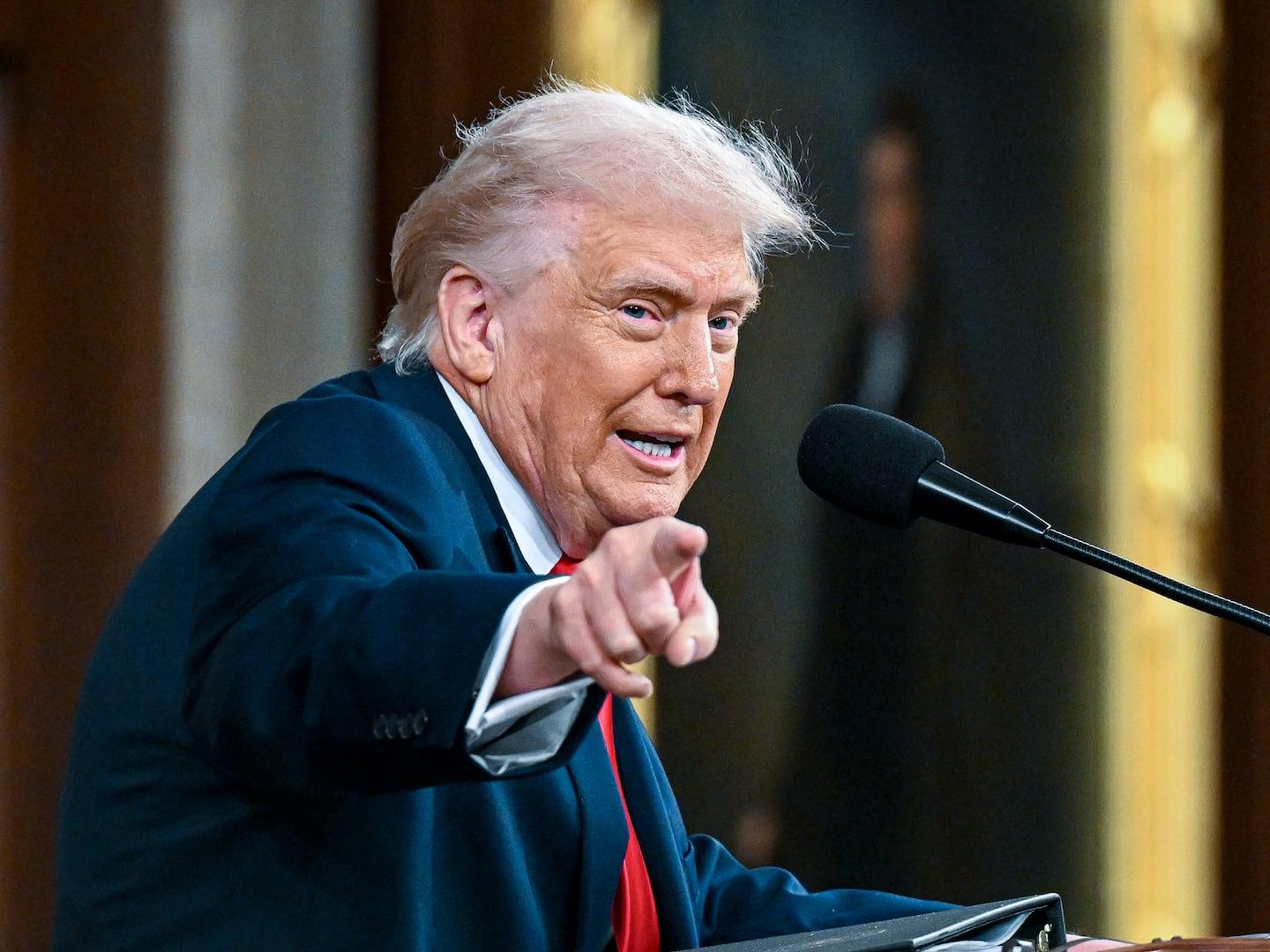


Presidents have no constitutional authority to oversee elections or dictate how they are run.
That hasn’t stopped President Donald Trump from a sweeping effort to reshape elections during his second term in office. Legislation on Trump’s election priorities has so far stalled in the U.S. Senate, and federal courts have for now blocked key provisions of an executive order on elections he signed last year.
But his efforts are affecting laws at the state level.
Since Trump resumed office last January, at least 10 states have passed legislation reflecting one or more of his preferred election policies, including Florida’s passage of a proof-of-citizenship registration requirement earlier this month. In total, at least one-third of state legislatures have seriously considered bills that align with, or seek to counter, Trump’s aggressive push to reshape the nation’s electoral system.
This all comes as Trump attempts to exercise his influence over elections in practically every way possible, from encouraging states to use a newly overhauled — but unreliable — federal database to identify noncitizens on voter rolls, to appointing officials who have repeatedly questioned election results or attempted to overturn them — not to mention his efforts to tip election outcomes in his party’s favor by pushing for partisan redistricting.
His influence is not without limits: No state has so far adopted his calls to nearly eliminate mail voting and passed a law to that effect.
Still, lawmakers in the states that have passed or advanced legislation aligned with the president’s preferred election policies have often cited him as the reason, or taken action following statements he’s made. In some cases, such as Texas’ midcycle redrawing of political maps, state lawmakers were responding to direct pressure from Trump.
“The process of spreading legislative ideas is one that always takes place in any administration, any political environment,” said Gideon Cohn-Postar, director of federal affairs at the nonpartisan Institute for Responsive Government and a historian of election law. “This one has been far more explicit.”
And to a lesser extent, some blue-state legislatures are aiming to counter Trump’s push into state election policy through, in one example, a new law that would block federal troops at voting locations.
Trump speaks, states follow
The president has sought to impose new documentary proof-of-citizenship requirements for registering to vote, end post-election grace periods for mail ballots and severely restrict their use, and redraw congressional maps. He’s often lobbied state officials directly, including at a gathering of governors last month, pushing election policy to the forefront of legislative agendas.
A Votebeat analysis of legislation found that since January 2025, when Trump took office for his second term, at least 13 states have advanced legislation out of at least one chamber that aligns with an election administration policy Trump has expressly demanded.
For example, in 2023, very few states introduced bills to require documentary proof of citizenship from voters, compared to nearly half in 2025, according to Chris Diaz, director of legislative tracking at the Voting Rights Lab, a nonprofit group that tracks all state legislation on voting and elections.
For years, Arizona for years was the only state that required documented proof of citizenship, though New Hampshire and Louisiana passed new requirements in 2024. But since the beginning of Trump’s second term, as he has relentlessly promoted concerns about potential noncitizen voting, Wyoming, South Dakota, and Utah passed a proof of citizenship requirement, and bills are currently headed to governors’ desks in Florida and Mississippi. Iowa’s legislature is also considering a similar bill.
Proponents of the bills have openly said they are acting to carry out the president’s wishes. Jenna Persons-Mulicka, a Republican state representative in Florida who sponsored the proof-of-citizenship bill there, said it “fully answers the president’s call” when she initially introduced it. Chuck Gray, Wyoming’s secretary of state, said in a statement that state’s measure was “key in supporting President Trump’s pivotal work to have proof of citizenship for registering to vote.”
And while states aren’t introducing as many mail voting-related bills compared to the 2021-2022 period, Diaz said the one area many states are still legislating on is accepting mail ballots postmarked by Election Day but received afterwards.
“I think you can really trace that and the rise in proof of citizenship legislation back to the president’s executive order last March,” he said.
During the 2024 election, 18 states and the District of Columbia allowed mail ballots to be counted if they arrived within a legal grace period and were postmarked by Election Day. The U.S. Supreme Court heard arguments in a case over the legality of that practice this week, but some states aren’t waiting for a ruling. Five Republican-controlled states have moved to eliminate their grace periods for late-arriving mail ballots, with four of those doing so after Trump directly called for its end in his March 2025 executive order.
In Ohio, one of the primary sponsors of a bill to end the state’s four-day grace period explicitly cited the executive order.
Presidential pressure on redistricting, voter rolls
In some cases, Trump, and his appointees in the federal government, have pressured state officials even more directly.
Last year, Trump pushed reportedly reluctant Texas Republicans into redrawing its congressional districts, setting off a midcycle redistricting war amongst the states, arguably Trump’s most profound influence on election policy. He tried the move again, unsuccessfully, in Indiana, calling out state legislators by name and promising to support primary opponents if lawmakers didn’t do as he wished.
Micah Beckwith, the Republican lieutenant governor of Indiana, also said unnamed members of Trump’s administration threatened the state’s federal funding if it didn’t redistrict.
And as tensions rose earlier this year over immigration enforcement in Minneapolis, Attorney General Pam Bondi suggested in a letter that the state should hand over its unredacted voter rolls to the U.S. Justice Department, which has sued for access to them. State officials said they perceived her letter as a demand made in exchange for potentially withdrawing ICE agents from the city.
Cohn-Postar, from the Institute for Responsive Government, said while it isn’t uncommon for presidents to push for federal election policy or even comment on state laws, as Biden did with a controversial election bill in Georgia in 2021, it is unusual for them to directly call on states to take specific action. But what sets Trump’s actions apart, he said, is the direct calls for change coming from the president and the speed at which states seem willing to change their laws in response.
Utah, for example, has had universal mail voting since 2012, meaning that counties could conduct their elections entirely by mail by sending all registered voters a mail ballot. By 2019, all counties in the state had adopted this system, and more than 80 percent of voters in 2024 were very or somewhat confident that their votes were being counted accurately. But last year, the state nevertheless opted to move to an opt-in mail voting system starting in 2029.
“These states have taken policy decisions that they might not have in another political environment,” Cohn-Postar said. “I think that’s not coming from inside the house. That’s coming from outside the house.”
Blue states push back
Meanwhile, a handful of states led by Democrats are taking steps explicitly aimed at preventing Trump from interfering with elections, as well as countering his redistricting push.
Trump’s calls to nationalize elections and the federal seizure of 2020 election records in Fulton County, Georgia, and Arizona, among other moves, have heightened concerns that Trump may try to interfere in the 2026 midterm elections, including by deploying federal troops or ICE agents to polling places.
While some members of his administration have said it won’t happen, Sen. Elissa Slotkin, a Democrat from Michigan, asked Homeland Security Secretary Markwayne Mullin the question during his confirmation hearing last week, and he did not absolutely rule out the possibility. Steve Bannon, who was an adviser to Trump during his first term in office, has said the recent deployments of ICE to airports could be used as a “test run … to really perfect ICE’s involvement in the 2026 midterm elections.”
In anticipation, some states are considering steps to strengthen restrictions on federal law enforcement at voting locations, including New Mexico, which in February passed a bill making it a felony for federal troops or armed law enforcement to be at polls.
Democratic attorneys general are also coordinating on what possible actions they could take should Trump attempt to interfere in the midterms.
Last month, Colorado went a step further, becoming the ninth state — and first in Trump’s second term — to pass its own version of the Voting Rights Act, in part as a reaction to concerns that the federal statute faces threats from the current administration.
Changes could prompt voter confusion
A risk of all this new legislation, and the potential litigation that could follow, is that it confuses voters.
“They hear that this law gets passed and then signed by their governors, and then it gets challenged, and then there’s a temporary restraining order,” said Jessica Jones Capparell, director of government affairs at the League of Women Voters, which has sued over Trump’s executive order.
“And so they have to figure out what’s going on, what they have to bring with them when they go to vote, what do they need to do to register, update their voter registration.”
The biggest question is what happens in the few months before the November election, Diaz, from the Voting Rights Lab, said. Legislative sessions are still underway in some states, and he pointed to Florida as a potential barometer for where laws on election administration might go in the months and years ahead.
“These next few weeks especially will be really important to watch what happens,” he said. “Their legislative session is probably gonna wrap up pretty soon, and I think that will sort of be a big sign of how serious are legislators taking this as a policy goal versus a talking point. I think if Florida did enact a proof-of-citizenship bill this year, I think that could be something that really sets a tone for other states to start doing it.”
Carter Walker is a reporter for Votebeat in partnership with Spotlight PA. Contact Carter at cwalker@votebeat.org.