
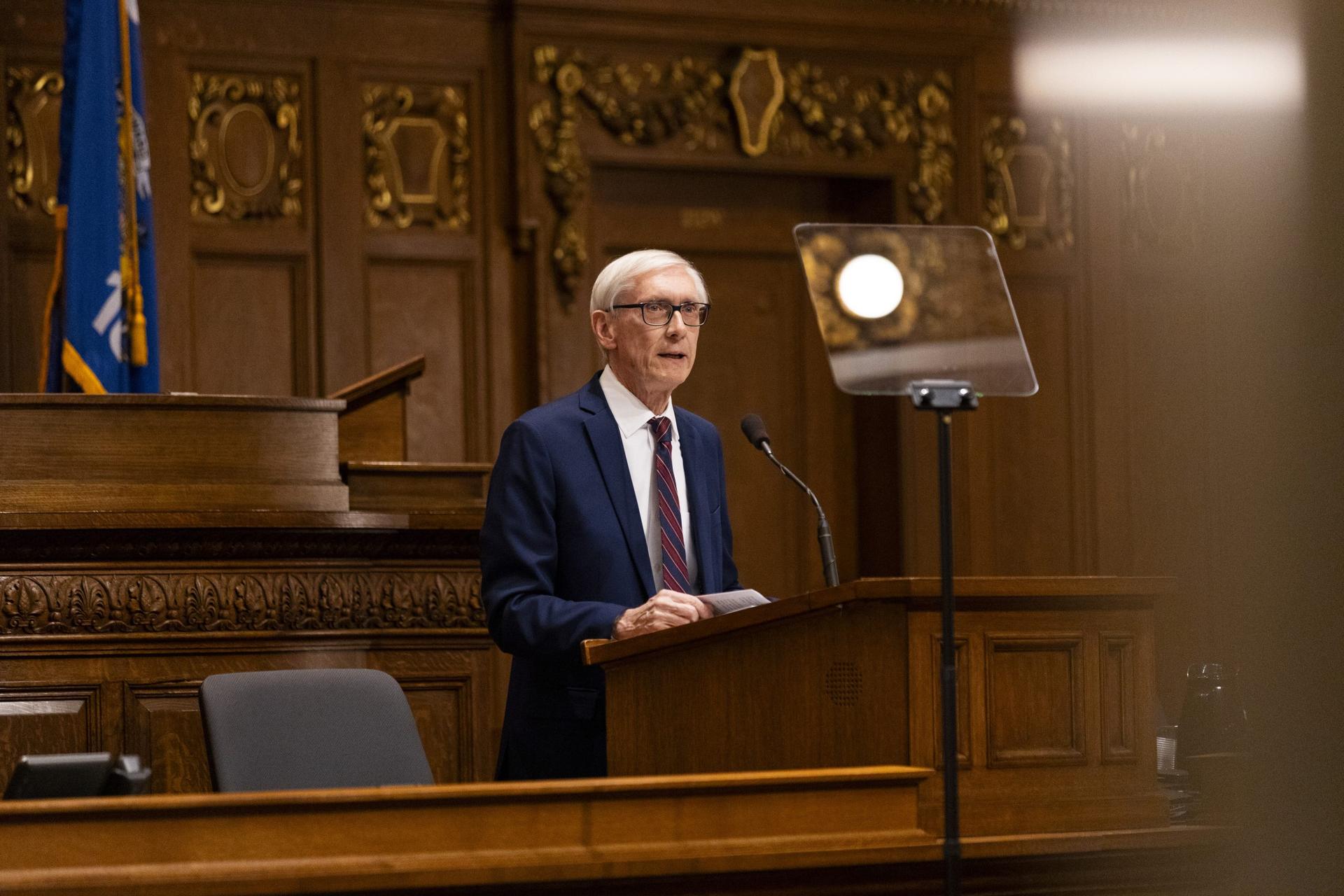


Gov. Tony Evers does not support a Republican-led amendment to a state bill that would require the Milwaukee Common Council to unanimously agree before it can change Milwaukee Police Department policies, a spokesperson for Evers’ office said.
The governor plans to veto the bill if it reaches his desk, the spokesperson said.
It’s the latest development in a long-running dispute between state lawmakers and Milwaukeeans over who should control police policy.

Rep. Bob Donovan, R-Greenfield, who represented Milwaukee’s South Side on the Common Council for 20 years, proposed the amendment to Senate Bill 799. The amendment would require all 15 council members to agree before they could reject or modify an MPD policy.
Donovan’s amendment sets a higher bar for influencing Milwaukee police policy than currently exists under state law. The Common Council can currently reject or modify an MPD policy with a two-thirds vote – 10 of its 15 members.
The amendment could have real and tangible effects on life-and-death matters in the city.
For example, city officials have long disagreed over strategies for how best to address gun violence, such as the use of ShotSpotter, a technology that alerts officers when gunfire is detected.
Some council members have supported it as a tool to respond more quickly to shootings, while others have questioned its effectiveness and cost.
If Donovan’s amendment were to be enacted, council members would have to agree unanimously in order to change it.
“Allotting single member veto power to any Common Council member who wishes to block a policy change that is potentially supported by the rest of the Council opens the door to unnecessary roadblocks for matters as serious as public safety,” said Amanda Avalos, former vice chair of the Fire and Police Commission. “Standard operating procedures and guidelines are meant to protect the members and community alike – there should be no room for governance loopholes.”
A more recent controversy involving the use of facial recognition technology illustrates how the two-thirds majority rule can influence policy.
MPD has previously said it was considering entering into an agreement with a company called Biometrica to use facial recognition technology to assist in criminal investigations. The announcement triggered widespread pushback from residents and others.
In May, 11 council members sent a letter to MPD Chief Jeffrey Norman expressing opposition to MPD entering a contract with Biometrica. That meant the Common Council had enough votes to veto the policy. If Donovan’s proposal became law, that wouldn’t be the case.
MPD’s perspective

Even if that policy did become law, that doesn’t necessarily mean that MPD wouldn’t take into account feedback it gets from others.
An MPD spokesperson said in an email that the department collaborates with local communities and officials in a variety of ways.
“MPD continually and regularly reports to the Fire and Police Commission, who still have directive powers, promotional powers and chief oversight, the Common Council that oversees budget, creates ordinance and resolution and now has (policy) modification authority, as well as the mayoral administration,” the spokesperson said.
Most importantly, they said, MPD serves and ultimately reports to the community it serves.
Donovan did not respond to requests for comment about the amendment.
Act 12
How police policy is determined has already undergone significant changes in recent years.
When Wisconsin Act 12 was enacted in 2023, it stripped the authority from the Fire and Police Commission to determine MPD policy – authority it held for many years.
Civilian authority over police policy is something quite rare in the U.S., Edward Fallone, former chair of the commission, previously told NNS.
With this power, the commission banned, for example, the use of chokeholds as well as “no-knock” warrants.
After Act 12 took effect, the commission’s role in setting police policy became limited to making recommendations, with the police and fire department chiefs setting policy and the council having authority to reject or change policy with a two-thirds majority.
The changes brought by Act 12 prompted the resignations of Fallone and Avalos.
Legislative steps
The bill has passed both chambers of the Legislature and now heads to Evers’ desk, where he plans to veto it.
The MPD respects the legislative process at the state and local level, the department’s spokesperson said.
Jonathan Aguilar is a visual journalist at Milwaukee Neighborhood News Service who is supported through a partnership between CatchLight Local and Report for America.