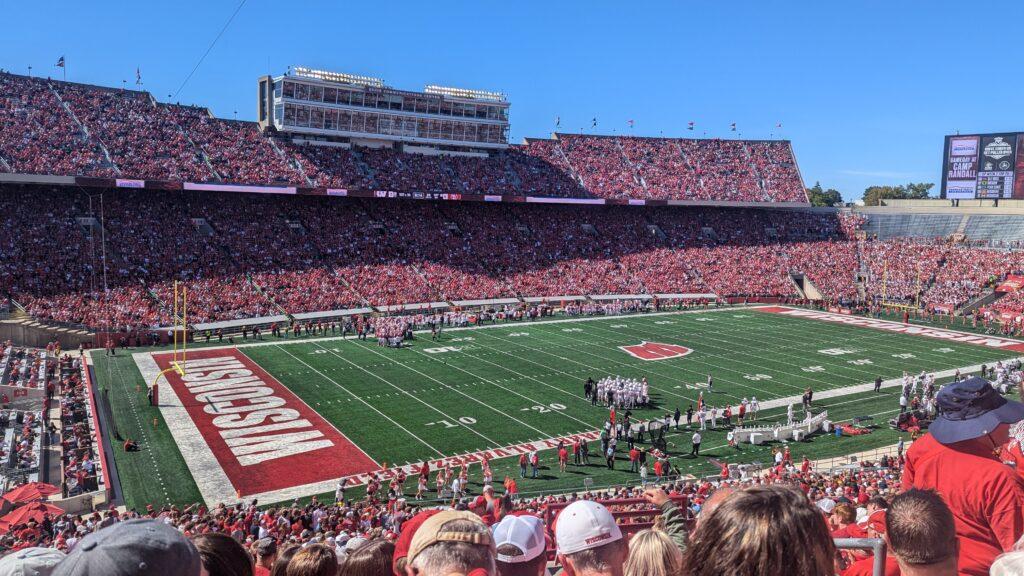


University of Wisconsin-Madison Athletic Director Chris McIntosh said at a public hearing on the bill last week that the measure is necessary to help UW maintain its athletics programs and competitiveness.
A recent landmark antitrust settlement in a House v. NCAA lawsuit allows college athletics programs to directly provide NIL compensation to student athletes.
According to written testimony, starting in fiscal year 2026 the settlement will add an expected $20.5 million annual expense to the UW-Madison athletics budget to cover the cost of the revenue-sharing requirements. The settlement allows schools to pay athletes up to an annual cap that starts at about $20.5 million per school in 2025-26 and increases every year potentially reaching over $32 million by 2035.
AB 1034 would provide $14.6 million annually in state funds to go towards debt service for the maintenance costs of UW-Madison’s athletic facilities. It also includes $200,000 annually in state funds for debt service for maintenance costs of the UW–Milwaukee Klotsche Center as well as $200,000 for the UW-Green Bay soccer complex. The purpose is to free up funds that the UW can use to provide students with opportunities for NIL agreements.
“If this bill doesn’t pass and is pushed off into the future, it will continue to put tremendous financial strain on athletics and on the university. We will have our backs up against a wall financially by the time that this would come forward in 2027,” McIntosh said. UW-Madison has 23 sports teams and he said this would especially help support its Olympic and women’s programs.
Without the bill, McIntosh said UW-Madison will need to reevaluate “our expectations on the success of our sports” or “how they’re supported or how many of them exist.”
There are at least 32 states that have passed laws to regulate NIL agreements for student athletes.
The bill seeks to codify the policies that UW-Madison and other campuses already have in state law. Some of those include prohibiting NIL contracts that conflict with school policies or provide money in exchange for athletic performance, as well as those that require student athletes to endorse alcoholic beverages, gambling, banned athletic substances or illegal activities or substances. It also includes a requirement that student athletes disclose third-party NIL deals they enter.
UW schools will also be able to contract with organizations that can help student athletes find NIL opportunities.
The bill is coauthored by Senate Majority Leader Devin LeMahieu (R-Oostburg) and Reps. Alex Dallman (R-Markesan), Scott Krug (R-Rome) and Paul Tittl (R-Manitowoc).
UW exempted from state open records law
Open records advocates have questioned the broad nature of an open records exemption included in the bill.
Beth Bennett, executive director of the Wisconsin Newspaper Association, said in written testimony that the language in the bill related to open records “appears to extend far beyond” its intended purpose and could “create a sweeping exemption for any financial record connected to a public university’s athletic program.”
The language included in the bill states that “to protect competitive interests and student privacy,” records related to the “generation, deployment, or allocation of revenue generated by an intercollegiate athletic program that are the subject of reasonable efforts under the circumstances to maintain the secrecy of the records, when competitive reasons require confidentiality” will not be subject to the open records law.
Bennett said the bill “creates a subjective and potentially expansive loophole” that would “enable a public institution to shield broad categories of financial decision-making from scrutiny simply by asserting competitive harm” and undermine “Wisconsin’s long-standing commitment to open government.”
Bennett said the bill’s language should be narrowly tailored if it is seeking to protect sensitive NIL agreements involving student-athletes.
Nancy Lynch, vice chancellor for legal affairs for UW-Madison, told lawmakers at the Senate public hearing on the bill that it would put the university on a competitive footing with peer institutions in other states, and said the open records exemption is important for that purpose.
“The need for the explicit exemption is focused on protecting competitive interests and student privacy,” Lynch said. “We seek only to codify our existing practice of denying access to student athlete NIL agreements and certain university records that are related to NIL strategy, allocation, revenue generation and use, the release of which would put us at a competitive disadvantage with our competitors.
Lynch said the provision would just provide “certainty” for student athletes and “clarity” for records seekers, not give them “an unlimited exemption to withhold anything we wish.” She noted that UW-Madison has released NIL records that don’t implicate students or competitive interests including its temporary NIL policy and the full athletics budget.
“This legislation would not change that,” she said.
However, she said the broad nature of the language would provide flexibility that allows the university to determine their response as requests come in.
“As the NIL landscape continues to evolve, the language as it’s been drafted helps us anticipate additional types of records that we don’t know yet may exist,” Lynch said.
A Legislative Council member told lawmakers during the hearing that the specific language in the bill “is not limited to the name, image or likeness under that specific phrasing,” but “does have to be limited to … generation, deployment or allocation of revenue related to the athletic program and it has to be when competitive reasons require the confidentiality.”
Sen. Mark Spreitzer (D-Beloit) asked whether the university would be open to an amendment that would ensure that the language applies to NIL.
Lynch said she didn’t necessarily have an objection to that but noted that the bill is not currently written that way and changes to the bill at this point could delay the legislation until the next legislative session.
The Assembly passed the bill in a 95-1 vote with little floor debate last month.
The state Senate will be in session in March, but the Assembly adjourned for its last regular floor session last month. Any changes to the NIL bill would need to be approved by both the Senate and the Assembly before the bill could go to Gov. Tony Evers.
The Joint Finance Committee voted 8-5 Tuesday to concur in the bill. There was no debate on the bill, though Sens. Patrick Testin (R-Stevens Point), Rob Stafsholt (R-New Richmond), Julian Bradley (R-New Berlin), LaTonya Johnson (D-Milwaukee) and Kelda Roys (D-Madison) all voted against it.
The Senate Government Operations, Labor and Economic Development committee also voted 3-2 via paper ballot Wednesday to approve the bill with Bradley and Sen. Chris Kapenga (R-Delafield) in opposition.
With four Republicans opposing, the bill will likely need Democratic support to pass in the Senate.