


That program currently provides child care benefits to families under a certain income threshold by splitting the cost of an employee’s child care between the employer, the employee and the State of Michigan.
“Our child care system is in crisis. The system is shrinking. Families can’t afford or find accessible child care providers,” said Sen. Rosemary Bayer (D-West Bloomfield), who sponsored one of the bills in the package. “Providers are losing employees, shrinking or even closing down, and families are struggling to pay for services if they can find one, with costs often over $1,100 a month.”
Bayer’s bill would require that state reimbursements made to child care providers must be adjusted for inflation annually.
“The cost of this crisis is $2.9 billion annually in economic impact. Family members desperately try to stay in the workforce, but 14% of our parents have left their jobs in the last half a year or so due to child care challenges,” she continued. “People are actually leaving employment completely because they cannot find a way to have their children cared for.”

Sen. Sylvia Santana (D-Warrendale) also emphasized her hopes for the other two bills in the package, which would change requirements around the process for licenses and for dealing with minor violations of child care law.
“I’m hoping that this package goes far enough to provide a more robust appeal process, and also provides more of a streamlined process between the licensure aspect,” Santana said, “what accountability measures that need to happen on behalf of those business owners who own daycares.”
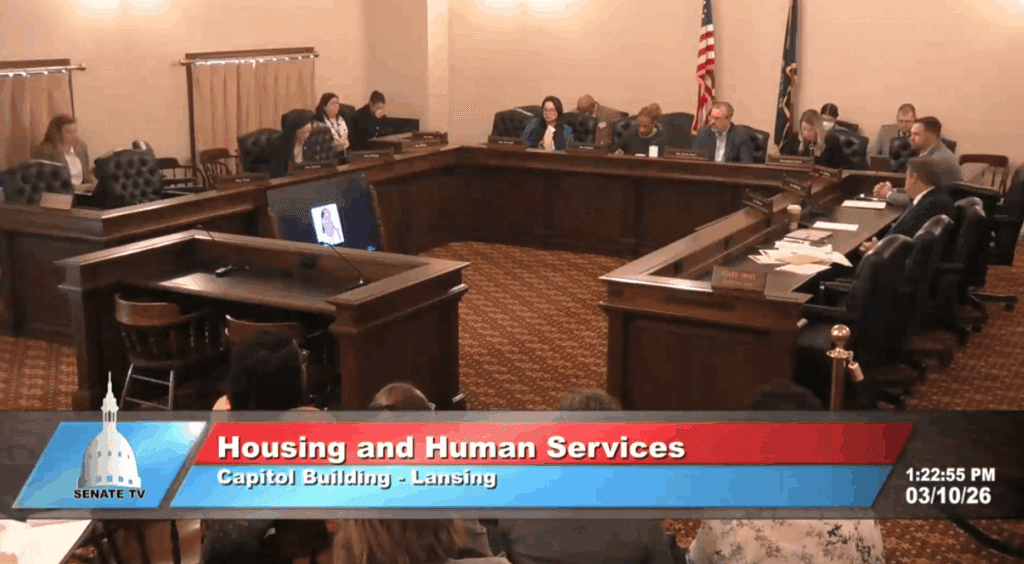
Owners and directors of child care centers and advocacy groups across the state also testified before the committee about the importance of making child care more accessible to Michigan families.
“We do definitely need additional public investment in the system to sustain it and make sure that it’s thriving,” said Annette Sobocinski, the executive director of Child Care Network in Washtenaw County. “But Tri-Share is a very critical tool we use to support families and employers and businesses with child care costs. So the fact that parents can have two thirds of their child care cost covered is a critical piece of helping them to stay in the workforce and work to improve their own family’s financial stability, and obviously benefits the employers as well.”
Sen. John Damoose (R-Harbor Springs) and Rep. Betsy Coffia (D-Traverse City) also presented legislation to expand the definition of family child care homes to allow “microcenters,” a pilot program for which was run in Leelanau County,
“Three micro centers were approved, located in a church, a village facility and a public school. Each serves 12 or fewer children and operates a stand alone owner run program,” Damoose explained. “In 2024 licensing rules were updated to create small capacity centers which allow up to 20 children. Change was helpful.”
Jacqueline Taylor, the owner and founder of Little Dreamers Early Learning Center in Lansing, said that Damoose’s bill, SB 733 “reflects the need for creative solutions that help expand access while maintaining safety and quality standards.”