
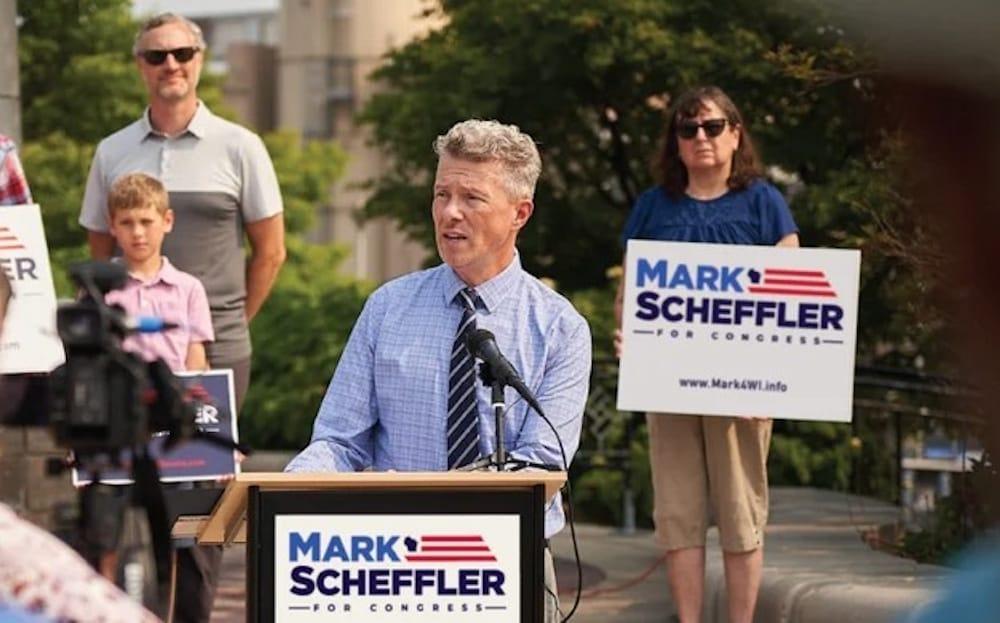


By any measure, Mark Scheffer’s bid to win a seat in Congress is an unconventional one. In part, that’s by design. As a Democrat running in a district most political analysts rate as “Safe Republican,” and with a demographic that, according to the Cook Political Report, performs 8 points more Republican than the national average, he figures he can’t run a traditional Democratic campaign and expect to have a chance to win.
Part of it is by temperament. Scheffler, a political novice, skews away from traditional Democratic Party tropes and themes, though his worldview is decidedly progressive. For the most part, Scheffler, who recently sold his financial services business to devote his time to the campaign, eschews cultural politics in favor of pocketbook issues, figuring that is where there is the greatest alignment of Republican and Democratic values and concerns.
Scheffler is also much more wonkish than the average politician and has highlighted two issues for which the messaging will likely need skillful honing to get across to the average voter: the so-called tiny tax and his preference for what he terms a sustainable economy.
But what most sets apart Scheffler’s bid to win the primary and ultimately unseat Republican incumbent Tony Wied in November is his announcement that, though he will run as a Democrat, he will serve as an Independent. He is also refusing Democratic Party contributions. This has hardly endeared him to Democratic political operatives in the district and he has been met with a tepid, if not downright chilly reception.
Scheffler is running in August’s 8th Congressional District Democratic primary against Rick Crosson and Katrina deVille.
He’s not abandoning the party, he says
Scheffler insists that it is only certain factions within the party structure who are not fully on board with his approach.
“I’m not getting pushback from the Democratic Party,” he says. “I’m getting pushback from individuals inside of the Democratic Party who are so fire-brand aligned with the Democratic Party that they feel that they can’t support my candidacy. I understand why they might be angry or frustrated by that. But I am much, much more angry and frustrated at having not been able to flip this district in 18 years. And the reason we haven’t been able to do that is because we haven’t been building broad enough coalitions inside of these gerrymandered districts to be welcoming to people who are on the fringe of the Republican Party.”
Scheffler points to the campaigns of Bernie Sanders and recently elected New York City mayor Zohran Mamdani as examples of how essential it is to reach beyond traditional Democratic voters. For Scheffler running in a tough Republican-leaning district, he needs almost all the Independent votes and a significant portion of dissatisfied Republicans, he argues.
“My opponents use the phrase ‘abandoning the party’ and ‘running away from the Democratic Party,’ and nothing could be further from the truth,” he says. “When I hear people say that, it’s just that’s the only thing that they can attack, but it’s based on the amount of fundraising I’m getting, the amount of support that I’m getting, the amount of allies and volunteers that we’re getting. It’s resonating with people.
“We do no favors for immigrants by losing elections,” he continues. “We do no favors for the trans and gay and LGBTQ-plus community by losing elections. We do no favors for the renewable energy industry by losing elections. So we have to win elections, and in order to do that, we can’t run the same kind of campaigns in rural Wisconsin and in these kinds of districts that we do in Milwaukee and Madison and Chicago and New York.”

Sustainable economics and the ‘tiny tax’
Scheffler’s policy prescriptions come in both macro and micro form. He can take a bird’s-eye view of our economy, arguing that constant growth should not be our focus. He says the vast majority of his time spent in financial services revolved around sustainable economics.
“For me that’s smart development,” he explains. “It’s smart growth. It’s sustainable growth that isn’t just built for the next quarter, like most corporations look at things. But it’s built for the next generation. So for me, sustainable economics is growing in a smart way that doesn’t trample the support systems of the planet, that respects the contributions of both labor and owners together.”
This macro view of economics bleeds right into the micro. Scheffler is promoting as an alternative to sales and incomes tax something called the tiny tax, which is effectively a small tax on all transactions in the economy. He uses as an example using your credit card (the tiny tax would not apply to cash transactions) for a $100 meal at Antojitos. Forty cents of that transaction would be paid by the restaurant to the federal government. The rate would be the same everywhere but the people who use the economy the most – big corporations and stock traders, for example – would be forced to contribute the most.
“You essentially turn the economy into a toll road,” Scheffler says. “So that encourages thrift. It encourages efficiency. It encourages tax cuts for everyday folks, and it forces billionaires and large corporations and megamillionaires to bear more of the responsibility for funding the economy because they’re the ones that have benefited the most from this national debt.”
Scheffler says the tiny tax would close all loopholes and generate $12 trillion in revenue if the rate is 40 cents per $100 of economic activity. Currently, income tax annually accounts for less than $3 trillion in revenue. It would allow the United States, Scheffler argues, to fund so many of the needs that are currently being ignored while lowering the deficit.
“Cutting our way out of our debt problem is not going to work and we’ve gotten to the limit of being able (grow our way out),” he says. “So the only way for us to get out of this debt trap is to have a system where the wealthy bear more responsibility for paying down the debt.”

‘We have to support women’
Though he is focusing on the economy, Scheffler knows he can’t run from the one cultural issue that has stood front and center over the past five years: reproductive rights. Since the Dobbs decision in 2021 that gutted the abortion protections of Roe v. Wade, Democrats have made it one of their top focal points in recent elections. On the whole, Scheffler thinks the Dobbs decision was a bad one. He still thinks, though, that both sides of the issue can begin to find some common ground, no matter how divisive it remains.
“So my philosophy is this, there are two kinds of abortion,” he says. “There’s medical abortion and there’s elective abortion. So medical abortion is ending a pregnancy for the health of the mother – if the pregnancy fails, if the fetus just is not viable, and I think that the government should absolutely stay out of that.
“On the elective side of it, I fall where I find a lot of women fall – and that’s progressive women and conservative women alike – that there should be reasonable restrictions against ending a pregnancy out of convenience, and so that would be a healthy mom, a healthy baby, pregnancy that’s going well, a pregnancy that will be successful if it continues to be well.”
Scheffler says that in his mind, that limit should be around 20 to 21 weeks. He also believes that it is society’s obligation to provide the essential care that all mothers and pregnant women require, including in such critical areas as mental health, pre- and post-natal care, childcare and contraception
“So, we can’t just say that we support women,” he says. “We absolutely have to support women, and we have to create the conditions where every pregnancy is a wanted pregnancy, every pregnancy is a planned pregnancy, and when pregnancies don’t go according to plan, we should absolutely be there to support safely ending a pregnancy, because sometimes doing so is actually a pro-life activity.”
Iran actions are wrong
Scheffler says he finds Trump’s war in Iran foolish. While he says we should promote democratic values abroad we should do so wisely. First and foremost, we should be most concerned with upholding those principles here at home, he asserts.
“The first rule of morality is that the ends never justify the means,” he says. “So for President Trump to advocate for regime change and to essentially do Israel’s bidding, I think, is incredibly problematic. I agree with (Mayor Zohran) Mamdani in New York when he said that Israel should absolutely exist, and he supports a secure, stable, prosperous Israel as a multicultural state.
“I think it’s important for us to support militarily defensive capabilities whenever we can, but only to those states that are aligned with our best interest. Iran definitely is not. And so when they talk about America First, it’s not to the exclusion of what we do overseas, but we need to be smarter about where we’re sending our military support, where we’re sending our economic support.”
The two-party system is terrible
Scheffler thinks his non-traditional campaign also provides him an entree into bipartisan politics should he win. In other words, he thinks he can win Republicans over to his ideas despite how utterly divisive our politics are in Washington.
His tiny tax, he argues, would garner Republican support if they saw it as he does: an opportunity to get rid of the income tax while reducing the deficit. While he’s willing to acknowledge that the Republican Party often doesn’t deal in good faith and therefore would make unreliable partners, he also blames the system itself for how we got here.
“I think there’s an old saying that I really, really like,” he says. “It’s if you put a really good person in a really bad structure, the structure wins all the time, and this two-party system that we have is a terrible, terrible structure. And when I say that I want to serve as an independent part of that is a recognition that we have 350 million citizens in the United States. How can we possibly think that 350 million people are going to fit either under this tent or that tent?”
He also points to examples of Republicans who he sees as acting patriotically, including Thom Tillis of North Carolina, who has recently called out the administration for its actions in Minneapolis; or Rand Paul, who has called for full transparency with the Epstein Files and has strongly criticized the war in Iran. He cites also Liz Cheney and Adam Kinzinger, who surrendered their party loyalty to stand up for democracy against Trump.
“I think at some point we have to get past the point of looking at what’s good for the party, and instead look at what’s good for the country,” he says. “So regardless of who the president is, if the President is sending armed militia into the streets of Minneapolis to shoot citizens and to abduct immigrants, there’s no way I’m going to support that.”
‘(Wied) is not a popular guy’
Scheffler sees corporate money as the root of so much of what currently ails us. He is refusing PAC and Democratic Party money in favor of individual donations, specifically what he calls the 50 by four People’s Pledge – 5,000 people giving $50 a month over the next four months leading up to the primary.
“Look at how Tony Wied is running,” he says. “Tony Wied is getting hundreds of thousands of dollars in campaign contributions from PACs, Super PACs and corporations. And I looked at his last filing at the end of the year. Out of the $600,000 that he raised last year, way more than $100,000 of that was from corporate PACS, and 96 percent of those corporations are not headquartered in Wisconsin.
“That’s why my campaign is being funded 100 percent by individuals. I’m leading the fundraising race (with his primary opponents) probably ten to one, because I’m doing daily call time, I’m telling people how I’m running my campaign, and I’m getting a ton of support.”
Scheffler absolutely believes he can unseat Wied despite Wied’s 15-point margin of victory in 2024. He will need to cut in half Wied’s 60,000-vote margin, meaning he’ll have to either turn out new voters or, as he sees it, win over disenchanted Republican voters looking for a fresh voice.
He thinks Wied is unpopular and that voters are unhappy with his refusal to engage with them even while Scheffler has held five town halls in conservative areas.
“He is probably thinking that it’s a pretty safe district just because of the way it’s drawn,” he says. “But he’s not a popular guy. Farmers are really upset about destroying relationships with their three biggest customers. They’re really upset about the tariffs and how much that’s driven up the cost of fertilizer and seed and implements, and he’s not doing any town halls at all. So unless you are an insider or happen to have high speed access, and you can dial in to a town hall with the guy, he’s just not listening.”
Scheffler says he will call on his rural roots to connect with District 8 voters. He grew up as the grandson of a dairy farmer and all his cousins were dairy farmers.
“I’ve lost three cousins to suicide in rural Wisconsin,” he says. “I’ve lost one to a murder-suicide. I understand rural issues. I am convinced that I’m the best candidate to be able to build affinity with the people that I grew up with. I’ve been in Wisconsin my entire lifetime. It’s a multicultural state. But more than anything, it’s talking about universal issues, and those are the things that will win us the election.”