

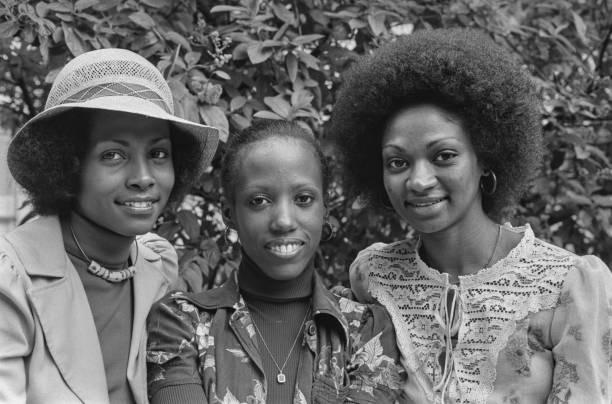
Source: Evening Standard/Hulton Archive/Getty Images

Mar 6, 2026, 3:32 AM CT


Share
We were shown a version of ourselves that looked whole.
We had love with struggle, but not isolation.
Partnerships that weren’t perfect but were present.
Community that caught us when life got heavy.
We saw it in The Cosby Show, A Different World, Living Single, Martin, Love Jones, and Brown Sugar.
Even when money was tight, relationships were messy and when life didn’t go as planned. We still had each other.
But what the screen didn’t show was what happened when the makeup came off.
What it cost us to keep smiling.
What it took to keep everything together when we were given the primary assignment to care for everyone else—emotionally, financially, spiritually—often without being cared for in return.
Behind the laughter was pressure.
Behind the ambition was debt.
Behind the degrees was exhaustion.
Behind the strength was silence.
This isn’t about victimhood.
It’s about cause and effect.
Scripture says when you care for the least of these, you care for the divine itself.
Black women have cared for everyone—families, communities, institutions, even America’s bottom line—while remaining the least protected, the least restored, the least resourced.
And the system is breaking because the foundation has been ignored.
When Survival Becomes Entertainment
Our real lives didn’t disappear.
They were repackaged.
We watched The Color Purple and learned how pain between Black women could be normalized.
We watched Set It Off and saw women pushed into extremes after doing everything “right.”
We watched Precious and finally saw what was happening behind closed doors—right before the mind fractures.
And then we reached the breaking point.
Straw, starring Taraji P. Henson, is not fiction to Black women. It is recognition. It is the final straw after years of carrying weight that was never meant to be carried alone. The performance resonates because the conditions are familiar: conflicting demands, no margin for rest, no safety net, and the expectation to keep going anyway.
What America consumes as emotional storytelling is what Black women are still living.
The Program That Failed Us
Many of us followed the program.
Be good.
Be educated.
Be dependable.
Be strong.
We joined sororities. Coalitions. Book clubs. Girl Scouts. Sister circles.
We went back to school. Took on debt. Trained others. Held institutions together.
We were told advancement would come if we just did more.
Instead, we got labeled.
Strong.
Angry.
Mad.
Masculine.
Those aren’t identities.
They’re system responses to overload.
When Mo’Nique sat on Club Shay Shay and spoke plainly about her life, her work, her boundaries, and the cost of telling the truth, she wasn’t performing. She was warning. She was saying what so many Black women have said quietly: I tried to talk to you. What else am I supposed to do—let you take from my family and my spirit forever?
This is not a personal failure.
This is outdated programming running on an advanced motherboard.
The Upgrade
Black women have already upgraded themselves.
Through lived experience.
Through ancestral memory.
Through intuition sharpened by survival.
Through wisdom learned when there was nowhere else to go.
The issue is not our capacity.
It’s the viruses we were forced to run.
This work is a call to clean the system—not by burning it down, but by restoring the foundation. By protecting the source. By choosing what we allow to be downloaded into our minds, our bodies, our homes, and our futures.
When Black women are supported—not mythologized, not exploited, not entertained, but supported—everything downstream changes.
This is not about politics.
It’s about repair.
And yes, this is a call to action.
Written to Black women.
For Black women.
By a Black woman who knows the cost—and the way forward.
Restoring Rhythm: A Call to Stand Down Without Surrender
This work now turns inward—not in retreat, but in correction.
What is being called for is not collapse, withdrawal, or disengagement from life. It is a reordering of rhythm. Black women have been conditioned into perpetual output: to carry, care, organize, stabilize, forgive, and endure without pause. That posture has been misnamed strength, when in truth it has been forced overextension.
Under natural law, nothing designed to generate life can remain in constant output without restoration. This violates rhythm. And when rhythm is violated long enough, breakdown is not failure—it is signal.
This call to action is not for Black women to prove anything further. It is an invitation to stand down from extraction, to return to the wisdom of the Black womb—not only as biology, but as intelligence. Womb wisdom knows when to labor and when to rest. When to give and when to withhold. When to nurture outward and when to replenish inward.
This is not selfishness. It is foundational maintenance.
Across cultures and belief systems, the womb represents origin, continuity, and regeneration. When the womb is protected, the system stabilizes. When it is depleted, everything downstream fractures. Black women have long been positioned as the foundation while being denied foundational care. That imbalance is no longer sustainable.
This is the spirit behind Soul Sistah Stand UP! —and now, Stand Down.
Stand up in self-definition.
Stand down from martyrdom.
Take your seat. Rest your body. Quiet the noise. Support your sisters laterally. Invest energy only where reciprocity exists.
This is not disengagement from the world. It is discernment.
Placing Black women first does not make this movement anti-anything. It makes it pro-life in its truest sense. Life begins in the womb. Culture flows from the womb. Regulation begins in the womb. To restore care to the womb is to restore balance to families, communities, and society itself.
The refusal to rest has never been a virtue—it has been a survival strategy imposed under pressure. That pressure has now reached saturation. The next phase requires something different: intentional rhythm, selective investment, and collective restoration.
What has been called “Black girl magic” was never meant to be consumed as spectacle. It is a generative force. And like all generative forces, it must be protected, honored, and replenished.
No more martyrdom.
No more proving.
No more carrying what was never meant to be borne alone.
This is not an ending.
It is a reset.

Marveta “Lotus Jay” Johnson is a Milwaukee-based writer and commentator who explores culture, community, and the social forces shaping urban life. Her work often examines how history, policy, and environment influence expectations and opportunity in Black communities. Through reflective commentary, she connects music, lived experience, and public discourse to encourage deeper understanding and dialogue.
Want More Local News?

Civic Media
Civic Media Inc.
The Civic Media App
Put us in your pocket.