


Nearly two decades before major medical breakthroughs and a better understanding of how to best interact with and care for people living with dementia Dr. Susan McFadden had dedicated herself to issues of aging.
This was the seventies, around the time that Alzheimer’s came to be identified as the most common cause of dementia, but before the etiology of the disease was known. The first approved dementia drugs were more than a decade off.
McFadden at the time was a psychology professor and researcher at UW-Oshkosh and she laughs in retrospect at her choice of field at such a young age.
“I’ve been teaching about aging for over fifty years and I wonder how I had the hubris to do this when I was 32,” she says.
Whatever may have driven her into the field, the work she has done over the past three decades following her shift in emphasis from the more general issue of aging to dementia itself has helped to make Wisconsin a state others now look to for guidance.
In 2011, McFadden teamed up with Dr. Lee Vogel of Mosaic Health; Beth Belmore of Lutheran Social Services and a long-time advocate for the aging; and Margie Rankin of Parkview Health Center to create the Fox Valley Memory Project, a comprehensive program for enriching the lives of those living with dementia and their care partners. FVMP, which operates at the Goodwill Community Campus in Menasha covers Outagamie, Winnebago, Calumet and Waupaca Counties. A quick glance at FVMP’s website or even just their events calendar reveals the extent of their dedication and the breadth of the opportunities, activities and resources available, from care partner support groups, care partner education, social outings, resource navigators, respite care, intergenerational education and so much more.

Music and the arts as connection
The four women recognized the stark need for better community engagement around dementia and more and better opportunities for social interaction for both those living with dementia and their care partners. In 2012, they received a three-year grant from the Community Foundation for the Fox Valley Region and from Bader Philanthropies.
By early 2012, the Fox Valley Memory Project opened a couple of memory cafes. Memory cafes are places such as actual coffee shops, museums or parks where those living with dementia and their care partners could gather not to talk about their disease but to socialize and have fun outside of the overwhelming circumstances of their daily lives. They have become a mainstay of FVMP’s program.
The idea behind memory cafes and, indeed, the Fox Valley Memory Project itself, is to integrate people living with dementia into community and to keep them socially engaged, not just because it honors their humanity and brings them joy but because it can ultimately prove beneficial in forestalling the course of their disease.
“(Memory cafes are) all over and you have a facilitator who plans a program, but it always has to be an engaging program,” McFadden says. “You don’t just want to have people passively entertained. It’s about hospitality and friendship.”
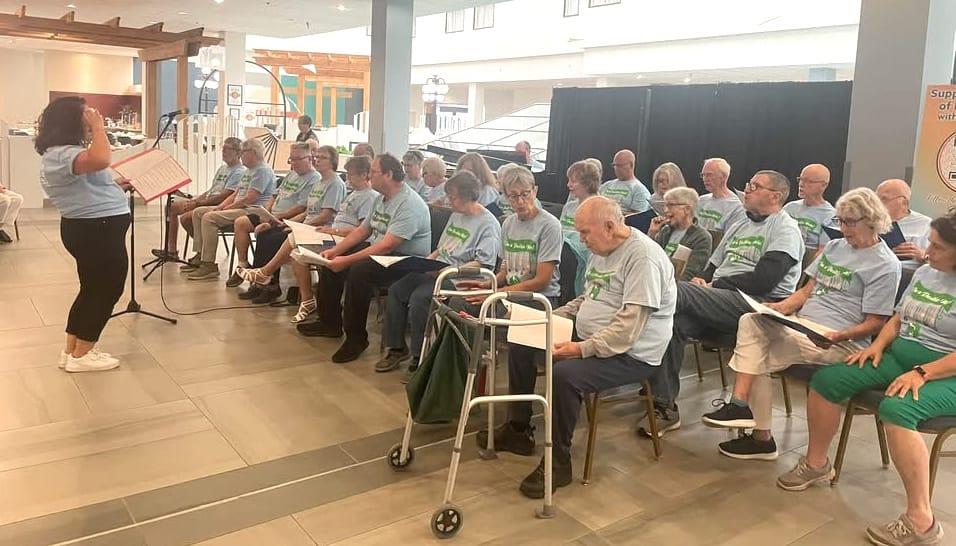
Often there is singing and at the memory cafe in Kaukauna each week, Susan’s husband, John, brings his ukulele for a sing-along. The arts have been proven to provide a meaningful and effective means of engagement and social interaction for people living with dementia. In fact, FVMP’s On a Positive Note Choir, made up of people living with dementia and care partners, performed an original song, “When Words Fail, Music Speaks” at last year’s Mile of Music.
“There is a science behind music and what it does for our brains, the connections that it forges and the neurons that are firing,” says choir director Deborah Scott. “You can see that in action as you’re watching a performance.”
McFadden says memory cafes are all about social interaction, singing, cookies, coffee and community – and putting the hard realities of life aside for a bit.
“We leave the diagnosis at the door,” she says. “We know everybody is dealing with some kind of dementia as a care partner but this is not a medical appointment, right? Most older people’s lives are filled with medical appointments. But we’re here to just enjoy being together.
“And there’s now research that demonstrates that Memory Cafes are good for the mental and physical well being of care partners and people living with dementia.”
A new program which received funding from the Alzheimer’s Association two years ago is Thryve, five hours of more individualized attention for those living with dementia that also allows five hours of respite for care partners. Occasional time away for care partners is considered not only essential for the well-being of the partner but for the personal living with dementia as well. Research indicates that care partners who take regular breaks are better equipped to provide high-quality, compassionate care over the long term.
“I’ve got all kinds of research on how the arts add to quality of life and possibly the slowing of the changes that are taking place in the brain,” McFadden says. “Certainly, social engagement, certainly eating healthy, certainly exercise, all these things that contribute to healthy aging, have a role in possibly preventing the development of some type of dementia. Not always but perhaps slowing its progression.”
The model for other states
The Fox Valley Memory Project initially began under the auspices of Lutheran Social Services, but when LLS changed its focus from aging to children with disabilities, FVMP decided to become a 501c3 non-profit in 2018. Things seemed to really take off for the organization after State Representative Mike Rohrkaste took over as Executive director. Rohrkaste, after years spent on the Speaker’s Task Force on Alzheimer’s and Dementia, brought with him plenty of expertise and rich networks and connections.
McFadden says Rohrkaste’s work in the Assembly resulted in more funding for dementia care specialists (DCS) around the state and that Wisconsin went from initially having only five to now having DCSs in all 72 counties and all the federally recognized tribes.
“We are the only state in the country that has this kind of comprehensive services for people living with all kinds of dementia – not just Alzheimer’s disease – and so other states look to us as a model,” she says. “We work closely with the DCSs in the four counties we serve. So there’s good relationships between this government side and the nonprofit side in our area, and this is a model that other states now are trying to replicate in their own ways.”
For McFadden, the shift in focus away from aging and toward dementia was the result of a confluence of four things in the late nineties. One was a book she discovered, “Dementia Reconsidered: The Person Comes First,” by T.M. Kirkwood, considered a revolutionary work that changed the focus from the illness to the individual. At around the same time, McFadden had begun to notice a dichotomy developing among gerontologists between those focused on healthy and successful aging and those focused on dementia.
In 1997, McFadden’s father died after a stroke, now considered a form of “vascular” dementia. And the final factor in McFadden’s seminal shift in emphasis was her introduction to Dr. Anne Basting, a MacArthur Fellow who came to UW Oshkosh as an English professor. Basting had founded TimeSlips, a new discipline that emphasizes creative storytelling to shift the focus for people living with dementia away from remembering and toward imagination.
“And so after reading this book and thinking about all this, I decided that I would never again write a paper about aging that did not include people living with some type of dementia,” McFadden says. “So, it’s the late nineties, and I’ve read this book, and I’ve met Anne, and you know, things converged, so I really began this journey into doing more with my students and also with people out in the community living with dementia.”

‘It’s fun to have community’
For Judy, the Fox Valley Memory Project has been a vital resource for living with and caring for her husband, Tom, diagnosed with Alzheimer’s in 2018. Tom grew up in Neenah and they decided to move back to Wisconsin from California three years ago to provide him a sense of familiarity as the disease progressed. Before they made the decision, though, they first attended a Memory Camp in northern Wisconsin. While the camps, which were founded by the McFaddens in 2018, weren’t initially associated with FVMP, they have since become part of the program.
“Tom long ago had been a camp director for the YMCA and we heard that there was something called a memory camp somewhere,” Judy says. “I thought it was in California. But when I googled it, I found it was in Wisconsin. And I found out it was up north, and Tom grew up with his family having a cottage in Crandon and I thought I need to call these people.
“And we agreed that we would come. And Tom loved it, so I thought, this is great. We’ll come back (to Wisconsin).”
Judy, who still serves as a palliative care chaplain in connection with UC-San Francisco, says she and Tom love the Memory Cafes and the lunch bunches that gather at a different restaurant in one of the four counties every Friday. She initially enrolled Tom in Mindworks, a three-hour program offered four days a week for people living with mild to moderate dementia. Mindworks promotes brain health through activities that are also designed to foster social interaction. Like with most of FVMP’s programs, this one offers respite care for care partners.
Tom loved it, but eventually his dementia progressed beyond what Mindworks could meaningfully provide for him.
The On a Positive Note Choir has become a particular favorite of Tom and Judy’s.
“As the director likes to say, it’s the most fun you can have on a Tuesday afternoon in a church basement,” Judy says, laughing. “We all sit together and you can read the words but at this point Tom doesn’t do the words. He whistles the tune. That’s okay. Most people sing it and I think it’s just wonderful. It’s fun to rehearse, it’s fun to perform together, and it’s fun to have community. And probably just having community is true for all of their offerings.”
Uncertainty over future funding
The Fox Valley Memory Project relies on donations, grants and their annual Living Life Fundraiser, this year on April 21. A grant from the Alzheimer’s Foundation in 2024 allowed FVMP to launch its Thryve program. In 2021, FVMP received a grant for nearly $1 million through the Administration for Community Living (ACL) to expand its support services.
But as with all charitable organizations reliant on grants for a significant percentage of their funding, FVMP might not be immune from proposed government cuts under the Trump administration. One of Fox Valley Memory Project’s key partners is the Aging and Disability Resource Centers (ADRCs) through which dementia care specialists (DCS) operate.
A concern is the proposed reorganization or outright elimination of ACL, which could potentially ripple out to ADRCs and ultimately impact FVMP.
Inasmuch as McFadden worries about such things it is regarding more generally research projects, though future grants for FVMP could also be at risk. She points to potential cuts to BOLD (Building Our Largest Dementia Infrastructure), which has given nearly a million dollars to dementia-related projects in Wisconsin over the past three years.
“Whether that continues or not, I don’t know,” she says. “So they’re trying to get support out there for all kinds of public health initiatives that might reduce risk or slow progression. There are proposals out there. Whether they get funded, I don’t know.
“But you have to believe that nearly everybody in Congress knows somebody in their families or their friendship networks who’s living with dementia.”
McFadden says the work will go on, regardless as they seek to create dementia-friendly communities. She would love to see the work extend into underserved communities.
“There’s lots of work to be done there,” she says. “Memory Project now has a memory cafe translated in Spanish. And we’ve been working with the Hmong community for some time. But it’s something that has to happen, because we do not have a magic pill for this.”
‘I’m not out there all by myself’
McFadden emphasizes that the work being done to foster dignity, joy and meaning in the lives of people living with dementia also provides a sense of purpose and meaning for those in the field. The Fox Valley Memory Project offers a program called Intergenerational Education and with an ever-aging population more and more young people will need a better understanding of dementia and grandparents living with it. McFadden tells the story of two students who signed up for service learning credits when she was still teaching.
“And I pick them up at 8 a.m. and drive them across the river to Evergreen (Retirement Community in Oshkosh) and they get in the car and one of them says, ‘This is my favorite time of the week,’” McFadden recalls. “These are 18 year old college students who are going to work creatively with people, some of whom are not verbal with very advanced dementia. And why is it their favorite time of the week?
“Because when you are doing this creative storytelling, you cannot be thinking about your algebra test. You can’t be worrying about how things went on Friday night. Yeah, you are fully in the moment with people living with, in this case, advanced dementia, and so the energy they brought to that demonstrated how this works. And that’s what our volunteers in the Memory Project, whether they’re volunteers at Memory Cafes or they’re volunteers with Mindworks, that’s what they all say.”
For Judy, what the Fox Valley Memory Project provides is not just help for her husband but a sense of community that cuts against the grain of the isolation she and Tom might otherwise be feeling. She says there is a natural inclination for people with serious illness to become what she terms “unintentionally isolated,” either because of stigma or discomfort or nervousness about how to behave toward others or how they are supposed to behave toward them.
“We’re less involved on a daily basis than we were when Tom was attending Mind Works,” she says. “But I feel like we’re very embedded in that community. Which is stunning that there is a community. I’m not out there all by myself, and Tom’s not out there all by himself. What a difference that makes. It is such a gift.”