
Local Hmong American sees ICE in Minnesota through a broader historical lens
Feb 6, 2026, 9:11 AM CT


Share
Listen:
This story was originally published by The Dairyland Patriot.
It is just one of hundreds of indelible images that have flooded American social media and television screens since the Department of Homeland Security sent nearly 4,000 ICE and border patrol agents to Minnesota in January.
ChongLy Thao, a Hmong American, is led out of his St. Paul home in frigid temperatures in only his underwear and a pair of crocs, a flimsy blanket draped around his shoulders. Video shows nearly a dozen ICE agents, guns drawn, banging through the front door of Thao’s family home and moments later Thao, in handcuffs, taken to an agency vehicle.
The operation was a case of mistaken identity and was conducted without a warrant. According to reports, the agents refused Thao’s request to show them his identification, then drove him out into the country before discovering they had the wrong man.
Thao, it turns out, is a U.S. citizen with no criminal record. Realizing they’d made an error, the ICE agents drove him back to his house and dropped him off without offering any apologies. Thao’s daughter and four-year-old grandson witnessed the entire affair.
Thao’s adoptive mother, Choua Thao, had been a nurse who treated Hmong and American soldiers during the Vietnam war and fled Laos when the Communists took over in the seventies.
The incident came just 11 days after Renee Good was shot three times in her car by ICE agent Jonathan Ross and six days before protester Alex Pretti was held down by six Custom and Border Protection (CBP) agents and shot 10 times in the back. All three instances, as well as the apparent use by ICE of a five-year-old as bait to lure other members of his family out of their house, have served as sparkplugs for massive protests around the nation, even in wind chills in the minus-double digits. In Appleton on Jan. 25, nearly 300 protesters showed up in -9 wind chills.

‘This is wrong …’
Hmong Americans, who live primarily in China, Vietnam and Laos, have a special relationship with the United States. The Hmong served beside U.S. soldiers during the Vietnam war, specifically in Laos, where they conducted rescue and intelligence missions as well as disrupted Viet Cong supply lines and guarded U.S. installations. Casualties among Hmong soldiers ranged from 30,000-40,000, a ten-times greater rate than U.S. soldiers during the war.
Because of their aid to the U.S. cause and the danger they faced when the war ended, some 30,000 Hmong had fled to the United States by 1978, and the Refugee Act of 1980 brought over many thousands more. Today, nearly 370,000 Hmong live in the U.S. Wisconsin has the third-largest Hmong population – some 70,000 – with the Fox Cities accounting for a little more than 10% of that total.
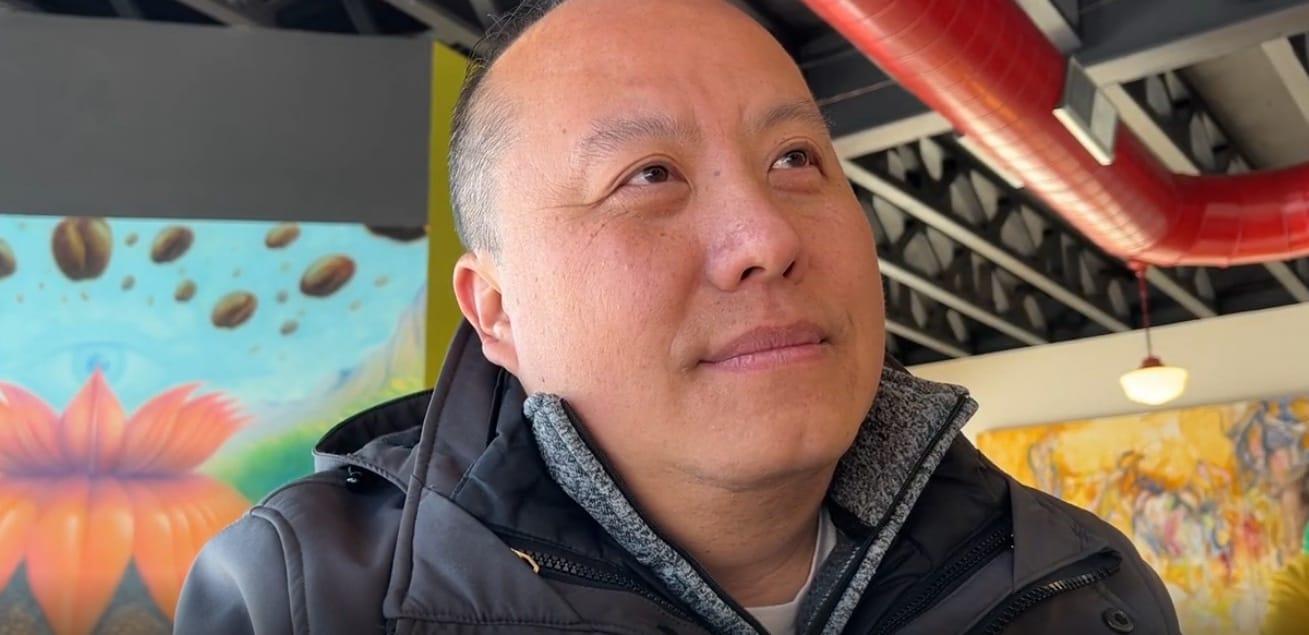
Peng Thao, who lives in the Fox Cities and is a member of the Appleton Area School District Board of Education, has been watching with increasing distress the daily events in Minnesota. He saw the video that captured the wrongful detainment and inhumane treatment of ChongLy Thao. While he says he was certainly upset by what he witnessed and admits that “seeing someone who looks like you” makes it more real, he sees what is happening in Minnesota not solely from the standpoint of a Hmong American but through the broader historical lens of American injustice.
“I’ve had the opportunity in the last two years to go to the Civil Rights Museum (in Jackson, Miss.) and to talk to some of the civil rights activists and organizers who were around during the Civil Rights era, and to see what they have faced,” he says. “I think that has helped me not see this as so shocking.
“This has been a history of this country – and of us seeing these things happen – and being able to actually understand the impact of it, whether it’s in the Hmong community, or whether it’s in other communities. And to realize it is important for me and every one of us to actually stand up and say, this is wrong for people to be treated that way. So it’s given me a broader and more in-depth understanding of it, where it’s like, it should be about all of us.”
0:00
Peng Thao discusses his reaction to the mistreatment and false arrest of Hmong American ChongLy Thao in St. Paul in mid January.
Making scapegoats of immigrants
Peng Thao and his family – including two sisters – came to the United States directly from refugee camps in Thailand in the mid-seventies, spending a couple of years in Seattle before his family eventually settled in Wisconsin. Peng was six when he arrived in Appleton and attended kindergarten at Columbus School.
He has spent much of his career in violence prevention. As such, he considers it folly that the administration is using public safety as a justification for deporting so many people, not only because, according to the Cato Institute, an estimated 75% of deportees over the past year had no criminal convictions (only 5% were convicted violent offenders) but because almost all violent offenses are committed in the home by people we know. Thao says this renders the specter of the dangerous “other” way overblown.
Data from the Texas Department of Public Safety reveals that U.S.-born citizens are five times more likely to be incarcerated for violent crimes than non-citizens.
“ICE says, we’re trying to get all the rapists and murderers out there,” Thao says. “We have to really think about solutions to public safety around people being safe in their own homes and in their own bodies. Because when we look at child abuse, sexual violence and domestic violence, the people who are doing that are the people who are in our homes. Probably 90-95% of the cases I’ve worked with are people who the victim knew.
“So we can’t have solutions to public safety just be about the narrative of the person lurking in the bushes or the stranger. Yes, that happens. But (what ICE is doing) doesn’t solve the problem of people who are experiencing abuse within their own homes.”
Thao goes on to assert that many of the Hmong people the administration has deported or targeted for deportation for violent crimes have already served their sentences and that the original charges are often two and three decades old.
According to data from the Southeast Asian Resource Action Center, 80% of Asian American Pacific Islander (AAPI) deportations involving criminal wrongdoing were based on old criminal convictions. Only 29% of all other racial and ethnic categories fit this pattern.

The threat is always there now
Thao, who is a naturalized citizen, points to the IRAIRA bill from 1996 during the Clinton administration as the beginning for placing so many Hmong in precarious circumstances. The Illegal Immigration Reform and Immigrant Responsibility Act expanded the list of deportable offenses, made the immigration strictures in the bill retroactive to crimes committed before it was passed and allowed DHS agents to detain individuals while their immigration cases were pending. The bill ultimately led to many Hmong and other immigrants in the penal system signing papers they didn’t know they were signing, Thao says.
“These people who made bad decisions in the nineties weren’t well represented in the criminal justice process,” Thao says. “They went into the prison system and were told, ‘Sign this paper if you want to (get out of prison).’ But they didn’t tell them what the paper was about, which was that the day Laos opens up their door, you will be deported.
“And they don’t really know what the paper says other than they can get out of jail so they’re going to sign. And they’re told not to worry about getting deported because Laos is probably never going to take you back. And a lot of people signed it.”
Signing that paper took away their pathway to citizenship or a green card, Thao says, and now they have the specter of deportation constantly hanging over their heads.
“So we have people in our own community who have been living with final removal orders for the last 20 years,” Thao says.
Those living under the weight of those signed papers have limited recourse. One is to reopen the case through the county district attorney to lessen the charge from a felony, then appeal through an immigration court to re-review their case and attempt to get back their permanent green card.
The other is a pardon from the governor.
Currently, more than 15,000 Southeast Asian refugees have final deportation orders.
With Trump applying pressure – successfully – on Laos to take back deportees, the Hmong community lives in greater fear than ever of being forced to leave a country that people like Thao have lived in for 50 years or more and who have little to no connection to Laotian society. While only six Hmong people were deported during the Biden administration, more than a hundred were sent to Laos in Trump’s first year back in office.
Violation of a sacred agreement
Thao says Hmong communities throughout Wisconsin, a state yet to see a large ICE or CBP presence, are obviously aware of the threat of their eventual arrival. He says a lot of Hmong in the Fox Valley are “self-prepping” or making contingency plans. The Hmong American Women’s Association in Milwaukee is beginning to organize around Know Your Rights training. Meanwhile Freedom, Inc., a Hmong- and Black-led organization, is preparing people in Madison, while in La Crosse a Hmong non-profit advocacy group, Cia Siab, Inc., is providing information and support.
“Because of the atrocities and the violence that our family members in Minnesota are facing at this moment, we are very well aware of what could potentially happen,” Thao says. “Hmong people are very connected to each other.
Thao stresses that an added danger is that the rhetoric coming from the administration around dangerous immigrants gives free rein for ICE and CBP to behave with impunity.
“That violence is so unacceptable because it’s not within the parameters of what law enforcement or the judicial system should be doing or should be allowed to do,” he says. “Government officials and elected officials have platforms. When you say certain things, it says it’s okay for you to do these things.
“And it’s not only officials like ICE who are getting permission to use their authority in very violent ways. But it’s also giving the ordinary, average American citizen permission to fully express their hatred. And that that is okay.”
Thao says he sees the administration’s current treatment of Hmong people as a violation of a sacred agreement they have always held with the United States. He says that’s especially true of those born in refugee camps because those are the ones facing the greatest threats.
“They are shocked as to why this is happening, because it’s like we helped the US,” Thao says. “We bled for the US. We saved U.S. soldiers that were there and the U.S. made a promise for Hmong people to be able to be here. We thought, we have all the rights as any other person living in this country.”
‘We all participate in that definition’
Thao says he doesn’t believe that there will be any permanent de-escalation in ICE and CBP tactics in Minnesota, despite the demotion of Greg Bovino, the so-called Commander at Large of Border Patrol. Already, DHS seems to be backing away from any softening in their rhetoric following Pretti’s murder. Nothing this administration says, Thao argues, can ever be considered anything but temporary.
That leaves, Thao asserts, people coming together in communities to support one another, as Minnesotans have done through mutual aid, neighborhood watches and the use of whistles to alert that ICE is in the area.
“The fact that we actually look out for each other, the fact that we actually understand each other and the whole sense of genuine care about each other,” he says. “The fact that we speak out about the violence that happens in our neighborhood, that happens in our neighbor’s home. Every time they interview a neighbor in domestic violence cases they say, ‘He was such a good husband, I didn’t think he would be that violent.’
“And it’s because we don’t actually care enough to know about each other. But what Minnesota is showing us is, if we can return to the state where we actually do care about each other, that we actually do have a sense of actual kindness toward each other, like, I actually do care how you’re doing, that’s gonna allow us to actually keep our community safe.”
Thao also thinks citizens need to consider anew what it means to be American, to recognize how the contributions of citizens and non-citizens alike make America what it is.
“That’s happening at this moment with trying to define who is actually a citizen and who actually gets rights and who doesn’t,” he says. “So that’s the other part that’s actually underlying this as well.
“And I think it’s incumbent that we all understand that we all participate in that definition. It doesn’t belong to one particular group. We are all a part of defining the fabric of America and who we are as Americans. Regardless of your status, regardless of where you came from, whether you were born here or not, the fact that you’re here allows you to have the ability to define and shape American culture and American citizenship.”

Want More Local News?

Civic Media
Civic Media Inc.
The Civic Media App
Put us in your pocket.