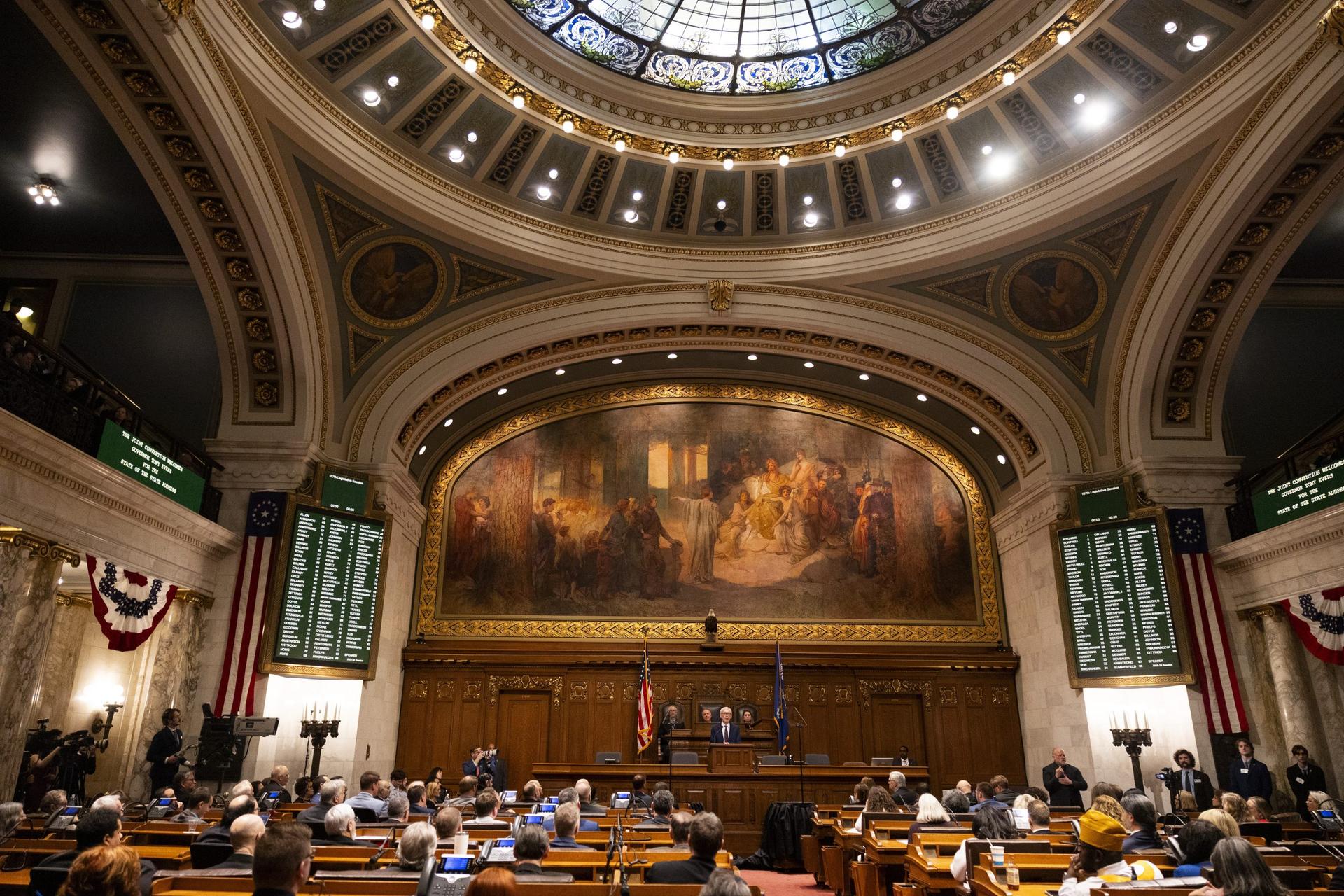


The final days of the Wisconsin Legislature’s 2025-26 legislative session are near.
The Assembly gaveled out for what could be the chamber’s final session day Friday preceded by a dramatic 24 hours that included longtime Assembly Speaker Robin Vos, R-Rochester, announcing his retirement and a concession from Vos to allow votes on bills to extend Medicaid funding for low-income mothers and require insurance companies to cover screenings for women at increased risk of breast cancer. The bills have stalled in the chamber for months.
Lawmakers could still return for a special session on tax cuts as negotiations continue with Republican leaders and Gov. Tony Evers. Democratic lawmakers and Evers have called on Republicans to continue work at the Capitol in Madison instead of turning to the campaign trail ahead of elections later this year. Evers this week also said he plans to call a special session in the coming months for lawmakers to act on a constitutional amendment to ban partisan gerrymandering.
The Senate will continue to meet in March.
Here’s a rundown of what is still being debated, what is heading to the governor and some of the key items to get signed into law this session.
What is still being discussed?
Tax cuts
The context: State leaders learned in January that Wisconsin has a projected $2.4 billion surplus. Evers at the start of the year called for bipartisan action on property tax cuts for Wisconsinites. Republicans have agreed with the idea that those funds should be returned to taxpayers. But both sides have yet to officially agree on how.
Republican arguments: In a letter to Evers on Feb. 16, Vos and Senate Majority Leader Devin LeMahieu, R-Oostburg, said they would agree to Evers’ request for $200 million to boost the special education reimbursement rate and provide an additional $500 million to schools through the school levy tax credit. In return, Republican leaders wanted to see an income tax rebate in the form of $500 for individuals and $1,000 for married couples who filed their taxes in 2024, reducing state revenues by $1.5 billion. “We are trying to be bipartisan,” Vos told reporters after Evers said the proposal doesn’t balance what he wants to see for schools. “We accepted his number and actually went higher than he requested.”
Democratic arguments: Evers told WISN-12 that he would not sign the Republican plan Vos and LeMahieu sent him. He wants to see more money for schools, specifically general equalization aid, which are dollars that schools can use without as many constraints. The 2025-27 budget Evers signed last summer kept that aid flat from the previous year, which coupled with fixed revenue limit increases under Evers’ previous 400-year veto gives school districts more latitude to raise property taxes.
Latest action: Assembly Majority Leader Rep. Tyler August, R-Walworth, said Republicans are still intent that Evers should take the deal that was offered. “It checks a lot of boxes, if not all the boxes on the things he had previously asked for,” he said.

Knowles-Nelson Stewardship
The context: In 2024, the Wisconsin Supreme Court ruled the Legislature’s top financial committee could not block the Department of Natural Resources spending for the Knowles-Nelson Stewardship Fund that was created in 1989 for land preservation. Republicans did not reauthorize funds to keep the program going in the 2025-27 budget, which puts the fund on track to expire this summer. Bills led by Rep. Tony Kurtz, R-Wonewoc, and Sen. Patrick Testin, R-Stevens Point, would extend the program until 2028, but also pause the majority of land conservation projects for two years and require the DNR to study and inventory government-owned land for nature activities.
Republican arguments: Republicans blame the court’s decision for limiting legislative authority over how the dollars are spent. During a public hearing earlier this month, Testin said he understood the bills were imperfect but action was necessary. “If we do nothing, Knowles-Nelson Stewardship is dead,” Testin said.
Democratic arguments: Senate Democrats on Wednesday said stopping money for land conservation projects would essentially kill the program. Democrats had been participating in negotiations on the future of the fund, but the Republican proposal had only gotten “significantly worse.” “We cannot and will not support a bill this bad,” said Senate Minority Leader Dianne Hesselbein, D-Middleton. In September, Democrats introduced a proposal to reauthorize the program until 2032.
Latest action: The Senate was scheduled to vote on the bills during a floor session on Feb. 18, but removed the bills from its calendar. The bills already passed the Assembly in January. After Senate Democrats said they would not support the current proposal, Testin told WisPolitics he would have to drum up support from Senate Republicans to determine the fate of the fund.
Toxic forever chemicals (aka PFAS)
The context: Republican lawmakers and Evers in January announced they were optimistic about a deal on legislation about the cleanup of toxic forever chemicals referred to as PFAS. The 2023-25 state budget included $125 million for addressing PFAS contamination, but the Legislature’s finance committee has yet to release those funds to the Department of Natural Resources. In January, Evers and Republicans said bipartisan agreements so far included the release of the prior funds, protections for property owners who are not responsible for PFAS contamination and a grant program to help local governments with remediation projects.
Republican arguments: Republican Sen. Eric Wimberger, R-Gillett, has sought protections from the state’s spills law and financial penalties for “innocent landowners” who did not cause PFAS contaminations and seek help from the Department of Natural Resources.
Democratic arguments: The Environmental Protection Agency has previously issued health advisories on PFAS in drinking water. Evers in January argued that the state has a responsibility to provide safe and clean drinking water across Wisconsin.
Latest action: The Assembly passed the legislation, Assembly Bills 130 and 131, on 93-0 votes Friday evening. The Senate has yet to consider the bills, but Wimberger in a statement Thursday night said amendments in the Assembly “will help us get this vital legislation across the finish line in the Senate and signed into law by the Governor.”

Online gambling
The context: Legal gambling in Wisconsin can only occur in-person on tribal properties, which means individuals who place online bets on mobile devices are technically violating the law. A proposal from August and Sen. Howard Marklein, R-Spring Green, would legalize online gambling if the server or device that a wager is placed on is located on tribal lands.
Supportive arguments: The bills from August and Marklein have bipartisan support. Lawmakers argue it provides clarity on what is legal in Wisconsin and protects consumers from unregulated websites.
Opposing arguments: The Wisconsin Institute for Law and Liberty in a November memo argued that the bills would violate the Wisconsin Constitution and the federal Indian Gaming Act and provide a “race-based monopoly to Tribal gaming operations.”
Latest action: The Assembly passed the bill Thursday on a voice vote, meaning lawmakers didn’t record individual votes. It now heads to the Senate.
Funding for a public affairs network
The context: WisconsinEye, the nonprofit public affairs network that has filmed legislative proceedings since 2007, went dark in mid-December due to not raising the funds to operate this year. The Legislature previously approved a $10 million endowment that could only be accessed if WisconsinEye raised matching dollars equal to its request of state lawmakers. Legislative leaders approved $50,000 to bring WisconsinEye back in February, but the Assembly and Senate had opposing views of how to provide transparent viewing of legislative processes going forward.
Senate arguments: Senate Republicans specifically have been wary of providing funds to WisconsinEye and expressed frustrations at how the nonprofit spends its dollars. Senate Republicans proposed a bill that would seek bids for a potential public affairs network, which could go to WisconsinEye or another organization. “Maybe we are getting the best value currently with WisconsinEye, but we greatly don’t know,” LeMahieu told reporters this month.
Assembly arguments: Assembly Democrats and Republicans proposed a bill that would place the previously allocated matching dollars in a trust and direct earned interest to WisconsinEye. That could generate half a million dollars or more each year for an organization with a $900,000 annual budget. Assembly leaders said they wanted to ensure continued transparency at the Capitol.
Latest action: The Assembly earlier this month passed its bill 96-0 that would provide long-term funding support to WisconsinEye, but the Senate has yet to consider the bill. The Senate passed its bill on requesting bids for a public affairs network on Wednesday. The Assembly did not take up the Senate proposal before gaveling out for the year.
What is heading to Evers?
Postpartum Medicaid
Lead authors: Sen. Jesse James, R-Thorp/Rep. Patrick Snyder, R-Weston
What it does: The bill extends postpartum Medicaid coverage in Wisconsin for new moms from current law at 60 days to a full 12 months after childbirth.
The context: Wisconsin is just one of two states that have yet to extend postpartum Medicaid for new mothers for up to one year. The proposal has been brought up in the Legislature for years, but Vos has long been the roadblock for getting the bill across the finish line, often objecting to the idea as “expanding welfare.” “Anybody who’s in poverty in Wisconsin today already gets basically free health care through BadgerCare. If you are slightly above poverty level, you get basically free health care from the federal government through Obamacare,” Vos told reporters earlier this month. “So the idea of saying that we’re going to put more people onto the funding that the state pays for, as opposed to allowing them to stay on the funding that the federal government pays for, it doesn’t make any sense to me.”
How they voted: The Senate passed the bill on a 32-1 vote in April, with Sen. Chris Kapenga, R-Delafield, voting against. The Assembly voted 95-1 Thursday to send the bill to Evers’ desk, with Rep. Shae Sortwell, R-Two Rivers, as the lone vote against. Vos voted to pass the bill.
Dense breast cancer screenings
Lead authors: Sen. Rachael Cabral-Guevara, R-Fox Crossing/Rep. Cindi Duchow, R-town of Delafield
What it does: The bill requires health insurance policies to cover supplemental screenings for women who have dense breast tissue and are at an increased risk of breast cancer, eliminating out-of-pocket costs for things like MRIs and ultrasounds. The proposal has been referred to as “Gail’s Law,” after Gail Zeamer, a Wisconsin woman who regularly sought annual mammograms but was diagnosed with stage three breast cancer at age 47.
The context: The proposal has been stuck in the Assembly for months after near-unanimous passage in the Senate last year. Some Republicans had concerns about the bill being an insurance mandate. Vos told Isthmus in January that federal regulations might not make the bill necessary in Wisconsin, but ultimately allowed a vote on the Assembly floor.
How they voted: The Senate passed the bill in October on a 32-1 vote. The Assembly passed the bill Thursday on a 96-0 vote.
Key bills signed into law (outside the state budget)
Wisconsin Act 42 – Cellphone bans during school instructional time
Lead authors: Rep. Joel Kitchens, R-Sturgeon Bay/Cabral-Guevara
What it does: The law requires Wisconsin school boards to adopt policies that prohibit cellphone use during instructional time by July 1. By October districts must submit their policies to the Department of Public Instruction.
How they voted: The bill passed the Assembly along party lines in February 2025 and passed the Senate on a 29-4 vote in October.
When Evers signed the bill: October 2025.
Wisconsin Acts 11, 12 – Nuclear power summit and siting study
Lead authors: Sen. Julian Bradley, R-New Berlin/Rep. David Steffen, R-Howard
What it does: The laws created a board tasked with organizing a nuclear power summit in Madison and directed the Public Service Commission, which regulates utilities, to study new and existing locations for nuclear power and fusion generation in the state. In January, the Public Service Commission signed an agreement with UW-Madison’s Department of Nuclear Engineering and Engineering Physics to complete the siting study.
How they voted: The Senate passed and the Assembly passed the bill in June 2025 on a voice vote.
When Evers signed the bills: July 2025
Wisconsin Act 43 – Candidacy withdrawals for elections
Lead authors: Steffen/Sen. Van Wanggaard, R-Racine
What it does: The law gives Wisconsin candidates a path other than death to withdraw their name from election ballots. The bill was proposed in the wake of Robert F. Kennedy Jr.’s effort to withdraw his name from the ballot in Wisconsin after he exited the presidential race in 2024 and endorsed President Donald Trump.
How they voted: The Assembly passed the bill in June. The Senate approved the bill on a 19-14 vote in October.
When Evers signed the bill: October 2025
Wisconsin Act 48 – Making sextortion a crime
Lead authors: Snyder/James
What it does: The law makes sexual extortion a crime that bans threatening to injure another person’s property or reputation or threatening violence against someone to get them to participate in sexual conduct or share an intimate image of themselves. Lawmakers named the bill “Bradyn’s Law” after a 15-year-old in the D.C. Everest School District who became a victim of sextortion and died by suicide.
How they voted: The Senate passed and the Assembly passed the bill on a voice vote.
When Evers signed the bill: December 2025
Wisconsin Act 22 – Informed consent for pelvic exams for unconscious patients
Lead authors: Sen. Andre Jacque, R-New Franken/Rep. Joy Goeben, R-Hobart
What it does: The bill requires that written consent is obtained from a patient before medical professionals at a hospital perform a pelvic exam while that person is unconscious or under general anesthesia.
How they voted: The Senate and the Assembly passed the bill on a voice vote.
When Evers signed the bill: August 2025