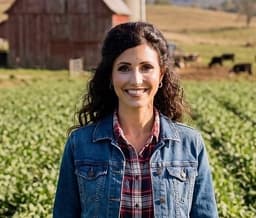
We're talking today to Elizabeth Fitzgibbon, who is an independent candidate for the Sixth Congressional District here in the state of Wisconsin.
Good morning.
Good morning.
And you're telling me that you call Nina home.
I do.
Okay.
All right.
So it's hard enough to run for office, but as an independent, how are things going for your campaign?
Well, I would say they would have the predictable challenges associated with not running as a major party.
Interestingly though, the message that I try to convey to people has resonated particularly well with people from the left and the right, young and old.
So it's been hard to get the message out because media is not so inclined to cover my particular campaign.
I feel it's provocative and truth-seeking and unifying, and so media and general iPhone is not particularly interested in covering it, but the people that I am able to reach, it's been very, very, very unifying.
So that's been just a tremendous value add because I feel like it's really the right message, it's the right time for the message, and the barriers to entry to getting the message out, it's just a very predictable challenge.
So I'm super appreciative for the opportunity to speak about it now for that exact reason.
Okay.
So, um, I see by your website that this, this run for the sixth congressional district all started out because of a family law case.
Maybe you can tell us about that.
Sure.
And feel free to chime in whenever, but I'll give you the very, very, very brief version.
Um, as you know, I'm in Winnebago County as well.
So.
Effectively, what happened was in 2022, my air quote ex-husband and I sought a divorce, a stipulated divorce from Winnebago County, but it turned out to be an unprecedented landmark family law case.
So in brief, what that comprised of is, effectively, I had an illegal divorce.
born of what I call judicial fraud and forgery in Winnebago County.
I took up the ranks ultimately to the U.S.
Supreme Court, and I now have three active federal civil right lawsuits out against much of the Winnebago County judiciary, among others.
So how my illegal divorce, which again, how that came to be, we can get into that as much or little as you want, but as it relates to the development of my congressional run is as follows.
In May 9th of May 9th of 2025, I was in DC preparing and filing my certiorary with the U.S.
Supreme Court.
And in order to create one, it needs to be constructed in a way that exposes things of national significance, right?
So you can't just lament about your own private case.
And it really
has to be turned into
this huge constitutional issue as it relates to the entire country.
And I believe that I successfully did that despite the fact that the certiorari was ultimately denied by SCOTUS, not on its merits, but just because they had discretionary review.
So as I was preparing my certiorari, I began to see these massive constitutional oversight gaps as it relates to family court and the broader family of domestic relations.
And while I was, again, preparing my writ of certiorari, I had to read significant case law.
And much of this case law, as it related to domestic relations, which again includes marriage, divorce, child support, alimony, custody, et cetera, it actually stated, the SCOTUS decisions stated in various forms, how Congress was an entity responsible for closing these oversight gaps.
and that basically through judicial inertia, not really statutory or constitutional requirements, SCOTUS really never had an interest in reviewing domestic relations matters.
And I, so in parallel of trying to appeal my own case and have my own case fixed ultimately through SCOTUS, I then saw this national concern, again, as it relates to constitutional violations and family law.
you know, per SCOTUS itself.
So then I created an eight-page congressional memorandum that outlined all of this, all of these important things, and you know, cited the case law from the U.S.
Supreme Court, and I gave that to all 535 members of Congress, both House and Senate, and then I also gave that to every single person in the Wisconsin State Assembly.
And
That was just over a year ago now that I sent that out.
So long before I was asking for people's votes, I had been fighting for their rights because even if SCOTUS had fixed my case, which it didn't, but even if it had, this still left a gaping gap across the country for people who are victims of the family court system.
And I just, in good conscience, I couldn't do that.
So I began this fight in parallel.
Unfortunately, I received
basically no feedback, no meetings, nothing, and I specifically had reached out to Glenn Grossman requesting meetings to address these issues, and he refused my meeting, so now I'm applying for his job.
And then as I began to recognize that I needed to create a congressional run based on my experiences and my desire to close this constitutional oversight gap for family court litigants,
I then created what became my 12 priorities.
And that effectively evolved because I began to recognize that behind every symptom that society faces, there's usually some sort of unconstitutional or flawed foundation that then from my perspective, the parties simply campaign on the symptoms that their bad policies create.
And I learned that in my own case.
My case was exceedingly unique and it was a symptom of a larger problem.
And that problem was the oversight gap that I was trying to fit.
So I identified what I believe to be 12 key areas that affect our society the most.
And my goal then was to, with the same rigor that I reverse engineered and dismantled family court,
My goal was to do that if I were to get into Congress with these remaining other categories, which again, I refer to them as my 12 priorities.
So I have certainly begrudgingly become an expert in family law, domestically, and in the judiciary.
And I've identified, again, then 10 other areas that I feel affect society equally.
But again, the parties often simply miss the diagnosis
symptoms as problems for the purposes of ending the conversation, whereas I see these situations quite differently, and I see them as symptoms of larger problems that no one really wants to talk about because the political duopoly isn't really in my
view
designed to fix problems so much as it is to manage them.
And that's what I'm fighting for.
I'm fighting to unify us because I believe that we're all victims of the same corrupt establishment.
and divided, we will fall if we don't begin to recognize the degree to which we've basically just been psychologically deceived into warring with each other as opposed to fighting against the same that's creating the divide and the harms to begin with.
Wow.
We used up most of your time on one answer, but Elizabeth, I just wanted to note, you have a website that's given for Congress
And you talked about 12 key areas.
You've got all the issues listed there in solutions, right?
Yes.
And I'm certainly, it would be disingenuous for me to pretend that I'm the same level of expert in, you know, these remaining 10 as I am.
And again, that judiciary and domestic relations.
However, I, I do have significant insight into most of these areas.
In fact, just very quickly.
The bulk of my campaign has been informative based.
So again, I'm not really trying to tell people what to think.
I'm just trying to get people to question the systems that govern their lives, right?
And so what I would do is I, throughout my entire campaign, I would bring in industry experts and keynote speakers and hold fundraising events associated with each one of these categories to provide voters an opportunity to be truly informed
about the information that they would otherwise not yet have access to because it's really not designed to know these things such as things about
our
monetary system or the surveillance state or the social security crisis and things like that so again i'm really i'm trying to just get people to look at solutions differently and to find ways in which we actually can unite because we're all bound by the same constitution right and it's our significant deviation from it
that have caused significant societal divide.
And we really, really, really need to restore back to constitutional alignment.
I don't know, just as an aside real quickly, I don't know if you saw this morning, but I sent you a press release that probably like three in the morning or something because I was up really late working on this.
But I just announced publicly because, again, my entire campaign is on
transparency, accountability, and ultimately prosperity slash affordability because you can't have true prosperity without accountability and you certainly can't have accountability without transparency into what even ought to be accountable, right?
And what I did is I just launched as of two or three in the morning my Wisconsin Judicial Accountability Initiative and that is focused on taking back our judiciary
And I launched a video on my congressional website and also my Facebook website and also my personal Facebook page and I am explaining that regardless of the congressional outcome on November 3rd because this fight for accountability and transparency didn't begin with the congressional run and it will certainly not end with one either.
And my goal is to get us once again all to unite to be able to take back our government and remind them who they work for.
And if the
The other branches of government are not going to properly step in to hold those who hold power over us accountable for their violations of our rights.
We as people have the responsibility to take it back ourselves and to remind them who we work for.
So I would urge people if you have any interest in being a part of the Wisconsin Judicial Accountability Initiative, again independent of the congressional outcome, this is what my focus will be and it will be on restoring
judicial accountability because we have all been significantly harmed, whether you're in family law or not, by the judiciary.
And it's time to remind them who they work for.
We've been talking with Elizabeth Fitzgibbon, who is an independent candidate for the Sixth Congressional District.