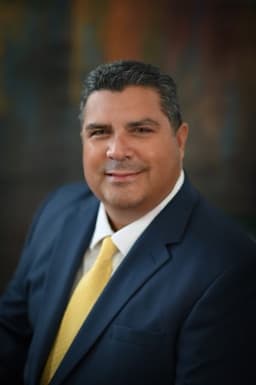
Joining us today, we have Sam Kaufman, who's the Fond du Lac County Executive.
Thanks for joining us, Sam.
Thank you, Bob.
Always a pleasure to be here.
So you gave your annual budget address last night.
What did you tell the county supervisors?
Well, I told them that once again, we have a balanced budget that we presented that I explained to them that, you know, I was very happy with the department had to present their budgets to me.
that they heard my message to them that we needed to be fiscally conservative and responsible to what we were doing, how we're spending the money, and to look for ways to minimize their costs, consolidate positions.
If there's a position unfilled, you know, Steve, it's even necessary anymore.
I've been trying to downsize county government to make it smaller, more efficient.
And we've done that over a period of time by selling off older assets, eliminating some positions and so forth.
Yeah, I told them that it's a $170 million gross budget that we're dealing with.
Shared revenue is slightly increasing for $27 million.
Gas tax, the GTA, is about $200,000 more we're getting next year, which will definitely help with our highways.
Overall, it was a good budget.
I had to cut about $4 million out of the budget compared to $8 million a year prior.
We actually were able to increase a few more miles of highly projects to get done.
You know, I had to explain and go over the fact that when we looked at like the human services department, you know, the acute unit, they made the decision to go ahead and close the facility starting January 1st.
I informed them last night that our forecast right now is that at the end of 26th, the acute unit will have sustained a loss of $1.7 million.
So to me, that model was not working.
And I stand by Director Van de Geven's decision or recommendation to change our model into increase the crisis intervention services program, which has been very successful.
I do believe that is a model going forward.
I also believe that the change in the acute unit to a crisis CPRF allows us to provide more direct services to those individuals in crisis that
don't qualify won't be placed in a locked facility, but we have the ability to place them in our CBRF setting voluntarily so they can get the services they still need and not feel abandoned by the system.
So I do think it's a system that can work, and that's what I told the county board last night.
So overall, I explained to them that our mill rate continues to drop in 22.
Our mill rate was $5.71 and I informed them at 2027.
Our mill rate will be $3.81.
So our goal is always to go through and run a very tight budget conservatively and be fiscal responsible.
We are going to carry another surplus because of the cuts we've made into 27, roughly about $3.2 million on the signed sales tax revenue will be surplus.
to carry us through the year.
And what I explained to the county board, and they understand, is that when you look at your budget, you're not the only looking at it.
Government relies on bonding for a lot of projects, and investors look at your budget.
They're looking at how you're handling your finances.
Do you have the ability to pay back debt?
And we've had a double A2 rating, which for our size of municipality and county, is a fantastic rating and excellent rating
to
have.
And because of that, we've consistently been able to get lower bond ratings compared to a lot of the other counties in the state because they know we have the ability to pay back our debt and we make sure we cure surpluses forward.
I always refuse to run a deficit budget.
That's something I will never do.
And I think it's key that we need to live within our means and make the cuts where necessary.
So that's essentially what I told the county board last night.
I look forward to working with them.
I did bring up the jail project to them that we need a decision.
In 27, my hope is that they will go ahead and make a decision out of the way so I can know going forward for budgeting purposes where we're going to sit with that project.
Okay, so broad strokes, any cuts in personnel or services?
No, the only, I did work with Kim Yor, Director of Public Health Department.
to restructure some of the programs.
So we had a, for example, a sanitary position that was unfilled.
That was on tax levy by about $100,000.
What we were able to do is revamp that system by creating a part-time environmental health person who would do a lot of the water testing and different things.
But by doing it that way, I eliminated the position and we don't have to have that on levy.
But what we did is the new position we created is going to be completely funded by fees now.
Instead, for those looking for those services, there will be a fee attached, which is already paying right now.
We also get funding from the state in regard to that testing and inspection work.
Those fundings will be used to pay for the positions, so it will not be on the tax levy.
So it was the little things like that that we were able to do by with positions that are not currently filled.
that we're just unfunded and are no longer going to fill by consolidating them in different ways.
And I think that's what you have to do.
You have to start looking at your budgets and finding the best way possible to make those necessary cuts in your budgets.
Sam, in the past, the county has used some surplus funding to pay down debt.
Anything like that for the 2027 budget?
Absolutely.
We are set to pay off another 8 million in debt.
If you look at the budgets I prepared consistently to the county board, every single year we've been paying down debt.
I do not like to carry debt.
Now, some debt, of course, you carry because, oddly enough, investors see that and see that you are paying.
So at times it can be a good thing, but the dollar amounts you want to maintain control of
Um, and, and next year we're scheduled again to keep paying that down itself.
So we've consistently done that.
And, and that's a model I always will do in our budgets.
All right.
I believe, uh, last night the counting board approved funding for additional jailers for the sheriff's office.
Where are they at with their personnel now?
Yeah.
No, it wasn't, they didn't approve funding for the positions.
It was to create for correctional officers.
What happened was the state administrative codes were changed and unfortunately It's something I wish the state and whoever the next governor will be will seriously look at changing On this but they changed the codes now So that for example with the rule of juveniles So if you've got a juvenile for example that that is restrained or in suicide watch The administrative code now requires that you have to have a correctional officer physically right there in sight
and hearing of that juvenile at all times.
So you can't do it by video watch.
You have to have an officer basically sitting there with that person.
So because of the rules they've made with administrative code, as to monitoring now the juveniles held or incarcerated, it required more staffing.
And this is something that the Sheriff's Department had been looking at for a while now.
They were aware of it, and they had tried to figure out, can we do it with the staff we have?
Well, in the end, what it came down to is they determined that they needed four additional correctional officers in order to bring themselves into compliance.
Now, there'll be times where maybe they don't have a juvenile restraint, that they don't need to be monitoring like that.
Well, then they can use those correctional officers to backfill some of the other correctional officers while working overtime.
But but the funding mechanism has not been approved by the county board yet This is nothing more than creating the positions only and then when it comes to the budget for 27 They will be looking then as far as the proper or to fund those positions if they choose to do that You know, I I did mention to the common board That part of a bigger discussion that has to happen is the future of our juvenile intake right now
We take in juveniles not only of our own county, but out of county.
By taking in the out of county juveniles, we've generated anywhere from $900,000 to a million dollars of revenue that helps offset our jail operational costs.
By adding these positions in, of course, we're cutting into that revenue.
But the bigger question is going to be, do we continue to do that?
Because one option you have is to simply house the juveniles out of county, our juveniles.
which may be three or four, and house them out into other counties instead.
Now, not a lot of counties are doing juveniles anymore with that or maintaining that type of service.
So we expect those rates will go up.
But why it's a bigger picture is because as they talked about the jail project, the question I will have is, do we want to build a juvenile facility?
Do we want to save that expense, which is going to be in the millions to construct that part of it?
Do we want to save that part
and not build it and house out.
Otherwise if we're going to build it then I expect that you're going to want to take in out of county juveniles to form a have a form of revenue stream coming in for operations.
So that's going to be the bigger question.
I'm not proposing that we go through not build it or build it but it has to be a question asked as far as looking at the overall cost of this project to see is this a route we want to go.
itself so they're gonna be a bigger question but as far as funding goes you know that that still has to come as part of the budget process
okay so I believe the process usually goes that now that the budget address has been given what's next when does the finance committee start holding meetings
the finance committee actually will be planning to meet next week they are scheduled
scheduled to meet on the 20th of October.
That is when the finance committee will meet to hold the budget hearing.
That's where they've invited various department heads to come in and they will be questioned in regard to their specific budgets.
Looking at my proposed budget, they want to know about, okay, the kind of executive is made cuts here.
Is this something you believe is necessary?
Tell me about your department.
So that will be taking place in the 20th.
That is open to the public.
I encourage the public to come and hear that budget hearing.
It starts in the morning.
It usually lasts through into the afternoon itself.
After the budget hearing is completed, the next step is on October 27th, there will be a public hearing where the public can come and actually speak to the county board to give their thoughts on the budget itself.
Now that's a hearing where they can speak to the county board, but the county board is not allowed to answer questions or talk to them during that portion of the meeting.
After that takes place, the finance committee will meet right after the county board to discuss the budget itself.
And then ultimately in November 3rd, the county board will come back into session and they will give their vote
On the budget at that time any supervisor can make an amendment to the budget to if they want any changes So it can't be done there or they can't ask the finance committee to propose changes in the budget also I you know I'm always open to ideas if the county board members want to go through and have a Discussion on one portion right budget that proposing as they possible changes I'm open that discussion as long as it doesn't sacrifice or
do anything detrimental to public safety and essential services.
I'm very open to having that discussion.
Well Sam, thank you very much for joining us this morning.
Appreciate your time.
Always a pleasure Bob.
Thank you.
We've been talking with Sam Kaufman, Bondalak County Executive.