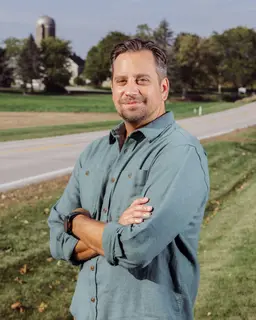
Joining us in the studio this morning, we have Brad Smith, who's a Democratic candidate for the sixth Congressional District seat here in the state of Wisconsin.
Good morning.
Good morning.
Thanks for having me.
Thanks for making the trip from Mequon.
That's quite a little venture.
Yeah, it was about an hour up the highway.
Beautiful morning outfall.
It's about as good as it gets in Wisconsin.
But you've been up this way campaigning before,
right?
Oh, yeah.
And my family history and everything else connects through this area.
I originally grew up in the Fox Valley, have a friend who lived in Rip and went to college here, and my family's from Warren Central, Wisconsin originally.
So this is familiar territory.
Well, tell us a little bit about yourself.
You're a veteran.
You have your own company.
Um, what made you decide to run for Congress?
Yeah.
Uh, great question.
So lifelong Wisconsinite, I've lived in Wisconsin my whole life and actually the sixth district pretty much my entire life.
Um, you know, times that I didn't were when I was deployed overseas for our army.
I also spent a little time in Stevens Point where I went to college.
So, uh, my family's story is a lot like this place.
Generations were dairy farmers up in Iowa, a pack area, um, into Fond du Lac, then my parents ended up working at a
um, feed mill and a supper club in Larson, Wisconsin, just west of the Fox Valley.
And so I live now in, uh, Ozaki County because my wife and I kind of followed work during the great recession to figure out where we could find jobs.
You know, it was a tough time to come out and be able to find work.
So that's where I'm raising two kids now.
Um, and I do have a small business.
So I help, um, Wisconsin companies go through digital transformation or trying to figure out digital projects.
So I kind of work project by project, helping, you know, well-known Wisconsin.
some manufacturers and less well-known smaller businesses to be able to modernize essentially.
Okay.
So you're a techie, so to speak.
Yes, so to speak.
All things considered.
Yeah.
All right.
So the first question I'm going to ask you is about AI and data.
Oh, good question.
Yeah.
So give us your thoughts on
that.
Yeah.
You know, it's interesting because the AI technology is changing so rapidly.
There is an understandable concern that I'm hearing that is truly bipartisan about how it is showing up in our communities.
And here in the Sixth Congressional District, we had the first two big data centers we've ever seen in Wisconsin of this type in Port Washington and Beaver Dam.
And they both had one thing in common, which was they were done under an NDA.
So communities had very limited foresight of what was coming.
And it was going to drastically change the nature of their community and also give away a lot of tax incentives.
at the same time with unknown environmental impacts.
And so the concern that I share with a lot of people here is the fact that these data centers have almost no regulatory controls to make sure that if they move ahead, there's transparency for the community and they can have a voice.
And if it fits their community and also the cost and the environmental impact that are going on.
Because in many cases, there's not even laws in the books that say that they have to make sure that they don't pass on the cost of increased power to families and ratepayers in the area.
And that just isn't right.
I mean, these are billion dollar backed companies.
The last thing we need to do is pay their way.
They use a lot of groundwater.
They draw a lot of power, right?
Absolutely.
These aren't just data centers like when you'd hear about that are like a warehouse.
These are hyperscale data centers, which are hard to imagine.
They are thousands of acres in size, and the two resources that they use most intensively are electricity and water.
And that has a significant impact on our environment.
And we have to make sure that we have an understanding of how do we make sure that the water isn't
unduly damaged or Polluted or consumed because our freshwater is one of the best resources and most vital resources that we have here in Wisconsin And then the same thing goes for power so you can hear about things like closed loop which uses less water But the one thing you don't hear about a lot of times then is that means it uses more power because you have rotating Coolant that you have to cool and that uses more electricity more electricity demands
more power generation, which also consumes water.
So we've got a lot of needs to be able to understand further ahead what is the environmental studies that are being done and how do we make sure that these companies are doing the right thing if they move ahead to be able to protect our communities, our resources, and everybody's budgets in the process.
All right.
You have some thoughts on health care and rural health care in particular.
Yeah, near and dear to me, you know, my family, most of them were born in a little hospital in Iola that is no longer operating.
And so that is the story of so many rural communities.
And it's about to get worse because there's been funds that are being cut for Medicaid that in 2027 are going to start showing up.
And a lot of our rural hospitals and clinics depend on some of those resources that come through from Medicaid and reimbursement that help them balance their budget and continue
to provide community care near every one of these rural communities.
So I'm very concerned about the track of consolidation that we are already seeing and that is going to accelerate with those cuts.
And in fact, I think we should be going the other way.
Our country is as wealthy as it's ever been.
We should be adding more clinics and more resources closer to people rather than less.
Let's talk about jobs and wages.
Yeah, right now.
Boy, I'm going to go back to AI for one.
We don't know how that's going to change things and create disruption.
We are already seeing it in the market when you talk about anything from software engineers to customer service.
It is going to have a profound impact on job displacement and we have to look ahead to how we help with retraining and also accountability to make sure that we have investment to support people who are displaced as this technology accelerates and does displace more jobs.
At the same time,
I think we have a big job to do to make sure that we're supporting the right to organize and unions and other organizations that have helped uplift people into the middle class and make sure that they have fair negotiating power in a world where we have more bigger companies and frankly more consolidation than we even saw during the time of, you know, the Gilded Age when we had
Frankly, the robber barons were closer to that time now than ever before.
And we have to do more work to make sure that people have access to good jobs and livable wages, where you can live and work in your community on one job, not three, which unfortunately too many people are having to do right now to make ends meet.
We're giving where you're sitting right now surrounded by farm fields Talk a little bit about family farms and rural communities farmers are getting killed by those diesel prices.
Oh, it's wild Yeah, I mean as I'm driving around I'm seeing six dollars and sixty nine cents for diesel prices and you know our farmers are Constantly being squeezed on both ends by input costs when you talk about diesel you talk about fertilizer and
and literally these costs are skyrocketing because of the choice of this war in Iran, which as a veteran who served overseas during the Iraq war, I do not feel Iran as our friends, but I also understand that you need to have strategy and exit strategy before you start something like that, because we're seeing what happens.
You know, this the street of Hormuz is closed and our prices are going through the roof and it's an economic choke point and they're exploiting it.
And it's to the detriment of people like our farmers.
I also look at, again, you talk about where we have consolidation of companies that are putting so much pressure on people like farmers.
When you talk about processors on the sell side, there's only usually around four of those and even less where they're consolidating the market.
So farmers are being squeezed where every time people have to adjust to keep margins healthy, it's being done
on the processor side or the input side, and they're being left in the middle with very little safety net that's shrinking rapidly.
In fact, I'm going to be visiting with a farmer today after this in Alto, who is telling me about how the DMC, the Dairy Margin Coverage Program, doesn't go nearly enough, even on the top end, to give them assurances that they'll be kept whole.
It's scary, especially when it's such a huge part of the state's economy.
Yeah, and don't even get me started about the Canadian, you know, counter-retailatory tariffs that are targeting dairy and whey, which are huge for our farmers.
Right.
Some of that impact we won't see until next year.
Right.
And those tariffs, again, disproportionately target industries in Wisconsin and the Sixth District when you talk about dairy products, whey products.
paper products, Fox Valley, if you think about that.
And also in Rippon, when you talk about large appliances, those are all things that are being targeted retaliatory tariffs because we've started this trade war that again, I don't think has been thought through thoroughly.
Well, I know you were enjoying some CCR on the way
in.
I
was.
Tell us a little bit about Social Security and Medicare, if you would,
in
their futures.
Yeah, there's a lot of rifle concerns that Social Security does not look solvent.
And we've heard this for years, but now there's only a six-year horizon to having to reduce payouts, which people have been paying into for their entire lives, and depend on being there.
And increasingly, I am hoping it'll be there when I get there, too.
And yet there are some really common steps, common sense steps I think we can take to help make sure that the funding remains solvent, like removing the pay cap that is in there right now, where after a certain payment level per year that some people like billionaires are hitting within 10 minutes of the start of the year, they pay it no more, right?
And so we need to make sure that people are continuing to
invest in that program because it's supporting all of our people in the community as they move into retirement age.
And the wage and the wealth and equality gap has grown so large that when it was designed with that cap, it never imagined a world where we'd have trillionaires.
And so one of the simplest things we could do is just remove that cap at which people stop paying in.
And then you make sure that people are paying an equitable share of their income the whole time.
And that will help solve almost instantly the majority of the problem.
Well, Brad, we got to wrap up.
But why should people vote for you on November
3rd?
I love that question.
You know, I am a lifelong Wisconsinite.
I care and I love about I love this place deeply.
The whole reason I am here is because I plan to continue to live my whole life here and hope to see my children and all of our future generations stay here.
So to do that, we have to stop up and make sure that we take care of our communities.
And those are the foundational things I'm asking people to support sending me to Congress to look after.
Let's look after livable wages, being able to afford a home in your community, childcare, health care, access to good schools.
These are not partisan issues.
These are people and family issues.
So don't worry about the party.
Worry about the values in the person and what they're going to be committing to do for us, because that is the only reason I'm here is to look after our community.
And that's what I've learned from generations of my family here.
Well, thanks for talking to us.
Thank you so much for having me.
We've been talking with Brad Smith who's a Democratic candidate for the 6th Congressional District seat here in the state of Wisconsin.