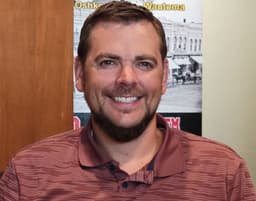
Our guest this morning is Adam Sontag, who is the Ripon City administrator.
Good morning.
Good morning.
Thank you for having me again.
Still near summer hours?
Yeah,
we have summer hours.
Yep.
So, uh, yeah, it, uh, what is it?
Memorial Day to Labor Day?
So, uh, I think so.
Yeah.
So usually we, you know, we end early on Fridays, but.
that also generally a lot of us do stay late because it's kind of a catch-up period.
So it's a nice little thing, but Labor Day will be back to being open until 4 or 4.30 on Fridays.
Okay, all right.
Makes sense.
People are busy and they're doing other things.
Well, a few years ago we were calculating it all out and there were like...
Everybody else is on vacation.
Nobody's coming in on Friday afternoons generally and and you can you know There's ways to get ahold of us and and so sure so it's all good.
I think it works out pretty well for And it's pretty well known at this point.
Yeah, so
last common council meeting the council approved what would be I guess the short in the version RFP for the shared ride taxi service.
Yep now
You have to set the hours.
This is all federally mandated, right?
Yeah.
So the shared ride taxi service is funded in large part by a federal and state grant.
And it's a it's a it's a section 5311.
They call it.
And the federal government is heavily involved in the not only the oversight, but funding the administration of it.
There's a lot of requirements that go along.
with the shared ride taxi service that are beyond just a normal taxi service, right?
The city manages the service locally, but we have all of this other federal oversight and state oversight.
So there's an entire division at the Department of Transportation that manages the shared ride taxi and other transportation programs.
And every five years we generally have to go to get a request for proposals or do procurement and that has an entire just it is a huge document that gets put together then has to be shared and we have to review proposals and Select a new vendor or a you know continue a vendor with a vendor if they if they are the low
cost option.
So it is a pretty complicated program.
It takes a lot of
There's like a lot of reporting required with it.
And the council met a couple weeks ago and we discussed, because our contract is coming to an end after five years, how we are going to proceed with procurement of the service with a number of hours.
Because currently, we, previously as we procured at over 13,000 hours annually.
We're currently operating at around eleven thousand five hundred hours and So we needed to kind of right-size the Procurement to the actual service and the level of service that we're providing So they actually selected a number of about ninety five hundred hours to offer annually and the main reason is simply the budget impact and we currently pay thirty two dollars and ninety seven cents for
for a taxi to be out there, right?
About 55% of that is the federal or state grant.
Then there are rider fairs and then there's what's the city match and the city match There has been a deficit growing the city was not adequately funding the taxi service fund out of the general property tax fund With a subsidy from from property taxes to fund that service for decades We have begun doing that, but there's a deficit once we also bought new had to acquire new vehicles because a lot of them were junk
So there's been a lot of things that we've been talking about over the past couple years, but it's all kind of coming to this point now where we have to go to procurement and Our peer communities because there's you know 25 30 other communities in the state that offer this same exact program in rural areas They're seeing taxi rates from vendors be
north of 40 plus, you know, 40, $45 an hour, which is a significant increase in costs for the city.
While the grant covers 55% of that, it goes up in cost, right?
And post COVID ridership has not recovered to what it was pre COVID.
We have seen about a 20 to 25% reduction in rides annually.
So right sizing the hours and not cutting the hours we did remove hours at late night a couple years ago because we were only doing a couple hundred rides a year late night where we're doing thousands of rides Monday through Friday and and Saturday mornings and Sunday mornings if that's the heavier use so we're using the data to say okay with ridership is down Costs are up Projecting this out to say this service we you know
We want to continue to offer, but we have to do it responsibly to the taxpayers because it could create a greater financial liability or concern to everybody.
And we have to be able to weigh this service versus
every other service we offer in the upcoming budget cycles.
So there's been a lot of discussion about this.
This isn't just something that has been discussed in one meeting.
We have over the last four or five years, every year during budget cycles, during a review of rates, review of the contract with Brown Cab is our contract holder.
we have discussed this.
So there's, it's just all kind of coming to this point.
You know, I feel just based on the feedback from the council, the council is committed and the city is committed to continuing this service.
But if we see a significant spike in that rate of, you know, from 32, 97 an hour to something, you know, it could be very high, right?
Because, you know, the contractor providing it, the vendor,
They're looking at everything from labor costs, insurance costs, fuel costs, right?
Because that's what we're paying for in the contract for them to offer that service.
And we're just hopeful that it comes in competitive.
And we can then just work within the schedule and work within the driver's schedules to meet the core purpose of that service, which is...
you know, elderly, disabled, you know, rides to medical appointments, grocery stores.
We understand it gets used for a variety of reasons.
So I think it's a, it's, you know, we're looking at the data.
We're trying to make the most responsible decision and commit to it, but also make sure it's sustainable.
So we're not, we're not getting
We're not having to cut something else to keep the taxi going right or we're balancing it all out So that's that's sorry.
That's a long answer, but I mean it's a very it's a very it's a complex situation It's not just you know, oh, you know
reactionary to one thing.
It's a lot of things that are in the background.
And frankly, it generally comes back to, at one point the state and the federal government's share of the taxi service was not at 55%, it was closer to 70%.
So the local share, and when we're on levy limits and we have expenditure restraint things within budgets or requirements, right?
If something goes up,
significantly that means we have to cut something somewhere else right so we're trying to balance that all out as we head into 2027 budget and into this procurement
okay
sorry there's a lot but
no that's fine uh houston street project a little behind
yep a little behind um there was a delayed to start with some um
Some of the the equipment and the materials that were there delayed a couple weeks and then they hit bedrock so So they had to essentially the sewer sanitary sewer was was being put in and from I believe Scott Street to East water there was bedrock that they hit because they had to go lower the the idea being that
When we redo the State Highway in 2030, we upsized and are planning ahead for that project to be able to connect into Houston Street, the sanitary in particular, because the State Highway project doesn't go through that intersection at Matoeman.
So basically we upsized that as a possible bypass To take the majority of the sanitary sewer from kind of the the east side of town down the State Highway and and divert that from the The area that goes down Blackburn So we upsized it from like six inch to like ten inch in this project.
So it provides enough capacity But it also needed to then connect to the future sewer that is deeper on the State Highway and then there's a
There's a hill.
So the hill was basically bedrock, a little hill there.
And so that took, you know, when sewers laid, they usually do about 200 to 250 feet a day.
They were at about 50 feet a day.
So it took a lot longer to get the sewer in in that stretch.
But we're working with the contractors to try to push forward a more aggressive schedule to keep it on schedule.
You know, I just never know sometimes you dig and you find stuff and in this case The the existing sanitary sewer replacing was not down as far so Probably because somebody way a long time ago, you know 80 years ago when the sewer was put in knew their hit bedrock and they said But nobody kept that record, right?
Wow.
Yeah, okay.
Yeah, we got to wrap things up, but
the city's quarterly newsletter is out you can get it at the website i guess
yep so we started a quarterly newsletter this year um we'd encourage people that you can sign up you can just find it also on the city website okay it can get emailed to you um there's updates there's uh questions to you know that i answer from the public uh there's
you know, recaps of things, upcoming information.
I think it's September.
We have our E-Cycle event.
I think that might have been put in there.
So that's coming up.
So just a good way to stay connected and involved and understand kind of what's going on or what's upcoming.
So we'd encourage residents to sign up.
It's newer this year.
And, you know, if there's a bigger demand and people want it more frequently, we'll increase it from quarterly, but right now it's quarterly.
So.
Adam, thank you very much for joining us this
morning.
Of course, thank you.
Appreciate
your time.
You
bet.
We've been talking with Ripon City Administrator Adam Sontag this morning.
Good morning, I'm Wayne Mauser for Civic Media News.
Police in Fond du Lac are investigating the shooting death of a 22-year-old Fond du Lac man.
Police in Fire Rescue responded to the 800 block of South Main Street shortly after 4.30 Thursday morning.
Sheriff's deputies assisted officers in locating three people in a parking area adjacent to the street.
The victim was found with a gunshot wound and died at the scene.
A 26-year-old Fond du Lac man was identified as a person of interest.
A 21-year-old Fond du Lac woman and the person of interest cooperated with officers and detectives in the investigation.
Police believe the incident was isolated involving individuals who were known to one another.
The investigation remains active.
A 29-year-old Wathoma man is facing a child abuse charge after police say a five-month-old baby was brought to Theta Care Hospital in Wild Rose with serious injuries and was spitting up blood.
Wathoma police and the Washera County Sheriff's Office responded to the hospital May 30.
Police said the infant's injuries were potentially life-threatening, appeared consistent with physical abuse, and left the baby unable to feed normally.
The child was later transported to the Children's Hospital of Wisconsin for treatment.
Investigators with Watoma Police and Washera County Child Protective Services interviewed caregivers and witnesses, including Stephen Polvy of Watoma.
Police said Polvy told investigators the infant was fussy and that, quote, sometimes you need to put your fingers into the back of the baby's mouth, unquote.
Another caregiver reported the infant spit up blood after the baby was alone with Polvy, this according to the release.
Police said Polvy was on probation for first-degree recklessly endangering safety in Sheboygan County.
and second-degree recklessly endangering safety in Washington County.
They said he was taken back into custody by the Wisconsin Department of Corrections following the incident.
The Washera County District Attorney charged polvi on July 23rd with child abuse, recklessly causing great bodily harm.
He's being held in the Washera County Jail.
The 44-year-old Juno man found guilty last month of killing his wife has been sentenced to life without the possibility of parole.
A Dodge County jury last month found Zachariah Rash guilty of first-degree intentional homicide and hiding a corpse.
Tuesday, a judge sentenced him on the homicide charge and in addition to six years in prison and five years of extended supervision on the hiding a corpse charge.
Thirty-seven-year-old Crystal Roche of Kleinman was last seen June 11th of 2024 but wasn't reported missing until June 23rd.
While searching Zachariah Roche's property in the town of Kleinman on June 26th of 2024, investigators found human remains in a burn area.
Forensics identified a tooth belonging to
Crystal Roche filed for divorce in 2023 and Zacharias' parental rights were terminated on June 17th of 2024.
The 44-year-old Oakfield man suspected of killing his wife was arraigned in Dodge County Court this week.
Tuesday, Aaron Nelson entered not guilty pleas to charges of first-degree intentional homicide and hiding a corpse charges them from the death of his wife, 42-year-old Alexis Nelson.
How well closing Fond du Lac County's inpatient behavioral acute health care unit affect law enforcement efforts?
Bob Nelson has the story for Civic Media News.
By a 15 to 9 vote, the Fond du Lac County Board this week have voted to close the unit at the beginning of 2027.
Sheriff Ryan Waldschmidt says that SSM Health operates a similar unit at St.
Agnes Hospital in Fond du Lac that is near the county's acute unit.
There is a behavioral health inpatient unit at St.
Agnes Hospital at SSM.
just adjacent to the acute unit literally across the parking lot.
Welchman says contrary to some talk during discussions over the closing of the unit it's not a way to save money as they look into building a new jail.
He says the county's human services department director proposed to closing the acute unit.
The two topics are completely unrelated in terms of how this came forward who moved it forward and proposed this and it's the director herself that that
He says
they also won't be taking someone who is suicidal or is having a mental health crisis directly to the county jail.
I'm Bob Nelson for Civic Media.
News.
Unemployment rates increased in all 72 Wisconsin counties in June.
According to federal labor statistics, Dodge County's jobless rate was 2.8% while Paca County's 3% and Fond du Lac County's rate was 3.2%.
The unemployment rate for Winnebago County last month was 3.3% and it was at 3.4% for both Green Lake and Washera counties.
Unemployment rates also increased in all 35 of the state's largest cities.
The cities of Fond du Lac and Oshkosh both had jobs
jobless rates of 3.6%.
Jobless rates in the state were similar to what they were in June of 2025.
And at day five of EAA Air Venture at Whitman Regional Airport in Oshkosh, one of yesterday's highlights was the spirit of freedom, a C-54 aircraft known as the Candy Bomber, which returned to the EAA grounds Thursday for the second consecutive year.
I'm Wayne Mauser for Civic Media News.
Our guest this morning is Adam Sontag, who is the Ripon City administrator.
Good morning.
Good morning.
Thank you for having me again.
Still near summer hours?
Yeah,
we have summer hours.
Yep.
So, uh, yeah, it, uh, what is it?
Memorial Day to Labor Day?
So, uh, I think so.
Yeah.
So usually we, you know, we end early on Fridays, but.
that also generally a lot of us do stay late because it's kind of a catch-up period.
So it's a nice little thing, but Labor Day will be back to being open until 4 or 4.30 on Fridays.
Okay, all right.
Makes sense.
People are busy and they're doing other things.
Well, a few years ago we were calculating it all out and there were like...
Everybody else is on vacation.
Nobody's coming in on Friday afternoons generally and and you can you know There's ways to get ahold of us and and so sure so it's all good.
I think it works out pretty well for And it's pretty well known at this point.
Yeah, so
last common council meeting the council approved what would be I guess the short in the version RFP for the shared ride taxi service.
Yep now
You have to set the hours.
This is all federally mandated, right?
Yeah.
So the shared ride taxi service is funded in large part by a federal and state grant.
And it's a it's a it's a section 5311.
They call it.
And the federal government is heavily involved in the not only the oversight, but funding the administration of it.
There's a lot of requirements that go along.
with the shared ride taxi service that are beyond just a normal taxi service, right?
The city manages the service locally, but we have all of this other federal oversight and state oversight.
So there's an entire division at the Department of Transportation that manages the shared ride taxi and other transportation programs.
And every five years we generally have to go to get a request for proposals or do procurement and that has an entire just it is a huge document that gets put together then has to be shared and we have to review proposals and Select a new vendor or a you know continue a vendor with a vendor if they if they are the low
cost option.
So it is a pretty complicated program.
It takes a lot of
There's like a lot of reporting required with it.
And the council met a couple weeks ago and we discussed, because our contract is coming to an end after five years, how we are going to proceed with procurement of the service with a number of hours.
Because currently, we, previously as we procured at over 13,000 hours annually.
We're currently operating at around eleven thousand five hundred hours and So we needed to kind of right-size the Procurement to the actual service and the level of service that we're providing So they actually selected a number of about ninety five hundred hours to offer annually and the main reason is simply the budget impact and we currently pay thirty two dollars and ninety seven cents for
for a taxi to be out there, right?
About 55% of that is the federal or state grant.
Then there are rider fairs and then there's what's the city match and the city match There has been a deficit growing the city was not adequately funding the taxi service fund out of the general property tax fund With a subsidy from from property taxes to fund that service for decades We have begun doing that, but there's a deficit once we also bought new had to acquire new vehicles because a lot of them were junk
So there's been a lot of things that we've been talking about over the past couple years, but it's all kind of coming to this point now where we have to go to procurement and Our peer communities because there's you know 25 30 other communities in the state that offer this same exact program in rural areas They're seeing taxi rates from vendors be
north of 40 plus, you know, 40, $45 an hour, which is a significant increase in costs for the city.
While the grant covers 55% of that, it goes up in cost, right?
And post COVID ridership has not recovered to what it was pre COVID.
We have seen about a 20 to 25% reduction in rides annually.
So right sizing the hours and not cutting the hours we did remove hours at late night a couple years ago because we were only doing a couple hundred rides a year late night where we're doing thousands of rides Monday through Friday and and Saturday mornings and Sunday mornings if that's the heavier use so we're using the data to say okay with ridership is down Costs are up Projecting this out to say this service we you know
We want to continue to offer, but we have to do it responsibly to the taxpayers because it could create a greater financial liability or concern to everybody.
And we have to be able to weigh this service versus
every other service we offer in the upcoming budget cycles.
So there's been a lot of discussion about this.
This isn't just something that has been discussed in one meeting.
We have over the last four or five years, every year during budget cycles, during a review of rates, review of the contract with Brown Cab is our contract holder.
we have discussed this.
So there's, it's just all kind of coming to this point.
You know, I feel just based on the feedback from the council, the council is committed and the city is committed to continuing this service.
But if we see a significant spike in that rate of, you know, from 32, 97 an hour to something, you know, it could be very high, right?
Because, you know, the contractor providing it, the vendor,
They're looking at everything from labor costs, insurance costs, fuel costs, right?
Because that's what we're paying for in the contract for them to offer that service.
And we're just hopeful that it comes in competitive.
And we can then just work within the schedule and work within the driver's schedules to meet the core purpose of that service, which is...
you know, elderly, disabled, you know, rides to medical appointments, grocery stores.
We understand it gets used for a variety of reasons.
So I think it's a, it's, you know, we're looking at the data.
We're trying to make the most responsible decision and commit to it, but also make sure it's sustainable.
So we're not, we're not getting
We're not having to cut something else to keep the taxi going right or we're balancing it all out So that's that's sorry.
That's a long answer, but I mean it's a very it's a very it's a complex situation It's not just you know, oh, you know
reactionary to one thing.
It's a lot of things that are in the background.
And frankly, it generally comes back to, at one point the state and the federal government's share of the taxi service was not at 55%, it was closer to 70%.
So the local share, and when we're on levy limits and we have expenditure restraint things within budgets or requirements, right?
If something goes up,
significantly that means we have to cut something somewhere else right so we're trying to balance that all out as we head into 2027 budget and into this procurement
okay
sorry there's a lot but
no that's fine uh houston street project a little behind
yep a little behind um there was a delayed to start with some um
Some of the the equipment and the materials that were there delayed a couple weeks and then they hit bedrock so So they had to essentially the sewer sanitary sewer was was being put in and from I believe Scott Street to East water there was bedrock that they hit because they had to go lower the the idea being that
When we redo the State Highway in 2030, we upsized and are planning ahead for that project to be able to connect into Houston Street, the sanitary in particular, because the State Highway project doesn't go through that intersection at Matoeman.
So basically we upsized that as a possible bypass To take the majority of the sanitary sewer from kind of the the east side of town down the State Highway and and divert that from the The area that goes down Blackburn So we upsized it from like six inch to like ten inch in this project.
So it provides enough capacity But it also needed to then connect to the future sewer that is deeper on the State Highway and then there's a
There's a hill.
So the hill was basically bedrock, a little hill there.
And so that took, you know, when sewers laid, they usually do about 200 to 250 feet a day.
They were at about 50 feet a day.
So it took a lot longer to get the sewer in in that stretch.
But we're working with the contractors to try to push forward a more aggressive schedule to keep it on schedule.
You know, I just never know sometimes you dig and you find stuff and in this case The the existing sanitary sewer replacing was not down as far so Probably because somebody way a long time ago, you know 80 years ago when the sewer was put in knew their hit bedrock and they said But nobody kept that record, right?
Wow.
Yeah, okay.
Yeah, we got to wrap things up, but
the city's quarterly newsletter is out you can get it at the website i guess
yep so we started a quarterly newsletter this year um we'd encourage people that you can sign up you can just find it also on the city website okay it can get emailed to you um there's updates there's uh questions to you know that i answer from the public uh there's
you know, recaps of things, upcoming information.
I think it's September.
We have our E-Cycle event.
I think that might have been put in there.
So that's coming up.
So just a good way to stay connected and involved and understand kind of what's going on or what's upcoming.
So we'd encourage residents to sign up.
It's newer this year.
And, you know, if there's a bigger demand and people want it more frequently, we'll increase it from quarterly, but right now it's quarterly.
So.
Adam, thank you very much for joining us this
morning.
Of course, thank you.
Appreciate
your time.
You
bet.
We've been talking with Ripon City Administrator Adam Sontag this morning.