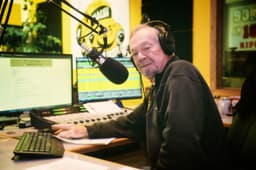
Good morning, I'm Wayne Mauser for Civic Media News.
Fondleland County Sheriff's officials say the remains of Bobby Joe Fritz were not found during the execution of a search warrant at a Campbell Sport home where he was living when he disappeared 43 years ago.
The scene has been turned back over to the current property owner who has no connection to the Fritz family.
Investigators did recover new potential evidence that will undergo further examination.
The initial search of the basement at Bobby Joe's former home uncovered potential evidence prompting a full-scale excavation involving sheriff's office detectives.
DCI agents, crime scene analysts, crime lab personnel, and a forensic anthropologist.
In total, investigators removed and processed about 505 gallon buckets full of dirt by hand from the basement.
This equated to a total weight of about 30,000 pounds of soil that was sifted by hand, searched, and items of interest collected for processing.
Additional items of potential evidentiary value were recovered and collected.
All evidence seized during the search will be submitted
to specialized laboratories for detailed analysis.
This process can take several months and sometimes over a year.
And the 11-year-old north Fond du Lac girl is dead after a minivan crashed in the town of Eden.
Around 3.09 p.m.
Wednesday, the Fond du Lac County Communications Center learned of a single car crash on County Highway V near Lyme Road.
The Fond du Lac County Sheriff's Office, along with Eden Fire Department and Eden First Responders, were at the scene.
Four people were in the minivan.
A 29-year-old Fond du Lac man drove it.
He was taken from the scene by ambulance to SSM St.
Agnes Hospital for minor injuries.
The 11-year-old North Fond du Lac girl was flown by Fetastar Aeromedical Helicopter through Children's Hospital in Wisconsin in Milwaukee.
Shortly after arriving, she was pronounced dead.
An 8-year-old Fond du Lac boy and 15-year-old Campbell Sport girl also suffered minor injuries.
They were treated at SSM St.
Agnes Hospital.
No names are being released at this time.
A motorcyclist died after they collided head on into a FedEx delivery truck in Shono County.
Crews responded to the crash at 922 AM Wednesday on Hillcrest Lane in the town of Westcott.
Initial reports indicated the driver of the motorcycle was not wearing a helmet and had possible head injuries.
Multiple deputies responded to the scene along with fire and EMS units when they arrived
they provided medical attention.
Unfortunately, the driver of the motorcycle, a 39-year-old man from the Chano area, was pronounced deceased at the scene.
The driver of the FedX truck was identified as a 25-year-old man from the Green Bay area.
Deputies say the FedX truck was going north on Hillcrest Lane and the motorcycle was traveling south.
The motorcycle crossed into the northbound lane and struck the FedX truck head-on.
The FedX truck came to a stop in the northbound lane and the motorcycle came to rest.
in the east stitch line.
The investigation remains ongoing.
Oshkosh police arrested a 28-year-old Oshkosh man Tuesday night for setting fire to his vehicle and damaging a neighboring home.
It happened in the 600 block of Frederick Street about 8.19 p.m.
Upon arrival, they located the suspect who admitted to setting the vehicle on fire and damaging some windows inside his residence.
The vehicle's fire spread to a neighboring home, causing damage to the siding.
No injuries were reported.
The man was taken into custody for arson to a building and criminal damage to property.
The Ripon School Board this week continued preparations for creating an operational referendum for the November ballot.
Bob Nelson reports for Civic Media News.
District Superintendent Ron Rabard gave the board information about the results of a community survey.
Rabard says the majority of 260 people who took the survey said they're likely to support a tax neutral operational referendum.
Over 85% were either indefinitely in support or likely in support of a tax neutral referendum.
May ripen school board next month will consider approving resolutions for a referendum that if approved by voters would allow the school district budget to exceed its revenue limit for six years for non-recurring purposes.
I'm Pop Nelson for Civic Media News.
Montello firefighters responded to a structure fire at Rivers Bend Resort on Fox Lane in Marquette County's town of Montello Tuesday afternoon.
Sheriff's officials say multiple first responders were dispatched to the scene.
When they arrived, they encountered heavy smoke and flames coming from the building.
According to the Montello Fire Department, they initiated an interior attack on the blaze, but after having fire in the ceiling and roof area caused a partial collapse personnel were
evacuated and firefighting efforts moved to the exterior of the building.
Seven different fire departments responded along with the Marquette County EMS, the Sheriff's Office and drone team.
The building was a total loss.
The Sheriff's Office and the Montello Fire Department are investigating the cause.
The property owners have been cooperating with investigators.
And today is day four of EAA Air Venture at Whitman Regional Airport in Oshkosh.
I'm Wayne Mauser for Civic Media News.
Joining us this morning from SSM Health, we have Laura Nikowski, who's the community health manager for a greater Fond du Lac region, and specifically the hospitals in Ribbon or Pond and at St.
Agnes in Fond du Lac.
Good morning, Laura.
Good morning.
Pleasure to be here today.
Now, we're going to be talking about the point in time, which is basically an account that's done twice a year.
Um to gauge the homeless population What is what is SSM health's role in this?
Yeah, so you know all of our housing resource partners are required by their federal funding to complete this census twice a year and it's always on the third
Wednesday of January and July into the third one day of the month, going into Thursday morning.
And what I've been partnering now for the point in time census, I started back in 2024.
So I've done, actually, I think this was my sixth one, you know, for my third one in July.
And I have a census recorder and I am a driver.
So there's a team of us.
We all have different routes.
And we go out and we drive around.
It feels kind of like you are stepping into a very, very different type of area.
You might be really from your area and be a local person.
But when you're driving around at night doing this, it feels very different.
And last night I had the opportunity of taking my intern and also a provider, a family med provider came with me as well.
And every time I kind of bring someone new, someone who's been interested in learning more about homelessness, I think we learn a lot when we participate in this because we can have a lot of preconceived notions.
We can make a lot of assumptions about what we think.
Homelessness is and I really think point in time the pit does a really wonderful job of showing you what it is and what's not and it's not something scary But it is a lot of people trying to make it work and living out of cars
Okay, so what area did you did you guys cover you're driving around?
Right, right.
So I've done a whole wide array, and it's really dependent on how many teams that you have available.
Last night, we unfortunately had a very small crew.
So if you're interested in being a point-in-time volunteer, I really encourage you to reach out to Advocat, which does a wonderful job of leading that work.
But we had a small crew, so we stayed more locally to the Fond du Lac area, but there was also a crew that was doing Green Lake.
and you have a route that then you have to like submit your route.
So we have like 10 locations.
There's like the east side, west side, north side, south, central, that type of thing.
I've done where I've gone all the way out into Campbell Sport and then you do that whole route and then you come back.
I've done the route in Ripon where you're gonna try and go to like the high V. You're gonna try and drive around maybe some schools of the park.
And you're looking for people not for a punitive or like reporting them, like badly.
What you're looking at is, hey, are these people homeless and do they need help?
How can we support them?
How can we make sure that they know about the resources available to them?
So it's always interesting.
You never know where you're gonna go.
And that's kind of the fun part.
Okay, so you start out at,
11 p.m.
and when does your night wrap up for the count?
Yeah, it depends.
So we usually wrap around 2 to 2.30 in the morning for our whatever route you were assigned.
And then it will continue on into the morning today.
And in Fond du Lac, we are really encouraging those to partake in the point in time resource fair.
where those that are unhoused can go where every all of those resource providers that are unhoused individual would likely use and have access to and want to are all there together and then while they are attending this resource fair they can then be captured in that census because it's still within the time frame.
I believe it goes into like the evening until today
But that would be something that Advocat being the owner of the point in time census probably can speak to that much better than I can.
Right.
Actually, we will be having Advocat's executive director on next week to talk about different things.
So we'll ask her.
Time
is wonderful.
Yeah.
Time is wonderful.
She was there with me last night.
Oh, was she?
Yeah, she sure was.
Yeah, we ended up not driving together, not because I don't want her to ride with me, but she just
There was less people in one car, so she just went with them.
That's
all.
Yeah.
Well, I know she knows her way around Rippendown because she's been out here quite a few times.
So anyway.
She has.
She has.
So this is something that is required by the U.S.
Housing and Urban Development Department, right?
Yes.
Yep.
Twenty-two years.
Yeah.
And then
And then there's also, like, you capture the number that those are in shelter, you know, like in the wintertime, those that are at the Holy Family Warming Shelter or those that are at, right now, at any time at St.
Catherine Drexel Shelter, you have your in-shelter numbers and then you have your on-the-street numbers.
Okay, so we talked a little bit about advocates rolling this, but how does this benefit what SSM Health does?
Absolutely.
So we need to work together, right?
It's very important that we want everyone to know and we certainly want our own house neighbors to know that we always will care for them and serve them.
We have a wonderful department called Samaritan Clinic.
It's not a clinic, not a brick and mortar clinic where they're gonna see patients, but it used to be back in the day when it first started in the 90s.
But what it really is is all of those social drivers of health
you know, housing insecurity, food insecurity, transportation barriers, financial barriers, all those barriers to getting health care, that team and department can take care of those individuals and be of love and support for them.
And it's a person, right?
It's a person that can help guide them.
So our role in providing health care is that our mission allows us to care for anyone and everyone that walks through our doors.
So it's really important for us to work in tandem with our homeless resource providers because it's our job to get them healthy.
We then need to work with our partners for when they leave us or they're not in our care to know that then they have the extra support that they need.
You know, there's a lot of folks that we serve every day in our hospitals that are getting surgery, that are going through cancer care, that are having babies, that are homeless.
And I think that's the other big misconception that I do a lot of work internally of saying, I think we think that if you're on house, you don't know how to access care.
And that's not true.
They are.
They're having surgery.
It's just, then we do all these things for them and we might not have known.
Then what?
How can we support them and make sure that they don't come back into us for an infection?
That they are getting all the supports that they need to have a successful
um baby delivery and you know that the baby's healthy and a lot of people like I said are on dialysis or cancer care so we just that that's extra support that they need right
right your health doesn't pause just because of your housing situation right
No, and you've got to work through that.
There's a lot of people living on the that are on house that are diabetic.
So then restoring your medication, right?
You
need that.
How can we help you?
And then also just making sure our staff is educated and knowing that it's not a compliance issue.
It's the fact that where are they going to access those things?
How are they going to keep their incision clean if they don't have access to running water?
Well, hopefully you can catch up on your sleep overnight tonight.
But
yeah.
Yeah, for sure.
That's okay.
You know, honestly, it works out just fine.
And then, you know, I got a phone call with you.
That's the start of my day.
So I can't think of a better way.
Well, Laura, thank you very much for joining us this morning.
Appreciate your time.
Thank you.
Have a good one.
You too.
That is Laura Nikowsky, who's a community health manager for SSM Health Greater Fond du Lac.
and we appreciate her telling us about the point in time count.
Joining us this morning, we have Fond du Lac County Executive Sam Kaufman.
Sam, thanks for joining us.
Of course, thank you.
The county board on Tuesday night voted 15-9 to close the acute unit, the inpatient behavioral health acute unit.
A lot of talk on that, a lot of discussion.
You think people had their say on it?
Well, you know, this is a very hard emotional topic, you know, and it's unfortunate that there was a lot of misinformation put out there.
You know, Jerry Van Hoeven who is the Director of Human Services made the recommendation and what a lot of people don't understand is that
As the director, she has dealt directly with this topic from day one.
I mean, 20 years ago or longer, she started working in the acute unit.
That was her first job here in the county.
She's very familiar with the operation.
She has seen the changes, what's been happening.
And ever since Alan started the crisis worker program here in the county, that has been a good thing because that has reduced the population or census down.
We used to be 25 beds.
Now we're averaging.
maybe five county residents, but our budget is close to four million dollars that we spend on mental health.
But the misinformation people were putting out there about this was that we're diverting the money now to the jail, completely untrue.
That money sustained in human services will continue with the mental health programs because we increase the crisis worker program, which is intended to keep people out of a locked facility, which is what I support.
To me, that's not the answer.
just shoving them into a locked facility.
You know, then you get into this bit of that, but we're just trying to put them in the jail.
Again, completely untrue.
That is not the situation.
We are trying to have more direct contact with those individuals who are in crisis.
And that program we have has been very successful.
And the plan now is to enhance that program.
So now we will be collaborating with the various individuals within the community, roving to mental health,
who now collaborate to enhance that crisis worker program to make it even more effective.
Because we want direct contact with those in crisis who can help them directly.
And so just having the easy answer of, help them into a facility.
That's not the answer.
And it's unfortunate that people have twisted, but once you took the emotion out of it, the facts were there.
And I supported your recommendation as a department head.
I'm not the expert in the room, but
I
rely on her and her consultation, all the experts that she did do.
So it's a very emotional matter, but just something that we will move forward on now since the county board has made this decision.
It was pointed out to me by the sheriff, actually, that SSM Health at St.
Agnes does have a similar unit to what the county has.
Absolutely.
And a lot of people don't understand that, too, is that there are facilities within an hour.
You've got SSM here, which I can tell you right now, at least, that they average anywhere from six to nine beds a day that are available, and they're in patient B or health unit.
There's facilities in Oskar, Gass, Nina, towards Milwaukee.
All of them have beds available.
And that's because the census or process for how we deal with mental illness has changed.
that the old approach of locking them into a facility is no longer the approach.
Now it's to go through and have the direct programs to crisis workers, to get that contact directed and help them through that crisis, to help them get therapy right away, instead of the negativity of locking them into a facility.
So that has been successful, actually throughout the entire state, because as Jared has pointed out,
the census in a lot of facilities have been dropping.
And that's because we're dealing with mental illness with a whole different approach.
And we're going to continue to do that.
I'm committed to that, I think, seriously.
And I know others do, and Jerry especially, and we will work through this to create an even better program.
The funding situation for the acute unit, what happens to the money that is received for the acute unit?
Does that get distributed to other human service programs?
Yeah, what will happen is the money that we're already spending on the operation, the kill unit, will be diverted into the crisis worker program.
Those funds will go through to hire more staffing for the crisis workers, more crisis workers themselves, because we have to provide 217 care.
And that will continue.
That is not going to stop.
We have programs within the Department of Community Programs.
Those will be enhanced also because we believe in developing those direct contact programs for those in crisis.
So the money's not being diverted anywhere to any other departments.
Again, not even to the GO's where people are trying to say it is.
It will stay within that department and still be focused on mental health.
Okay.
Also during the county board meeting the other evening,
there was a presentation on designs for a new jail.
What can you tell us about that?
Yeah, you know, the county board had contracted with venture architects to come up with design plans or schematic designs for various sites, one off the highway department, one across the street.
I know that they're also looking at an area just next to us in the north end of the county building.
A few of the supervisors had made that request.
That didn't cost the county any more money to have a look at that.
And I'm glad they are.
We have to look at all the options available.
And obviously, in the end, we've got to figure out what the funds are or how much it's going to cost.
But Venture came in to do an update, basically, to show them
Okay, this is kind of what we're looking at, a kind of a layout, but nothing in detail.
The more detailed schematic designs will come later.
However, those designs, when they're provided more detail, because of security reasons, as was pointed out by Venture and the Sheriff's Department, they can't be put out there publicly to show the actual detailed designs, because that's a security risk to not only the courts, but to the jail and the Sheriff's Department.
but they will be providing that.
The supervisors will see them most likely in a closed session when it comes to those detailed plans.
But that plan is moving forward.
Venture said at the meeting Tuesday night, they anticipate most likely in September is when those schematic design detailed plans will be provided.
I will then be looking then to figure out, okay, what is the estimated cost for each of these options?
the county board will then task me with trying to figure out options of how to pay for that, which I will have to look through as we go into the budget time, and then come back to them and say, well, these would be your options.
Then the county board, by understanding from the chair, they'll be listening to sessions around the county to get direct input from our residents, and then the county board will have to make a decision as to site design and how they want to go ahead and fund this.
There's no final decision on anything at this point.
Okay.
At what point do you look at possible cost scenarios?
Well, once I have a better idea of what each of the proposed designs and site locations would cost, at least estimated, that would give me a better idea of, okay, how do we do this?
There's only a couple of options.
You're either going to completely bond for it.
which is going to mean, obviously, a property tax increase to pay that back, or a combination of a sales tax allocation with the bonding amount, which we would use sales tax then to lower the amount of bonding.
But what people have to understand is there's only some sales tax, so when you take the sales tax out to pay for that, you're going to have to cut other budget, department budgets, in order to pay for or to cover that loss or so.
there will be some things they're gonna have to consider here, but really those are gonna be the only two options.
Will there be information sessions for the public before the county board makes a decision?
Oh, absolutely.
I know that Chair Abel and I discussed that.
I've insisted.
I know he has very adamant about doing that.
There has to be listening sessions around the county before any decisions are made so the county residents can see
the basic design layout and go through and give input as far as cost.
And I know, I don't want a property tax increase, and I know others don't either.
A jail is a necessary evil.
And unfortunately, it's just something that we have to be looking at, but the County Board has to make a decision.
I need that decision from them no matter what that decision is, just so I can figure out how we're going to budget going forward.
Okay.
We have to wrap things up, but Sam and I was going to ask you, because we had the Fundlag County Fair last week.
How is the new stage for the grandstand working out?
I'll tell you, they had some amazing concerts there.
I always want to give credit to the Fair Board.
They do such a fantastic job every year, and we're so blessed to have them in their commitment to that, but the stage was fantastic.
The concerts they had going on, that stage was a great thing.
I heard nothing but compliments in regard to how that stage worked out, so we're so happy the Ness Exchange Bank came forward and made that fantastic donation to make that a reality.
Well, you certainly had a variety of entertainment from a Michael Jackson tribute to a night ranger and Trace Adkins.
So you couldn't go wrong.
Yeah,
it was a great lineup.
And I said it's all done by the fair board and kudos to them because they deserve all the credit for a great fair again.
Well, Sam, thank you for joining us this morning.
Appreciate your time.
Thank you, Bob, for your time.
We've been talking with Sam Kauffman, Fundalac County Executive.
Joining us this morning from SSM Health, we have Laura Nikowski, who's the community health manager for a greater Fond du Lac region, and specifically the hospitals in Ribbon or Pond and at St.
Agnes in Fond du Lac.
Good morning, Laura.
Good morning.
Pleasure to be here today.
Now, we're going to be talking about the point in time, which is basically an account that's done twice a year.
Um to gauge the homeless population What is what is SSM health's role in this?
Yeah, so you know all of our housing resource partners are required by their federal funding to complete this census twice a year and it's always on the third
Wednesday of January and July into the third one day of the month, going into Thursday morning.
And what I've been partnering now for the point in time census, I started back in 2024.
So I've done, actually, I think this was my sixth one, you know, for my third one in July.
And I have a census recorder and I am a driver.
So there's a team of us.
We all have different routes.
And we go out and we drive around.
It feels kind of like you are stepping into a very, very different type of area.
You might be really from your area and be a local person.
But when you're driving around at night doing this, it feels very different.
And last night I had the opportunity of taking my intern and also a provider, a family med provider came with me as well.
And every time I kind of bring someone new, someone who's been interested in learning more about homelessness, I think we learn a lot when we participate in this because we can have a lot of preconceived notions.
We can make a lot of assumptions about what we think.
Homelessness is and I really think point in time the pit does a really wonderful job of showing you what it is and what's not and it's not something scary But it is a lot of people trying to make it work and living out of cars
Okay, so what area did you did you guys cover you're driving around?
Right, right.
So I've done a whole wide array, and it's really dependent on how many teams that you have available.
Last night, we unfortunately had a very small crew.
So if you're interested in being a point-in-time volunteer, I really encourage you to reach out to Advocat, which does a wonderful job of leading that work.
But we had a small crew, so we stayed more locally to the Fond du Lac area, but there was also a crew that was doing Green Lake.
and you have a route that then you have to like submit your route.
So we have like 10 locations.
There's like the east side, west side, north side, south, central, that type of thing.
I've done where I've gone all the way out into Campbell Sport and then you do that whole route and then you come back.
I've done the route in Ripon where you're gonna try and go to like the high V. You're gonna try and drive around maybe some schools of the park.
And you're looking for people not for a punitive or like reporting them, like badly.
What you're looking at is, hey, are these people homeless and do they need help?
How can we support them?
How can we make sure that they know about the resources available to them?
So it's always interesting.
You never know where you're gonna go.
And that's kind of the fun part.
Okay, so you start out at,
11 p.m.
and when does your night wrap up for the count?
Yeah, it depends.
So we usually wrap around 2 to 2.30 in the morning for our whatever route you were assigned.
And then it will continue on into the morning today.
And in Fond du Lac, we are really encouraging those to partake in the point in time resource fair.
where those that are unhoused can go where every all of those resource providers that are unhoused individual would likely use and have access to and want to are all there together and then while they are attending this resource fair they can then be captured in that census because it's still within the time frame.
I believe it goes into like the evening until today
But that would be something that Advocat being the owner of the point in time census probably can speak to that much better than I can.
Right.
Actually, we will be having Advocat's executive director on next week to talk about different things.
So we'll ask her.
Time
is wonderful.
Yeah.
Time is wonderful.
She was there with me last night.
Oh, was she?
Yeah, she sure was.
Yeah, we ended up not driving together, not because I don't want her to ride with me, but she just
There was less people in one car, so she just went with them.
That's
all.
Yeah.
Well, I know she knows her way around Rippendown because she's been out here quite a few times.
So anyway.
She has.
She has.
So this is something that is required by the U.S.
Housing and Urban Development Department, right?
Yes.
Yep.
Twenty-two years.
Yeah.
And then
And then there's also, like, you capture the number that those are in shelter, you know, like in the wintertime, those that are at the Holy Family Warming Shelter or those that are at, right now, at any time at St.
Catherine Drexel Shelter, you have your in-shelter numbers and then you have your on-the-street numbers.
Okay, so we talked a little bit about advocates rolling this, but how does this benefit what SSM Health does?
Absolutely.
So we need to work together, right?
It's very important that we want everyone to know and we certainly want our own house neighbors to know that we always will care for them and serve them.
We have a wonderful department called Samaritan Clinic.
It's not a clinic, not a brick and mortar clinic where they're gonna see patients, but it used to be back in the day when it first started in the 90s.
But what it really is is all of those social drivers of health
you know, housing insecurity, food insecurity, transportation barriers, financial barriers, all those barriers to getting health care, that team and department can take care of those individuals and be of love and support for them.
And it's a person, right?
It's a person that can help guide them.
So our role in providing health care is that our mission allows us to care for anyone and everyone that walks through our doors.
So it's really important for us to work in tandem with our homeless resource providers because it's our job to get them healthy.
We then need to work with our partners for when they leave us or they're not in our care to know that then they have the extra support that they need.
You know, there's a lot of folks that we serve every day in our hospitals that are getting surgery, that are going through cancer care, that are having babies, that are homeless.
And I think that's the other big misconception that I do a lot of work internally of saying, I think we think that if you're on house, you don't know how to access care.
And that's not true.
They are.
They're having surgery.
It's just, then we do all these things for them and we might not have known.
Then what?
How can we support them and make sure that they don't come back into us for an infection?
That they are getting all the supports that they need to have a successful
um baby delivery and you know that the baby's healthy and a lot of people like I said are on dialysis or cancer care so we just that that's extra support that they need right
right your health doesn't pause just because of your housing situation right
No, and you've got to work through that.
There's a lot of people living on the that are on house that are diabetic.
So then restoring your medication, right?
You
need that.
How can we help you?
And then also just making sure our staff is educated and knowing that it's not a compliance issue.
It's the fact that where are they going to access those things?
How are they going to keep their incision clean if they don't have access to running water?
Well, hopefully you can catch up on your sleep overnight tonight.
But
yeah.
Yeah, for sure.
That's okay.
You know, honestly, it works out just fine.
And then, you know, I got a phone call with you.
That's the start of my day.
So I can't think of a better way.
Well, Laura, thank you very much for joining us this morning.
Appreciate your time.
Thank you.
Have a good one.
You too.
That is Laura Nikowsky, who's a community health manager for SSM Health Greater Fond du Lac.
and we appreciate her telling us about the point in time count.