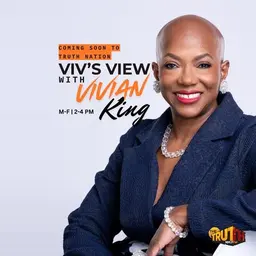
Milwaukee, it's time to energize your soul and open up your mind.
I just have a joy
for life and so I have a joy for people too.
You are tuned in to Viv's View on 101-7 The Truth.
where your story is her story.
You know, as a black woman, it's like you want to be like us, but you don't like us really.
That's right.
Yeah.
It's time to see things from a different point of view.
I think that that was God saying, OK, you can do this.
Yeah.
So go ahead and try.
Truth Nation, our view, your view, and Viv's view, right here on 101-7 The Truth.
I have all kinds of friends.
from all over the world.
And so I just thank God for the experiences that he's given me.
Now live from the American Family Insurance Studios at Third Street Market Hall on the award-winning 1017th Truth.
Here's your host, Vivian King.
Everybody, how are you today?
Welcome to Viv's View, day three of Viv's View.
I'm really excited.
Lots of things to talk about today, but we have a very special focus because you all know, you just heard it in the news break about the brewers.
So look, I brought my brewers hat.
I can't put it over my, those of you who are not.
Looking on YouTube you can't see my brewers hat, but I
have a
brewers hat.
How do you like exact you like it?
I like So I will say you know the brewers are doing it right and I hope that Already they have surpassed last year because well, you know what happened last year.
They had not won a game In this series and so now they are up to oh
I have my friends who are saying, oh, they're going to do it in six.
Oh, they're going to do it in five.
You know, I want them to kind of return the favor to the Dodgers.
And shall I say, dare I say, sweep?
Wouldn't that be great, Zach?
Yes.
To show that we, you know, we learned our lesson last year.
We didn't rest on our laurels.
We are here to play.
We came to play.
So we're going to talk about baseball today because a good friend of mine said whatever happened to Blacks playing in baseball and I think there are there are blacks in baseball in major league baseball But there were a lot more it seemed when I was growing up now granted I have I'm a I am a Brewers fan now However, I am a Cardinals fan at heart
I know, I know, I know.
But right now I'm a Brewers fan because of course the Brewers, of course I live here in Milwaukee and so the Brewers are our team and so of course I root for the Brewers unless they're playing the Cardinals.
I'm sorry my grandmother would get me if I did not.
I remember when they were in the playoffs one time and I was at home in St.
Louis visiting and
the cartons were going to Milwaukee to play the Brewers and My grandmother mentioned that and I said, oh, yeah, you know, I may go to the game and she said that's right You are up there with those Brewers Just remember you live in Milwaukee, but you're from St.
Louis.
I'm like, okay.
Yes, ma'am.
All right, but
May she rest in peace.
She was a diehard Cardinals fan for 85 years She passed away at age 103 and so she rooted for the Cardinals her entire well for 85 years of her 103 years of life So I'm sure she's looking down and saying okay since the Cardinals aren't in it you can go ahead and root for the Brewers and so we are rooting for the Brewers they're in
Los Angeles tonight, and we'll be playing the Dodgers, and we hope we see a victory.
And that's why I wanted to talk about Blacks and Baseball.
A friend of mine, a good friend of mine, said, whatever happened to Blacks and Baseball, is it one of the sports that young kids like and work toward?
try to play or did basketball lure them away or football lure them away.
You know, baseball is reportedly America's pastime.
So did blacks leave baseball or did baseball leave blacks?
We're going to explore that today.
We're going to explore that today.
I have some really cool people coming in to talk about it.
I will say this, just give you like a little background, the percentage of
Black American players in Major League Baseball experienced a long-term decline over several decades, dropping from roughly 18% to 20% in the 1980s and 90s down to a low of about 6% in recent years.
Though apparently this year opening day rosters saw a slight uptick
rising to 6.8%, so 64 players by the 2026 season.
So there's a little uptick and the Brewers fare better than most major league teams.
So some of the factors that we're gonna really talk about, you know, what is maybe icing out black students and young players?
You know, why aren't they interested?
You know, one of the reasons may be what I'd you know, just mentioned that maybe football is luring them away.
We're in football season and we always hope that Baseball season extends to this time because it means we're in the playoffs, but now of course people are looking at football as well basketball season will start soon
It usually starts at the end of October.
So these are our, you know, our winter sports that are starting up now.
And so maybe they have lured students away from loving basketball, I mean, baseball.
But anytime I want to walk, I see baseball teams out there.
I know there's, there are the Little Leagues, the National Little League World Series.
So I know kids are still playing baseball, but just how many, how many are there?
You know, what are they doing?
When I grew up, as I mentioned, I grew up in St.
Louis.
And so, you know, in the seventies or so, I just remember Bob Gibson of the Cardinals and and and Lou Brock of the Cardinals.
And I remember going to camp.
in the 70s and I Was so excited because my dad loved baseball my grandfather loved baseball So they always would talk about baseball and we went to several Cardinals games over the years and I remember being so excited that one of my camp counselors was Wanda Brock who was Lou Brock's daughter and so I was so excited to
go home and say, hey, Wanda Brock, Lou Brock's daughter is our camp counselor.
So that was that gave me some bragging rights when I was when I was young.
But everybody talked about baseball.
Everybody talked about baseball.
And at that time, baseball was really big in St.
Louis.
We also had the baseball car.
I mean, the football cardinal.
So we had the baseball and football cardinals in St.
Louis.
Of course, now those, those Cardinals moved to Arizona years later.
So we don't have that.
And then we had the Rams and football, but baseball has always been big.
Baseball has always been big in St.
Louis.
And so when I moved to Milwaukee, I noticed some similarities because baseball was big here with the Brewers.
The other thing is.
this is a brew town, so this is a beer town.
We have Anheuser-Busch in St.
Louis, and then there's Miller here, and of course all of the others, Papson, all of the others.
So we had a big baseball town.
So we, you know, we loved baseball, and
didn't play baseball I do recall my dad was an educator he was a principal of course started off as a teacher math teacher etc but he was a principal worked his way up to being a principal and he used to you know they have summers off and so one of the things that he used to do is play actually
umpire softball games.
So I remember when Miller Park here in Milwaukee was first built.
And I said, you know, I always wanted to give my dad, you know, something experiential for, you know, gifts for a father's day, birthdays, Christmas, even.
But for one father's day, I gave him the a set of tickets to go.
visit Miller Park and So we did that and we had seats that were right behind home plate and The umpire came out of him because as he was as they were pitching he was calling all of the all of the pitches and and he was he was pretty right on I think he could have done that major league way as well I See one of our guests has arrived and they're hanging out
The rest of the team is is talking to them and taking pictures and so we'll be able to Get in touch with him and talk to him.
We'll get in on that scene soon, but we'll be talking baseball But right now we got to go to a break and so we will be back after this
Viv's view with Vivian King will be right back.
Until then, stay connected with the latest news, conversations, and stories at 1017thetroof.com.
Listen, watch, and share your view.
Truth Nation, it's time to give back to the conversation.
Our view, your view, Viv's view.
Viv's view with Vivian King returns now on the award-winning 1017 The Truth.
Of course, that's Shining Star by Earth Window Fire, my favorite group of all time.
And we have a Shining Star in the studio, but we're going to talk to him next segment.
But we've already been having a great conversation, so I cannot wait for you to hear him as well.
One thing I do want to tell you though, before we get a little farther, is life's better when you know you're covered.
With a home and auto policy from American Family Insurance, you're not just buying covers, you're getting an agent who helps you feel protected and prepared.
Someone who understands what you've built and what you're building next.
Because when your home and your ride are protected the right way, you're free to focus on your family, your goals, and your future.
Ensure carefully, dream fearlessly with American Family Insurance.
Get a quote or find an agent at amfam.com.
American Family Mutual Insurance Company, SI, and its operating company's 6,000 American Parkway in Madison, Wisconsin.
We're going to continue to talk baseball, but I did want to just bring up a couple of things that sparked my interest and just really my outrage.
I don't know if you guys heard about the father that
died on a roller coaster at a theme park and You know just such a sad situation he was a father and an educator and I He was ejected from the seat and he was sitting next to his niece and Just what a what a what a just a sad story.
So I just want to you know
Just extend my condolences to that family.
His name was Hassan Kameer.
I think that's what it is.
Wait, let me look it up real quick.
I know I wrote it down.
Hassan Kameer, I believe.
He was with his niece again.
Yes, I'm sorry.
I mispronounced it.
Hassan Kareem.
Hassan Kareem, he was 42 years old.
He was celebrating his niece's birthday and they were at the Goliath roller coaster.
And, you know, just I mean, I love roller coasters.
I mean, I haven't been on one in a while.
My my dear devil days have kind of calmed down a little bit.
But, you know, just just condolences to Hassan Karim's family.
You know, what a way to just a terrible way to lose a loved one.
you know, anytime you lose a loved one is not good, it's sad, and it's hard on you, but, you know, so tragic, and especially during a time when you're having fun and celebrating a birthday, and so my hats go off to that family.
And I heard
he allegedly survived a car accident to the week before something?
You know, Ben was telling me that, Ben Jim and my producer, he was telling me that before I came in, and he said there was a, like, this was the third thing.
That even happened and so yeah, I mean gosh You know our condolences to that family and then also there are 2.5 to 3 million black Catholics in the United States And I know they are paying attention to Pope Leo who just recently had lung surgery
But the lung surgery went well apparently and so But I know Catholics are praying for Pope Leo and especially Pope Leo is our first American born Pope.
So that's pretty, you know, that's pretty We've got some bragging rights on and from Chicago.
So
right down the road, too.
So yeah Wanted wishing speedy recovery to Pope Leo
And to all the Catholics out there, we are praying for the Pope.
I am Baptist, but I am faithful.
And so we pray to the same God.
So yes, we are wishing a speedy recovery to Pope Leo.
Because in Milwaukee, in the Milwaukee area, there are about 5% of the African-American community.
represent themselves and call themselves Catholics.
So I know several Catholics in the area and so we are praying for the Pope.
Welcome back to 1017 The Truth, the award-winning 1017 The Truth.
We are coming to you live from the American Family Insurance Studio.
And as I was telling you, we're talking about baseball today.
And so I was telling you how when I was younger, my dad loved baseball, my grandfather loved baseball, and my grandmother, who moved from Mississippi to St.
Louis when she was, I think she was 15.
Yeah, she was 15.
She was 15.
Since then she started rooting for the Cardinals and so for her 100th birthday I sent since I was in the news I sent a news release to NBC channel 5 in St.
Louis and I said die hard Cardinals fans celebrates a hundred and
They came out and it was so funny and so she was shocked of course that they came and I remember them interviewing her and saying and asking her you know, what is the reason for your longevity and she said Loving others treating others as you want to be treated with love So I try to do that too, you know, maybe I have my bad days I try to follow in her footsteps.
She was
She was on the shorter side.
So she was, she was shorter than me and her mom, my great grandmother was shorter than me and they used to call me tall.
And so I guess when I was in sixth grade, I was five, two.
Now I'm not in sixth grade anymore and I'm five, three.
So, so I did.
So I was tall to them.
And of course.
Had a friend in in high school who was 5-2 at the same time she grew to be 511 so she left me but I was still tall to my mother and my grandmother and my great-grandmother, but she loved baseball and and she has been rooting for the Cardinals for for years I remember going to one of the playoff games years ago and
The Cardinals were the brew it was at Miller Park and the Brewers were playing the Cardinals and so I had on a cardinal shirt and This lovely Brewers hat, which I can't fit over this You know so you see it though if you're watching on YouTube So it's my Brewers hat and so people kept looking at me like what?
What is this?
And I said, okay, I'm rooting for the Brewers, but I also root for the Cardinals.
And so whoever wins today, I'm a winner either way.
So that's how I did it.
You understand that, Zach, don't you?
No, it doesn't work that way.
It doesn't.
Why not?
You gotta pick a side.
You gotta pick a side.
I'll pick the side.
That's like when
a parent has two...
two of their, you know, kids in the same league and they have the half and half jersey, like, nah.
We don't
do that.
You would pick one of your children.
You better pick a son.
And the Bible Solomon said, you can't split the son.
You can't split the baby.
Doesn't the Bible also say something about sparing the rod and spoiling the child or something
like that?
Yes, yes, yes.
It does, but stop it.
Stop, stop, stop.
Anyway, we're going to be talking about baseball.
And, you know, just to kind of give you a little more background for me, I told you Bob Gibson, Lou Brock, I told you about Wanda Brock, then later on, you know, and I had.
left the city by then.
I guess I think I was in college.
But then Willie McGee and Ozzie Smith, you know, loved Ozzie Smith.
He was such a great shortstop.
So, you know, we had, we just have a storied history in St.
Louis.
And then the, in my class, I was in my, there was a guy in the class after me, Bernard Gilkey.
who ended up playing for the Cardinals.
And then, do you guys know Nellie, the rapper?
So I just, in doing my research, just found out that Nellie actually played baseball.
He was years after me in my high school, University City High School in the St.
Louis area.
He played baseball for U-City High, but then he broke into the music business and left baseball.
So, I mean, you know, he went into music instead of baseball.
So that's one person that baseball lost from the black community because he might have made, he might have made it to the major leagues.
Who knows?
Who knows?
Who knows?
But we are going to talk about baseball with two very interesting gentlemen.
I cannot wait.
One of them said, I know more than he does, but I, I.
Do not, so you will find out that he will know much more than me when we come back after this on the 1017,
the truth.
You're listening to Viv's View with Vivian King.
Where we energize your soul, open up your mind, and remind you that your story is her story.
On the award-winning 1017.
Truth Nation, I am so excited because I have some very accomplished gentlemen in the room with me and we're going to be talking baseball.
So first we have Larry Heisel, who is a former Milwaukee brewer, and just found out that he went through St.
Louis for a minute.
Mr. Heisel, thank you so much for joining us.
Believe me, it's my pleasure.
And I did go to St.
Louis for a week.
I was hoping that I could play there, but the Minnesota twins, I guess, wanted me worse than St.
Louis, so they traded
for me.
Oh, man.
Well, you still succeeded.
And then the other person that we have in the studio is Michael Morgan, who is a former government official.
He's an attorney.
And he doesn't.
He probably won't want me to say this, but he also used to play with the Chicago Bears.
OK, I know it was a short stint, too.
Well, I had a cup of coffee with the bear.
I was it really wasn't a playing stint with him.
It was more, hey, I want a cup of coffee and four games and four or five games.
I forget how many games
at any
rate.
It's a great pleasure being here with you.
And we are here because.
Michael's idea.
This is Michael's idea.
He said, you should do something on blacks and baseball because I think the numbers have declined.
And so I had seen that the numbers had declined over the years, especially, you know, and I was saying in my when I was young.
Bob Gibson, Lou Brock, and then I went to camp in Wanda Brock.
Lou Brock's daughter was my camp counselor, so I was so excited.
And then in the 80s and 90s, you had Willie McGee, you had Izzy Smith, and so, and then of course, you know, just...
My grandmother watched baseball until she passed away at year 103.
So she was always, I was telling the audience, she told me one time when the Brewers were playing the Cardinals that, okay, just remember, you live in Milwaukee, but you're from St.
Louis.
So the thing is, there has been a decline in blacks in baseball, in major league baseball over the years, which I think may,
I don't know, does that affect how kids want to play baseball?
Why did you want us to do this topic, Michael?
Well, you know, one of the things that came to mind when I was thinking about baseball, and I always think about baseball this time of
year, right?
Because you're a baseball
fan.
We're in the tournament
up to the fall classic, right, the World Series.
And I recall as a kid growing up in Alabama, how big baseball was in the South.
then moving up to Chicago was very big up north also.
In fact, some of the best baseball players in the country, Hank Aaron,
Willie
Mays, they all, you know, they grew up in Alabama, you know,
where I'm
from.
So baseball was always big.
And over the years, I noticed that fewer and fewer and fewer black athletes were making the transition from
high school or college baseball to major league baseball.
And
when you
look at the statistics, it's real.
Right now, there are maybe 60 or 70 black players.
Back in 1974, I think there were, depending on who's counting, if you count Latin ball players, there are black Latin ball players.
Also, there are 130 major league baseball players.
So you can see a precipitous.
drop in the numbers.
So when you and I were talking, I was thinking about that.
I was thinking
about the fact how big baseball was in my community and growing up in the black community.
And how sort of Wayne today.
So
there are a number of good reasons for that, but
it's a reality.
And we'll talk about those today.
And when I mentioned that to my my producer, Ben, he was like, Oh, I don't think we've ever talked about blacks and baseball on the truth.
So.
and Zach is nodding his head.
So this is, we're breaking new ground here.
And so Larry, listening to the statistics and probably living the statistics, what are you seeing and experiencing?
1968, my first year in the major leagues, 20 major league teams, 10 less than they have now.
We had more black players playing then.
than there are today.
And in 68, and I certainly agreed, there was the saying, baseball is America's
pastime.
And everyone loved it.
None more than blacks.
I would go to stadiums in 68 and 69, and there would be big sections of blacks.
And specifically because
of
Mr.
Willie Mays
and
all those wonderful players.
But Jackie Robinson.
Great deal to do number 42.
And many people, friends of mine to this day became Dodger fans because of Jackie Robinson.
And I was so blessed to have played this game.
And being able to walk on the shoulders.
of some of the greatest
athletes
and greatest human beings that ever existed.
And my goal when I became a Major League player, I hoped that I could make an impression on one kid the way that all those blocks before me made an impression on me.
I'm sure you did.
And which is why I was able to get Michael to be here today because you were here.
And so when you're, you know, as both of you or professional athletes, you do have connection with kids like you.
I know today and, you know, I used to be in television news and we would cover the brewers and the books and, you know, all of the, all of the athletes visiting schools.
And so how inspiring.
Are you still, you know, as an athlete today to young kids?
Is that what fuels people wanting to be you and do what you do?
I'm amazed when I played it even to this day.
I go to schools.
I'm 80 years old, still work for the Brewers.
And I shouldn't call it work.
They allow me to continue my passion.
which is mentoring disadvantaged youth, impoverished kids, visiting children at
Children's
Hospital.
And I'm amazed at, even though the kids don't know me at first, once they get to know me, there's a level of respect that I receive that I know is because of the fact that I play professional sports.
And I never take that for granted.
My job, and I say this every day, is to change the thinking of a lot of young black men.
I don't mentor girls, but invariably they're girls, they're sisters.
But with all of them, my one goal is to encourage them to live the absolute best life humanly possible.
There's a wonderful world out here.
awaiting people that will give effort and work extremely hard.
And even though it's more difficult for us than all of the races, there's a lot of people that's experienced success and leading the way for all of us.
Absolutely.
Unlike Larry, when I visit a school or talk to someone about my professional career, they first ask me,
Mike who?
I have no idea.
But once you talk about the fact that you actually did participate in professional sports, as Larry pointed out, that's a great deal of respect, right?
I mean, any athlete who can get to the pinnacle of their sport, right, play in the, you know, the first league, the major leagues, you know, I suppose they should be.
you know, recognized in
some respect.
Now, if you're Larry
Heitzel, and
you had a
wonderful career, you know, hitting the baseball as hard as anyone in the league ever has, it offers some of the best pitching that you can imagine the Bob Gibson's of the world and Fergie Jenkins of the world and, you know, some of those guys who was just tremendous.
So your career is, you know, just a stellar career.
So you get that respect.
But the other thing that I like to try to remind young people, young black boys and girls, when I'm in school, is that, you know, that was then the fact that I,
yeah, I played,
like I said, I had a cup of coffee with the Chicago Bears.
The fact of the matter is, I refuse to be defined by what I did when I was between 18 years, between the age of 18 and 23, when I was done.
I remind them that, as you pointed out, I was able to go on to graduate school and become an attorney and to pursue a career that exposed me to a wonderful world and hopefully had some impacts on the way we live.
So the message that I try to preach is, yeah, go out and try to do what you can in athletics.
It's also important that you get the books, get the studies and put yourself in a position to be able to succeed in other areas after you're done with sport because, you know, father time is undefeated.
At some point, the
body just won't allow you to do it anymore.
So, but if I could do it as well as Larry Heisel, I would have done
it for as
long as I could in the major leagues.
As Larry, did you play with Richie Allen?
I did.
Yeah.
My favorite player of all time.
You talked about hitting the ball hard.
Oh, yeah.
I have never witnessed before or after Dick Allen play a human being hitting the ball harder than Dick Allen.
My baseball bat.
was 35 inches long and weighed 34 and a half ounces, which at that time was was average.
That's a nice piece of wood.
Oh Dick Allen used a 40 ounce bat, which is unbelievable.
One ounce in baseball, the weight of a bat is easily recognizable.
Two ounces.
I mean, you know, I could recognize that in my sleep.
His bat was so heavy that
Most players couldn't pick it up, but he swung it like it was 30 ounces and Many of my most fond memories Was because the Dick Allen and his wonderful wife Barbara I'll never forget.
I'll tell one quick story.
I came from a real small city
Where
my first a Portsmouth, Ohio,
okay
The
best clothing stores were
for old men
and my rookie season Made the team we had the worst suits on all the trips and Dick Allen's wife is the most kind Way came to me and said Larry if
You ever.
Believe you want to buy some clothes.
I'll take you where Dick.
Purchase his clothes.
Not tell her what.
What she didn't say was, Larry, you are the worst dress player
in all of
baseball.
Change that outfit.
Change that wardrobe.
I did go.
It was really funny.
We went to this one section where.
Clothes fit me and I told her, I said, Barbara, listen, you pick the clothes because.
I know if you like them, all other women will like them.
So
she said, okay.
Very good.
And she said, we'll take that one, that one, that one, that one, that one, that one.
And she kept going.
I said, Barbara, um, I don't have as much money as your husband, but I remember
maybe just that one and that one.
And she picked the ties, the shirts.
And honestly, I went from the worst dressed player to the best because of Barbara.
Of course, with the money that some of these players make today, right?
You can hire a fashion
advisor
or pay Barbara for her services and buy those extra three or four or five.
Exactly.
The minimum salary, my rookie season, $12,000.
The minimum salary today, 850.
thousand dollars.
Damn.
And,
you know,
there are players like in all the sports who are making 20 million, 30 million dollars a year.
It's gotten to the point where it's unbelievable.
Right.
You know, the reason I brought up Dick Allen is he was one of my favorite ball players because of what you just talked about.
He could hit a ball as hard as anyone has ever hit a baseball.
The other thing that I loved about him is that he was one of those athletes just watching him, right?
I thought that man, like I think you probably could have also could play in NFL or, you know, maybe the NBA because he was, you know, a big guy, not, you know, a six, eight, six, nine guy, but he was what, six, two or so?
Yes.
Yeah.
Yeah.
And just a tremendous athlete and, you know,
One of the reasons why I think, and it's been proven with the numbers, that you saw a decrease in the number of black ball players going to MLB is because they had other opportunities, right?
The number
of
scholarships that became available when the SEC and some of the other conferences were recruiting black ball players, particularly in the South, became available.
that almost exhausted the number of players sometimes.
They're gonna be together.
And we're gonna go to a break and continue that conversation when we come back.
You're listening to 1017, The Truth from the American Family Studio, Insurance Studio.
We'll be
right back.
Truth Nation, it's time to give back to the conversation.
Our view, your view, Vib's view.
Vib's view was vivid.
King returns now on the award-winning 1017 The Truth.
Welcome back.
You're listening to Viv's view on the award-winning 1017 The Truth from the American Family Insurance Studio.
And I'm sitting here with Larry Heisel, former brewer, and Michael Morgan, major baseball fan.
And we were just talking about how there were, we have fewer blacks over decades.
involved in baseball, and how do we get that back?
I want to look at some of your comments from YouTube, the live chat.
Mackie Samuel said, Black Americans did not leave Major League Baseball.
Major League Baseball left Black Americans.
MLB recruits players from Latin America.
And then LaRon Taylor said, I got a Mark McGuire homerun baseball and played high school baseball with Lance Painter.
who pitched for the Cardinals.
You hardly see anybody black at Brewers games anymore.
They show the same black and then this didn't.
I don't know.
They may show the same black fans, I think.
So we were talking.
Oh, and then one other Mackie Samuels also said all 30 MLB teams operate training facilities in the Dominican Republic.
MLB determined that it was less expensive to train third world talent in a third world country rather than in the United States and Larry you're nodding your head
When I work for the Toronto Blue Jays in their modern league system They sent me to the Dominican Republic where we had a team comprised of Some of the hardest-working young men I've
ever
been around in my life
They stayed on the facility.
They ate there.
They slept there.
They studied there and They would do anything To try to better themselves because they knew that it would do But make their lives and families life a lot easier And I tell the kids here that when you're competing you're competing against those kids that play every day But I also tell them this is my personal opinion
that if 10% of the Blacks who played football and basketball in the pros would switch to baseball, we'd have at least, we'd have more players than anyone because I believe that the Black athletes, no one can compete with them.
When they want something, oh my goodness, it's hard to defeat
them.
Like a Hank Aaron.
Yes.
Yeah.
You know,
back in the 1980s when MLB, Major League Baseball, made that pivot and decided that, you know, let's go down to Latin America.
Let's see if we can recruit some of those athletes down there.
They're very, very hungry.
Any kid from the Dominican Republic or any
of
those countries down there, right?
If they hit a big, no pun intended, in Major League Baseball, they're, you know, they're set for life, right?
And the other money than they've ever seen
more
money than they've ever seen before.
And that pivot may have been the result of, and I agree with your the viewer that Major League Baseball did move away from black athletes in the United States.
And those largely.
I don't know if it was largely, but one of the reasons may have been because they had to compete against football and basketball.
Suddenly, like I was saying before, scholarships became available.
Almost every major college in America had, you know, 65, 70 scholarships that they could offer.
The other thing is the road to the NFL and the NBA
is much more direct for a gifted athlete than Major League Baseball.
It's a very secure this route, right?
You're signed out of high school sometimes, you play in the minors, if you're lucky, you demonstrate your talents, you get to the majors.
In football, right, you play four or five years, whatever the number is today, if you demonstrate some ability, you get drafted,
you have
a tryout.
You know, you get one or two or three years to prove yourself.
If not, then you move on.
Baseball, you can be in a minus for a very, very long time.
I mean, you know better than I do, Larry, what that system is like.
Now, without question, I know when I played, and I'm quite sure it's true today, their players in the minor leagues in their early 30s never played one day in the major leagues.
but they still have that hope that one day they'll get there and everything will
change.
Yeah, so Major League Baseball did pull back, but to Major League Baseball credit, a few years ago, they did put in place a program specifically targeting Black
You're listening to Thieves View with Vivian King.
Where we energize your soul, open up your mind, and remind you that your story is her story.
On the award-winning 1017 The Truth.
We're not talking about computer love.
Today, we're talking about baseball love.
But before we do that, Milwaukee, you're invited.
Join 1017 The Truth for the Pink and Blue Health Summit November 14th from 10 a.m.
to 1 p.m.
at Thrive on King, 2153 North Dr. Martin Luther King, Jr.
Drive.
Explore breast and prostate health resources, plus enter for a chance to win a Chula Vista Resort getaway valued at $500.
Admission is free and everyone is welcome.
Registration is encouraged but not required.
Registered guests will receive a truth gift bag while supplies last.
Be sure to register at 1017truth.com and welcome back to views view on the award-winning truth radio and I'm here with Larry Heisel and Michael Morgan and we're talking about baseball and has baseball
abandoned blacks?
Is that a provocative question?
Your eyes are like, I don't know.
You know, it's certainly made it a thousand times more difficult
for
them to participate
than when I
was growing up.
You know, the cost of a glove, I use what they call the Wilson A2000, went on the internet to check the price, $350.
for the kind that they sell to high school kids.
It's not the same leather that they use for major league gloves.
Baseball bats, the aluminum bats, $350.
And the kids that I mentor, kids who are disadvantaged, they can't come close to affording that.
And it makes it so challenging for them to participate.
Lindig baseball is so expensive.
I mean, that just surprises me.
Well, yeah, I wasn't aware of the equipment costs,
right?
But, you know, just doing just a little bit of research, what you find is that, as I was saying before, uh, baseball is a pastoral sport, right?
I mean, if you
can find a
vacant lot or a field, if you grew up in rural South, you can go out there and, you know, kick around a ball a little bit.
Uh, that was the way it was.
you know, 60s, 50s, and 60s when Larry and I were young athletes.
Nowadays, it's much more structured and organized, right?
In addition to the almost prohibitive costs associated with equipment, you know, to get noticed, right?
If you're interested in playing baseball beyond
Little League
Baseball, you have to first find a team.
find the dollars to pay the registration fee.
If you demonstrate some talent, you're invited to be part of what is often called a travel team, which has additional costs associated with,
you
know, getting to the games, paying for housing, those hotel accommodations and all sort of things.
So when you add up all those costs, it's almost prohibitive.
for a lot of black kids to participate in the sport.
Sure, they can still do what we did, go out and kick a ball around a little bit, but that's a lot different from the structures that we grew up in, where you had some volunteer coaches and parents who would put together a team and off you went.
So it is a much more expensive endeavor.
I think Major League Baseball recognized that, and that's why they put together
The initiative I'm drawing a blank on what the initiative the name of the initiative is But it was pushed by Hank Aaron and some of the older players Who said wait a minute, right?
We got to do something about this you pivoted away from youth black youth and in the United States
You're
going to the Caribbean Basin doing a real good job of recruiting players.
You got to spend some money and invest in
identifying black ball players back kids in in the United States and they did that and and to the extent that you have Little League Baseball Leagues, I'm not sure Major League Baseball is associated with either Beckham Stapleton or Journey House.
Journey House also has a very nice Little League Baseball program, but those are the kinds of
organizations I think Major League Baseball needs to embrace.
The Brewers need to embrace.
And I know that the Brewers do in fact support Journey House.
And I think
they also
support Beckham Stapleton, right?
I believe so.
And that's
the way you do it.
Larry would know that.
Yes.
There's an RBI league
of
young athletes.
Major League Baseball will support that.
Every year they'll invite them to a game at the ballpark and I have the honor and privilege to talk to those young men, try to encourage them.
I've always hoped and tried to get it started but was unable to get it to a point where I was really pleased.
I remember saying how every team
They'll pay a fortune to have a team in the Dominican Republic, Puerto Rico.
I said, why not have teams like that in our black cities, you know, Chicago, LA, Milwaukee?
I said, there's a lot of good talented players that I know if given the chance, they would make that investment worthwhile.
But as of yet, you know, they're doing a little bit, but not as much as I hope they do one day.
I want to get our listeners in here because I forget to do the phone call or the phone number.
833-212-1017, 833-212-1017.
I will say though, YouTube is hopping because one person said my grandma's brother played three sports like Jackie Robinson and who knew, they knew him.
and said he was way better than Jackie Robinson.
Jackie Robinson got the nod.
And then somebody said, whoever destroyed our baseball culture should be exposed.
Oh, RBI revitalizing baseball in inner cities.
That's,
yeah.
That's a program
that Harry
was referring
to.
Absolutely.
And so, you know what?
What?
How?
How can we help?
Can the community help with the people who are listening out there right now?
No, that's a great point because I have some ideas.
I know even with the brewers that I work with and they do a good job.
They will get players to go to Beckham Stapleton field and put on a little clinic.
And I said, that's wonderful.
I said, it would be nice if.
you could convince those players to just show up at a game at Beckham's Dapleton, unannounced, but just go up and show those kids that we care.
When I was growing up in Ohio, Cincinnati, Frank Robison came to our city and I met him.
And for three weeks, I thought I was Frank Robison.
I'd practice every day.
He just gave me that inspiration.
And I know they get that from basketball, the Michael George, the Yonises.
I wish that the Major League player, even though we don't have a lot of black players, that they would participate in trying to encourage young black kids to play and specifically those ones who are playing now.
I was looking at some statistics and so there's an uptick because it went from.
you know, down to 6% of black players, but then the cost of playing baseball, up 68%.
So, you know, the number is going in the wrong direction.
Therein lies the challenge, right?
And Major League Baseball, through its programming, has recognized that.
So I agree with much of what Larry was just saying.
The other pieces, we need to talk about the wonderful history of black ball players in the major leagues.
You know, from 1947, right, to today, was, well, not till today, till about 19, I would say 1978, was the heyday.
of Black participation in Major League Baseball.
You had Hank Erring, Willie Mays, Frank Robinson.
Frank Robinson also was the first Black manager in the Major Leagues also.
All of those MVPs, I didn't mention some of the Cubs I grew up in.
I spent some time in Chicago and I mentioned to Vivian that one of the great gifts
from the Cubs to St.
Louis was Lou Brock.
We are very happy about that.
Thank you.
But the heyday, the participation, William McCovey, you know, the big stretch and, you know, just so, Fergie Jenkins, you know, we talked about so many players participating in the sport, but we also have Kurt Flood, who courageously stood up to the reserve clause.
uh, uh, litigated it, challenged it, litigated it in court.
And one of the reasons why major league salaries are where they are today is because of the courageous efforts of our court flood.
Um, uh,
and so it was just, uh, uh, not a situation where, uh, we have a great tradition on the field, but we also have a great tradition, uh, built during that era and beyond, um, in, in the court system.
challenging the way the contracts were structured and made the league baseball, to let to the money that we have today.
And then the other piece that I love is that the rich history of managers, Frank Robinson we talked about, Dusty Baker, who's
was one of my favorite players and one of my favorite managers also, who did a wonderful job, won World Series World Championship and just did a wonderful job in the current Dodger manager, whose name I won't mention.
Hopefully he won't win another World Series.
He does the bruiser in
trouble.
At least not this time.
Not this year.
But you know, the front office
also,
right?
Well, managers in the dugout, right?
When given an opportunity, uh, uh, those black ball players went on to become great managers.
When I played, I'll never forget it.
Um, even when I came to Milwaukee in 1978, the only black person we would see associated with the game would be our teammates or opposing players.
Never saw.
anyone black in the front office.
No coaches, no managers.
Now, things have really, really changed.
Like
I said, I work
for the brewers and
we have
a ton of young, talented, gifted employees, many in the analytic department in sales.
So it's changed, but still can get better.
And I encourage all young kids that if you
maybe can't play in the game, try to get a job.
There's a lot of wonderful ways to employ yourself in professional sports.
Absolutely, absolutely.
We have to go to a break.
I'm gaging what Zach is telling me.
So we're talking to Larry Heisel and Michael Morgan about Blacks and baseball and how we can get more kids to be involved.
We'll be right
back.
after
this.
Take me out to the ball game.
Take me out to the crowd.
Buy me some peanuts and cracker jacks.
I don't care if I ever get back where we root.
Root root for the home team.
If they don't win it's a shame.
One, two, three strikes you out at the old
ball game.
I used to love that song and wait I shared that with somebody when I came here when I got to Milwaukee in 95 and went to County Stadium at that time and I said oh don't don't you sing this song and at the time they didn't or and I was just like what are you sure so anyway
most ball parks around the majors they almost all
right
exactly
So
I don't know if
this person had not been to a game lately or ever because
I'm
like, I learned that song a long time ago.
Yeah, yeah, I just heard the seventh inning stretch.
Yeah, that's where they, you know, of course, the brewers also does that roll out the barrel thing.
Take me out to the ball game.
But it's a tradition in ball parks.
Absolutely.
Absolutely.
We had a caller that said some of the historically black colleges and universities have baseball clubs.
And what exactly do they say?
I believe he said something about hosting all star tournaments down there or something.
OK.
So there are maybe there's hope for some baseball players, black baseball players.
And I know that the black colleges I keep
up
with and they do play baseball.
I've watched some of their games and some of those kids are talented.
Hopefully they'll they'll keep playing and keep improving because nothing pleases me more than to see a young black player step in that batter's box and take a
swing.
all my hopes and dreams have come true.
I told myself that one day I hope that there'll be a lot more blacks participating in this game than when I began.
And there does appear, in addition to historically black colleges and universities, you know, casually watching the collegiate playoffs in the NCAA World Series,
There appear to be more black ball players, particularly in the SEC,
the Big
10, now that we have some of the California schools participating.
Yeah, there are more ball players playing not only in collegiate ball in HBCUs, but also in some of the big colleges and universities.
And that bodes well for Major League Baseball being able to pull through some of those athletes, because that's a feeder system also for MLB.
right?
Collegiate ball.
No, to that point, I train a lot of
athletes
and I tell them the training game has changed with me.
I would always tell the athletes, I'm not your father, I'm not a relative.
I can only suggest what you do.
Now I tell them that I demand you do things.
And specifically for one reason,
You know, now with this Neil program, college athletes are awarded money.
In many cases, a lot of money.
My grandson playing baseball, baseball, they don't get as much as the other sports, but he's making enough money that he could feed a family for four, a four.
And I tell the kids, I want every one of you to work so hard that one day you'll be able to say, mom,
This is a check from college
that I'm going to give to you because
I worked so hard, they felt I was worthy of this check.
And I said, there's no greater way than to pay your mother back than to be able to help her financially.
So I've always been biased.
I always felt sports was important, but now it has an even greater importance.
So Larry, I have to ask you this question, right?
I know you attended the Ohio State.
Oh, that is
a bitter taste of my mouth.
Being from Badger from UW.
But did you play baseball at Ohio State?
You know, Mike, my friends, I'm the most criticized player that ever played baseball.
My buddies
I had three real good buddies and we decided we were going to play.
My reason was different than everyone.
My, my life story is really not the best.
I wasn't orphaned by the age of 10, lost my father when I was seven, mother when I was 10, no brothers, no sisters.
And I moved in with a lady who were extremely poor.
When I was 10, one of my best buddies at Larry.
There's
the
Little League organization that awards coupons redeemable at Dairy Queen for extra base hits.
And this is the truth.
I didn't like baseball.
I would not have played, but I signed for the food.
Every time I passed by a Dairy Queen, I think about going in and getting a hot dog because I get a foot log and a milkshake.
But that was my reason for playing.
and I developed the love for the game.
But you know, Mike, I accepted a basketball scholarship to Ohio State University.
I felt that if I had any chance to play professionally, it would be basketball.
One of my greatest joys, my senior year in high school, the University of Michigan, invited six players throughout the country that they wanted real, real, real bad.
I'm the same age as Luau Center.
Korea.
He
was one of the six of those six.
Four went on to have just fabulous, fabulous careers.
And in basketball, I tell the kids, this is the truth.
There's nothing special about me.
What enabled me to, to be successful?
I said, my goal was to outwork everyone.
I said, I didn't care if you were 10 times better.
four times stronger, faster.
I'm going to compete with you because I'm going to put in more time.
And that was always my goal.
And with baseball, it was a learning process where I had to learn a lot.
But I always told myself, I will learn it.
There's no question.
It might take me a little bit longer, but I'll get there.
And, you know, my career with all the setbacks and challenges, I felt has.
placed me in a better position to encourage kids.
I said, because we're always, we're all going to fail.
And what I try to teach you kids is learn how to use that failure as a motivating force.
I said, when I come to a game, I'm not concerned with you hitting the home run or making the touchdown or dunking.
My focus is on when that player blocks your shot or your strikeout, how you respond.
And
I said, you have to learn that when something bad happens, whatever it takes for me to guarantee it won't happen again will do.
And we go over ways to deal with that.
So, you know, my life has been difficult, but it's been a joy.
What about the work ethic of young people today?
Has it declined?
Is that one reason that we don't have somebody, you know, striving like you did?
You know, I mean.
They're poorer in Latin America poorer than America, right?
And so
You know Vivian Mike I Love the work of the athletes and I take them through what I call pro week and Pro week is when at five o'clock in the morning We're gonna be in the gym working out and we're gonna work out for three hours and I tell the kids that
I don't want you to ever say a word to me or anyone about how important this game is to you and what you want to achieve.
I want you to show it.
And I said, there's no better way than to be doing things that no one else would do.
And with a lot of the kids, I'd be at their house at 4 or 15, knock on the door, they're asleep.
But that's second or third day, many of them, they're up.
When I go to athletic events, specifically football and black schools, I'm disappointed that many times they have to combine two schools to make one team.
And the kids don't play as hard.
I have a lot of philosophies about athletics.
And I always tell the kid that during that game and specifically when you finish, I want you to ask yourself one question.
Because I have played harder and if the answer is no things have to change and I watched them and when kids play hard, you know, I sit at basketball games right the Right in the center of the stadium about halfway up and when they do what I like I'll just hit my heart a couple of times Let them know that I'm extremely pleased, but that's a great question
Yeah, how do we motivate kids?
I mean I I think you know we were talking and it's all about exposure and so if you're exposed to different people That's why I think it's so important for them to see athletes or whoever whatever you know What you know, whatever you're doing you need you need exposure to know that it exists And so think about that because we got to go to a break.
We'll be back
We're talking baseball on Viv's view at the award-winning one-on-one seven The Truth.
Our view, your view, Viv's view.
Stay right there, Truth Nation.
The Viv's View with Vivian King returns on the award-winning 101.7 The Truth.
The 101.7 The Truth YouTube channel and 101.7TheTruth.com.
Truth Nation, it's time to give back to the conversation.
Our view, your view, Viv's view.
Viv's View with Vivian King returns now on the award-winning 101.7 The Truth.
Are your finances low?
Is your mindset off track?
Or are you simply ready to get into real estate?
Well, mark your calendars and don't be late.
Tune in to On The Journey with Coach Erika Saturday, October 17th, from 11 a.m.
to noon on 1017 The Truth.
It's all about mindset, money, and real estate, helping you take the next step toward building a better future.
Welcome back everyone to our
day that we're talking baseball because of course the Brewers are in the playoffs they're up to nothing against the Dodgers and I am hoping that they return to the Dodgers with the Dodgers did to us last year so we have Larry Heisel and Michael Morgan here talking baseball of course Larry used to play for the Brewers he has a storied history and Michael is a huge baseball fan and so we've been talking baseball one thing that I
love about team sports in general, is that they really teach so many great lessons about life and about character and about courage.
And that's what I want our kids to really learn.
So true.
Vivian, when I work with kids, I tell them that we're taught to try to do our best and succeed at every turn.
But
I said, in
athletics, it won't work that way.
And if you play, you're going to fail.
And what you have to do is learn how to use that failure in a way that it's going to motivate you to learn more than anything.
And when I played, I felt I did that as well as anyone.
I would strike out and hated it more than anyone.
Never threw a helmet or broke a bat.
I put my baddie in nice and calmly, I'm helmet up, went and sat down, and I had to figure out a way where I guarantee this won't happen again.
And every second was focused on how I can get better.
And that's one of the lessons I work with the kids.
I tell them that in my life, what made me who I am was how to overcome all the problems.
And honestly, it got to the point in my life where I wake up in the morning and I said, okay, what problem is going to come at me today so I can get it out of the way and enjoy my day.
And
I tell all the kids, we're going to learn how to deal with those difficulties because they're going to come.
And I want you to be able to say one day that of all the problems I've had, I've been able to overcome them and have the most enjoyable life imaginable.
You know, I think one of the reasons why you see a lot of athletes who are entrepreneurs is because of the mindset that you just talked about Larry.
Entrepreneurs and are individuals that employers want to bring to their organizations.
This dogged determination, right, to be successful and to be able to evaluate yourself and try to understand what do I need to do.
to help myself to be more successful.
We were talking in the break about how important coaches are and managers are to
your athletic career, but I
think even more important to lifelong learning.
I had a coach in Little League Baseball, Mariel McKenzie.
And
don't you remember the good coaches or the people who are hard on you?
Yeah,
he was terrible on all of us.
But in a loving kind of a way.
And he wasn't a big guy.
He was a little guy, right?
We were little league players and some of us
were eye
to eye with him, right?
Some of the older guys.
But he used to talk about all the time, there's winning and learning, right?
You got to figure out why you didn't succeed, right?
that work well in baseball, right?
I didn't go anywhere in baseball.
I didn't do very much in athletics.
But it was a little axiom, a little piece of wisdom, right?
That kind of stayed in my head so that no matter what I was doing, right?
If I didn't succeed, it's like, okay, why?
What happened there,
right?
What do I
need to do differently to get over the hump next time to get to the success that I want?
And that's what a good
That's what a good coach will do.
You can have whatever role models as former players.
But I think those coaches are the best mentors for not just for sport, right?
And you hear this all the time.
I mean, great athletes and
not so
great athletes will talk about what a great influence coaches have had on them, not just in their sport, but then their their life.
You also talked about, you know,
We were Vivian mentioned team sports.
One of the things that team sports teaches you is, you know, you got to understand what your job is, how it fit into the larger scheme, and always do your job, right?
Whatever it is, right?
You know, you can't do somebody else's job.
You just got to do what, what, what the play call for
it.
Play your role,
right?
In my tradition, right?
If you're running back.
You know, you're not out there blocking, handing you the ball.
You should know what everybody else is doing.
But you gotta make sure that you get there on the timing, you know, to get everything right to be successful.
The
other thing that Team Sports does is it helps you to form lifelong relationships, right, with individuals whom you've gone through, you
know.
Battle with I
hate
using my term, but you've gone through some
challenges challenges right
and life and some settings that and They're they're lifelong.
You know the guy guys that I met at the University of Wisconsin when I was 17 18 years old We still talk to one another.
We still get together.
We still travel and you know celebrate
And
you don't have to talk to them every day.
No, then when you get with them, it's like you never left each other.
You don't
miss a beat.
And you were just talking about Lyman, a good friend of yours and what a what an inspiration he was.
I thought that was a great story that you might want to share if we have time.
Go ahead.
I tell everyone and when I talk to the kids, I have to be careful because things I say.
probably will sound unbelievable.
But this athlete approach sports unlike any human being I have ever met in my life.
We like to joke with each other and motivate each other.
And we come up with these sayings.
One time I finished batting practice, just took batting practice.
And Lyma walked over to me and said, Larry,
Go inside and prepare for your after game speech.
You say you're going to be the star of the game.
Just
the way
you're hitting the batting practice.
But you know, the way he worked, I'll never get one year.
He said, Larry, we're going to be in the top 1%.
And we're able to do it.
And he said, Larry, in order to do that, we have to outwork the other 99%.
And we came up with this philosophy.
I told my grandson.
So before that game start, Lyman, I would tell ourselves, we have to out hustle, out think, out work, out prepare everybody on that field.
And remember when Lyman used to say, and I'm going to tell him my grandson and he used to say, Larry, before the game start, we're going to make them remember us after this game.
We went out there with a great, great attitude.
And one of the things that Lyman.
taught me, which I have with me every second, is to believe in your abilities.
And I remember with the kids, I said, Larry, the best way to prove it is not say it, but go out and do things.
At age 40, every winter I would take up a new hobby.
Many times a couple in a year.
I tried everything.
You know, I'm a pilot.
I take flying lessons.
I took flying lessons, scuba diving lessons.
I joined the chess club, went to MATC, took a computer programming course, took a couple of culinary courses, boxing lessons, Brazilian jujitsu lessons, and what I learned.
You learned something new every day.
The cliche is right.
That computer programming course was tough, but I got an A and.
I told myself, Larry, you can do things.
You can do anything you put your mind to.
And that's what I tell the kids.
And I'll challenge them to do things.
I'll challenge them to play chess.
I joined chess clubs.
I teach them how to code a little bit.
But I want the kids to, when there's an obstacle, if someone would say, ah, that algebra is too difficult for you.
The second they say that, the first thing I want you to say is, watch me.
Watch
what
I do.
Watch what I do.
And attitude to me and belief is just so critical.
Right.
A-3-3-2-1-2-10-17, if you want to get in on the conversation, we're still here.
So what do you think about these brewers?
I mean, you know, this is, they play baseball a lot like y'all played baseball back in the day, right?
When you had to know how to bunt, how to move a runner along, and what do you think of this team?
You know, Mike,
I'm biased.
No, you're not.
I take kids from children's hospitals to the ballpark, kids that I mentor, and those players are so nice to them.
I've never done this before.
I called the president of the club and the general manager and told them that my associates with professional sports, I have never met a nicer group of young men.
They can play.
My goodness.
They're pitching.
I love, I love their pitching and, uh, in baseball and specifically in, in the tournament, I always tell people you can disregard statistics because statistics are based upon the entire league.
You plan against the good teams, good pitchers, average team, average pitchers, poor teams, poor pitchers.
But say, when you get into that playoff, there's nothing but good pitching.
Right.
So a lot of players will be eliminated.
And there's certain players that your hope will perform well.
It's not a guarantee, but it's a good yardstick.
Those young men, they play hard every game.
They do a lot.
I knew you talked about players doing their job.
That's what they do.
You know,
some hitters
are there to hit home runs.
Others are there to hit singles.
Others, there's still bases and they all do that with perfection and
they're playing their way.
I, I was hoping I say, if we in the first two games in one to one, I'd be excited.
Now you must be ecstatic.
Oh, I am.
But you know, Vivian.
To me, the game of the playoff is tonight.
They're going to territory.
There's outstanding picture named snail.
And we're throwing a young man, Glasser, who's good.
But if they win tomorrow night and all their pictures, the first picture, uh, scruble for them, one like two Cy Young Awards next day that.
Asian player was outstanding tonight.
Snail, he's won.
Cy Young Award.
But to me, the best picture is going to be thrown the night after if we lose tonight.
There's a good chance tomorrow is going to be a challenge and a half.
So we have to win tonight.
We have to win tonight.
So I'll be watching.
I'll be watching every pitch.
Well, in the.
We'll end this segment right now.
We're going to be right back.
I know my.
Producer's going to be mad at me because I went over, but anyway, we'll be right back on 1017 the truth.
Viv's view with Vivian King will be right back.
Until then, stay connected with the latest news, conversations and stories at 1017thetruth.com.
Listen, watch and share your view.
Truth Nation, it's time to give back to the conversation.
Our view, your view.
And this
conversation has been like candy.
It's been so sweet talking about baseball.
And I like other sports as well.
But I thank you so much for joining Vibes for you today.
We have Larry Heisel and Michael Morgan talking about baseball.
Of course, we're rooting for the Brewers in their series with the Dodgers.
And I've been saying I want them to deliver to the Dodgers, what the Dodgers did to us last year.
From our YouTube audience, I see somebody said, we're going to rock snail.
Laurent Taylor says we're going to rock.
snail so hope so since the next picture is even better right yeah so in our last segment I want you guys to give some advice some advice to major league baseball when it comes to recruiting blacks and some advice to the african-american community when it comes to liking and getting involved in baseball
to baseball and
It's changed so much.
When I first started, five years before I started to play, blacks couldn't stay at the same hotel with whites, couldn't eat at the same restaurants, and it progressively got better.
But even when I played in the 70s, there were owners, specifically the owner of the Boston Red Sox, who stated he would not have a black on his team.
So it was difficult, but thanks to change has gotten better not to the point where I wanted to be I wish baseball would Truly set their minds to giving Black the opportunity that they truly truly deserve because it would be a win-win for everybody and most of all the fans because I guarantee you the play of baseball would improve dramatically
to everyone else, no Vivian, my life is these young kids and I do anything in the world for them.
It hurts me to read in the newspaper or hear on the news where a young kid is shot by another kid.
Just the other day, a 14 year old boy.
shot and murdered a 17 year old
boy.
I heard about that.
And I tell people
they should be playing baseball or some doing something constructive.
I never thought as a race, we would progress this point.
I tell people, if one day you read about me being shot, it won't be by a Ku Klux Klan member.
It'll be by one of these young kids who.
For some reason, believe that shooting someone black is something that should be done.
We have to change.
We have to do better.
Growing up, I was the proudest black man that's ever lived.
And it was a privilege to wake up every morning, every time I would see an adult.
And even now, Mr. Misses.
because I knew what they had to endure.
My mother and father, even though I didn't know them well, and all the mothers and fathers that age, their one goal, their one objective was not to live a life full of luxury and joy, but their objective was to make it better for our children if they did everything.
And I'd love to see us get back to that point.
where as a race, like when I was young, I said the black race is the greatest race ever to live.
And I want us to get back to that position.
Well, you know, I, I believe that, you know, we, we do have challenges in our community and Larry just outlined, you know, one.
But I believe that there are a lot of kids out there who want to do the right thing.
They, they, they want to
you know pursue athletics whether it's football or basketball and some of them baseball they want to do coding and computers and you know art in you know any music right
they
want to be hip-hop artists right and they're motivated what we have to do I think is give them an opportunity to realize their great potential
Right?
We as adults have to say to ourselves, right?
What can we do in our family, in our neighborhood, right?
To ensure that kids around us, in our village, within our reach, right, have an opportunity to play baseball, to pursue music, to...
pursue a math degree or law degree or medical school, whatever the case, whatever the case it is, we can't abdicate our, you know, sacred responsibility to each other, right?
I mean, we grew up in communities where, you know, that was very, very real, right?
If we didn't support one another,
Word there wasn't a lot of support that was going to be coming right we
really
had to work together as it relates to sports and and baseball specifically I think maybe baseball has the right idea with the program that you talked about that initiative that they had in place I'd like to see it expanded
and
intensify right and be as intentional about cultivating
More black ball players in America as they are in the Dominican Republic
in
Australia In Germany and some other places around the world They major league baseball wants to be a world sport and they really do believe that they can But part of the growth of baseball has to be in our community with our with our kids and
What we need to remind ourselves as African Americans is that this this this great business of baseball, right?
Was actually built on the back backs of some greats the brand of baseball that Larry Heisel and Hank Aaron and Jackie Robinson and Frank Robinson and
Philippa Lou and
you know all those guys
That's entertaining baseball, right?
That's the kind of baseball that folks want to go out and watch, right?
That's why baseball was America's
pastime,
not just for white audiences, but for all of America, right?
And all of the world began to watch also.
So we need to understand our history and know that this platform on which Major League Baseball is operating today was
partially built
by
us.
Could I take a moment to apologize?
Because I know it probably sound like I was saying every black child is horrible.
Oh, no.
No, that wasn't.
No.
That's not what I heard at all.
I didn't hear that either.
Exactly.
We didn't hear
that.
We didn't hear that.
Yeah, with me, with one child
fails, it tears my heart apart.
Exactly.
And I, as much as anyone going to these schools, I get to meet some of the most adorable and great young black kids ever.
They're
great.
All of them to be correct.
That's my point.
I don't want any of them to fail.
So I apologize.