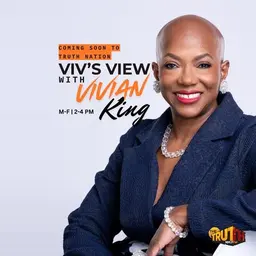
Milwaukee, it's time to energize your soul and open up your mind.
I just have a joy for life, and so I have a joy for people too.
You're tuned in to Viv's View on 101-7 The Truth,
where
your
story is her story.
You know,
as
a
black
woman, it's
like you want to be like us, but you don't like us really.
That's right.
Yeah.
It's time to see things from a different point of view.
The thing is, that was God saying, OK, you could do this.
Yeah.
So go ahead and try.
Truth Nation, our view, your view, and Viv's view, right here on 101, 7 The Truth.
I have all kinds of friends.
from all over the world.
And so I just thank God for the
experiences that he's given me.
Now live from the American Family Insurance Studios at Third Street Market Hall on the award-winning 1017th Truth.
Here's your host, Vivian King.
And welcome, everyone.
Good afternoon Truth Nation and welcome to the very first edition of the new and improved Viv's view.
I say new and improved because I created this concept back in 2004 when I was still an anchor reporter for WTMJTV.
I was at WTMJTV for for about ten and a half years and a shout out to Bailey Coleman, Sherwin Hughes, Jazz Tyler.
The three of them had me on their shows, and we kind of talked a little bit about my career, and a little bit about why I was coming here, and just thank you for such great conversations.
We each had, you know, individual takes on what I'm doing here today, and really Viv's view is a different take on what's happening in our world, what's happening in our community, and just what's happening around us.
And I just want you to know how I think about that.
You know, I have done a few things since I worked at Channel 4.
I worked at the former Roundy supermarkets in public affairs.
I worked in community relations, lead community relations for Aurora Healthcare, the former Aurora Healthcare.
You know, there have been a lot of changes with companies, et cetera.
That's another thing that's going on, lots of changes.
I wrote an adult book called When the Words Suddenly Stopped, finding my voice again after a massive stroke.
And I have written a children's book, Grace Welcomes the Lady Next Door, book one in the Growing Up Polite series.
I also have a program for kindergarten through second graders to help them embody being polite because I think that's important.
And we'll talk about that at some point, you know, throughout the time that I have with you, maybe not today, but later on.
And I also, of course, have this new and improved show.
And I'm really excited about it.
Shout out to Cherie Harris for calling me in the first place to ask me to consider this possibility.
I was excited about that.
And then I talked to Beko Baker.
And so shout out to him for being so welcoming and sharing what you all wanted.
And then shout out to my new producer, Ben Jamin.
And we've been talking nonstop, it seems.
And it's a good thing.
We have a good relationship already, and it hasn't even been that long.
And shout out to Zach, because he's pushing the buttons.
One of the things that I said when I was coming, I was like, I don't have to push the buttons, do I?
So funny thing, he pointed at me to start talking.
And I started talking, but there wasn't anything.
Going out to you and he says you've got to push the on button.
So see I even need somebody to tell me to push the on button.
So thank you Zach I'll know next time he gave me a thumbs up So One thing that I really like about this since You know, like I said new and approved Vibes view it aired on Channel 4 Daily when it when I was there
three minute segment each day.
Now I am on the award winning 1017 the truth.
So that's new.
The other thing, the truth is giving me two hours a day.
Can I talk for two hours?
Some people say yes.
And the biggest thing is that I can be what I am unapologetically black.
I'm going to be that here and it's not even an issue.
And so, in fact, that's what we want to be because this is Milwaukee Black Talk.
So one thing, too, that has changed since I was on channel four is I am bald.
And so I know we have, you know, YouTube and you guys can see me.
So you can see I'm bald and.
You know, I've written a book about being polite and so People who are rude that is my pet peeve pet peeve total pet peeve and so You know now that I'm bald people stare Sometimes it's gotten a lot better because now I've been I think it's what's this 2026 I think I shaved my head in 2020
And so in the beginning, you know, I expected people to be surprised because I actually had a friend years ago who shaved her head because she wanted to.
And so a lot of people knew we were close and they would always kind of pull me aside to say, is she OK?
And I was like, yes, she just decided to do that.
So because of that experience.
I knew what it would be like.
You know, I knew people would be, you know, concerned.
The crazy thing is when people come up to you and they just assume that you're sick because you have a bald head.
And so they look at you with this lamented face and say, are you okay?
How was your health?
And so, you know.
At first I didn't.
I was like, why are they looking so sad?
I'm fine.
Then it dawned on me.
Oh, they see that I am bald and they see that, you know, when they see a bald woman, they automatically think that the person is sick, that the person, you know, has cancer.
And so they were thinking that and and their face was showing it.
And so sometimes, you know, I answer and, you know, share.
But other times I just let them
be who they are and act like I don't notice the difference in their faces and their voices.
But it's kind of crazy, kind of crazy.
So one of the things that happened to me, the reason I even wrote a book about being polite is because
I was at Jazz in the Park one Thursday, years ago.
In fact, really years ago, because it was back in 2007.
And I was with my friend, the one who had previously shaved her head, but she had hair at this point.
And we were, you know, walking and, you know, listening to the music.
And I think Jazz in the Park was about to be over.
And so this guy came up to me and said, oh,
You're the woman on TV and I would never think yes, of course I'm the woman on TV because you know when you're when you're on TV You don't know number one if the person is watching your station number two if they're watching your station when you are on because I wasn't on 24 hours and so I never was like oh, yes, I'm the woman on TV and so I Said I was a woman on TV and the person said oh
Well, you looked 500 pounds when you were on TV.
It took everything in me.
What do you mean by
that?
Exactly.
I said, Zach, I said, uh, you must have me mixed up with someone else.
So that's how it's going to be.
We all want to play.
Exactly.
Exactly.
And I just said, you have me mixed up with someone and I walked away and I was so mad, you know, because I'm like.
The thing is when you are when you come into someone's home through television They think they know you and so they think they can say whatever to you and so I was telling this to my friend and I said I should write a musical about it and then I said or I said I should write a song about it is what I said and I started just making up this song and so I would sing a few bars and and
keep walking sing a few bars and keep walking and then I ended it and my friend said did you just make that up and I said yeah and she said I mean it was kind of good so after that I thought oh well you know I love musicals that's another thing about me I love musicals I know a lot of my friends do not but I think you're either a musical person or you aren't
So I'm a musical person.
So I said, I want to write a musical about it.
I looked it up.
I ended up saying, OK, I'm going to write a children's book because a good friend of mine said, hey, you should if you if you want to write a musical, you should you should write a book for kids because my main character in the musical was going to be a little girl.
And so anyway, I said, OK, so I ended up writing the book and I want.
My my goal is to have a kinder society Nothing against adults, but you know adults are stuck in their ways and it's hard to necessarily teach them new tricks if you will But kids you can start with them and have them grow up polite and so that's really what I want to do because they will change society and It's it's in our kids hands
So that's why I love kids and that's why they are ripe for learning new things and some of them don't get home training that maybe I got or you got.
And so we're gonna have to work with the kids.
They'll show us the way.
The kids will lead us.
So that's my little stick about that We got a lot coming up today When we come back we're going to be talking to Drake Bentley of the Milwaukee Courier and Later on we'll be talking about it is October as many of you may know is breast cancer awareness month and so that's a topic near and dear to me and So we'll be talking about that as well because black women are severely impacted
by breast cancer, and we want to talk about that.
So we'll be back in just a
second.
I just have a joy for life, and so I have a joy for people too.
You are tuned in to Viv's View on 101-7 The Truth,
where your story
is
her story.
You know, as a black woman, it's like you want to be like us, but you don't like us really.
That's right.
Yeah.
It's time to see things from a different point of view.
The thing that that was God saying, okay, you can do this.
Yeah.
So go ahead and try.
Truth Nation.
our view, your view, and Viv's view, right here on 101 7 The Truth.
I have
all kinds of friends from all over the...
Truth Nation, it's time to give back to the conversation.
Our view, your view, Viv's view.
Viv's view with Vivian King returns now on the award-winning 1017 The Truth.
Welcome back to the award-winning 1017 The Truth and Viv's view on our very first day.
We've been talking about breast cancer and I want to at least read this to you because join 1017 The Truth for the Pink and Blue Health Summit November 14th from 10 a.m.
to 1 p.m.
at Thrive on King located at 2153 North Dr. Martin Luther King Junior Drive in Milwaukee.
Wisconsin, explore breast and prostate health resources, plus enter for a chance to win a Chula Vista Resort Getaway valued at $500.
Admission is free, but only registered guests can attend.
Every registered guest receives a free gift bag loaded with goodies, including items from supporting sponsors and vendors.
Get connected and grab your goodies.
Register today at 1017thetruth.com.
And you know, if you've been here listening to us, this is the very first day of Viv's View on 1017 The Truth.
And October is Breast Cancer Awareness Month.
And we were just talking with some people from the Wisconsin Breast Cancer Coalition about breast cancer awareness, about legislation.
We talked to some survivors.
Really, we were breaking the silence about breast cancer, and my next guest is part of doing that as well.
I have Dr. James Wu here, who is a hematology and oncology fellow at the Medical College of Wisconsin.
In addition to seeing cancer patients, he has a passion for cancer education and cancer screening and conducts research focused on cancer disparities.
Dr. Wu, thank you so much for joining us today.
Yeah, thank you so much for having me.
I think it's always nice to be in a session like this after cancer patients and survivors tell their stories.
And I'm glad that the first show has such an important focus.
So thank you again.
Well, thank you so much.
I know you have coming up, there's going to be a breaking the silence event.
And I know I had, oh, I have the flyer right here.
And so it's breaking the silence, the third annual one, gynecologic and breast cancer awareness.
And so it's a lunch and learn event.
You're going to be talking about various things.
But after having the conversation, we just had, you know,
This is Milwaukee Black Talk, and we were talking about African-American women and not having the incidence as high as white women, but dying more often than white women.
There are probably so many reasons for the disparity, but what is probably the number one?
Yeah, so I think you know when we look at the numbers, that's exactly right across
In fact, most cancers, there is a disparity between black individuals and white individuals.
And we know in breast cancer, as you said, black women are diagnosed at a lesser rate than white women, but have a higher, or almost 40% chance of dying compared to white women.
And the barriers are a spectrum, but one is there are barriers to access.
And that access starts from prevention.
And what does that prevention mean?
You know, healthy lifestyle, you know, not smoking clean air, all those things, healthy foods.
But it also means lack of access to the right screening, like mammograms, lack of access to just even seeing a primary care doctor in the first place to get connected to those mammograms, lack of access to insurance, which precludes people.
You know, we talked about the Gale Act earlier, right?
but
some people don't
even have insurance to begin with, so that's a major barrier.
And it moves even beyond that access, but black women also face later stage of diagnosis.
So because they, black women often don't have that access to earlier mammograms, good primary care, they're being diagnosed at later stages, which makes it harder to treat.
And also black women have a higher incidence or
likelihood of having something called triple negative breast cancer.
And
that's a breast cancer that is negative for three really important markers, estrogen, progesterone, and HER2.
And without these markers, which there are great medications to treat, it makes it harder to treat the breast cancer.
So that also makes the outcomes or the survival worse.
for black women that have higher rates of this triple negative breast cancer.
So it really, like you said, is a combination of many things that lead to that disparity.
And so how do we get, how do we start to tackle that disparity?
I mean, if, you know, I'm, I don't have insurance.
If I've got to, you know, work, I don't know, two and three jobs or...
Whatever the case, I mean, I don't have time.
It's not on my mind.
How do we get women to see that primary care is much less expensive than going to the emergency room and finding out, oh, I have breast cancer there?
Yeah.
I don't think there's an easy answer, and I think this is a question and a struggle that we've been battling for a long time.
And as you and a lot of Milwaukee natives are aware, Milwaukee is a heavily red-lined area where, based off where you live in the city, it really showcases disparities.
So certain areas, depending on where you live, have lower access to, say,
good health systems or good hospitals, good physicians, good healthy foods, good schools, and by association that cascades down into later stream effects.
So I think starting from investing in those areas is going to be really important to building back up the communities.
you know, it's easy to say like, hey, we need more screening or we need more insurance.
But really, it starts from even before that where we need to invest in the populations that have been underserved due to historic changes and kind of politics of the area.
Yeah.
So, you know, I'm just thinking about, you know, a woman,
you know,
who is, you know, who's
Who doesn't have that access like so where how do we invest in that?
How you know, who do we talk to the
city?
Do we talk to the hospitals?
Do we have town halls and a lot of people would say, you know We're sick of having town halls that we just talk talk talk and don't do anything Where would you say we need to start first?
Yeah, I think you know a lot of these great initiatives and
that ultimately lead to changes and investment start from the grassroots, right?
So people like yourself, people like the previous caller in the last segment who's really involved in policy, getting people together and then pushing and then bringing this information, like say, here are the disparities.
We know they've been documented for a long time and then bringing it.
to our policymakers, and then ultimately moving the needle forward.
And that's something that people have been doing for a long, long time, and it's hard work.
And slowly, we've been making progress.
I think we talked about the topic of hope in the last segment.
I want to highlight that again, because truly, there has been a lot of hope in all cancers and breast cancer specifically.
Since 1989, the amount of breast cancer deaths has decreased by 44%.
So there's been a lot of improvement in treatment and a lot of improvement in access, but there still are those gaps remaining and that's what we have to keep on pushing forward.
So
a lot of advocacy and a lot of grassroots work has resulted in improvements and outcomes across race ethnicity, but there still are those gaps that we still have to keep on pushing.
So we have to identify what are those remaining areas that still need our improvements and access and part of what we're doing and
this breaking the silence event that we're having is kind of improving, you know, the awareness of the community, similar to what this show is doing today, where we're highlighting, you know, the stories of the cancer survivors.
And there's going to be more than four million breast cancer survivors, you know, in the United States.
And that's a
testament to how
well
our.
know, medicines are doing in treatments,
but we got to get people there, right?
We don't want them to
be diagnosed late and then have really poor outcomes compared to being diagnosed early just in the breast where five-year survivals are greater than 99%, right?
We can really kind of intervene at when it matters the most if we can diagnose them early.
We're talking about
nationally, but what about Milwaukee County?
I read somewhere that Milwaukee County has an even higher incidence of breast cancer for women, for black women, than the national average.
Yeah, no, that is true.
So in Wisconsin specifically, it has the third, I think, largest black white disparity in breast cancer deaths.
When you look across a nation and then specifically in Milwaukee you have younger black women have higher rates of you know breast cancer deaths compared to white women
So I think, you know, there's, I mentioned, you know, the geographical disparities that we all know too well in Milwaukee.
There's a lot of ways to kind of upstream what I mentioned to try to target those, but you know, on the ground,
how
does that look like?
I know at the Medical College of Wisconsin, we're investing in some kind of mobile mammogram units to kind of...
get out of our siloed regions and whether that's wabatosa or different suburbs and move into areas that maybe there is a higher rate of breast cancer death because we're not catching those cases earlier.
So moving really into the community is the key to identifying where the need is the most and then really meeting the people where they are.
So moving the mammograms out of the clinics and getting into the community.
is a great example of a way that we can maybe catch.
But again, we have to pair the ability to detect these cancers with a mammogram.
But then once we detect it, what do we do?
Does that patient and individual have the means to be treated to get into a clinic to see a cancer doctor?
All of those things have to line up in succession as well.
And so are you saying, I mean, with your mobile mammograms, are you saying people, women come?
to those?
No, those
would be ideally driven around to different areas in Milwaukee where we've potentially identified higher risk of say breast cancer incidents or new cases or higher risk of people dying from breast cancer.
And so, but when you have driven those two different neighborhoods, are women coming and getting mammograms?
Yeah.
So to my knowledge, we're still in the process of developing this.
So it hasn't been driven out yet, but that I know.
especially mobile mammogram mobile screening units not just for breast cancer but also for lung cancer as an example.
They've been successful in different areas of the U.S.
and increasing uptake of screening as well.
But again that's just one example of a potential way to start combating these disparities.
Okay we're talking to Dr. James Wu from the Medical College of Wisconsin about breast cancer and we'll continue our conversation with him when we come back.
Energize your soul and open up your mind, Truth Nation.
Viv's View with Vivian King will be right back on the award-winning 1017 The Truth.
You're watching Viv's View with Vivian King on the 1017 The Truth YouTube channel.
Be sure to like
and subscribe today and keep seeing things from a different point of view.
Viv's view that is.
That was one of my favorite songs from high school.
Or maybe before that.
But today, we are putting a spotlight, not a flashlight, but a spotlight, a huge spotlight on breast cancer because October is breast cancer awareness month.
And in the studio today, at this hour, I have Dr. James Wu, who is...
a hematology and oncology fellow at the Medical College of Wisconsin.
And in addition to seeing cancer patients, he has a passion for cancer education and cancer screening.
And he conducts research focused on cancer disparities.
And I care about that because
Black women are at the wrong end of this, and we, you know, as you mentioned before, we're at the wrong end of a lot of health issues, and breast cancer is just one of them.
We don't have the same incidence, or we have a lower incidence compared to white women, but we have higher deaths, which is ridiculous.
We were talking in the break about the, you know, your...
Doctors tell you you know you start getting your mammogram when you're 40 somebody else said 45 But we talked earlier.
We know we had Keisha here who had metastatic breast cancer and she got that younger than 40 and so what do you say to those women who Are getting breast cancer at a younger age below 40 sometimes in their 20s How do you even detect that and how do you how do you how do you get?
around that.
I think there's two important takeaways from this conversation about people being diagnosed young.
The first is that one in 10 women who are diagnosed with breast cancer are actually diagnosed under the age of 45.
So that's still a large number of women, right?
And the screening guidelines that we have in the United States really start around age 40.
That's when most insurances will start covering mammograms for women.
And it's true that when you have a family history of breast cancer or other cancers, you're at an increased risk of breast cancer.
But in fact, 85% of women who are diagnosed with breast cancer don't have a family history, right?
But that still means it's important to talk to your family, right?
Oftentimes as a community, and this is true in the Asian culture, but we don't often talk to our families about...
Cancer like our grandparents our parents about their health history
But it's
important really especially for cancer to talk about your health history your shared health history if your parents if your grandparents if other relatives have a history of breast cancer It's important that you know because this information could be crucial for you to share with your Primary care doctor that could potentially allow you to get screening earlier if you're at a higher risk and I think
I heard Akisha and, you know, the other guests mentioned before, how do you know if you have breast cancer or get concerned if you are below that age of 40,
right, where
the screening starts?
And I think it's important, as she mentioned, to know your own breast, right?
So
know what feels like normal, right?
Are there new lumps and bumps that weren't there before?
Is it asymmetrical, only on one side versus the other?
Are you having abnormal discharge, abnormal pains?
Are things not aligning with what you've been known to be normal?
So that just means that we have to keep more cognizant of what normal feels to us and have a good idea if things are changing.
And it's okay to bring up concerns to your doctor.
In fact, that's what we're here for, right?
If you
have any concerns, you know, we want to hear them from you when you come visit us or even if you send us a message through the application, like, hey, doctor,
I'm concerned that my left breast there feels like maybe there's some bumps.
Can you, can I come in and get it checked out?
Happy to see you.
Happy for you to come into clinic to see us, right?
I do that all the time.
You know, something's happening with my body.
I'm like, doctor, I'm emailing my doctor saying this is happening.
And so I got something, you know, just recently.
And so.
Yeah, people need to do that.
But they need also need a primary care physician.
And so they're not, you know, if you don't have a primary care physician, you're not even doing that yet.
You know, so we got to get we got to get women to how do we get them?
I mean, there's there's some, you know, federally qualified health centers, you know, various people, organizations that provide free, you know, clinics.
You know, my church even had a health talk and a health
event this past weekend and one of the mobile breast mammogram Vans the mobile van was there and and they were doing various things and so you know I think those kinds of organizations try to fill the gap but you know how we there's a dire need to get more people seen and To let them know this is you need to pay attention to your health now.
Yeah, I think
It's twofold.
One is on the side of the people being affected, those patients, those individuals, and increasing awareness.
But let's not move the blame on the individuals.
There's a lot of system factors.
We
talked
about
lack
of insurance, lack of even access to primary care, lack of sick leave from a job.
You're getting sick, but you can't take off because you need to pay for rent.
You need to pay for food for your children.
There are all sorts of protections that necessarily preclude.
On one side of it, we can do cancer awareness education and help improve the understanding of our community for why it's important.
And for those people that have the means to get connected with a primary care, or if they're already connected, start asking those questions or get this grading.
Maybe they didn't know that they needed.
That's great.
We've kind of bridged that gap.
But then there's other gap.
that we're still not bridging just by providing the education, right, which is to get people that maybe they knew they needed this, but they can't actually get this grading because they can't pay for it.
So the first part of that question is what the Breaking the Science event, which is on Wednesday, October 14th, is at MATC.
It's from 11.30 to 1.00 PM, and it's free to all.
There's actually a virtual option, which is great, as well as an in-person option, which with lunch provided.
And we hope to see you there.
And the focus of that event is, you know, I'll be speaking a little bit with my colleague about some statistics like we've talked about today, talking about breast cancer, as well as gynecologic cancers during that event.
And then we'll also have survivors share their stories.
Akisha actually shared her story last year.
And she's invited some of her other ABCD mentors to share their stories this year.
So
the
other part.
aside from that is getting people connected to those resources.
A really great program that we have is the Wisconsin Well Woman program.
They
provide free screenings for mammograms, as well as pap smears for cervical cancer.
So there are resources around, but again, those resources are not necessarily known to all, right?
So also spreading the word
on.
But you'll be talking about that at this breaking the silence.
Yeah, exactly.
Yeah.
And it's free, everyone.
It's free.
It's Wednesday, October 14th, 1130 a.m.
to 1 p.m.
downtown Milwaukee campus of MATC, room M605, or you can attend virtually, and how can they attend virtually?
Yeah, so if you look at the Medical College of Wisconsin Cancer Center Facebook page or LinkedIn page, there should be a post with the flyer, and there's an RSVP link.
Alternatively, if you find me on LinkedIn or whatnot, you can DM me and I can send you the virtual link.
But once you RSVP with the flyer online, then we'll send you a virtual link that you can log
into.
Got it.
Dr. Wu, thank you so much.
We could go on and on about this, but I love that breaking the silence is free, that people can come.
It's an hour and a half, so that's not too long of a time.
You can get the resources that you need.
and hopefully get the help.
And even if, you know, if you, you can tell your friends, you can come and share the information with other people, just somebody in the family and the circle needs to get the information.
So thank you so much, Dr. Woo for joining us and being on my very first Viv's view on the award-winning 1017, The Truth.
We'll be right back.
Every story deserves to be heard.
because your story is her story.
Viv's view with Vivian King returns after this on the award-winning 1017 The Truth.
Truth Nation, it's time to give back to the conversation.
Our view, your view, Viv's view.
Viv's view with Vivian King returns now on the award-winning 1017 The Truth.
That's my boy Prince all my friends know I love Prince and group some of my people that aren't necessarily my friends know I love Prince So I love Prince, but that's a story for another day Are your finances low is your mindset off-track or are you simply ready to get into real estate?
Well mark your calendars and don't be late tune in
to On The Journey with Coach Erica Saturday, October 17th, from 11 a.m.
to noon on 1017 The Truth.
It's all about mindset, money, and real estate, helping you take the next step toward building a better future.
We have been talking about breast cancer because October is Breast Cancer Awareness Month, and we've been breaking the silence.
which you heard there's an event coming up on the 14th from 11 30 to 1 p.m at matc the main campus downtown campus and one of those people who will be there is valencia brown phd she's the dean of community and human human services pathway let me say that again she's the dean of community and human
services pathway at Milwaukee area technical college and You know, she has a long and distinguished record of leading everywhere.
She goes But breast cancer does not discriminate does it dr. Brown
Tell
me about your journey.
So my journey 11 years ago.
I was diagnosed
with breast cancer
in my
right breast
My journey started because MATC had an event to get more women to get tested and get their mammograms and they were given the way a $25 gift card.
So I wanted that gift card.
So
I decided
to- Thank God you wanted the gift card, right?
I always
say that gift card saved my life, but I had two surgeries.
I did six weeks of radiation.
and to Moxican for five years, and last year when I did yearly checkups, twice mammograms, I called the machine, I had to get in the machine.
So every year I had to do that, but last year my doctor told me I was 10 years cancer free,
that she was done with me.
So yes, praise God.
But because you wanted a $25 gift card, that is why you were able to find out that you
hand breast cancer.
Yes.
What would you tell people who women who are you know who don't know enough about breast cancer?
I would tell them whether they think that it could happen to them or not get tested no matter what go and get tested because you just never know and you know you may think you find you may think you're feeling fine because that's how I was feeling but they should definitely go and get tested and take a friend with them.
And so did you have what stage were you when you
I was
in stage one, which was, which was a good stage.
The
doctor told me that, you know, if there was a cancer that I wanted to have, it would be the one, but nobody wants to hear the C word at
all.
So it
didn't matter what stage I was in.
It was still cancer and you
got to take it serious.
I was going to say, and the fact is you didn't, you didn't even think there was anything going on.
I did not.
I didn't think anything was going on at all.
And then it got real when I went in for the mammogram and they told me to come back.
for the biopsy, so then
I
started to get nervous, and then they told me that I had cancer.
Early detection is so
key.
And so, this is the third annual Breaking the Silence.
Well attended, or what are you?
Oh,
it's very well
attended.
The room is always full.
Many of the same people come back, but each year you get some new people, you know, no matter how many times people hear your story.
it's still something that needs to be said because women really need to get out there and make sure that they get tested.
So yes, it's
well attended.
And the thing is we don't, we just, I think we have amnesia as human beings.
You know, something happened to us and, you know, it's serious when we talk about it and we find out about somebody else, but then we go on about our lives and then we're not thinking about it ever again until something else
happens.
And then for me, it's like every time I go to the doctor for a checkup, it's always stressful because once you are diagnosed with cancer, for me, it just sticks with me and it makes me really nervous each time I go to the doctor.
Well, I was going to say because of the fact that it can recur and has in several people.
And so praise God that it has not in you.
Right.
And we'll just continue to keep that.
you know, Dr. Wu was talking about the disparity and how black women are more likely to die, 30% to 40% more likely to die of breast cancer than white women.
And so we got to see about ourselves.
We got to
see about ourselves.
We got to keep talking about it, get ourselves out there, support each other and go to the doctor.
And self breast exams.
We didn't talk about that earlier today, but...
That's where it can start, because if you feel something that's abnormal, that's not regular,
you should go to the doctor right away.
And I do self-rex exams regularly, especially since I've been diagnosed.
When my doctor told me that she didn't want to, she didn't need to see me anymore because it was 10 years, I still wanted to go because even though I'm feeling myself, she's the professional and I still wanted that security
blanket.
So I
still go, you know.
to get by mammograms and make sure I'm checked.
But people, you have to get checked.
And if you don't think you know how to do the checks, there's all types of pamphlets and forms that they will show you how to do your own self-check.
They probably have a YouTube video about.
I'm sure they do.
I am
sure
they do.
You can find anything on YouTube.
You can.
So when you say like regular, like how often do you should you do a.
Well,
every day when I'm
in the
shower, I always feel to see if I feel something different.
Because for me, like I said, once you're diagnosed, you have that worry.
It may not be something that worries you and eat at you every day.
But for me, it's very important that I check myself every day.
And I think all people should, because you just never know when it may occur.
I
mean, I'll tell you.
I don't do it every day, but now after this talk, I'm gonna make sure, I'm like, oh yeah, I should think about it.
You know, maybe once a month, I don't know.
At
least once a week.
I
know, okay, okay, bad Vivian, bad Vivian.
Okay, once a week, at least.
At least, at least, at least, at least.
I just, you know, can't...
I just can't tell you enough how important breaking the silence on breast cancer is because so many people just forget about it and they don't think about it and sometimes it's not gonna happen to me or do you have that with people?
I think that people just don't think about it.
I'm sure people think that it doesn't happen to them.
After
I
was diagnosed, I have a sister that's five years younger than me.
She was diagnosed two years after I was diagnosed.
And then
I have a sister that's two years older than me.
And she was diagnosed last year.
And she had a different kind of breast cancer than I did.
And she
didn't have an
early stage.
So she's still going through her treatments right now.
We talked about this with some of the survivors earlier.
One survivor has metastatic breast cancer, which, you know, there's no cure.
But I asked her, you know, I said, the fact that you're here gives people hope for, you know, after diagnosis.
What would you say about hope for after diagnosis?
And I guess I said I was gonna ask this to...
To the audience if you want to call in and give us your Your thoughts or if you have an experience you want to share with us.
I'm talking to dr. Valencia Brown She's a PhD a dean of community and human services pathway at Milwaukee area technical college But breast cancer does not discriminate and no matter how good of a leader you are you you got it But you're over it
right and when you were talking about hope
I say never give up, never.
You just never know.
It's something that you really, this is a fight that you really have to fight.
And the longer you fight, one of the things that the doctor told me, he was like, stay focused and stay positive and don't be stressed.
Now the stress is hard,
but
that's one thing that changed about me when I was diagnosed.
I said, I'm gonna stay positive.
I can't succumb to this.
And I think if you stay positive, especially during your journey,
then it's just, it's easier on you and it's easier on the body.
How do you deal with your friends, your family, people who know you've had it, they come up.
I mean, I was telling somebody, you know, before because people see my bald head and think that I have cancer and they come up and, oh, are you okay?
I know you don't want to deal with that.
I don't want I didn't want to deal with that.
So when I got diagnosed, I didn't like my co-workers.
I didn't tell anybody.
Nobody knew that I was battling cancer.
I didn't tell a lot of my family members.
I didn't even tell my daughter.
My mother eventually as it got closer to the surgery told my daughter.
And that was a mistake.
I should have made sure that everybody knew so that they could give me support.
I needed that support.
If I did it again and I don't wish to have it again, I would make sure that I have that support because looking back on it, I just needed that support.
And then the last day of radiation, I
catered
in food for my staff and they said, what are we celebrating?
And only thing I told them was life.
And eventually they found out, but I never
told them at that moment.
I will say that I had a really good friend who passed away from cancer.
her husband called me and told me she had passed away.
And I was like, what?
Wow.
You know, I mean, it was just traumatic because we were about the same age and she had cancer, but she told her family.
She does not want anybody to know because she did not want people to feel sorry for her.
And I know that's, you know, we were upset about that, but.
You know, she at least had the support of her family, but she didn't want anybody outside to feel sorry for her.
And I'm sure a lot of people feel that way.
I'm sure a lot of
people feel that way.
I guess we're always
taught
to be strong.
And so sometimes you just need people.
So
just because you need people doesn't mean you're not
strong.
Exactly.
That you're just
getting some support that
you, you know,
more support than you normally would have received at any other time.
We all
need support.
Definitely.
Tell them again about breaking the
silence where to come.
Breaking the silence is at Milwaukee area technical college to downtown campus.
It's going to be in room M605.
The doors open at 11 o'clock.
The event starts at 1130.
There's going to be a lunch.
There's going to be some females there telling some good stories.
And I want you to know just because you're a male and you're listening does not mean you do not need to come.
We had a room full of men at
whether it was supporting somebody who had breast cancer or knowing someone who had breast cancer.
And men can get breast cancer.
So men were in the room.
So don't think just because you're a male that you're not welcome.
You are.
Everybody come out.
It's a good event.
We all need to learn.
Dr. Brown, thank you so much for coming in and talking to us.
Thank you.
And I'm so glad you are cancer free.
Thank you.
Thank you.
We'll be right back to wrap up on.
Viv's
View.
Viv's view.
Viv's view with Vivian King returns now on the award-winning 1017 The Truth.
So we're back with Viv's view.
Viv's view.
Let me enunciate that a little better on the award-winning 1017 The Truth.
And you know, we had one caller, but she was part of the Wisconsin Breast Cancer Coalition, and I kept forgetting to give you all the number.
The number to call is 833-212-1017.
So we've got, you know, a few minutes left.
So if anybody wants to call in and chat, that's great.
But I just wanted to, first of all, it's been it's been cool.
You know, I got some little gifts here.
I got one extra gift.
Sierra came down from she's part of management and she came down with a beautiful plant.
I love it.
So thank you, Sierra.
You know, we talked a lot about breast cancer because
you know, as I said, one in eight women will be diagnosed, will develop breast cancer during her lifetime, and it's personal because how many of you out there either have had breast cancer, you know somebody who's had breast cancer, you've been through it with someone, we all can know, I mean, we all can probably say that
we have been impacted by breast cancer.
And it is a scary thing.
My friends who have had it said that they heard what we call the C word and then they didn't hear anything else that the doctor said.
And for black women, it's...
You know, we have horrible outcomes.
Breast cancer is the most commonly diagnosed cancer among black women in the United States, and it remains a major public health concern.
An important distinction is that although black women have a slightly lower overall incidence of breast cancer than white women, black women are significantly, significantly more likely to die from the disease.
Our mortality rate with breast cancer is horrible.
We need to pay attention.
We talk to people who are trying to change things and make things better.
But it's tough.
It's tough.
833-212-1017.
Now, I don't want to forget the men because there are some men out there who have developed breast cancer.
I need to find those statistics.
Zach, can you find those statistics for me about men with breast cancer?
And so we can't leave them out because they need to be a part of the conversation as well.
You know, we just think of breast cancer affecting women, but it can affect men.
About 2,670 men are diagnosed with invasive breast cancer a year.
And I'm sure they probably don't want to say anything, you know, because society thinks breast cancer is a woman's disease.
But they're out there.
Breaking the silence is trying to break the silence.
You need to have people with you.
You need to know about it.
You need to know the resources that are out there.
Yeah breast cancer awareness October the whole month, but you know, we want to make sure that We keep the conversation going even beyond this.
I know we'll have other things I won't be talking about breast cancer for the rest of the month because there are other things domestic violence month is October as well.
We'll be talking about that because that's something that I
Hey, Kyle.
That's something that I am very intrigued and, you know, dismayed by as well.
Tomorrow is Tuesday, October 13th, which means we are, what, three weeks away from November 3rd?
And so voting is very important to me.
As a kid, my parents used to take me to the polling place when they voted and instilled in me how important our voice is through vote, through the vote.
And so many of you out there don't think that's important.
And I think it is.
We'll talk about why it is.
We'll talk about some of the issues out there.
My good friend.
Michelle Bryant will be joining us and she knows all things about voting and She's over the social action committee for my sorority Delta Sigma Theta Milwaukee alumni chapter.
So she'll be talking about that We'll talk to some others as well.
We're doing a countdown to midterms countdown to midterms.
And so each Tuesday we'll be talking about that
As I told you, I hate rude behavior, so each day I'm gonna hope that I instill some kindness in you.
And you are showing me a lot of kindness on YouTube, so thank you so much.
Christina Candy Classy Girl said, welcome, thank you.
Maybe Shannon, hey, maybe Shannon, I was listening to you guys.
Althea, thank you so much.
You and Berea sent this to me.
I appreciate it.
Ray Nitty, thank you so much.
And you said you were gonna, I didn't see you sit, you didn't stay for the whole show if you stayed at all.
But I appreciate you wanting to see how I did today.
And I hope I did you proud.
Day one of Viv's view on Truth Nation.
Welcome to Truth Nation, Curly Q227.
I love it.
Daryl Fortune, thank you for saying congrats.
Congratulations Viv, an excellent start to the new and improved Viv's view.
Gwen is a, she's biased because she's a really good friend.
So she was with me when I was initiated into the illustrious Delta Sigma Theta Sorority Incorporated.
22 days will come quick.
Yes, 22 days until elections.
And so what did we learn today?
We learned a lot.
We learned that breast cancer, one in eight women will be diagnosed.
We've learned about an event tonight that will support that, that I'll be bartending at at the Fister at Blue.
And my tips will go towards breast cancer.
And then you also heard about breaking the silence.
And you can go and learn about resources there as well.
And we also had the weekend views with Drake Bentley of the Milwaukee Courier.
So he'll be here every Monday.
So you can hear us talk.
I see Linda Graves says, congrats Viv from your family in ATL, the ATL.
Althea says, great story, Dr. Valencia.
And we're gonna be having great stories about all kinds of topics.
And I don't know what your view is, but when you come to 1017 The Truth, the award-winning 1017 The Truth, Monday through Friday from two to four p.m., you will get Viv's view.
Have a great rest of the day, everyone.
It's been great.