Milwaukee's Unsung Heroes: Unveiling Community Resilience

Transcript

Milwaukee's Unsung Heroes: Unveiling Community Resilience

Say Something Real · Tue Sep 15, 2026

Yeah.

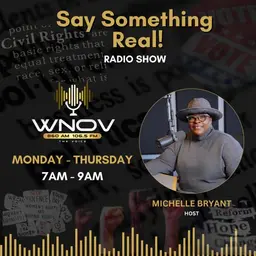
Good morning. Good morning. What's happening family? Welcome to the show. It is Michelle. Brian here. WNOV 860 AM 106.5 FM. You are listening to say something real. I don't know where my music was this morning. I'm in protest. I am in protest. But

We gonna do it anyway. Uh, yeah, you know, fired the band. So that's what happened. Every time I was listening that morning, Michelle, when you was like, we don't like when they both.

I was just getting ready to say it. I was just getting ready to say it. And y'all know why stuff is off. Because D-Mo is here. So just mess up the whole board and it's all overcast and just dreary. Because somebody showed up. I don't mean any of that.

Good morning. Good morning, bros. Uh I see you got your your your whip hanging down. Hold on. You know, I'm trying to look like black Jesus up in here. Like the Lord will make a way. I see you in particular locks in that twist to do. Uh I figured I'll do something. Uh I'm just saying this is uh unusual for you here to be down. It's unusual. Don't don't do

Who's that? Tom Jones? Tom Jones. Don't do Tom Jones. It's not unusual to be loved by you. That's it. Really. Oh, I'm just saying not used to it. How are you feeling this morning now? Well, you know, sale today is Tuesday. At least that's what they tell us.

Can't believe everything they tell us. I'm sick of you. I'm just saying. I am sick of you. You know, the morning started off kind of dim, you know? Did it. I asked the Lord to turn up the lights, man. Okay. And you think you think you got hurt? Well, I didn't ask him yet. Oh, you're going to ask. But I'm going to petition him in about 20 more minutes. Petition. That's it. Lord, please send the light because I just don't operate well. The one is

You know the one that's demo side. Okay. Okay. No, I just don't have the energy that I need. Hmm. All right to run on and see what the end gonna be. I need sunlight. All right. Well, I'm moving past you. Hey. Hey, Debo. How you doing this morning? I'm good. Back to you.

But I'm just gonna say, well, we got a lot going on this morning, packed show. I got guests coming in this morning. And I think one of the conversations you all will be extremely interested in, homegrown young brother, that there is a documentary that is being done about, so we will have that conversation. But you know,

Just a couple of things before we get rolling. What was it? A little boozy in town not too not too long ago. OK, OK. So if anybody has his number, you're going to tell him you can help him get a part.

I got, I got a bridge I want to sell. I don't even need $600,000. I mean, I'll do it for $200,000. I'll do it for $200,000. But my son is going to send this to me first thing this morning, like it's breaking news. You're a player. You might want to talk about this for what? I've talked about it before, but Louisiana rapper Torrance Hatch, a.k.a. Bootsy Badass.

appeared on CBS in 60 minutes to say that he had filed a precedent setting arbitration, claim against conservative political operatives, Jack Berkman and Jacob Wall, seeking a partial refund after paying them $600,000 upfront for an unfulfilled presidential pardon.

I mean, first of all, it seems that there has been a pay to play situation going on with this White House, with this administration for a while. And some people know how to play the game well, and others do not. Some people took advantage of the perceived, the alleged play for play activities and

Potentially these two guys had no connection to the White House at all. They just saw a sucker coming. I'm not sure. But I do want to unload this bridge, this real estate that is existing only in my head. I don't have a actual physical location I can send you to. But, you know, I hate to say it.

But when we think we can play the games that other people play You didn't get somebody almost a million dollars Almost a million dollars now you not on paper You trying to get a part which means that you have completed all the terms of whatever your your sentence was Now I don't know if you potentially

If this can be listed as a crime, because it's interesting because you're trying to bribe a government official. You were a party too, because there is nowhere where you can legally go onto a portal or a website and pay a dollar amount to be able to get a presidential pardon. This is illegal. I don't care how you look. Let me just say this. This is ethically challenged. I don't care how you look at it.

So, to be able to now say, I'm going to sue you because y'all took my money and I didn't get the pardon, but sir, there's nowhere where you can legally pay money to have a pardon considered anyway. Yes, Jermaine? Unless, unless this was the stipulations to the pardon. What? What stipulations? Well, we can get the pardon done for you.

But it's going to cost you $600,000. I mean, that's one thing if you're working with an organization who says we charge a service fee to be able to help people go after parts. So for our time, filing the paperwork, helping you complete the application, that's one thing. Right. Now, what I'm trying to say is. But how you sell it. It's a loophole. How you sell it is the issue. And that's what I'm saying. It's the loophole because

Again, you gotta look at this whole debacle that's going on in the White House. You got this dude selling Trump shoes. He's selling phones. He's selling Bibles that people have never gotten thus far. These cell phones and things like that that he promised. So it's about money because it's all about that had paid for these phones and they haven't received it.

I think it was like a hundred something thousand something like that that was out here or like a million something like that I don't want to quote the numbers wrong When I write I have to pull it up again, but these people haven't received they phones They're asking where are the Trump phones? The Bible that this dude created that he was selling the shoes that he thought that would You know go over well in the black community And then you have

And he know that these black rap artists have money from whatever they're doing, if it's from the industry or whatever. So if you can present, hey, I mean, I can get you out of trouble, but just give me this right here and I can make it happen. These are the loopholes that they are running in that we can't play. I'm just saying we got to be smarter. You know, they were talking about that since Donald Trump has been in office in less than two years.

This man's wealth has increased by 2.2 billion dollars. His son, who just, we are now finding out because of a news article on ProPublica, had portions of his elaborate wedding for only like 50 people, paid for by someone who is, you know, a sidekick of Vladimir Putin, you know.

President of Russia was actually at a meeting in China with Vladimir Putin and You're paying a hundred and something thousand dollars to rent the island where this you know private wedding was had You're paying for the fireworks. You're paying for this. I think all toll is over three hundred thousand dollars That some random dude who has a criminal record who?

It has a whole bunch of challenges and is connected to again These Russian bad boys, but you know and I go back to the hunter Biden drama and Did hunter Biden try to get some people a meeting with his dad and it was a phone call and Joe Biden said hello

And all of that pales in comparison to what we see in front of us. And yet crickets, for the most part, crickets from Republicans who had so much to say about illegal servers when Hillary Clinton.

Was running for office and yet Donald Trump steals classified information and would not for him running for office again He probably would be in jail for stealing classified documents, but you run for president and all your criminal investigations go away You know, I'm just saying at some point when do you get physically sick of?

all of the hypocrisy and the double standards that we are seeing right now. Like literally raised a boatload of hail about what Hunter Biden did or didn't do, utilizing the power of the office of the presidency and his daddy and those connections. And yet you got Jared Kushner, you got Don Jr., you got the whole Trump clan, the daughter-in-law, sounded all like a greedy money. I'm just like,

There's nothing wrong with the friend doing something for a friend There's somebody you met two years ago So somebody you met two years ago was dropping three hundred thousand dollars on a wedding for you Stop playing with people The most crooked These are the most crooked people ever these are the most crooked people ever and

You got people who were charged with the responsibility to make sure that the American people are covered and protected at all times and they are either complicit or they're willing to look the other way because of their own individual gains and what they want.

But when you say have somebody come into office saying I'm here to drain the swamp and now the entire Country is a freaking cesspool. There isn't a swamp anymore all of it is mired in in in Backroom deals and money and you know Jermaine talked about the Trump phone. I mean like think about that

You got somebody sitting in the highest office, not just in the land, but potentially in the world and you're using that position to hawk cheap items like you some freaking sideshow circus salesman. I mean, the phones. People had to pay $100 upfront to preorder. They take a year to get delivered.

And then when they get delivered, there are problems. And then he told all these people they were going to be made in the USA exclusively. Portions of the products are not made in the USA. As with every cell phone that we touch. So I know I jumped right in this morning because like I said, I got guests coming into the studio. But when I say.

As the news stories were breaking yesterday, and you just had to sit there with the level of disgust, particularly, you know, and I didn't really get into it yesterday, but Trump had been asked about reparations.

And he talked about how this country couldn't afford to pay reparations for crimes that people today didn't commit. That was basically the gist of what he said. So, A, we acknowledge their crimes, and there is no statute of limitations on murder. Just want to be clear about that. And while there are statues with limitations on civil suits and what can be done,

I just find it amazing that I can bribe people with a $5,000 payment if you help Republicans maintain control of Congress, but you don't have no money. And we got $400 million to do a damn bar room. And we got $150 million to set up a UFC fight. And we got

$200 million to set up a damn race car track in the middle of DC. But we don't have no money to address the things that we did that were illegal and murderous in this country. We'll have no money for that. But we got the money to build a freaking golden arch like we do in one half of McDonald's in front of the damn Arlington Cemetery.

And we got money to put gold gilded frames around pictures and on furniture in the White House looking like some mess from out of the 18th century We got money for all of that. We got 18 million dollars 14 million dollars to spend on a reflecting pool But we don't have no money to make it right for putting people in bondage and still in their lives and killing them. We'll have no money for that We'll have no money for that

Do these people hear themselves? Do you hear yourself? Do you hear yourself? Because I hear you The only thing I say I have found myself doing more and more and Jay I saw you I'm coming but the thing that I have found myself doing more and more and more, you know

And I'm a history major. And I often think about the conditions of African Americans coming through the Middle Passage, what it was like to be here, being enslaved in the early aspect of the years of their lives in this country. But I'm going to tell you something. The amount of frustration, sometimes outright anger at watching.

the hypocrisy and the double standards and that we're going to dismantle black history and it's a dirty word to say diversity equity or inclusion. It's a dirty word.

To talk about fairness, you know, you try to question the the competency of black professionals in workplaces CQ Brown whose you know military career is is to be modeled after versus this damn drunk we got running the Department of Defense right now. Oh wait the Department of War cuz y'all ignorant. I mean like

The frustration that you feel and then I have to try to take that and say but what what so I realize that every day I Have no clue what those people went through back in the day because I can barely stay in what I see today

the inequity, the injustice that, you know, Charlie Kirk, oh, if it was a black, you know, the plane goes down or the plane has, you know, mechanical failures. Oh, I wonder if it was a DEI hire. And people, then we go erect flags and monuments to the races. Like, I don't know what it was like for folks back in the day. I keep saying, I don't understand.

Because this little bit and this that we are dealing with today is nothing compared to what black folks went through back in the day. This is nothing.

Us trying to argue with you know Donald Trump about whether or not you're gonna stop ballots at the post office Versus showing up to a polling location to vote and somebody putting a bar a jar in front of you with jelly beans in it and saying Tell me how many jelly beans is in the jar before we can hand you a ballot What we are dealing with today pales in comparison. Don't get me wrong. It's not like it's not serious It's not like you know, it's not an injustice. It's not like it's not, you know, just just um

Unjustified it's none of those things. I'm not saying any of that But when I tell you it is the stuff that I'm watching today that gives me a deeper respect of the black folks that went before us

the stuff that they endured and that they they managed the way to keep their head up and to stay pride, you know, proudful and they found a way to be educated and they found a way to open doors. Y'all, when I tell y'all, I understand every day that the damn people that I'm cut from is some of the baddest people on God's earth. And this is a reminder to me of who I am and where I come from and who I belong to.

I don't care how frustrated I get now. I have to remember people endured way more than we going through and they figured out a way to fight. We have tools at our disposal. We have opportunities to be able to be in these rooms and play on these fields and level this mess if we step up and we do that.

So as you are sending your kids to school this morning, we need to have these conversations with them so they understand the way we came up out of all of that is because we all understood the assignment. Now everybody didn't participate.

But the overwhelming majority of us, we knew the assignment. When we went to school, we knew the assignment. Education was the key to flipping the script on a lot of this nonsense that goes on in our community. We understood the assignment. When you send your kid to school, and I see a yellow school bus out this door right now, many of y'all are not helping your children understand the damn assignment. It's an assignment.

All right. Now I got that off my chest. I got to take a break. It's Michelle Bryant, WNOV, 860 AM on 6.5 FM. You listen to say something real, I'll be right back. And I actually referenced the fact that the topic this morning centered around a hometown, you know, brother, someone that many of you will know very well once the conversation starts. But let me, let me start here.

A lot of people don't know that my first name is Cordelia. And I remember as a kid, being young, asking my dad, like, you know, and my mother, you know, like, for real, that gave me this old lady name, like, why is this a thing? And

Cordelia is a character in William Shakespeare's play, King Lear's youngest daughter. And she is fiery and stubborn and independent. And, you know, so the more I learned about the character, the more I was like, okay, I can see that, you know, or my people were foretelling my future. I don't know. I don't know if you grow into the name or if the name, you know, just ultimately begins to fit, but.

That also reminded me of other conversations. I've had regarding Shakespeare because Just studying over the years I came I became familiar with this phrase and Heavy is the head that wears the crown. Okay. Now That is a modern variation of this line from William Shakespeare's play Henry the fourth part two

And the original line says, uneasy lies the head that wears a crown. And they were talking about the fact that King Henry IV had many sleepless nights because of the immense anxiety, danger, and lack of rest that came with ruling a kingdom. So modern day, fast forward to today, I have definitely

heard the phrase use more than once in relationship to the young brother that we have in the studio with us. Mr. Von May. So let me start first of all by saying good morning, bro. How are you doing this morning? I'm sorry, was that in for Michelle? Did you? I'm just saying, I think that was for me. And we are joined in studio.

by some folks that are working on a project that I think is going to catch some people off guard. Some folks will be like long overdue. And so let me welcome Mackenzie to the studio. Hello. Good morning, Mackenzie. Good morning. And Sean to the studio. Good morning. Hey, good morning. So first of all, let me set you up this way. Became familiar with this project that actually is a film.

And I'm going, I'm sorry, wait, what are we doing? And get super amped and excited. So I'm trying to figure out best way to set it up. But Sean, let me, let me start with you in relationship to setting this up. Go ahead, Sean. Oh, I thought you were going to ask me. Yeah, yeah, yeah. How do we do this? Give me five minutes to think about it.

No, how did this get started? Gosh, I don't know. I've been following Vaughn Mays for a long time, and yeah, New Elm come out in 2020, 2021, I think it was, and that was heavy as the crown. I'd seen them around for a long time.

always watched them and admired them and I think we had kind of seen each other around a lot and I knew Vaughan was a little bit familiar with my work. I was doing a lot of covering different people and events that were going on in 2010 and everything that was going on. Oh, what I do is I'm a filmmaker. I'm a director and I'm a teacher at UW-Milwaukee. I'm the program director of DACUW, which is our documentary media center at UW-Milwaukee. So we make films. I make a lot of documentaries and

I just knew that I would love to connect with Juan Mesa sometime to hear some of the stories that he's got to tell about Milwaukee and that happened. And it took a really long time to five years to really kind of flesh out all the different things, aspects that we need to get across in this film. I think we cover a lot of ground without covering too much at the same time too. So Mackenzie, what's your role on the project?

Hi. Yeah, I am the producer of Heavies the Crown. I started this film five years ago as a student of Sean's at Jackie W M. And it gave me the opportunity to get these real world experiences and real world stories to get out there and see what's going on.

And yeah, ever since then, I just graphed onto the story and wanted to. So like whose idea is it? Was it your idea? Was it whose idea? Who's idea is it? Is this your idea? Wait, because I need to get my own documentary. So the whole purpose of this, it goes back. I mean, it goes back just historically in Milwaukee. I've been a part of a bunch of films, documentaries. And I always noticed that.

a lot of the lens we get seen in and get put out as is usually attached to something negative, right? And so there are a lot of negative images, negative stories that impact how Milwaukee is seen. Of course, we all know the ills of five, three, two, or six is the worst it is the worst of that. And so I wanted to

One, have something that we own and control the narrative of, and two, be intentional about spreading more a better or positive image about the city and the things that's happening here and the people that are here. So, as Sean said, being a part of the George Floyd era protests and stuff like that, I've definitely seen him around. He's covered a lot of that stuff through film and photography.

And so just building a relationship from there. I think he worked on some other films associated with that stuff. And so I took this matter of fact, Keon was the first person I pitched this idea to when he had this building down here on Atkinson. And so I came to him and I was just saying, we need to do a film that highlights the positive things that talks about the folks that's doing the work. And so fast forward to this.

I came out with an album. Because during the protests, I noticed we don't have music that's centered around the protests, not our own music, not the people that's making the music. It's usually like a major artist will play a song and kind of force it to fit what we're doing or what we're talking about. And so Heavy is the Crown started as a music project, an album that tells the story of the social injustice here, the ills that are happening.

the families and you know the different situations and so this is like moving toward a visual visualization of those stories but also again having that that focused intentional lens of what the BBC documentary was supposed to be about originally. That was why I agreed to do that film.

They turned it into something completely. That's that size white because we were like where did this come from? And so, you know, this was an opportunity for me to be like, okay I'm gonna actually do what that was meant to do and what I've been wanting to do all this time Well, you know years ago. I had an opportunity to Read some of your work You had no book and has lyrics in it music and you I think when you were working on the project initially for the album, but

I think we were doing one of our usual dropping off either toys, food, we were doing something.

you had written something and I was just so enamored. I was like, oh my God, this is so good. And so it wasn't a surprise, because let me be clear. It's a whole bunch of it wasn't moving, but we can't put it in the paper and come up with a whole track. You know, a soundtrack to what's happening. So that's a unique gift. But I do appreciate the need to be able to control these narratives. Jermaine, you're going to get put out. To control the narratives and tell these stories.

So when the idea is pitched and, you know, Mackenzie, I'm looking at you. I'm like, you look like a freshman. I'm the producer. I'm like, what is going on? So when the idea comes to the table, is it an automatic, like, yes, let's get on board? How do you, how does all this get put into motion then? I mean, and.

There are a ton of us that don't even know about evidently this great work, and I'm an alum of UWM. This work that's going on at UWM around documentaries and film. So how does it, okay, so we got the idea, who do we reach out to? How do we get the ball in place? And how do we get these great folks at the table?

Producer, how do you come in? Yeah, going back to that, I was a student of Sean. So, Jackie Dobuem is really the foundation of it, where we started. And then as the story grew and went so many directions and got redesigned and reordered, I just stuck with it. I wanted to see the story come to its full fruition and see the impact of it and hear the conversations after the fact of it.

I would say we've had about 50 different students touch this film at some point over the course of five years So yeah, that's kind of the group that we're looking at for this and then yeah, we've got a bunch of different important conversations and

bunch of important different Milwaukee people in this that speak to these complex situations as well. You know, you know, also before you jump in, Sean, I think this, the whole, I think the key word to this is organic, right? Because because Sean specifically had been out during the protests, right? And had that connection. It was only natural, you know, having him come out to film like Farina's events at the dream team, all these different other, you know,

things that were happening, like gift drives, like they were covering a lot of that stuff, and that stuff ended up being a part of the story. So it was so much that was collected over time that ended up contributing to the story in total. It kind of just organically happened.

Yeah, jumping in, Sean, about how we actually got before Sean jumps in. So I'm going to do two things. I'm going to read something from the trailer connected to the film. Take a quick commercial break when we come back. We'll break some of this down. But heavy is the crown follows Milwaukee community activists and violence interrupter Von Mays as he works alongside individuals in neighborhoods most affected by cycles of violence, systemic neglect and contested approaches to policing. The film examines what it means to care for city from the inside out.

foregrounding the resilience and forms of care that sustain communities from within. And that's a whole lot. And it's so crazy because when you're doing it, I'm just responding. You know, you don't even...

It's funny when somebody has to come back and try to capture the work and what that looks like. So I'm going to take a quick break. And when we come back, we will get into some of the, you know, the things that are featured, the stories, the issues and the players, you know, because he said, yeah, we got some interesting folks in there. One or two, I think I may know. So let's do this. I'll take a quick break. Michelle, Brian, WNLV 868-106.5 FM family will be right back.

I don't know if they created a child, but it was an extra marital relationship. So, you know, he went to the Deacons. He said, the Deacons, man, they immediately embrace me, say, pastor, that's okay. That's all right, man. We understand, man. You just, man, God forgive you. Da da da, we're going to work it out. We support you. Me being the devil's advocate, Clark, I raised my hand and I asked the question.

I said, what if you went to those same deacons and said that you had a gay relationship? Would they be as embracing? Yeah, the crickets tell you. He would have been gone.

Now isn't that something that a double stand the difference between being a legal observer and Being in the way being someone that folks can come up and say hand me your cell phone You know and what do you do if an officer tells you stop filming or you know to step back? It's keep filming You're on this sidewalk you have the right to film now ice just grabbed a phone up in Minneapolis, so You know but as a citizen and

Under our Constitution, you have the right to stand on this sidewalk and film and observe and tell the truth. The Bible says a woman is supposed to just- I agree. But you have women who are pushing back on this idea that women has a subservient role when it comes to men.

Because the Bible's not the Bible's not telling men how to dress Show me show me the Bible where it says the mission dress modestly I Got it. I have I've always had it and I got seven sisters and the same and we didn't have to do that and we are all very successful women

even though they will make public declarations, they will, you know, issue resolutions, they will say whatever they want to. He feels like militarily that there are very few countries that can come up and come for the US. And so and on some level, he's right. Unfortunately, on some level, he's right. But people can get us more than militarily.

You know whether we talk about cyber attacks Infrastructure attacks there are ways to get us back and to shut us out. We are not invincible as a nation Even though they will make public declarations they will you know issue

resolutions, they will say whatever they want to.

Family, welcome back to the show. So I am pleased to have in studio this morning, none other than Von May's community activists extraordinaire, you know, Santa Claus starting November, October, you know, I mean, just everything, the person you call when you are in trouble, when you need housing, when you need food, there's a disaster. We need to get resources to another community, another city, another state.

and that whole concept of that you do have sleepless nights because you are, I mean, as soon as you, I would sell somebody on Labor Day weekend, on Labor Day, on Labor Day itself. Oh, I'm gonna get ready to sleep in. I'll have to do the radio and my phone rang right away. Michelle, I need help and blah, blah, blah, blah. And I'm like, come on. And, you know,

Not nearly half as many people don't want to know your number. So we were talking about some of the actual things that folks can expect to see when they come to the film and some of the people that are either interviewed or are part of the story. So Sean, before we went to break, I was queuing that up for you just to talk a little bit about what it looked like in terms of putting this together. Yeah, well, that was the interesting thing about it was initially when Juan and I started talking about it.

most people would want to, like, their story to be all about them, like their hero story, right? And that's not really the most interesting documentary. And Yvonne immediately knew that this film was not about him, but it was about all these other people that do their part in different sectors of the north side, right? So we, you know, we sit down, I think, one of the more beautiful conversations, and I shouldn't say that, but like, one of the great conversations is with him and former Senator Lena Taylor, now Judge Taylor, and I don't want to tell too much about that conversation, but...

I think you'll go away. You'll have some tears in your eyes, I think, and at the end of the film. But then we're also meeting up with Mariah Smith, who does First Day Fitts here in Sherman Park. We have Sidan Smith, who's done so much here in the community. Siquana. Siquana Taylor, yeah. Stay representative of Siquana Taylor.

And so, I mean, it's so many people you could have talked to. I don't try to figure out how you even get to narrowing down or... Oh, we were difficult. We were like, we really got to massage. How much got left on the cutting room floor? There's a lot, let's see. You know, but so what are the things, you know, like you said, I want to be able to highlight and spotlight the work that other folks are doing. So are there some central things that kind of run through this film? Are there things that will surprise viewers when we go to see the premiere?

Um, I think we talk a lot about community police relations. We talk a lot about, um, just the community issues and who's tackling those things. Talk about racism. We talk about, um, you know, specifically with, uh, with Lena, you know, um, those experiences in politics being black in the city, um, and persevering and, you know, being resilient through that stuff. Um, Sequana, we had a conversation about, you know, um,

areas that are underserved and what it looks like to bring service and resources to those areas to the point where we had some community members interrupt the conversation and we actually organically just was asking them like, what do y'all need over here? What is y'all? And what they said, we put together and they led it and we're part of it. It's so much that went into this film. And just to tell you,

One conversation we had was like three hours by itself. So there's so much that couldn't be packed into 90 minutes, right? That as I said, like there was a long list of names. I'm like, you need to get this person in here. We had it and we wrote it down to 90 90 minutes. So I definitely want people to understand there's so much more with the intent that we wanted to show that, you know, we definitely had to narrow it down to make to make it all come together and make sense. But it's a lot in there.

So now where is the film being shown? Because I've already got two people hitting me up saying where, when. So who can speak to that piece of it? Okay, yeah. So we've been fortunate enough to be accepted into Milwaukee Films Dialogues Documentaries Film Festival. We premiere for One Night Only World premiere in Milwaukee. Congratulations!

That's exceptional. Yeah, we wouldn't want it to be anywhere else but Milwaukee, obviously. But one night only as of right now for the premiere, it'll be Sunday, September 27th at 4.30 at the Oriental Theater on the east side of Milwaukee. So we only have that one opportunity to see that film.

After that Make sure that we are all there to see this. Yes, we are working on as I was telling you know, my brother's man You know, we did this with no finances. We did this essentially the only

Finances I could say that we did receive was initially I pitched this to greater Milwaukee Foundation And I got a grant for like 7,500 and we use that to buy the equipment that really started most of what the filming was done with

essentially and so I mean other than that you know after after this premiere we will have a conversation about support and trying to raise funds to get this submitted to other film festivals and other outlets and probably hopefully do some traveling because this was done I didn't even consider the concept of what we actually did touching 50 students with this project right but part of my intent the whole time was conversations even about

a curriculum, of course, having to start conversations in colleges with students about activism and advocacy. So we want to get this on the road and build it up across the country to show Milwaukee in a better light. So we'll have that conversation about support afterwards. Well, you know, the one thing I'll always tell you, because people frequently reach out to ask how they can support here. So once you figure out, you know,

the pathway forward to come back by the station. We'll make sure we put out a picture and a call that folks that want to get behind you that they can do that because it's so cool to help support something that is not in the midst of the moment of tragedy. The majority of time when I'm talking, we're trying to find housing. We're trying to bury a child and trying to, you know, it's just to be able, that's why I was talking about this young girl. She was

I think she got accepted into medical school at 17. And her mother was saying though that even though she got scholarships, stuff was still expensive. So her mom was still doing a GoFundMe. And I was like, the ability to be able to GoFund something like that, you know, to help uplift a young person who is doing incredible things and ultimately will benefit all of us. So make sure you circle back around. As you guys kind of navigate this. But what, let's talk about it though, from that student experience, from that, you know,

You come into this McKinsey. I mean, why was this the area of interest for you? Yeah, I never came to Milwaukee's again. I'm not from Milwaukee. I'm from Waukesha County. Okay, so it's new. Wait, you never came to Milwaukee? No, I didn't. No, the closest I would get was like Miller Park. What in the world is going on? Thank you for Minnesota's my where. You're up the street, McKinsey. I know, I know. That's crazy, okay. No, I can't get enough of it. There's no other place I'd rather be.

So yeah, from a student perspective, it has changed my entire idea of what community means and how we can support each other. In what way? I think we've talked about it in the film, I believe, with Saquana's portion, but just viewing Milwaukee as a whole community rather than this neighborhood, that neighborhood, that's their neighbors. How can we actually all support each other, all work together, have these conversations to do better?

Okay, and I'm blown away 50 students. So this program you're doing over here at UWM Shire. I'm sure there are young people, some older people, that are interested in like this work. What does this look like at school? Yeah, but right before I get to that, I just want to say that's kind of the cool thing about it. It's like academia, usually we're reading books, we're separated from things, and Professor Vaughn over here allows us to say that Milwaukee is our classroom.

where the students are actually really kind of loud out there as he's teaching them all about the things that they're not learning in person, right? So, so that part is really a lot of fun. But that's what we always try to do at Daki WM2 is try to get out into the community and get the, a lot of the students might be from the suburbs or maybe Northern Illinois or something like that. And, but to get them out there in the community is kind of the goal at all times. So, and what was your question? No, I mean, I think that that's for you. That's cool because, you know,

There are things I think sometimes I always wonder how hard it is to capture certain things because like you said, you're trying to make a point with this Yeah, this documentary you're trying to show something and It takes special people to be able to capture that I know I was looking at some photos by Gordon Parks recently and This photographer what Gordon Parks was able to do with a camera You know, it's lengths to hues with a pin and so it's not every eye

that can can can tell this the story or bring this to life right was was any of this a struggle because like you said you you got to cut down hours and hours to get to a 90 minute product so much of it was organic this the part that was

attempted to be intentional was the hardest part. They were like, you know, we want to go out with you and see what Comfort does on the day. And I'm like, yeah, we can do that, but I don't know how we're gonna do that. So it was a lot of like, yeah, we doing this today. Yeah, this is happening right now. So a lot of that, you know, you know, a lot of what we do is so random, right? So trying to be intentional about showcasing certain

certain parts or a day in the life type of deal that that was like the least thing that we got to do right so um but the same order that we do with the gift drive right where people come out they go through these neighborhoods that's supposed to be the worst most dangerous places right and nobody leaves there with nobody comes or leaves with that same perception right that's what we were trying to do with this film because we get such a

bad rap right but this is an amazing city there are amazing people there are amazing things going on but if you don't focus on that or be intentional about being in spaces where you can have those experiences more you know um you know more consistently than what we get showed every day then you'll miss it and i think that that's a huge disservice for our city that so many people miss

those type of experiences in our city because of the fear and because of how things are perceived, right? So, yeah, it was, it was, it was a hard experience. What was the hardest thing? Hardest thing any of you. Hardest thing about doing this.

For me, it was like not being able to show as much as I wanted to show. We had to make a film. We had to put it in 90 minutes. And I just wanted to pack so much in there, right? Because I don't want to leave people out. There's so much. We're going to release some stuff. Eventually, after the film comes out, I like some of these small conversations. Because it's a must. I know actually Voss talking about the gift drives here. He's been doing for I don't know how many years. It'll be 13 this year.

We started right here. This is where we met up at and then we went down and we went down 20th.

And I think we went, if I'm not mistaken, we went down 20 of them and then we went right to a lot of those blocks this way. So we have this area in 2020, yes. Listen, I had to go back and make a list to make sure of where all we have been before. So it's been, yeah, yeah. We've been in a lot of places people don't realize. What you mean? I mean, I'm just blown away, you know, with this that's happening in the city. And, you know, I've always saw.

and the heart of the things that you were doing in the city, but to have a uh actual documentary of the things that you're doing is great man because then um you know people can see it years down the line you know the way you wherever you know that you might be the president or something. I mean but I'm just gonna say this because this is the one thing about leadership that I have always appreciated everybody doesn't have it but you know I love the idea that while

You know, you are the feature The or you are the headliner the feature is the work and the different groups and people that are doing that because you know, how many times that we you know, just probably I I'm not able to do the things I'm doing if the community does not show up You're not able to do you can't carry all that on your back. You know, you got people running around. Okay, I'll pick up this I'll do this. I'll meet you here. Yeah, so you realize and to your point

The stories that that are portrayed frequently in the media when it comes to the city of Milwaukee I was listening to and I won't make a political but I was listening to one of the candidates running for governor who basically was trying to scare the rest of Wisconsin that you know the rest of the state will become Milwaukee and I'm like well you know what

Since we are 40% of the economic engine of the state that will be you know, we got major league baseball the NBA You know all these different things apples hockey amazing universities like there is so much to love about this city But whenever I get you know, like even remotely like something will happen

and I will be talking about it and my phone will start pinging, that outside phone will start ringing, what can we do to help? What you need? Sometimes I don't even ask the question, I just go outside and there's something out here. And so that's the thing I think being able to capture that about the city and I appreciate that you saw the need to tell that story through a different lens and that you were able to enlist some help.

and folks to come through and help make it happen. So, Jermaine, I see you. What? Go ahead. Go ahead, go ahead. No, I'm just saying, man, I'm...

Come to the

So this is gonna be in the Barbershop. Look, you can get it on CD by the end of the week. I'm just saying, or now you can just send it to their phone. Well, sorry, sorry. You know, I had to get one. I'm sorry that you had to experience that. Well, look, let's remind people one more time where the film will be shown, when we need to come out, be prepared to support. Let folks know that information.

Yeah, so it'll be the 27th at 430 at the Oriental Theater this month this month at 430 get your tickets now at the Milwaukee film who's putting this on and I also want to give a shout out to the film that's going to be player prior to us. It's going to open up. It's called Dear Milwaukee. It was put on by Arts at Large. I think it's Adam Carr and Eric Monnegro and

Marquis Mays will help working with a lot of youth in creating this film It's a six-minute short. It's gonna just like I play right before our film So please come up for that also. So is there gonna be a talk back or anything connected to the film? There'll be a Q&A. I'll do a meet and greet

So, we can get a big baller. Really? Look, I mean, where is our media credentials at? So, I can, you know, come uninvited. Say, hey, I'm media. I'm media. Can I get in, please? You know what? This is such a full circle moment. Yeah. More, I'm just gonna say, I remember when. I remember when. We'll come a long way.

So what is it like, though, before you get out of here, just to sit back and kind of see this moment? You know, I never really get to reflect. The way my mind works, we set goals, we get to them, and then it's the next thing. I think this may be a moment where this and the next launch of what we're doing are super huge things. I'm trying to make a transition to do

larger, more impactful things instead of the everyday mundane, tiring burnout stuff. And so, yeah, this is a time of my life where I'm trying to transition and phase out. It's a lot of new leaders and young folks coming up. I'm not trying to be out here.

you know, tearing myself up another 10 years. So how can I up with other people? How can I open the door for other folks and, you know, move on to some of those? Yeah, you're getting old, bro. You're getting old. I mean, because that's the first sign of it. When you realize I can, I've done that and I can be more effective in other ways. But I love the, because I always tell people to never forget that those little mundane things

is how people know you know that that that unfortunate that grind of being out here door to door you know delivering these gifts and coming into crisis and helping people find shelter those are the things that propel you to where we are today but

Also heard what you said, and this is what's so important succession planning There were other young people going with you and watching and now some of those roles They're ready to step in as you begin to do those bigger larger projects And that's the way this thing is supposed to work We're all is supposed to always be refilling refueling and bringing new blood to the table And you know and I love being able to say you know

Because I'm doing that in my own life now. I'm playing the game differently. You know, I'm moving in a different circle. Not that those other things that I did wasn't important, but there are other people waiting to do that now. Get out the way, Michelle. So, you know, I like that. I just want to thank you guys so much for including us on the media tour.

to talk about it. I will definitely be hyping this and bringing it up to our listeners, reminding them to be there. I will be there on the 27th. I'm going to have something. So is there a program that you can autograph for me when I get there? So we're working on that. We also have hopefully flash drives with the album on there and some other stuff. So, you know, for people who haven't heard the music, because you will hear it in bits and pieces throughout the film.

But I want to bring people back because a lot of people miss that, you know. And so we definitely want people to hear those stories and get that project in. I'm going to teach our brother, I need a hack. I need some, but I need a girl. We're talking about first, but we go ahead and conversation about support so we can have some of those things. We also want at some point to have stuff where we're able to.

Fund ourselves and then not have to pull from it or rely on grants and all those different stuff. So if we have stuff that we own that can accumulate that stuff for us, you know, I'm always right here with it. But definitely because there's nothing I go to if I go to Ali Sadiq. I got a bottom art somewhere go anywhere.

Even if I don't need it, I'm buying it because, you know, you in the moment. So capitalize on that. We need some merch. Yes, sir. Before we wrap, you guys don't sneak me in. I got the camcorder. I'm coming. I am so mad at you. And it's like he calls me to have this whole thing. We'll try to think about. So how do bootleggers do it today? Because no one has a DVD player anymore. I'm going to school.

because somebody got in my truck and I had a DVD and I pushed the DVD and they like almost fell out. Like, you have a DVD player. When I do music, I'll have to really remember. I'll be one of the press CDs. I'll be like, they will have no way of playing. So let me figure something else out. And you said USB, you brought my boy Keon back. I remember I was getting ready to drive home for the holidays. And I was like, oh my God, I wish I had a...

to straight Christmas music to take me all the way. I was driving from here to Atlanta. So I was like, I want Christmas music to take me from here to Atlanta. Now stop Christmas music. This was in like November. And none of the stations were going to be on yet. This dude created a USB, a flash drive for me that had 400 Christmas songs. And it'll take about five minutes.

When you said that USB, I immediately went back to there. So we're going to support this look family.

This is, you know, this dude, he has been in here many times, whether it was the man show, making us aware of the community issues. This is one of the people that I call when I need help in trying to do something for somebody in the community, we need to show up and support this project. And we want to thank the people over at UWM who saw the significance, the relevance, the importance of Beta Foundation as well for making that. GMF. What'd you say? GMF. Yeah. OK. Great. Milwaukee Foundation. Yeah. My bad for doing that.

Because you know, I thought I had a spiky moment while you were talking. Spike Lee said when he was doing Malcolm X he had to go to Michael Jordan, Oprah Winfrey, Magic Johnson to be able to complete that project because the studios would not bring like a three hour versus the two hour that it was supposed to be and that it was the community that stepped up to help finish that project. So

You know, look at y'all. All right, family. Let me take a quick commercial break. Michelle, Brian, WNOV, A68M, little 6.5 FM. We know where we will all be on September 27th. All right, we'll be right back. 17 months. There's been 24. Oh, no, wait, I don't want that one. I want that one. Hold on. Hold on, hold on. I pulled up the wrong one. I thought I had the right one.

Let me see. All right, family, welcome back to the show. Here we go.

BET hasn't been black-owned in 25 years. Robert Johnson sold it back in 2001. And ever since then, the people deciding what happens to our stories haven't been the people who understand what those stories mean to us. When we don't own the institution, we don't own the archive. And when we don't own the archive, somebody else gets to decide whether our history

is worth keeping. This isn't the first time this has happened. MTV News did the same thing back in 2024. It took the internet archive and outside non-profit stepping in to preserve almost 200,000 BET articles because BET itself wouldn't.

We have spent generations building institutions, building platforms, building our own outlets, and then selling them off the first time somebody waves a check. Every time we do that, we hand our history to people with no reason to protect it.

We have to stop treating ownership like it's optional. It's not the same for us, unfortunately. Our culture is not content for somebody else's video strategy. Our history is not a line item to cut when the business model changes. If we want our stories still standing 50 years from now, we have to be the ones holding the archive, funding the archive, and refusing to sell the archive.

So that is a sister who I get a lot of her videos a lot of people share her her content with me and And I'm gonna go back and get her name so I could share it with you guys because I'm just so used to seeing her videos

But the point that she was making, as I was sitting here having the conversation with Vaughn and Sean and Mackenzie, you know, when Vaughn talked about that he had done the work with the BBC and was anticipating that the story would look one way, but by the time it makes it to air,

It looks completely different and it's in, you know, a much more negative light than was, you know, discussed or anticipated. You understand over and over again the value of ownership, the value of being able to control content. I was listening this morning to them talking about there is a white performer

who goes by the name Macklemore. And he was a part of a concert tour and was recently put off the tour. Ed Sheeran has been doing tours and Macklemore was one of his openers. And Macklemore at one of the most recent concerts, at one point on the stage, he said Free Palestine, okay?

And there were Jewish owners of venues who did not like what he said. They've, you know, one guy, you know, and I'll get his name. He said, you know, he said other things and he can't play at our venues. And this was the thing that I thought about in terms of freedom of speech. So if Jewish people own the concert venue,

And I say something that they don't like. Um, but it's a public, you know, the public comes here shows are bought because I'm like, so you think everybody to buy a ticket that come to the concert they hear as shearing.

agrees with everything you say. So you're taking money off the door from people that you may or may not know their views. It just became this real sketchy kind of area for me about, again, who controls the narrative and who gets to decide and define who gets a platform, who gets to make money, who gets to be present. And so they made a decision to let Macklemore go.

I don't know all the statements that this owner who started rallying the troops to go out of their way to say all of these venues that were owned by a particular group that we would keep this guy out. But I'm like, I don't even know where to start. I just I don't even know where to start.

Because I'm somebody is I've listened to Macklemore the things that he talks about Again, I got to go back and appreciate every statement that they've made and trying to frame out Whatever this concern is but It is a slippery slope when you start talking about a business venue that says a person can't come Because you said they said something you don't like politically

We've seen people, some police group, disinvited a performer because they didn't like something they said about Donald Trump to perform at one of their events. And so we are seeing this new phase in which, and I shouldn't say a new phase, because politics have shut doors for people before that were entertainers.

But generally it was the entertainers that was saying I won't play here I won't come here, you know because of racism because of this because of that And I'm like looking at somebody saying, you know Business owners who didn't used to let black people come to the front door. You could come saying but you can't you can't eat here You can't use the front door You gotta give off the property as soon as you're done performing. There's some of the same people so

I'm struggling right now with what freedom of speech looks like in this country, because anything you say just about these days, somebody can call you anti-Semitic. And just like that, it's believed, it's over, you've been labeled, so you can't ever criticize Israel. You can't ever criticize, you know, all these people being displaced and killed, what the settlers are doing, that we're just really not talking about in this country.

But just killing people like you can't talk about none of that because you brought her up against being called anti-semitic That's nonsense to me You have the right to your opinion. You have the right to free speech. We allow it every day The mess that we put up with as black people that we hear other people say ain't nobody who's in a damn job for real for real behind us

and the stuff that you said, ain't no university presidents losing their jobs, you know, that they don't work their whole life in academia to get to these levels because of something you said about us or you didn't protect us on your campus. Let me go to the fall line. Hey, caller, what's happening? Hello? Yeah, can you hear me? I can. Okay, you know something.

It's hard to hear you, but speech that was just planned by that lady. I don't know. What was her name again? I'll get it for you. Go ahead. Because that was that was real fire. See what has happened here is that we've allowed unwelcome parasite. We've been the host for many years. We've allowed unwelcome parasites to come in and feed off of us and erode the black man's infrastructure.

See, the black man's infrastructure is our economy and our neighborhoods. That's how you able to move stuff and how you're able to put political dollars together. People say, y'all, y'all just, you guys never put no money together and get your own people to run for you. Or see, listen, with businesses, the business owners that we had in our communities all across the country, we could do that because especially in cities that is local and elections,

because you had an infrastructure of cash that was going on in our communities. We don't, I look at Center Street Fish Market, I drive past there. I mean, they come in, they spend good money, they make the joint look good, and I go in there and get some cooking. A bunch of other people that don't belong in this country. We sold it, the lady said it right, we can buy it. Wait, Center Street Fish Market is not black all no more? Girl, go down there and take a look. I mean, it looked good. No!

Don't get me married this morning. Listen to this year. So anyway, I didn't cause you to have no salt on them people for seven years, but we got this point. Every, every time a person waves a dollar in front of you, my granddaddy told me this because I had a bad habit. I was a hustler. I just say or whatever, you know, I'm, I'm, I'm a real, a dealer. He says, say some stuff you just can't say, oh boy. And you know something, I took that to heart and in result of that,

I've been pretty, I've made some pretty wise choices. And guess what, it's not always comfortable sometimes. Sometimes you just gotta wait until the money's come again. It's called, you got it one time, you gon' get it again. So we, that lady is right. Our infrastructure has been eroded. We've got parasites in this community that have, that have, willing me, I mean, we have willingly allowed them in. And now that we're trying to do a parasite cleanse,

nobody wants it, and especially the medicine that we're using. I mean, look, we got to use some old whitejack in the White House to do the parasite clean. I mean, and people don't want it because it's ugly medicine is coming from an ugly source and it's nasty. But we need this deal because now look, the infrastructure is gone. And then this is one other thing, Michelle. And I know you're going to hang up on this is the reason why I keep harping.

about that situation with the tax girl because that's the last of our little infrastructure that we got in our communities. It's going to be gone. Grandmom stuff going to be gone. Uncle stuff going to be gone. If you look at the reoccurring taxes and your people, especially fixed income, it won't reoccur it. It won't add up. If you got a fixed income in five years, your income ain't going to be jumping up at all if you jump up at all.

and it's going to be gone. This is the stuff I'm talking about. I ain't got nothing personal against these people, but I got something personal about keeping off stuff.

No, no, no, I'm up against the clock. That's all I gotta take a break. All right. Okay. Thank you, bro. I appreciate it. All right, family. Let me take a quick break so I can get this other color in Michelle. We'll be right back y'all. I'm choking. All right, y'all. Welcome back to the show. I just gave a lead. That's history. Fish market is not owned by black folks no more. Lord have mercy y'all. What do we be doing? Let me go to the phone line. Hey, Collin. What's happening? Jesus.

Hey, Carl. Nope. Nope. Hang on. All right. Yes. Yes. Yes. Well, first of all, the industry would be open if they were stopped taking two filets and breaking them in half and seeing you got a four piece. That's why they fly. Yeah, he ain't lying. He ain't lying. He ain't lying. He ain't lying. He ain't lying. He ain't lying. He ain't lying. He ain't lying. He ain't lying. He ain't lying. He ain't lying. He ain't lying. He ain't lying. He ain't lying. He ain't lying. He ain't lying. He ain't lying. He ain't lying. He ain't lying. He ain't lying. He ain't lying. He ain't lying. He ain't lying. He ain't lying. He ain't lying. He ain't lying. He ain't lying. He ain't lying. He ain't lying. He ain't lying. He ain't lying. He ain't lying. He ain't lying

I don't, they, we, they say, well, uh, Center Street campus, well, if you can't get two filets and breaking them, well, you expect they're going to be closed. You know what? Well, I'm, but I'm, I'm gonna say, okay, I'm gonna say that it's multifaceted because understand this, if enough of us went there and supported them, which meant that their business was popping, they might not have to do, to do what they got to do to stretch the food, to be able to stay open. By the time you get to doing that, you desperate and you stretching food.

We will go spend our money in places where people we know they don't like us. We know they don't spend no money in our community. And all they do is take, take, take, take, take. And so we don't have no problem with that. We'll go spend our money with people who we know don't like us. I'm not going to spend my money who was going to serve me to bear minimum.

I don't think they should be doing that. I don't think they should be doing that.

Okay, I don't know about being queen selling dog food. So that's not Do you have proof that this other dog food is to be clean? Okay, but we gotta be careful about what we say And it was somebody you gotta be an overweight got to do with your service what I got to do service

I'm just gonna say this and I mean it is good and bad and everything but I just know that the standard

that we hold black businesses too. And we held other businesses to those same standards. And I'm not talking about, oh, it's clean in here. Oh, you know, they got a meat showcase. I ain't talking about that. I'm talking about, you know, people don't mess with us. All they do is take our money.

And they open up whatever they can open up, whether it's hair shops, or it's these little fish and chicken joints. And half the time they hitting on black women like they think we some prostitutes, not going to contribute to nothing in this community, not going to sponsor nothing. I mean, just suck. And because you don't go open that mess up in your white neighborhoods.

Right. You come right down in here. Right. Where we act like black people don't know how to put some damn lemon pepper on fish. I keep saying this over and over and over and over again. You you you purposely just like when St. John's went the the clothing brand because I'm thinking about this because Bob Mackie just passed away. But when the clothing brand St. John's was refusing to let black women boutique owners carry St. John's merchandise in their locations.

I only own one St. John's suit and it's leather. It wasn't even that old lady knit mess that everybody wearing. It was a leather suit by St. John's. That's the only St. John's suit I've ever owned. When Marshall Fields was open, I got it from there. But I wish I would spend my money with people that don't want black folks to be able to sell their clothes.

I wish I would. And St. John's knew they had a problem, so they was tap dancing trying to figure out how to hurry up and fix it because it was black women that was helping to keep St. John's relevant. When I go to Congressional Black Caucus, just like I think was it at the NAACP conference, I don't remember if they were there, but I just went to some black conference and St. John's and their white ladies selling it was standing right there selling St. John's suits at the event that I was just at.

They usually will have somebody trying to sell St. John's at CBC I'm not shopping if you if I know because there's a whole bunch places I shop with I don't know what you doing But when I know what you doing you only in here to siphon money and take it out of our community and you Disrespectful in the way you view us see us and use that money in some cases to harm us I

I don't give no damn about how many pieces of fish I can get from JJ's. JJ's will never get my money. Because I know what you do. But we will run the list down on why we won't go to black people. But you ain't got that list going to some of these places that you know only in our community to suck up our money and they don't even like us. And you know it.

But people can be friendly enough, you know They can be friendly enough but you already know what's really going on And they don't open up these stores nowhere else with somebody's all looking food that they'll be fresh and you down here. Yeah, I ain't gonna call no names Yeah, but Charlie here, you know, that's a whole food as it now says But

People have been doing this for years to us, but we will run a black business in the ground about why we can't go there. And you turn right around and go on a store where you know these people don't mean our community, no damn good. The only reason they over here is to pimp us and take all of our money. You know it. So if I can tolerate that, how come I can't talk to these people that own this black restaurant, but like, hey fam, I want to spend my money in here, but let me tell you what's stopping me.

And all I'm gonna do is go find another black restaurant to spend my money with Because if we flood the zone in some of these black restaurants the way we flood like I don't know cuz I've been up a yard like That you can't never get on find the lack ever cuz traffic you can never get on find the lack. Yeah, traffic is crazy. It's not like we can't do this

You know, but hold people accountable. Tell them why you're leaving. You don't raise those concerns, but I just know this. Y'all take a lot off a whole bunch of other people that you won't take off black people. I do know that. I know you got to go, but I just want to say that. I just want to say this. You just made a point. These spots here, JJ's and all that other stuff that you see in the hood and in the south side. If you go out there, if you go to.

To the white neighborhood? You don't see them. No, you ain't gonna see them. You don't see them at all because you see these top notch prestigious restaurant and stuff that they go to that's four-star, five-star. Just like the main chain restaurants. You know, I'm gonna just tell y'all, like we could go on a whole revolution and have a whole bunch of money in our community because we could stop driving a million miles to go to Applebee's. We can stop driving a million miles to go to a restaurant.

how many restaurants do you go to on a regular basis that are sit down restaurants that are not in our community and not going just because we want to just go but because they're not they're not here they're not they're not you can't find one right so i'm just saying i'm not doing it with y'all i'm not i'm not doing it

Everybody got an excuse for why you let people abuse you and spend your money with them. I'm not doing it, but you hard as hell on black people, but you ain't hard on none of these other people. I'm not doing it with y'all. I gotta go. All right, family, that's the show for the day. Buzz, I appreciate y'all. Family, I'll talk to y'all tomorrow.

Yeah.

Good

morning.

Good morning.

What's happening family?

Welcome to the show.

It is Michelle.

Brian here.

WNOV 860 AM 106.5 FM.

You are listening to say something real.

I don't know where my music was this morning.

I'm in protest.

I am in protest.

But

We gonna do it anyway.

Uh, yeah, you know,

fired the band.

So that's

what

happened.

Every time

I was listening that morning, Michelle, when you was like, we don't like when they both.

I was just getting ready to say it.

I was just getting ready to say it.

And y'all know why stuff is off.

Because

D-Mo is here.

So just mess up the whole board and it's all overcast and just

dreary.

Because somebody showed up.

I don't mean any of that.

Good morning.

Good morning, bros.

Uh I see you got your your your whip hanging down.

Hold

on.

You know, trying to look like

black Jesus up in

here.

Like the Lord will make a way.

I see you in particular locks in

that twist to do.

Uh I figured I'll do something.

Uh I'm just saying

this is uh unusual for you here to be down.

It's unusual.

Don't don't do

Who's that?

Tom Jones?

Tom Jones.

Don't do Tom Jones.

It's

not unusual

to be

loved by you.

That's it.

Really.

Oh, I'm just saying not used to it.

How are you feeling this morning now?

Well, you know, sale today is Tuesday.

At least that's what they tell us.

Can't believe everything they tell us.

I'm sick of you.

I'm just saying.

I am sick of you.

You know, the morning started off kind of dim, you

know.

Did it.

I asked the Lord to turn up the lights, man.

Okay.

And you think you think you got hurt?

Well, I didn't ask him yet.

Oh, you're going to ask.

But I'm going to petition him in about 20 more minutes.

Petition.

That's it.

Lord, please send the light because I just don't operate well.

The one is

You know the one that's demo side.

Okay.

Okay.

No, I just don't have the energy that I need.

Hmm.

All

right to run on and see what the end gonna be.

So I

need

sunlight.

All right.

Well, moving past you.

Hey, hey, I'm

good back to

you.

But I'm just gonna say, well, we got a lot going on this morning, packed show.

I got guests coming in this morning.

And I think one of the conversations you all will be extremely interested in, homegrown young brother, that there is a documentary that is being done about, so we will have that conversation.

But you know,

Just a couple of things before we get rolling.

What was it?

A little boozy in town not too not too long ago.

OK, OK.

So if anybody has his number,

you're going to tell him you can help him get a

part.

I got, I got a bridge I want to sell.

I don't even need

$600,000.

I mean, I'll do it for $200,000.

I'll

do it for

$200,000.

But my son is going to send this to me first thing this morning, like it's breaking news.

You're a player.

You might want to talk about this for what?

I've talked about it before, but Louisiana rapper Torrance Hatch, a.k.a.

Bootsy Badass.

appeared on CBS in 60 minutes to say that he had filed a precedent setting arbitration, claim against conservative political operatives, Jack Berkman and Jacob Wall, seeking a partial refund after paying them $600,000 upfront for an unfulfilled presidential pardon.

I

mean, first of all, it seems that there has been a pay-to-play situation going on with this White House, with this administration for a while.

And some people know how to play the game well, and others do not.

Some people took advantage of the perceived, the alleged play-for-play activities.

Potentially, these two guys had no connection to the White House at all.

They just saw a sucker coming.

I'm not sure, but I do want to unload this bridge, this real estate that is existing only in my head.

I don't have a actual physical location I can send you to.

But, you know, I hate to say it.

But when we think we can play the games that other people play You didn't get somebody almost a million dollars Almost a million dollars now you not on paper You trying to get a part which means that you have completed all the terms of whatever your your sentence was Now I don't know if you potentially

If this can be listed as a crime, because it's interesting because you're trying to bribe a government official.

You were a party too, because there is nowhere where you can legally go onto a portal or a website and pay a dollar amount to be able to get a presidential pardon.

This is illegal.

I don't care how you look.

Let me just say this.

This is ethically challenged.

I don't care how you look at it.

So, to be able to now say, I'm going to sue you because y'all took my money and I didn't get the pardon, but sir, there's nowhere where you can legally pay money to have a pardon considered anyway.

Yes,

Jermaine?

Unless, unless this was the stipulations to the pardon.

What?

What stipulations?

Well, we can get the pardon done for you.

But it's going to cost you $600,000.

I mean, that's one thing if you're working with an organization who says we charge a service fee to be able to help people go after parts.

So for our time, filing the paperwork, helping you complete the application, that's one thing.

Right.

Now, what I'm trying to say is.

But how you sell

it.

It's a loophole.

How you sell it is the issue.

And that's what I'm saying.

It's the loophole because

Again, you gotta look at this whole debacle that's going on in the White House.

You got this dude selling Trump shoes.

He's selling phones.

He's selling Bibles that people have never gotten thus far.

These cell phones and things like that that he promised.

So it's about money because it's

all about that

had paid for these phones and they haven't received it.

I think it was like a hundred something thousand something like that that was out here or like a million something like that I don't want to quote the numbers wrong When I read I have to pull it up again, but these people haven't received they phones They're asking where are the Trump phones?

The Bible that this dude created that he was selling the shoes that he thought that would You know go over will in the black community And then you have

And he know that these black rap artists have money from whatever they're doing, if it's from the industry or whatever.

So if you can present, hey, I mean, I can get you out of trouble, but just give me this right here and I can make it happen.

These are the loopholes that they are running in that we can't play.

I'm just saying, we got to be smarter.

You know, they were talking about that since Donald Trump has been in office in less than two years.

This man's wealth has increased by $2.2 billion.

His son, who just, we are now finding out because of a news article on ProPublica, had portions of his elaborate wedding for only like 50 people, paid for by someone who is, you know, a sidekick of Vladimir Putin, you know.

President of Russia was actually at a meeting in China with Vladimir Putin and You're paying a hundred and something thousand dollars to rent the island where this you know private wedding was had You're paying for the fireworks.

You're paying for this.

I think all toll is over three hundred thousand dollars That some random dude who has a criminal record who?

It has a whole bunch of challenges and is connected to again These Russian bad boys, but you know and I go back to the hunter Biden drama and Did hunter Biden try to get some people a meeting with his dad and it was a phone call and Joe Biden said hello

And all of that pales in comparison to what we see in front of us.

And yet crickets, for the most part, crickets from Republicans who had so much to say about illegal servers when Hillary Clinton.

Was running for office and yet Donald Trump steals classified information and would not for him running for office again He probably would be in jail for stealing classified documents, but you run for president and all your criminal investigations go away You know, I'm just saying at some point when do you get physically sick of?

all of the hypocrisy and the double standards that we are seeing right now.

Like literally raised a boatload of hail about what Hunter Biden did or didn't do, utilizing the power of the office of the presidency and his daddy and those connections.

And yet you got Jared Kushner, you got Don Jr., you got the whole Trump clan, the daughter-in-law, sounded all like a greedy money.

I'm just like,

There's nothing wrong with the friend doing something for a friend There's somebody you met two years ago So somebody you met two years ago was dropping three hundred thousand dollars on a wedding for you Stop playing with people The most crooked These are the most crooked people ever these are the most crooked people ever and

You got people who were charged with the responsibility to make sure that the American people are covered and protected at all times and they are either complicit or they're willing to look the other way because of their own individual gains and what they want.

But when you say have somebody come into office saying I'm here to drain the swamp and now the entire Country is a freaking cesspool.

There isn't a swamp anymore all of it is mired in in in Backroom deals and money and you know Jermaine talked about the Trump phone.

I mean like think about that

You got somebody sitting in the highest office, not just in the land, but potentially in the world and you're using that position to hawk cheap items like you some freaking sideshow circus salesman.

I mean, the phones.

People had to pay $100 upfront to preorder.

They take a year to get delivered.

And then when they get delivered, there are problems.

And then he told all these people they were going to be made in the USA exclusively.

Portions of the products are not made in the USA.

As with every cell phone that we touch.

So I know I jumped right in this morning because like I said, I got guests coming into the studio.

But when I say.

As the news stories were breaking yesterday, and you just had to sit there with the level of disgust, particularly, you know, and I didn't really get into it yesterday, but Trump had been asked about reparations.

And he talked about how this country couldn't afford to pay reparations for crimes that people today didn't commit.

That was basically the gist of what he said.

So, A, we acknowledge their crimes, and there is no statute of limitations on murder.

Just want to be clear about that.

And while there are statues with limitations on civil suits and what can be done,

I just find it amazing that I can bribe people with a $5,000 payment if you help Republicans maintain control of Congress, but you don't have no money.

And we got $400 million to do a damn bar room.

And we got $150 million to set up a UFC fight.

And we got

$200 million to set up a damn race car track in the middle of DC.

But we don't have no money to address the things that we did that were illegal and murderous in this country.

We'll have no money for that.

But we got the money to build a freaking golden arch like we do in one half of McDonald's in front of the damn Arlington Cemetery.

And we got money to put gold gilded frames around pictures and on furniture in the White House looking like some mess from out of the 18th century We got money for all of that.

We got 18 million dollars 14 million dollars to spend on a reflecting pool But we don't have no money to make it right for putting people in bondage and still in their lives and killing them.

We'll have no money for that We'll have no money for that

Do these people hear themselves?

Do you hear yourself?

Do you hear yourself?

Because I hear you The only thing I say I have found myself doing more and more and Jay, I saw you I'm coming but the thing that I have found myself doing more and more and more, you know

And I'm a history major.

And I often think about the conditions of African Americans coming through the Middle Passage, what it was like to be here, being enslaved in the early aspect of the years of their lives in this country.

But I'm going to tell you something.

The amount of frustration, sometimes outright anger at watching.

the hypocrisy and the double standards and that we're going to dismantle black history and it's a dirty word to say diversity equity or inclusion.

It's a dirty word.

To talk about fairness, you know, you try to question the the competency of black professionals in workplaces CQ Brown whose you know military career is is to be modeled after versus this damn drunk we got running the Department of Defense right now.

Oh wait the Department of War cuz y'all ignorant.

I mean like

The frustration that you feel and then I have to try to take that and say but what what so I realize that every day I Have no clue what those people went through back in the day because I can barely stay in what I see today

the inequity, the injustice that, you know, Charlie Kirk, oh, if it was a black, you know, the plane goes down or the plane has, you know, mechanical failures.

Oh, I wonder if it was a DEI hire.

And people, then we go erect flags and monuments to the races.

Like, I don't know what it was like for folks back in the day.

I keep saying, I don't understand.

Because this little bit and this that we are dealing with today is nothing compared to what black folks went through back in the day.

This is nothing.

Us trying to argue with you know Donald Trump about whether or not you're gonna stop ballots at the post office Versus showing up to a polling location to vote and somebody putting a bar a jar in front of you with jelly beans in it and saying Tell me how many jelly beans is in the jar before we can hand you a ballot What we are dealing with today pales in comparison.

Don't get me wrong.

It's not like it's not serious It's not like you know, it's not an injustice.

It's not like it's not, you know, just just um

Unjustified it's none of those things.

I'm not saying any of that But when I tell you it is the stuff that I'm watching today that gives me a deeper respect of the black folks that went before us

The stuff that they endured and that they they managed the way to keep their head up and to stay pride, you know, proudful and they found a way to be educated and they found a way to open doors.

Y'all, when I tell y'all, I understand every day that the damn people that I'm cut from is some of the baddest people on God's earth.

And this is a reminder to me of who I am and where I come from and who I belong to.

I don't care how frustrated I get now.

I have to remember people endured way more than we going through and they figured out a way to fight.

We have tools at our disposal.

We have opportunities to be able to be in these rooms and play on these fields and level this mess if we step up and we do that.

So as you are sending your kids to school this morning, we need to have these conversations with them so they understand the way we came up out of all of that is because we all understood the assignment.

Now everybody didn't participate.

But the overwhelming majority of us, we knew the assignment.

When we went to school, we knew the assignment.

Education was the key to flipping the script on a lot of this nonsense that goes on in our community.

We understood the assignment.

When you send your kid to school, and I see a yellow school bus out this door right now, many of y'all are not helping your children understand the damn assignment.

It's an assignment.

All right.

Now that I got that off my chest, I got to take a break.

It's Michelle Bryant, WNOV, 860 AM on 6.5 FM.

You listen to say something real, I'll be right back.

And I actually referenced the fact that the topic this morning centered around a hometown, you know, brother, someone that many of you will know very well once the conversation starts.

But let me, let me start here.

A lot of people don't know that my first name is Cordelia.

And I remember as a kid, being young, asking my dad, like, you know, and my mother, you know, like, for real, that gave me this old lady name, like, why is this a thing?

And

Cordelia is a character in William Shakespeare's play, King Lear's youngest daughter.

And she is fiery and stubborn and independent.

And, you know, so the more I learned about the character, the more I was like, okay, I can see that, you know, or my people were foretelling my future.

I don't know.

I don't know if you grow into the name or if the name, you know, just ultimately begins to fit, but.

That also reminded me of other conversations.

I've had regarding Shakespeare because Just studying over the years I came I became familiar with this phrase and Heavy is the head that wears the crown.

Okay.

Now That is a modern variation of this line from William Shakespeare's play Henry the fourth part two

And the original line says, uneasy lies the head that wears a crown.

And they were talking about the fact that King Henry IV had many sleepless nights because of the immense anxiety, danger, and lack of rest that came with ruling a kingdom.

So modern day, fast forward to today, I have definitely

heard the phrase use more than once in relationship to the young brother that we have in the studio with us.

Mr. Von May.

So let me start first of all by saying good morning, bro.

How are you doing this morning?

I'm sorry, was that in for

Michelle?

Did you?

I'm just saying, I think

that was for me.

And we are joined in studio

by some folks that are working on a project that I think is going to catch some people off guard.

Some folks will be like long overdue.

And so let me welcome Mackenzie to the studio.

Hello.

Good morning, Mackenzie.

Good morning.

And Sean

to the studio.

Good

morning.

Hey, good morning.

So first of all, let me set you up this way.

Became familiar with this project that actually is a

film.

And I'm going, I'm sorry, wait, what are we doing?

And get

super amped and excited.

So I'm trying to figure out best way to set it up.

But Sean, let me, let me start with you in relationship to setting this up.

Go ahead,

Sean.

Oh, I thought you were going to ask me.

Yeah, yeah, yeah.

How do we do this?

Give me five minutes to think about

it.

No, how did this get started?

Gosh, I don't know.

I've been following Vaughn Mays for a long time, and yeah, New Elm come out in 2020, 2021, I think it was, and that was heavy as the crown.

I'd seen them around for a long time.

always watched them and admired them and I think we had kind of seen each other around a lot and I knew Vaughan was a little bit familiar with my work.

I was doing a lot of covering different people and events that were going on in 2010 and everything that was going on.

Oh, what I do is I'm a filmmaker.

I'm a director and I'm a teacher at UW-Milwaukee.

I'm the program director of DACUW, which is our documentary media center at UW-Milwaukee.

So we make films.

I make a lot of documentaries and

I just knew that I would love to connect with Juan Mesa sometime to hear some of the stories that he's got to tell about Milwaukee and that happened.

And it took a really long time to five years to really kind of flesh out all the different things, aspects that we need to get across in this film.

I think we cover a lot of ground without covering too much at the same time too.

So Mackenzie, what's your role on the project?

Hi.

Yeah, I am the producer of Heavies the Crown.

I started this film five years ago as a student of Sean's at Jackie W M. And it gave me the opportunity to get these real world experiences and real world stories to get out there and see what's going on.

And yeah, ever since then, I just graphed onto the story and wanted.

So like

whose idea is it?

Was it your idea?

Was it whose

idea?

Who's idea

is

it?

Is this your

idea?

Wait, because I need to get my own documentary.

So the whole purpose of this, it goes back, I mean, it goes back just historically in Milwaukee.

I've been a part of a bunch of films, documentaries.

And I always noticed that.

a lot of the lens we get seen in and get put out as is usually attached to something negative, right?

And so there are a lot of negative images, negative stories that impact how Milwaukee is seen.

Of course, we all know the ills of five, three, two, or six is the worst that is the worst of that.

And so I wanted to

One, have something that we own and control the narrative of, and two, be intentional about spreading more a better or positive image about the city and the things that's happening here and the people that are here.

So, as Sean said, being a part of the George Floyd era protests and stuff like that, I've definitely seen him around.

He's covered a lot of that stuff through film and photography.

And so just building a relationship from there.

I think he worked on some other films associated with that stuff.

And so I took this matter of fact, Keon was the first person I pitched this idea to when he had this building down here on Atkinson.

And so I came to him and I was just saying, we need to do a film that highlights the positive things that talks about the folks that's doing the work.

And so fast forward to this.

I came out with an album.

Because during the protests, I noticed we don't have music that's centered around the protests, not our own music, not the people that's making the music.

It's usually like a major artist will play a song and kind of force it to fit what we're doing or what we're talking about.

And so Heavy is the Crown started as a music project, an album that tells the story of the social injustice here, the ills that are happening.

the families and you know the different situations and so this is like moving toward a visual visualization of those stories but also again having that that focused intentional lens of what the BBC documentary was supposed to be about originally.

That was why I agreed to do that film.

They turned it into something completely.

That's that size white because we were like where did this come from?

And so, you know, this was an opportunity for me to be like, okay I'm gonna actually do what that was meant to do and what I've been wanting to do all this time

Well, you know years ago.

I had an opportunity to Read some of your work You had no book and has lyrics in it music and you I think when you were working on the project initially for the album, but

I think we were doing one of our usual dropping off either toys, food, we were

doing

something.

you had written something and I was just so enamored.

I was like, oh my God, this is so good.

And so it wasn't a surprise, because let me be clear.

It's a whole bunch of it wasn't moving, but we can't put it in the paper and come up with a whole track, you know, a soundtrack to what's happening.

So that's a unique gift.

But I do appreciate the need to be able to control these narratives.

Jermaine, you're going to get put out.

To control the narratives and tell these stories.

So when the idea is pitched and, you know, Mackenzie, I'm looking at you.

I'm like, you look like a freshman.

I'm the producer.

I'm like, what is going on?

So when the idea comes to the table, is it an automatic, like, yes, let's get on board?

How do you, how does all this get put into motion then?

I mean, and.

There are a ton of us that don't even know about evidently this great work, and I'm an alum of UWM.

This

work that's going on at UWM around documentaries and film.

So how does it, okay, so we got the idea, who do we reach out to?

How do we get the ball in place?

And how do we get these great folks at the table?

Producer, how do you come in?

Yeah, going back to that, I was a student of Sean.

So, Jackie Dobuem is really the foundation of it, where we started.

And then as the story grew and went so many directions and got redesigned and reordered, I just stuck with it.

I wanted to see the story come to its full fruition and see the impact of it and hear the conversations after the fact of it.

I would say we've had about 50 different students touch this film at some point over

the

course of five years.

So yeah, that's kind of the group that we're looking at for this.

And then yeah, we've got a bunch of different important conversations.

bunch of important different Milwaukee people in this that speak to these complex situations as well.

You know, you know, also before you jump in, Sean, I think this, the whole, I think the key word to this is organic, right?

Because

because Sean specifically had been out during the protests, right?

And had that connection.

It was only natural, you know, having him come out to film like Farina's events at the dream team, all these different other, you know,

things that were happening, my gift drives, like they were covering a lot of that stuff.

And that stuff ended up being a part of the story.

So

it was

so much that

was

collected over time that ended up contributing to the story in total.

It kind of just organically happened.

Yeah, jumping in, Sean, about how we

actually got before Sean jumps in.

So I'm going to do two things.

I'm going to read something from the trailer connected to the film.

Take a quick commercial break when we come back.

We'll break some of this down.

But heavy is the crown follows Milwaukee community activists and violence interrupter Von Mays as he works alongside individuals in neighborhoods most affected by cycles of violence, systemic neglect and contested approaches to policing.

The film examines what it means to care for city from the inside out.

foregrounding the resilience and forms of care that sustain communities from within.

And that's a whole lot.

And it's

so crazy because when you're doing it, I'm just responding.

You know, you don't even...

It's funny when somebody has to come back and try to capture the work and what that looks like.

So I'm going to take a quick break.

And when we come back, we will get into some of the, you know, the things that are featured, the stories, the issues and the players, you know, because he said, yeah, we got some interesting folks in there.

One or two, I think I may know.

So let's do this.

I'll take a quick break.

Michelle, Brian, WNLV 868-106.5 FM family will be right back.

I don't know if they created a child, but it was an extra marital relationship.

So, you know, he went to the Deacons.

He said, the Deacons, man, they immediately embrace me, say, pastor, that's okay.

That's all right, man.

We understand, man.

You just, man, God forgive you.

Da da da, we're going to work it out.

We support you.

Me being the devil's advocate, Clark, I raised my hand and I asked the question.

I said, what if you went to those same deacons and said that you had a gay relationship?

Would they be as embracing?

Yeah, the crickets tell you.

He would have been gone.

Now isn't that something that a double stand the difference between being a legal observer and being in the way being someone that folks can come up and say hand me your cell phone You know and what do you do if an officer tells you stop filming or you know to step back?

It's

no keep filming You're on this sidewalk you have the right to film now ice just grabbed a phone up in Minneapolis, so You know but as a citizen and

Under our Constitution, you have the right to stand on this sidewalk and film and observe and tell the truth.

The Bible

says a woman is supposed to just- I agree.

But you have

women who are pushing back on this idea that women has a subservient role when it comes to men.

Because

the Bible's not

the Bible's not telling men how to dress

Show me show me the Bible

where

it says the mission

dress modestly

I Got it.

I have I've always had it and I got seven sisters in the same and we didn't have to do that and we are all very successful women

even

though they will make public declarations, they will, you know, issue resolutions, they will say whatever they want to.

He feels like militarily that there are very few countries that can come up and come for the US.

And so, and on some level, he's right.

Unfortunately,

on some level, he's

right.

But people can get us more than militarily.

You know, whether we talk about cyber attacks, infrastructure attacks, there are ways to get us back and to shut us out.

We are not invincible as a nation.

Even though they will make public declarations, they will, you know, issue.

resolutions, they will say whatever they want to.

Family, welcome back to the show.

So I am pleased to have in studio this morning, none other than Von May's community activists extraordinaire, you know, Santa Claus starting November, October, you know, I mean, just everything, the person you call when you are in trouble, when you need housing, when you need food, there's a disaster.

We need to get resources to another community, another city, another state.

and that whole concept of that you do have sleepless nights because you are, I mean, as soon as you, I would sell somebody on Labor Day weekend, on Labor Day, on Labor Day itself.

Oh, I'm gonna get ready to sleep in.

I'll

have to do the radio and my phone rang right away.

Michelle, I need help and blah, blah, blah, blah.

And I'm like, come

on.

And, you know,

Not nearly half as many people don't want to know your number.

So we were talking about some of the actual things that folks can expect to see when they come to the film and some of the people that are either interviewed or are part of the story.

So Sean, before we went to break, I was queuing that up for you just to talk a little bit about what it looked like in terms of putting this together.

Yeah, well, that was the interesting thing about it was initially when Juan and I started talking about it.

most people would want to, like, their story to be all about them, like their hero story, right?

And that's not really the most interesting documentary.

And Yvonne immediately knew that this film was not about

him,

but it was about all these other people that do their part in different sectors of the north side, right?

So we, you know, we sit down, I think, one of the more beautiful conversations, and I shouldn't say that, but like, one of the great conversations is with him and former Senator Lena Taylor, now Judge Taylor, and I don't want to tell too much about that conversation, but...

I think you'll go away.

You'll have some tears in your eyes, I think, and at the end of the film.

But then we're also meeting up with Mariah Smith, who does First Day Fitts here in Sherman Park.

We have Sidan Smith, who's

done so

much here in the community.

Saquana Taylor.

Yeah, stay

representative of Saquana Taylor.

And so, I mean, it's so many people you could have talked to.

I don't try to figure out how you even get to narrowing down or... Oh, we were difficult.

We were like, we really got to massage.

How much got left on the cutting room floor?

There's a

lot,

let's see.

You know, but so what are the things, you know, like you said, I want to be able to highlight and spotlight the work that other folks are doing.

So are there some central things that kind of run through this film?

Are there things that will surprise viewers when we go to see the premiere?

Um, I think we talk a lot about community police relations.

We talk a lot about, um, just the community issues and who's tackling those things.

Talk about racism.

We talk about, um, you know, specifically with, uh, with Lena, you know, um, those experiences and politics being black in the city, um, and, and persevering and, you know, being resilient through that stuff.

Um, so we had a conversation about, you know, um,

areas that are underserved and what it looks like to bring service and resources to those areas to the point where we had some community members interrupt the conversation and we actually organically just was asking them like, what do y'all need over here?

What is y'all?

And what they said, we put together and they led it and we're part of it.

It's so much that went into this film.

And just to tell you,

One conversation we had was like three hours by itself.

So there's so much that couldn't be packed into 90 minutes, right?

That as I said, like there was a long list of names.

I'm like, you need to get this person in here.

We had it and we wrote it down to 90 90 minutes.

So I definitely want people to understand there's so much more with the intent that we wanted to show that, you know, we definitely had to narrow it down to make to make it all come together and make sense.

But it's a lot in there.

So now where is the film being shown?

Because I've already got two people hitting

me

up saying where, when.

So who can speak to that piece of

it?

Okay, yeah.

So we've been fortunate enough to be accepted into Milwaukee Films Dialogues Documentaries Film Festival.

We premiere for One Night Only World premiere in Milwaukee.

Congratulations!

That's exceptional.

Yeah, we wouldn't want it to be anywhere else but Milwaukee, obviously.

But one night only as of right now for the premiere, it'll be Sunday, September 27th at 4.30 at the Oriental Theater on the east side of Milwaukee.

So we only have that one opportunity to see

that

film.

After that

Make sure that we

are all there to see this.

Yes, we are working on as I was telling you know, my brother's man You know, we did this with no finances.

We did this essentially the only

Finances, I could say that we did receive was initially I pitched this to greater Milwaukee Foundation And I got a grant for like 7,500 and we use that to buy the equipment that really started most of what the filming was done with

essentially and so I mean other than that you know after after this premiere we will have a conversation about support and trying to raise funds to get this submitted to other film festivals and other outlets and probably hopefully do some traveling because this was done I didn't even consider the concept of what we actually did touching 50 students with this project right but part of my intent the whole time was conversations even about

a curriculum, of course, having to start conversations in colleges with students about activism and advocacy.

So we want to get this on the road and build it up across the country to show Milwaukee in a better light.

So we'll have that conversation about support afterwards.

Well, you know, the one thing I'll always tell you, because people frequently reach out to ask how they can support here.

So once you figure out, you know,

the pathway forward

to

come back by the station.

We'll make sure we put out a picture and a call that folks that want to get behind you that they can do that because it's so cool to help support something that is not in the midst of the moment of tragedy.

The majority of time when I'm talking, we're trying to find housing.

We're trying to bury a child

and

trying to, you know, it's just to be able, that's why I was talking about this young girl.

She was

I think she got accepted into medical school at 17.

And her mother was saying though that even though she got scholarships, stuff was still expensive.

So her mom was still doing a GoFundMe.

And I was like, the ability to be able to GoFund something like that,

you know,

to help uplift a young person who is doing incredible things and ultimately will benefit all of us.

So make sure you circle back around as you guys kind of navigate this.

But let's talk about it though, from that student experience, from that, you know,

You come into this McKinsey.

I mean, why was this the area of interest for you?

Yeah, I never came to Milwaukee's again.

I'm not from Milwaukee.

I'm from Waukesha County.

Okay, so it's new.

Wait, you never came to Milwaukee?

No, I didn't.

No, the closest I would get was like Miller Park.

What in the world is

going on?

Thank you

for Minnesota's my man.

You're

up the street, McKinsey.

I know, I know.

That's crazy, okay.

No, I can't get enough of it.

There's no other place I'd rather be.

So yeah, from a student perspective, it has changed my entire idea of what community means and how we can support each other.

In what

way?

I think we've talked about it in the film, I believe, with Saquana's portion, but just viewing Milwaukee as a whole community rather than this neighborhood, that neighborhood, that's their neighbors.

How can we actually all support each other, all work together, have these conversations to do better?

Okay, and I'm blown away 50 students.

So this program you're doing over here at UWM Shire.

So I mean, I'm sure there are young people or even some older people that are interested in like this work.

What does this look like

at school?

Yeah, but right before I get to that, I just want to say that's kind of the cool thing about it.

It's like academia.

You know, usually we're, we're books, reading books, we're separated from things.

And Professor Vaughn over here allows

us to say that

Milwaukee is our

classroom.

where the students are actually really kind of loud out there.

He's teaching them all about the things that they're not learning in person, right?

So that part is really a lot of fun.

But that's what we always try to do at Daki WM2 is try to get out into the community and get the, a lot of the students might be from the suburbs or maybe Northern Illinois or something like that.

But to get them out there in the community is kind of the goal at all times.

So, and what was your question?

No, I mean, I think that that's for you.

That's cool because, you know,

There are things I think sometimes I always wonder how hard it is to capture certain things because like you said, you're trying to make a point with this Yeah, this documentary you're trying to show something and It takes special people to be able to capture that I know I was looking at some photos by Gordon Parks recently and This photographer what Gordon Parks was able to do with a camera You know, it's lengths to hues with a pen and so it's not every eye

that can can can tell this the story or bring this to life right was was any of this a struggle because like you said you you got to cut down hours and hours to get to a 90 minute product

so much of it was organic this the part that was

attempted to be intentional was the hardest part.

They were like, you know, we want to go out with you and see what Comfort does on the day.

And I'm like, yeah, we can do that, but I don't know how we're gonna do that.

So it was a lot of like, yeah, we doing this today.

Yeah, this is happening right now.

So a lot of that, you know, you know, a lot of what we do is so random, right?

So trying to be intentional about showcasing certain

certain parts or a day in the life type of deal that that was like the least thing that we got to do right so um but the same order that we do with the gift drive right where people come out they go through these neighborhoods that's supposed to be the worst most dangerous places right and nobody leaves there with nobody comes or leaves with that same perception right that's what we were trying to do with this film because we get such a

bad rap right but this is an amazing city there are amazing people there are amazing things going on but if you don't focus on that or be intentional about being in spaces where you can have those experiences more you know um you know more consistently than what we get showed every day then you'll miss it and i think that that's a huge disservice for our city that so many people miss

those type of experiences in our city because of the fear and because of how things are perceived, right?

So, yeah, it was, it was, it was a hard

experience.

What

was the hardest thing?

Hardest thing, any of you.

Hardest thing about doing this.

For me, it was like not being able to show as much as I wanted to show.

We had to make a film.

We had to put it in 90 minutes.

And I just wanted to pack so much in there, right?

Because I don't want

to leave people out.

There's

so much.

We're going to release

some stuff.

Eventually, after the film comes

out, I

like some of these small conversations.

Because it's a

must.

I know actually Voss talking about the gift drives here.

He's been doing for I don't know how many years.

It'll be 13 this year.

Oh my

God.

She's been 13.

You've been getting my money for 13

years.

Hey, I was just saying this before.

I didn't see something.

These kids are grown up.

Oh, they're welcome to be like, hey, you gave me that mic that one time.

Hey, listen.

That's

part of it.

Hey, 2022 started right in front of this building right here.

Yes.

Yeah.

Hold this for

forever.

It was like minus six hours.

Really?

Yes.

What did you do out in front of the building?

22.

We started right here.

This is where we met up at, and then we went down, and we went down 20th.

And I think we went, if I'm not mistaken, we went down 20 of them and then we went right to a lot of those blocks this way.

So we have this area in 2020,

yes.

Listen, I had to go back and make a list to make sure of where all we have been before.

So it's been, yeah, yeah.

We've been in a lot of places people don't realize.

What you mean?

I

mean, I'm just blown away, you know, with this that's happening in the city.

And, you know, I've always saw.

and the heart of the things that you were doing in the city, but to have a uh actual documentary of the things that you're doing is great man because then um you know people can see it years down the line you know the way you wherever you know that you might be the president or something

I mean but I'm just gonna say this because this is the one thing about leadership that I have always appreciated everybody doesn't have it but you know I love the idea that while

You know, you are the feature The or you are the headliner the feature is the work and the different groups and people that are doing that because you know, how many times that we you know, just probably I I'm not able to do the things I'm doing if the community does not show

up

You're not able to do you can't carry all that on your back.

You know, you got people running around.

Okay, I'll pick up this I'll do this.

I'll meet you here.

Yeah, so you realize and to your point

The stories that that are portrayed frequently in the media when it comes to the city of Milwaukee I was listening to and I won't make a political but I was listening to one of the candidates running for governor who basically was trying to scare the rest of Wisconsin that you know the rest of the state will become Milwaukee and I'm like well you know what

Since we are 40% of the economic engine of

the state that will be you

know, we got major league baseball the NBA You know all these different things apples hockey amazing universities like there is so much to love about this city But whenever I get you know, like even remotely like something will happen

and I will be talking about it and my phone will start pinging, that outside phone will start ringing, what can we do to help?

What you need?

Sometimes I don't even ask the question, I just go outside and there's something out here.

And so that's the thing I think being able to capture that about the city and I appreciate that you saw the need to tell that story through a different lens and that you were able to enlist some help.

and

folks to come through and help make it happen.

So, Jermaine, I see you.

What?

Go ahead.

Go ahead, go

ahead.

No, I'm just saying, man, I'm...

Come to

the

So this is gonna be in the Barbershop.

Look, you can get it on CD by the

end of the

week.

I'm just saying, man.

Oh, now you can just send it to their phone.

Well, sorry.

Sorry.

You know, I had to get one.

I'm sorry that you had to experience

that.

Well, look, let's remind people one more time where the film will be shown, when we need to come out and be prepared to support.

Let folks know that information.

Yeah, so it'll be the 27th at 430 at the Oriental Theater

this month

this month at 430 get your tickets now at the Milwaukee film who's putting this on and I also want to give a shout out to the film that's going to be player prior to us.

It's going to open up.

It's called Dear Milwaukee.

It was put on by Arts at Large.

I think it's Adam Carr and Eric Monnegro and

Marquis Mays will help working with a lot of youth in creating this film.

It's a six-minute short It's gonna just like a play right before our film.

So please come up for that also

So is there gonna be a talk back or anything connected to

the film?

There'll be a Q&A.

I'll do a meet and greet

So, we can get a big

baller.

Really?

Look, I mean, where is our media credentials

at?

So, I

can,

you know, come uninvited.

Say, hey, I'm media.

I'm media.

Can I get in, please?

You know what?

This is such a full circle moment.

Yeah.

More, I'm just gonna say, I remember when.

I

remember when.

We'll come

a long way.

So what is it like though, before you get out of here, just to sit back and kind of see this

moment?

You know, I never really get to reflect.

You know, the way my mind works, you know, we set goals, we get to them and then it's the next thing.

I think this may be a moment where this

and the next

launch of what we're doing are like super huge things.

I'm trying to make a transition to do

larger, more impactful things instead of the everyday mundane, tiring burnout stuff.

And so, yeah, this is a time of my life where I'm trying to transition and phase out.

It's a lot of new leaders and young folks coming up.

I'm not trying to be out here.

you know, tearing myself up another 10 years.

So how can I up with other people?

How can I open the door for other folks and, you know, move on to some of those?

Yeah, you're getting old, bro.

You're

getting old.

I mean, because that's the first sign of it.

When you realize I can, I've done that and I can be more effective in other ways.

But I love the, because I always tell people to never forget that those little mundane things

is how people know

you

know that that that unfortunate that grind of being out here door to door you know delivering these gifts and coming into crisis and helping people find shelter those are the things that propel you to where we are today but

Also heard what you said and this is what's so important succession planning There were other young people going with you and watching and now some of those roles They're ready to step in as you begin to do those bigger larger projects and that's the way this thing is supposed to work We're all it's supposed to always be refilling refueling and bringing new blood to the table And you know and I love being able to say you know

Because I'm doing that in my own life now.

I'm playing the game differently.

You know, I'm moving in a different circle.

Not that those other things that I did wasn't important, but there are other people waiting to do that now.

Get out the way, Michelle.

So, you know, I like that.

I just want to thank you guys so much for including us on the media tour.

to

talk

about it.

I will definitely be hyping this and bringing it up to our listeners, reminding them to be there.

I will be there on the 27th.

I'm going to have something.

So is there a program that you can autograph for me when I get there?

So we're working on that.

We also have hopefully flash drives with the album on there

and

some other stuff.

So, you know, for people who haven't heard the music, because you will hear it in bits and pieces throughout the film.

But I want

to bring people back because a lot of people miss that,

you

know.

And so we definitely want people to hear those stories and get that project in.

I'm going to

teach

our brother, I need a hack.

I need some, but I

need a girl.

We're talking about first, but we go ahead and conversation about support so we can have some of those things.

We also want at some point to have stuff where we're able to.

Fund ourselves and then not have to pull from it or rely on grants and all those different stuff.

So if we have stuff that we own that can accumulate that stuff for us,

you know, I'm always right here with it.

But definitely because there's nothing I go to if I go to Ali Sadiq.

I got a bottom art somewhere go anywhere.

Even if I don't need it, I'm buying it because, you know, you in the moment.

So capitalize on that.

Yeah.

We need some merch.

Yes, sir.

Before we wrap, you guys don't

sneak me in.

I got the camcorder.

I'm coming.

I am so mad

at you.

And it's like

he calls me to have this whole thing.

We'll try to think about.

So how do bootleggers do it

today?

Because no one has a DVD player anymore.

I'm going

to

school.

because somebody got in my truck and I had a DVD and I pushed the DVD and they like almost fell out.

Like, you have

a DVD player.

When I do music, I'll have to really remember.

I'll be one of the press CDs.

I'll be like, they will have no way of playing.

So let me figure something else

out.

And you said USB, you brought my boy Keon back.

I remember

I was getting ready to drive home for the holidays.

And I was like, oh my God, I wish I had a...

to straight Christmas music to take me all the way.

I was driving from here to Atlanta.

So I was

like, I want Christmas music to take me from here to Atlanta.

Now stop Christmas music.

This was in like November.

And none of the stations were going to be on yet.

This dude created a USB, a flash drive for me that had 400 Christmas

songs.

And it'll take

about five minutes.

When you said that USB, I immediately went back to there.

So we're going to support this look family.

This is, you know this dude.

He has been in here many times, whether it was the man show, making us aware of the community issues.

This is one of the people that I call when I need help in trying to do something for somebody in the community, we need to show up and support this project.

And we want to thank the people over at UWM who saw the significance, the relevance, the importance, the Vader Foundation as well for making that.

GMF.

What'd

you say?

GMF.

Yeah.

OK.

Great.

Milwaukee Foundation.

Yeah.

My bad for doing that.

Because you know, I thought I had a spiky moment while you were

talking.

Spike Lee said when he was doing Malcolm X he had to go to Michael Jordan, Oprah Winfrey, Magic Johnson to be able to complete that project because the studios would not bring like a three hour versus the two hour that it was supposed to

be

and that it was the community that stepped up to help finish that project.

So

You know, look at y'all.

All right,

family.

Let me take a quick commercial break.

Michelle, Brian, WNOV, A68M, little 6.5 FM.

We know where we will all be on September 27th.

All right, we'll be right back.

17 months.

There's been 24.

Oh,

no, wait, I don't want that one.

I want that one.

Hold on.

Hold on, hold on.

I pulled up the wrong one.

I thought I had the right one.

Let me see.

All

right, family, welcome back to the show.

Here we go.

BET hasn't been black-owned in 25 years.

Robert Johnson sold it back in 2001.

And ever since then, the people deciding what happens to our stories haven't been the people who understand what those stories mean to us.

When we don't own the institution, we don't own the archive.

And when we don't own the archive, somebody else gets to decide whether our history

is worth keeping.

This isn't the first time this has happened.

MTV News did the same thing back in 2024.

It took the internet archive and outside non-profit stepping in to preserve almost 200,000 BET articles because BET itself wouldn't.

We have spent generations building institutions, building platforms, building our own outlets, and then selling them off the first time somebody waves a check.

Every time we do that, we hand our history to people with no reason to protect it.

We have to stop treating ownership like it's optional.

It's not the same for us, unfortunately.

Our culture is not content for somebody else's video strategy.

Our history is not a line item to cut when the business model changes.

If we want our stories still standing 50 years from now, we have to be the ones holding the archive, funding the archive, and refusing to sell the archive.

So that is a sister who I get a lot of her videos a lot of people share her her content with me and And I'm gonna go back and get her name so I could share it with you guys because I'm just so used to seeing her videos

But, but the point that she was making as I was sitting here having the conversation with Vaughn and Sean and Mackenzie, you know, when Vaughn talked about that he had done the work with the BBC and was anticipating that the story would look one way, but by the time it makes it to air.

It looks completely different and it's in, you know, a much more negative light than was, you know, discussed or anticipated.

You understand over and over again the value of ownership, the value of being able to control content.

I was listening this morning to them talking about there is a white performer

who goes by the name Macklemore.

And he was a part of a concert tour and was recently put off the tour.

Ed Sheeran has been doing tours and Macklemore was one of his openers.

And Macklemore at one of the most recent concerts, at one point on the stage, he said Free Palestine, okay?

And there were Jewish owners of venues who did not like what he said.

They've, you know, one guy, you know, and I'll get his name.

He said, you know, he said other things and he can't play at our venues.

And this was the thing that I thought about in terms of freedom of speech.

So if Jewish people own the concert venue,

And I say something that they don't like.

Um, but it's a public, you know, the public comes here shows are bought because I'm like, so you think everybody to buy a ticket that come to the concert they hear as shearing.

agrees with everything you say.

So you're taking money off the door from people that you may or may not know their views.

It just became this real sketchy kind of area for me about, again, who controls the narrative and who gets to decide and define who gets a platform, who gets to make money, who gets to be present.

And so they made a decision to let Macklemore go.

I don't know all the statements that this owner who started rallying the troops to go out of their way to say all of these venues that were owned by a particular group that we would keep this guy out.

But I'm like, I don't even know where to start.

I just I don't even know where to start.

Because I'm somebody is I've listened to Macklemore the things that he talks about Again, I got to go back and appreciate every statement that they've made and trying to frame out Whatever this concern is but It is a slippery slope when you start talking about a business venue that says a person can't come Because you said they said something you don't like politically

We've seen people, some police group, disinvited a performer because they didn't like something they said about Donald Trump to perform at one of their events.

And so we are seeing this new phase in which, and I shouldn't say a new phase, because politics have shut doors for people before that were entertainers.

But generally it was the entertainers that was saying I won't play here.

I won't come here You know because of racism because of this because of that And I'm like looking at somebody saying you know Business owners who didn't used to let black people come to the front door.

You could come saying but you can't you can't eat here You can't use the front door You gotta give off the property as soon as you're done performing.

There's some insane people so

I'm struggling right now with what freedom of speech looks like in this country, because anything you say just about these days, somebody can call you anti-Semitic.

And just like that, it's believed, it's over, you've been labeled, so you can't ever criticize Israel.

You can't ever criticize, you know, all these people being displaced and killed.

what the settlers are doing that we're just really not talking about in this country, but just killing people.

Like you can't talk about none of that because you brought her up against being called anti-Semitic.

That's nonsense to me.

You have the right to your opinion.

You have the right to free speech.

We allow it every day.

The mess that we put up with as black people that we hear other people say ain't nobody losing a damn job for real for real behind us and The stuff that you see it ain't no university presidents losing a jobs You know that they don't work their whole life in academia to get to these levels because of some you said about us or you didn't protect us on your campus Let me go to the fall line hey caller what's happening?

Hello

Yeah, can you hear me?

I can.

Okay, you know something that... It's hard to hear you,

bro.

Hold on a

moment.

A speech that was just planned by that lady.

I don't know.

What was her name again?

I'll get it for you.

Go ahead.

Yeah, because that was real fire.

See, what has happened here is that we've allowed an unwelcome parasite.

We've been the host for many years.

We've allowed unwelcome parasites to come in and feed off of us and erode the black man's infrastructure.

See, the black man's infrastructure is our economy and our neighborhood.

That's how you're able to move stuff and how you're able to put political dollars together.

People say, y'all just yuck.

You guys never put no weight together and get your own people to run for you.

Or see, listen, with businesses, the business owners that we had in our communities all across the country, we could do that, because especially in cities that is local in elections, because you had an infrastructure of cash that was going on in our communities.

I look at Center Street Fish Market, I drive past there.

I mean, they come in, they spend good money, they make the joint look good, and I go in there and guess who cooking?

a bunch of other people that don't belong in this country.

We sold it.

The lady said it right.

We can

lay in the street.

Fish market is not black.

I don't know more

girl.

Go down and take a look.

I mean, don't get me married this morning.

Listen to this year.

So anyway, I didn't call drop no salt on them people for some of it, but we got every every time a person weighs a dollar in front of you.

My granddaddy told me this because I had a bad habit.

I was a hustler, I just sell whatever, you know, I'm a will to deal.

You say some stuff you just can't sell, boy.

And you know something, I took that to heart.

And in result of that, I've been pretty, I've made some pretty wise choices.

And guess what, it's not always comfortable sometimes.

Sometimes you just gotta wait until the money's come again.

It's called, you got it one time, you gon' get it again.

So that lady is right.

Our infrastructure has been eroded.

We've got parasites in this community that have willingly allowed them in.

And now that we're trying to do a parasite cleanse, nobody wants it.

And especially the medicine that we're using.

I mean, look, we got to use some old Whitejack in the White House to do the parasite cleanse.

I mean and people don't want it because it's ugly medicine is coming from an ugly source and it's nasty but we need this deal because now look the infrastructure is gone and then this is one other thing we share and I know you're gonna hang up on this is the reason why I keep harping about that situation with the tax girl because that's the last of our little infrastructure that we got in our communities.

It's going to be gone.

Grandmom stuff going to be gone.

Uncle stuff going to be gone.

If you look at the reoccurring taxes and your people, especially fixed income, it won't reoccur.

It won't add up.

If you've got a fixed income in five years, your income ain't going to be jumping up at all, if you jump up at all.

And it's going to be gone.

This is the stuff I'm talking about.

I ain't got nothing personal against these people, but I got something personal about keeping off stuff.

No, no,

no, I'm up against the clock.

That's all I gotta take a break.

All right.

Okay.

Thank you, bro.

I appreciate it.

All right, family.

Let me take a quick break so I can get this other color in Michelle.

We'll be right back y'all.

I'm choking.

All right, y'all.

Welcome back to the show.

I just gave a lead.

That's history.

Fish market is not owned by black folks no more.

Lord have mercy y'all.

What do we be doing?

Let me go to the phone line.

Hey, Collin.

What's happening?

Jesus.

Hey, Carl.

Nope.

Nope.

Hang on.

All right.

Yes.

Yes.

Yes.

Well, first of all, the industry would be open if they were stopped taking two filets and breaking them in half and seeing you got a four piece.

That's why they fly.

Yeah, he ain't lying.

He ain't lying.

He ain't lying.

He ain't lying.

He ain't lying.

He ain't lying.

He ain't lying.

He ain't lying.

He

ain't lying.

He ain't lying.

He ain't lying.

He ain't lying.

He ain't lying.

He ain't

lying.

He ain't lying.

He ain't lying.

He ain't lying.

He ain't lying.

He ain't lying.

He ain't lying.

He ain't lying.

He ain't lying.

He ain't lying.

He ain't lying.

He ain't lying.

He ain't

lying.

He ain't lying.

He ain't lying.

He ain't lying.

He ain't lying.

He ain't lying.

He ain't lying.

He ain't lying

I don't, they, we, they say, well, uh, Center Street campus, well, if you can't get two filets and breaking them, well, you expect they're going to be closed.

You know what?

Well, I'm, but I'm,

I'm gonna say, okay, I'm gonna say that it's multifaceted because understand this, if enough of us went there and supported them, which meant that their business was popping, they might not have to do, to do what they got to do to stretch the food, to be able to stay open.

By the time you get to doing that, you desperate and you stretching food.

We

will go

spend our money in places where people we know they don't like us.

We know they don't spend no money in our community.

And all they do is take, take, take, take, take.

And so we don't have no problem with that.

We'll

go spend our money with people who we know don't like us.

I'm not going to spend my money who was going to serve me to bear minimum.

I don't think they should

be doing

that.

I don't think they should be doing that.

Okay, I don't know about being

queen selling dog food.

So that's not

Do you have

proof that this other dog food is to be

clean?

Okay, but we gotta be careful

about what we say And it was somebody you gotta be an overweight got to do with your service what I got to do

service

I'm just gonna say this

and I mean it is good and bad and everything but I just know that the standard

that we hold black businesses too.

And we held other businesses to those same standards.

And I'm not talking about, oh, it's clean in here.

Oh, you know, they got a meat showcase.

I ain't talking about that.

I'm talking about, you know, people don't mess with us.

All they do is take our money.

And they open up whatever they can open up, whether it's hair shops, or it's these little fish and chicken joints.

And half the time they hitting on black women like they think we some prostitutes, not going to contribute to nothing in this community, not going to sponsor nothing.

I mean, just suck.

And because you don't go open that mess up in your white neighborhoods.

Right.

You come right down in here.

Right.

Where we act like black people don't know how to put some damn lemon pepper on fish.

I keep saying this over and over and over and over again.

You you you purposely just like when St.

John's went the the clothing brand because I'm thinking about this because Bob Mackie just passed away.

But when the clothing brand St.

John's was refusing to let black women boutique owners carry St.

John's merchandise in their locations.

I only own one St.

John's suit and it's leather.

It wasn't even that old lady knit mess that everybody wearing.

It was a leather suit by St.

John's.

That's the only St.

John's suit I've ever owned.

When Marshall Fields was open, I got it from there.

But I wish I would spend my money with people that don't want black folks to be able to sell their clothes.

I wish I would.

And St.

John's knew they had a problem, so they was tap dancing trying to figure out how to hurry up and fix it because it was black women that was helping to keep St.

John's relevant.

When I go to Congressional Black Caucus, just like I think was it at the NAACP conference, I don't remember if they were there, but I just went to some black conference and St.

John's and their white ladies selling it was standing right there selling St.

John's suits at the event that I was just at.

They usually will have somebody trying to sell St.

John's at CBC I'm not shopping if you if I know because there's a whole bunch places I shop with I don't know what you doing But when I know what you doing you only in here to siphon money and take it out of our community and you Disrespectful in the way you view us see us and use that money in some cases to harm us I

I don't give no damn about how many pieces of fish I can get from JJ's.

JJ's will never get my money.

Because I know what you do.

But we will run the list down on why we won't go to black people.

But you ain't got that list going to some of these places that you know only in our community to suck up our money and they don't even like us.

And you know it.

But people can be friendly enough, you know They can be friendly enough but you already know what's really going on And they don't open up these stores nowhere else with somebody's own looking food that they'll be fresh and you down here You know I ain't gonna call no names Yeah, but y'all in here, you know, that's a whole food design I said But

People have been doing this for years to us, but we will run a black business in the ground about why we can't go there.

And you turn right around and go on a store where you know these people don't mean our community, no damn good.

The only reason they over here is to pimp us and take all of our money.

You know it.

So if I can tolerate that, how come I can't talk to these people that own this black restaurant, but like, hey fam, I want to spend my money in here, but let me tell you what's stopping me.

And all I'm gonna do is go find another black restaurant to spend my money with Because if we flood the zone in some of these black restaurants the way we flood like I don't know cuz I've been up a yard like That you can't never get on find the lack ever cuz traffic you can never get on find the lack.

Yeah, traffic is crazy.

It's not like we can't do this

You know, but hold people accountable.

Tell them why you're leaving.

You don't raise those concerns, but I just know this.

Y'all take a lot off a whole bunch of other people that you won't take off black people.

I do know that.

I know you got to go, but I just want to say that.

I just want to say this.

You just made a point.

These spots here, JJ's and all that other stuff that you see in the hood and in the south side.

If you go out there, if you go to.

To the white neighborhood?

You don't see them.

No, you ain't gonna see them.

You don't see them at all because you see these top notch prestigious restaurant and stuff that they go to that's four-star, five-star.

Just like the main chain restaurants.

You know, I'm gonna just tell y'all, like we could go on a whole revolution and have a whole bunch of money in our community because we could stop driving a million miles to go to Applebee's.

We can stop driving a million miles to go to a restaurant.

how many restaurants do you go to on a regular basis that are sit down restaurants that are not in our community and not going just because we want to just go but because they're not they're not here they're not they're not you can't find one right so i'm just saying i'm not doing it with y'all i'm not i'm not doing it

Everybody got an excuse for why you let people abuse you and spend your money with them.

I'm not doing it, but you hard as hell on black people, but you ain't hard on none of these other people.

I'm not doing it with y'all.

I gotta go.

All right, family, that's the show for the day.

Buzz, I appreciate y'all.

Family, I'll talk to y'all tomorrow.