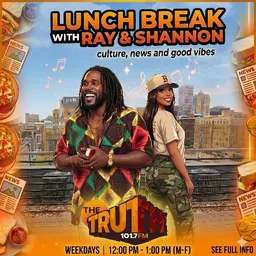
The views and opinions of the hosts and guests of this program are of their own, and not a reflection of Milwaukee Black Media or 1017 The Truth.
Good afternoon, Milwaukee.
You're tuned in to the lunch break on 1017 The Truth, where everything is an option on the menu.

And one thing about me, I'm a tough cookie, but I know what I can do.
And I'm not suffering.
All right.
I fought my whole life.
I'm all right.
Excuse me, Cletus.
Hop on who this man?
I wasn't doing it.
So I was like, I'm not paying $1,000 to sleep on somebody couch.
Grab your lunch, hit send on that email, and get ready for the best hour of your day.
My way
of thinking
is that the parents do all they can.
But once the kids leave off that door, whatever have you, they make their own decisions.
I don't care if you nine or 99, it's still your decision about the situations that you get involved yourself in.
Look into their taxes.
Look into this.
We talking about elected officials doing backdoor deals and somehow she still wanna blame immigrants.
That's what we talking about right now.
We following the money and you still wanna blame black people and immigrants and welfare and all of these things for policies and backdoor deals that put poor people in
worse position.
Live from the American Family Insurance Studio at the Third Street Market Hall.
Like you said, they want to pat their pockets, but they need a reason to push things through.
And I guess the low-hanging fruit is, OK, well, this is a problem, right?
Y'all want to fix the problem, and they just hope nobody looks into it like, wait, when did food trucks
become an issue?
Here are your hosts, Ray Nitty and maybe Shannon.
What
Happy Friday.
Happy Friday.
It is Friday.
Yes, you are now punched in on your lunch break, your favorite two hours of the day with the lunch break crew, your favorite crew, Ray Nitty, maybe Shannon.
DJ Brother Z holding us down with the production and sound.
I hope y'all feeling good.
Man, we got a wild menu today on this Friday.
It's feel good Friday, Shannon.
We got some wild stuff on the menu.
How you
feeling?
Feeling good, man.
It's Friday.
We didn't got through it.
lunchtime.
It's been a long week, but it's lunchtime.
That's the favorite time of the day.
always made me happy.
I should have brought some snacks.
Feel good Friday, man.
You know what?
Last time, I think, was that last Friday or was it Friday before I went to Poland?
We had everybody call in and share what they was proud of, happy about or, you know, feeling good about.
I think you called it, um, weekly wins.
in our Facebook group.
So if we want to celebrate y'all, man, this is about love, 833-212-1017.
If you got something, your weekly wins.
Come share your weekly wins, share your truth with us.
Right here with the Truth Family, man.
Live from the American Family Insurance Studio.
Shout out to other people where they can find us, man.
Of course, of course.
So if you'd like to give us a call, 833-212-1017 is the number to dial.
You can text that number as well.
Again, that number is 833-212-1017.
If you'd like to join the chat, watch us live in studio.
Like I said, our cousins be clowning in chat, but it's a good time.
We're on YouTube as well.
It's at the truth.
Wait, 101.7 the truth.
I was reading a post behind you.
I was like, wait, what?
Don't mind y'all.
It's Friday.
glitching.
I'm glitching,
May I?
There's 101.7 the truth on YouTube.
Join the chat.
Watch us live.
Make sure you follow your host at Ray Nitty, R-A-Y-N-I-T-T-I and myself, maybe Shannon M-A-Y-B-E-S-H-A-N-N-O-N.
You can find us on all platforms and make sure you guys head over to Facebook.
That's where the lunch break crew hangs out after the lunch break is done.
And we continue some of these conversations and give you all links and resources or just to give you all what we were
I was posting earlier this week.
I was like, I'm gonna put the video in the group.
It's there.
Whatever you're looking for is there.
Go
Facebook.
We are the lunch break over there.
Don't miss out on the conversations after lunch is done, all right?
Really?
Yeah.
Look, I forgot all about that.
So, okay, so what is the fast?
Exactly.
What's your, what's your...
food?
you ever heard people do like what is it called 75 hard where they pick like
I could do 30 I ain't got 75 in me.
That's too long.
That's over two months.
I ain't got that in me So I was like I'm gonna do 30.
I was like, I'm gonna pick a book.
I'm gonna read at least a few pages a day
Try to work out like man, I got some I got some plans.
All right big plans, man, but I'm gonna start no time soon.
I'm gonna start like a When it when this book come in the mail, that's what I'm gonna start
I got to start somewhere too shots out today I'm still waiting for the the caller to call back.
He said he had them books, man
Yeah, you was in the chat that day when he said he had those books that he intercepted.
Yeah, to preserve the history, man.
So we'd love to get
that.
return phone call.
I promised you.
Man, it's Labor Day weekend.
So I'm working, but I also was like, I got one day off.
Do I rest or do I get outside?
And I kind of want to go outside.
They said everybody else.
So I think I'm gonna do some politicking.
No.
I need to
I was feeling last weekend.
got to be ready.
It's like, oh, let me get to it.
It's only be so long before somebody like, and then you see me doing this.
Are doing it.
About five minutes.
I got a guide.
I get up.
You want
Definitely feel that having a little to-do list like last weekend.
That's how I was I was like I got so much stuff I wanted to catch up on I kind of got caught up on it So I have small things that I want to get to but I'm like, you know what last weekend I focused on the to-do list and making sure things was going as they should so This this weekend gonna be let me step out see what's going on out here
no, I guess not.
Was it?
It
Hollister, was
I think it was.
Hollister was.
So first on the list, did y'all hear about the foster mother that traded her foster child for a monkey?
Yes, it sounds completely made up in something out of a movie, but no, it happened and she was sentenced yesterday, I believe.
So we don't get into that story.
And then we also go and get into her sentencing.
So yeah, foster care child, they were called like two.
200 times on this woman and she was still a foster kid, but that's a longer story.
She literally sat away for a monkey like a literal monkey.
I got
Honestly, I
we don't.
Well, we got the video of the foster mom.
I have that.
But
I tried to find the kid couldn't find the kid.
But I think after seeing it, I still have more questions than answers, but we don't let y'all listen to it and see what y'all think about that.
We also have the teacher from Rufus King here in Milwaukee, Wisconsin that has been going viral, like mega viral.
He's
all over TikTok, all over the news because he said,
These kids gonna hold it in my classroom.
I wonder what the parents think about that.
Parents,
I
know sometimes y'all be like, they could hold it.
And sometimes, you know, it can make my baby sit there.
So I want to hear from y'all parents.
continue.
Milwaukee Rap takes over the library.
We're going to talk about big Frank local culture and how they let him take over the library.
That Milwaukee rap, they have no Milwaukee rap on the signs at the library.
So we don't get into that.
I want to elevate that story a little bit, but we don't get into all of this after our interview.
Don't go anywhere.
You're listening to the lunch break on the award-winning 101.7 the truth with Ray nitty and maybe Shannon.
This is the lunch break.
Don't go
anywhere
what up
y'all
welcome back welcome back welcome back to your favorite two hours of the day it's your lunch break where Ray Nitty may be Shannon DJ brother Z holding us down with the production that sound live
on the award-winning 10170 Truth from the American Family Assurance Studios.
How y'all doing?
Shannon, how you feeling, man?
Man, I'm feeling great.
Super excited for this interview.
We got family in the building today.
This is some of our real cousins in the building, man.
I know some of these folks from church.
You know, used to drive us to play basketball at Cardinal Stritch back in the day.
You know, people that's older than me now and stuff.
You know what I'm saying?
But we got some homies, man, from the Office of Community Wellness and Safety, and we are going to allow them to introduce themselves.
We've had portions of their umbrella come on the show before and other shows and talked about the work that they do, but we get to get a different view here.
So go ahead and introduce yourselves, man.
Good afternoon.
My name is Julian Pfeiffer.
I'm a program manager with DCWS where my work focuses on preventing violence, interrupting the escalation of violence, and connecting those impacted by violence to the support they need to heal.
Quinn Taylor with the Department of Community Wellness and Safety.
I serve as a community violence prevention program coordinator.
I've been with the department now going on for years.
happy to be here.
And before I pass it over to my brother, Sharman, I really just want to give biggs up to Ray.
I've been able to watch his journey for almost three decades now and to see his elevation, the way he's been able to evolve.
A lot of people here, you know, it's maybe your first time experiencing him through the radio, but I've been able to witness him on the front lines, doing community outreach, being an entertainer.
just so many different hats that he wore.
So very appreciative to be here in his presence.
Man, I appreciate that, man.
What's
going on, everybody?
My name is Sharma and Pittman, one of the pastors at Evolve.
I also serve as the community director there in simple bridging the gap between the faith and the community, figuring out ways how we can just serve beyond just the spiritual needs of the person, but making sure we're able to serve them in a holistic manner.
when it's
Yeah, of course.
So for somebody listening who has never heard of the Department of Community Wellness and Safety, what exactly does your department do?
That's a good question.
Thank you.
Maybe Shannon for the question.
And also you, like I've been able to witness your growth, your integrity, how you move with so much charisma and respect met you through Ray many years ago.
So it's exciting to see you in this role also.
As it relates to the Department of Community Wellness and Safety, a lot of people know us as the Office, or remember us as the Office of Violence Prevention, OVP.
Okay.
Just a moment, we can turn some volume up.
How was that?
Is that better?
Many people know us as, remember us as the Office of Violence Prevention.
Now we're the Department of Community Wellness and Safety.
At our core, it's all about prevention.
How do we support and strengthen communities?
Offer wellness and safety while also having the lens of prevention and intervention And
how do
we get in front of things before they happen?
Okay, so what does violent violence prevention look like before the police ever become involved?
Well one thing what I would say is this office was created in 2008 to take a public health approach to violence prevention because historically
Things like violence has been seen by societies and communities as a criminal justice issue.
But the challenge with that is that's after harm has already occurred.
And so taking a public health approach to violence prevention means zooming out and trying to figure out what's going on with and studying populations and understanding the conditions that people are living in that can increase the risk of violence.
So figuring out what's going on with the population and getting a good glimpse of that.
and then being able to try and stop violence before it happens.
And it looks different in different forms.
It may look like assisting a young person with employment or connecting them to mentorship.
It may be supporting a family after a tragedy, attending visuals, balloon releases.
It may be mediating a conflict where you have two different groups.
at odds with one another and trying to de-escalate before it turns into gunplay.
It can look like a mother or a family that's in a domestic violence situation and now wants out.
How do we support that family?
How do we get them to a safe environment?
It could look like an individual or a family at imminent danger of survival and having to find emergency housing while
our street outreach teams and intervention specialists of Mediate to create a safe environment for their return.
So it's multiple hats, it's partnerships, it's collaboration.
We do not do this work alone.
One of the reasons why we have Pastor Sormon here, we're very, very happy for the partnerships and the relationships we're able to garner through those that's already doing the work, helping to extend and support a lot of their efforts.
But that's a glimpse into some of the work and what violence prevention looks like.
Brother Julian, you said taking a step back and, you know, not just looking at the end result, which is the violence, right?
But the conditions, the environments.
As a department now, what data do we have to share with the community that says, hey, these are the conditions.
These are the environments.
Have we, I feel like we may have shared it, but for those that may not know, because I'm a little closer to the department.
So, you know, I look at the information you all put out and share.
Some people don't.
So in,
What have you all seen are these conditions?
What are these determining factors that are causing an elevated or a
byproduct of violence?
I would point to things like economic conditions.
Milwaukee's state of the state of Wisconsin's median household income is 36 percent higher than the city of Milwaukee's.
household income that makes a big difference in you know where people can live whether how you know their ability to put food on a table if they can can get to work so when you're dealing with you know that disadvantage you know that's in it that's increased stress pressure another thing folks might look at when we hear a lot of the conversation and controversy when you see
Just a team takeover, street takeover, things like that.
Youth may be acting out in the community.
And so people are wondering, what's
wrong with the
kids?
What's going on out here?
What's its parenting issue?
People should know about Milwaukee youth.
Black youth represent about 30% of
the
Milwaukee County population.
But they also represent about, but they represent 70% of the kids who are removed from their home by the child's welfare system.
So that gives you a glimpse at the adversity, you know, and the conditions that youth are experiencing.
Mental health, the Milwaukee Health Department has a community health assessment that they do.
Residents have told them that there's about one in five or 20% of Milwaukee adults report experiencing frequent mental distress more than two weeks out of the month.
These are the conditions that increase the risk of violence that we want folks to understand, taking a public health approach and zooming out, seeing what's going on in communities.
are
It creates higher hyperactivity, lower lack of focus.
It decreases mental awareness and being able to read and things of that nature.
Also,
Your cognitive distance, the ability to make proper choices.
Why have we not yet?
We have this data because it's on the DNR's website.
Why have we not yet connected the environmental injustice and the data that we have that shows that exposure to these chemicals and toxins.
Elevates these byproducts.
Like, why have we not connected or have we connected that conversation to environmental justice and holding corporations accountable for cleaning up our neighborhoods that we are constantly breathing these type of things in every day?
Well, I mean that's a conversation that is happening in urban planning so people are thinking about things like that They are taking into consideration some some of these factors But you are just looking at the big picture when you look at things like the housing stock and higher concentrations of lead in those but you another another environmental toxin is noise noise pollution so just Zooming out again as I keep circling back to that over the years
I lost my train of thought here, but what I would like to say is that the noise pollution, those are things that influence people's, all the things that you talked about, but come back to me, let me, I'm losing my train of thought here.
No song.
Let me just jump in real quick, because Ray, you touch on something very, very important, and what you're speaking of is something that has been happening.
and cities and
Let us go to break.
And then when we come back, we'll we'll get into that because I do think this is a very important subject and you all are out there putting your lives at risk every day trying to address trying to intervene in violence.
And it's a byproduct.
It's a physical product that we are walking around.
It's an invisible.
product that we are taking in every taking in every day as a community That I feel like we're not paying enough attention to so when we come back I'd like And we don't have to dominate the conversation with that But it's just something I'd like to put on people's radar because we experienced it and we'll get back to that after these
messages
Man feeling good.
It's a good conversation that we have in today, too So super excited to keep that going
Two one two ten seventeen is the number to dial if you just joining us.
We are talking about the conditions that our communities are having to.
Live within and the byproduct of violence that Office of Community Wellness and Safety is trying to.
So courageously intervene.
Stop.
Diffuse, things we don't see behind the scenes, right?
Meeting with separate ops or parties that's into it.
And doing this all with just an orange t-shirt and some gun locks, y'all.
And a very slim budget.
Yeah.
But these are the conditions and the byproducts that they have to go and
Navigate towards and I asked the question like we know all of the other Yes, we know the railroads.
We know the the highways that was put through the cut through our name We know the liquor stores are there.
We know all of these devices that help create terrible condition.
We know the economic injustice But I feel like the environmental injustice flies under the rug
And I think that's the one thing of the silent, the invisible thing that's impacting not just our kids, adults too.
If we walking around poison, then we don't know it, but DNR has a website that you could go and put your address in and see all the toxins that surround you.
And if you go, go put them out.
I've been talking about it for years.
We got dragged through.
every press for TCE, a chemical we didn't use.
All we did was put $70 million on Center Street and tried to bring a satellite space for Office of Community Wellness.
But unfortunately, the evacuation pushed the timeline back in.
Y'all had lives to save.
Y'all couldn't wait on
us.
And that was part of it also.
We had to go door-to-door with you all.
Telling residents they had to leave.
Well, we have seen progress in recent years with the removal of the lead pipes and addressing the lead laterals.
But the reality is that Milwaukee is an old city.
It's an old infrastructure.
And so that's the beauty of the practice of public health is pointing these things out and helping make the argument to a population how it's in the best interest for the health and the overall well-being economically, socially.
to address these issues and improve and upgrade that infrastructure.
But we also have to acknowledge that, you know, when we look at historical patterns that there will be populations that bear the brunt of, you know, the disparities when you're talking about making changes and improving infrastructure and who's going to bear the brunt of it.
And we
It'll get to the north side.
I moved here when I was.
15.
They been saying that since I was 15 straight off the island.
I'm 42 now.
I've used more than half the life expectancy of a black man and this was like, damn.
They saying that to me or my kid.
Yeah.
Yeah.
Some of those same neighborhoods look the
Or worse.
One of the things I proposed in my master's program at the Zilber School of Public Health at UW-Milwaukee is that doing a study where we would get a chance to look at the childhood blood-led levels of incarcerated African Americans in our Wisconsin prison system, I think that it disties in right to what you're talking about.
And I think that I'm not sure we'd be surprised to know what some of those levels are, man.
I'd be surprised
Environmental injustice is a bigger part of, is a big part of the picture as well.
Why am
We need that sometimes.
So.
We have seen reports showing that there are decreases in shootings and other serious crimes.
What do you believe is actually driving those numbers down?
That's a good question.
I think it's a combination of things.
Definitely the level of outreach and engagement that's happening from CVI organizations such as a critical response team for life, events, peace.
You have amazing work that the credible messengers are doing.
the activation over the summer with safe summer sites, ensuring that young people have safe spaces to go, especially in the evening hours when we see violence at the highest levels, and just supporting and partnering and collaborating with the amazing residents, community-based organizations, faith-based organizations that's already doing amazing work.
I contribute a lot of it to the alignment, being able to focus and collaborate with one message.
And I don't want the numbers from this year to get overlooked, although homicides and non-fatal shootings are trending in the right direction.
There's still neighborhoods and families, and Ray alluded to
those neighborhoods earlier that does not see a decrease in violence or the trauma that they witness on a day-to-day basis.
Now that we have this data, now that things are trending in the right direction, how can we focus our energy, our resources in areas of the city that has not seen that level of...
decrease that still goes without having a level of investment and healing on a regular basis.
So that's the focus on this is our city campaign that Julien will talk about.
But I think that's some of it.
Sharma, could you kind of expand on some of the work through
faith-based that Evolve has been doing in some of the partnerships through DCWS?
Absolutely.
I think for Evolve, Pastor Ken's vision has always been to figure out, again, not just to tend to the spiritual needs of a person, because those are real, but figuring out ways that these same people that are coming inside of the church are the same people that live in these communities, that need access to houses, that need access to resources.
And oftentimes, if you look at the history of the church,
There was a time where the church was a hub for people to get those resources and get access to it.
So that's the approach that we've taken, whether it's our single parent housing initiative.
We're trying to partner with different organizations to help get people's sustainable income, sustainable income to get to sustainable housing within that program.
It's supporting them and helping them understand their finances, build their credit and so forth.
So they can be homeowners one day.
and also just making sure that you don't, you don't just drop them off and just say, hey, figure it out on your own, but actually walking with individuals.
So that's really our approach.
And even when it comes to, I want to make sure I'm answering exactly what you said.
Repeat that part again, the last part of that question.
Yeah, no, I think you answered it.
Just wanted to expand on some of the work from a faith based lens, how it ties into community.
Violence prevention and intervention
got you even for an example with our mentorship program We've partnered with even some of the names that Quinn mentioned with like four and four life with our mentorship program In the schools where we're literally sitting down talking with the very youth that oftentimes we see in the news people speaking negatively About them but getting a chance to hear their perspective on the options that sometimes they don't even know that they have
which
then
we know when you feel limited in what you can choose from.
Oftentimes you don't make the wisest decision, so we've been figuring out ways of how do we pour into our youth, how do we invest back into them with just recently we had to stop the violence basketball tournament where, you know, we're partnering with Department of Community Wellness and Safety, the Safe Summer Initiative site, and other programs that really want to pour into our youth and figure out ways that, yes.
How do we create environments and save environments for them, but
also how
do we incentivize it?
So we
say
hey put money in a pocket
Because we also know that that finances are oftentimes going to be a pool for them and a lot of times the negative Deviant behavior is can what can bring that so how can we step in the gap and not just put our presence, you know In effect, how do we put our money where our mouth is?
How do we invest in our youth and just figuring out ways to partner with organizations that are doing the work as Quinn said for him for life the credible messengers and so forth that
are really boots on the ground trying to pour into our youth and give them hope for a better future.
And if I could just dive into explaining exactly what those numbers are, we've had Milwaukee seen about 76 homicides so far to this point, year to date.
Last year, that number was 100.
So that's a 24% decrease.
Non-fatal shootings are down 27% from 377 down to 277.
go back two past couple of years.
Homicides are down about 20% non-fatal shootings down 43%.
So that's progress.
But I think urgency and progress can exist at the same time, but also acknowledging that there are neighborhoods where violence is not evenly distributed.
There are neighborhoods where their reality is different than what we're reporting here.
And so that's one of the things we came to talk about today is our plan for addressing that.
That's good information, man.
That's good information.
We got a break coming up soon.
As a matter of fact, let's go to break real quick, Shannon.
When we get back, we will get back into more of the conversation with Office of Department of Community Wellness and Safety.
My bad, you're department now.
Big cut.
Man, I don't go anywhere, y'all.
This is the lunch break on the award-winning 10170
Truth.
What
Yeah.
diving back in.
ahead.
Because I was going to get right into the questions I had.
like, you know.
So I know we talked about how some parts of the city may not feel that those numbers are actually down when it comes to shootings and serious crime.
I guess the improvement improvements that are happening.
Do you see it more in certain neighborhoods or other than others?
I think I want to say, yeah.
Like, are there specific neighborhoods that you see more improvement than others?
Well, our focus has been trying to figure out what's happening in the ones that are seeing the highest concentration of violence.
So that's what my mind has
been on.
I'll give you an example.
You think about, just as
an example,
Burline Locust between 21st Street and 27th Street or Atkinson between 10th and 14th Street.
Atkinson again between 19th and 28th Street.
Even on the south side, Greenfield Avenue between 1st Street and 15th Street, from the analysis of the data that we've have going on in terms of what we've seen with fatal and non-fatal shootings, these neighborhoods, those incident clusters represent some of the highest concentration of violence we've seen in the city in 2026.
And that's where those folks, that's where residents will tell you, I don't see it here when people are talking about decreases in violence.
those
Environmental toxins.
Wow.
charges
But we also need to acknowledge, though, that when we talk about the environmental toxins, a lot of those are the result of some of the pollution that happened during the height of the manufacturing
boom
that the Midwest and across the nation had seen.
So there was prosperity, man.
African-Americans put their kids through college, and they were part of, solidly, part of the black middle class.
I remember growing up in Nasterloch Park and lots was full.
First, second, and third, shift of rigs and stratens, Alice Chalmers.
So long term, there's repercussions on what happened with the environment.
But there's a trade-off that happens when you talk about industrial production and manufacturing.
I think people are making that trade off in decisions across the country and across the world right now and you can you can look and see how the patterns play out which populations are better brunt of it.
So
It's like yo, thank you for the industrial impact, right?
But don't leave us a lifetime of cancers.
Things that bro, I'm just talking I'm just talking about poison and the ability to make good choices and spike advice I didn't even mention the cancers All the studies is there this ain't like I ain't I don't got no degree Let's take a phone call from to me.
Yeah To me that's how you spell to me.
I thought it was some some, you know black people be
I don't know how to spell it.
She
got a comment for
How y'all doing?
How y'all doing?
I am committed.
And I just want to say thank you, Quinn, for real, because I'm a gun violence survivor.
My son, he was 14 years old.
He got killed 12, 28, 24.
And I just recently had a conversation with the young man that killed my son and Mr. Taylor, my pastor, and Ms.
Diana from the Department of Corrections.
She also gave me a hand in having this conversation with my son.
So my question is, what can we do
you know, do you think going inside the schools and having conversations with the youth will really help like bring down some of these guns on some of these stolen cars and you know, stuff like that because a lot of kids at home don't have mothers to say, hey, I love you or you know, I'm saying stuff like that.
So what can we do to help our youth become better people?
Thank you, Commit, for calling in.
And thank you for being an example of how you can turn pain into purpose.
Using the experience that you went through that no parent should ever have to bear, losing a son to gun violence.
And you had a choice.
You had a choice.
How do you respond to that?
And you chose to move into positive behavior.
How can you...
do all you can to prevent the next one.
Part of your healing process was wanting to have a conversation with the young man that killed your son, thankful for being able to be in a position to help facilitate that, to allow healing to take place for you, for your family, and for him.
We got to understand that, that even him as the perpetrator, that there's a cycle, that a lot of this is learned behavior.
And he needs just as much support and resources and tools to move his life forward just as Kemiid did, just as that community, that witness, that tragedy.
So
that's the ripple effect.
That's what this department is tasked with.
And we really, really rely on individuals like Kemiid, on partners like Evolve and Pastor Sermon.
and platforms like The Truth to be able to get the information out on where the resources are, to hear from residents and community members on what's needed, how can we do what we do better, how can we support you more.
That's my answer.
I'll pass it over to Julian to follow
up.
Took the words right out of my mouth.
Yeah, cause I'm listening.
I was just gonna say thank you.
Thank you for calling in and sharing your truth with us because I've seen a lot of the families y'all out there consoling.
And for me, it'd be overwhelming.
Like, I'd be out there crying because you could feel these families pain.
And I'm like,
This department this office at the time was catching so much scrutiny From people behind this that I don't see out there, bro.
I Don't see them out there with the families, bro.
I Seen bro praying for everybody that needed prayer
Speaking speaking of healing brother, I would like to point out that You know because people who have been impacted by violence need healing
The Department of Community Wellness and Safety created what we call our credible clinicians and healers network.
We refer individuals who have been victimized, lost a loved one, even overdose.
And we can connect them to free mental and behavioral health services.
And we have been doing that for several years now.
In 2025, the department reached out to over 700 families to offer to connect them to these kind of services.
So speaking of healing, we're
proud.
We're proud of that and we intend to keep it going.
For sure.
So how much do you guys think untreated trauma plays into the violence that we see?
I know Quinn mentioned that it's a cycle.
Untreated trauma is one of the
main root causes of violence that we're looking at here today.
And so when you think about a youth who, remember, I started out with saying that black youth represent 30% of the Milwaukee County population, 70% of youth who have been removed from their home by the child welfare system.
That number, I'm staggered by that because
That's the type of adversity that our youth are going through.
And so that translates to, you know, that that impacts the way a young person or anyone, the way they think, the way they feel and the way they behave.
Just a couple of weeks ago, our office sponsored.
education and awareness training with a group of young women over at the Silver Spring Neighborhood Center who are working on getting their pathway into health care careers.
And what we talked about was, you know, how to manage stress and how to navigate conflict.
And that's the type of education and awareness that you want to promote to young folks, but to folks in general.
I think I read in the
community health assessment from the Milwaukee Health Department.
There's about a quarter of Milwaukee adults over age 30 who have had one or more of their own childhood experiences, unaddressed trauma that they're dealing with.
So when you talk about one of the examples we try to use when we're trying to promote mental health awareness and people utilizing resources as the example of an athlete, you get injured on the field, you get injured on the court.
Before you can go back into the game, you can go
back on the field, you need rehab, you need therapy, you need someone to help you with managing, you know, how to handle what you've been through and ways to compensate and ways to cope.
That's the same with some of the things you go through that injure you psychologically or mentally.
It's nothing wrong with therapy, nothing wrong with talking to someone.
We've seen gun violence get normalized and not just in Milwaukee, but across the country.
So promoting that mental health awareness and making folks understand that healing is necessary and it's okay to talk to someone.
When we come back, I don't want to rush y'all away.
We got a little more to talk to if y'all got a few more minutes.
And we got a caller.
MineTrader has a question about this as well.
So we want to make sure we give it adequate time to breathe.
Don't go anywhere, y'all.
This is the Lunch Break crew on the award-winning 10170 Truth.
you
What it do what it do what it do welcome back with the lunch break crew Ray nitty Maybe Shannon DJ brother Z holding us down with the production and sound it is our two Live from the American family insurance studios.
This is the award-winning one-on-one Point seven the truth Shannon yo
How y'all feel?
Y'all good?
Yeah, we good.
We got
one more second with
on, let's
how do you ever get us out
politically correct right
this is our city is what we got the countdown so it's the it's a DCWS is fall and fourth quarter prevention strategy We will DCWS will focus a coordinated mobilization of community resources in specific incident clusters as part of a end of year
violence prevention strategy.
Some of those neighborhoods I talked to you about, we're going to be inviting partners to come.
And so just like the violence is concentrated in those areas, we want to concentrate resources in those areas.
We're going to invite partners in all other city agencies, other community organizations.
The ask of them is going to be between now and December 31st, 2026.
As part of a challenge to keep the count down, we're going to ask people in organizations to bring what you do to where it's needed most.
That could be eviction prevention resources.
We talked about some of the conditions in the neighborhoods.
Mental and behavioral health resources, substance abuse resources.
So we're going to invite partners across the spectrum and we're going to create a
action calendar and a plan and we're going to ask folks to get in where you fit in.
Whatever your lane is, let's respond in those neighborhoods who say they don't see or don't feel the decrease that we're going around celebrating.
We're pretty excited about
it.
Absolutely.
This is our city is about all of us having a shared responsibility, a goal in this.
Like we said earlier, there's already a lot already happening.
There's a lot of great activation and support offered through churches in these areas.
There's community-based organizations.
There's associations in these areas.
There's block clubs and block captains that has been activating in these areas.
There's cleanups that's happening in these areas.
But with this data that we have,
And with the support that we have through other city departments such as the
health
department Department of city development Department of Public Works Going into these areas talking directly to residents There's a lot of information that we can receive that you can never Get from a data or survey Residents can tell you this light has been out for six months that this house has been abandoned and now
individuals are living in this house, that
there's
drug activity happening around the alley.
So connecting with those residents and empowering them, ensuring that they have the tools, the resources, and the support of our city, and to declare that this is our city, that everyone has a responsibility.
That's the hope, and that's the aim, and that's what we'll be doing throughout the rest of 2026.
How are you doing?
This is Monty.
Monty.
up today.
This is Monty from I will not die of gun violence.
wanted to send a shout out to the city of Milwaukee Community Wellness and Safety because I've experienced losing someone in the gun violence and the support that they've shown has been outstanding.
And one thing that I like most about them is that they do the same thing I do.
It's not just about the victims, but the victimizers also.
a big shout out to Quinn Taylor because he was the one that interacted with me and told me the decisions that I was making were the right decisions because one thing that you were talking about earlier was the environmental things that people go through such as unhealthy communities and so forth and so on.
But I don't think you touched on the topic of...
of social conditioning
where
we've been raised to
believe
that revenge is the thing for one fight, we all fight and you've got to get your get back and no snitching and holding courts in the street.
All of those social conditions and some people are just thanking social media, but it actually starts at home and then school and cultural beliefs is a whole lot more dynamics to it.
I
wanted
to give a shout out to you guys for the work that you're doing and the work that you continue to do.
The new ideals that you're implementing.
I just wanted to give you all a shout out.
I've
to many different directors and I always felt like this department was a punching bag a place where people could easily pass blame where Departments that have way more significant budgets and equipment Don't I say nobody get blamed either
But I know y'all to do this type of work and it's okay to say it y'all don't got to say it.
I'm gonna say But I do I do feel like Yo, they going I've been out with y'all on sometimes not even
Maybe less than five percent And the less than five percent that I went out and witness was so overwhelming for me So y'all do it every day every night every hour every time somebody calls And I'm like when we really gonna either address real condition is or get them adequate support
Man and just to add to that point
right to exactly what you're talking about because I've been to some of them same events or or nice events as well as calls that they respond to and you were there as well and to be able to see the level of the weight that you all have to carry with you know sometimes you all don't have the financial support but yet you still show up and you figure out ways like hey we may not this may not be in the budget but how can we support
And I've seen it with my own two eyes, and even with the partnership with Evolve, I mean, we see over.
4,000 people on a Sunday and our partnership with them where we have a resource to where when people are in need it's like hey fill out this form and we'll connect you to whatever the resources that you are and we're emailing Julian and saying hey this person needs emergency housing and this person is in a domestic violence situation and you see these emails coming in got it we got it we working on it and you hear people following up saying hey I talked to Quinn or I talked to this person over at DCWS and they were able to assist me and
It goes on and on.
There are times when I'm talking to Quinn and I'm like, you know, bro, what you doing?
He like, hold on, bro, let me call you back.
I got to respond to this crisis in the community.
I'm like, where do you sleep?
I'm telling
to be down in the
up.
So it's like.
You know, I just I just think it's it's important for people to hear and and and understand the level of everything that that you are navigating and trying to make sense of really.
Because I'll be honest.
The job y'all doing, y'all got to be crazy.
You got to be insane
to believe.
But that's why y'all need it though That's why you need it to pick up a responsibility For a fraction of the budget about to come out.
I know y'all ain't even dropping the bucket on that one.
I'm telling you I'm Five hundred some folks know what I'm just saying
I commend y'all for the work that y'all do because it is, for one, to believe that the work that I'm doing is gonna change.
And we need more forward thinking, crazy thinking, people like that.
Yeah, yeah.
And Ray, you and I had a conversation over three years ago when, you know, I told you like, hey, bro, I got this opportunity.
It was an opportunity that
you brought to
me.
that opened the door for me to be where I am now.
But when joining, you know, you and I had that conversation and you asked me like, hey bro, like why?
Why you want to take this path?
And it was because I believe that there can be change, long-term change in the city of Milwaukee and that we can be a part of it.
So
that's what it's all
about that belief system when you look at these communities these neighborhoods that's been suffering year after year now decade after decade How can we change the mindset?
How can we instill hope in a belief system that?
What you consider normal like this isn't this isn't a normal life.
You don't have to live in poverty what you see outside your window isn't Supposed to happen like this.
That's that's real trauma and getting people to understand that that's
That's trauma.
And then gaining that trust to allow them to allow us in to now start administering the support, the healing, the wellness that we have to stabilize situations in neighborhoods.
Investment in prevention costs us all less.
This is our city.
It's about all of us having a role share responsibility
And it doesn't matter what your qualifications are every pain is a universal language When you meet people where they are, you don't know how you're changing the trajectory of their life
it
and
We salute y'all for the work that y'all doing, man.
Y'all really doing God's work, and y'all crazy for believing that this could change, but I'm crazy with y'all because I do believe that a lot of this could change.
Don't go anywhere, y'all.
When we get back, we gonna get into the rest of the menu on the lunch break right here on 10170 Truth.
Welcome back to the lunch break with your boy, Ray Nitty.
Man, I'm sorry, man.
It's the lunch break.
I had to take a bite, man.
I was famished.
I was going to fall out.
Famished?
What you got over there?
Oh, that sounds good, actually.
I thought you was going to say a peanut butter cookie.
I'm like, man.
family.
I'm
no, that was
that was
a
We was able to you know, go off script a little bit and get a little real and Shot out to the Department of community wellness and safety man They do a lot of amazing work.
They work with a lot of amazing people credible messengers frontline responders Even handling a lot of the after effects of
or shootouts or things like that, working through different resources that they have in making sure things don't spill over.
And I don't think they get enough credit, man.
I damn sure know they don't get enough resources to do the work that they do.
So, man, 833-212, Shannon, 1017, that's the number to dial.
Shouts out to our cousins in the chat, man.
We ain't even get to talk to y'all like that so far.
Yeah, Curly,
what is it?
No, I just realized that I was like, damn.
So, cousins, this next story sounds outrageous.
So when you first hear the headline, look, a child for a monkey, you would think somebody made this up.
A Missouri foster mother was accused of essentially trading a child in her care for a monkey.
And now we have a major update in this case 70 year old Brenda douche did douche.
Damn.
I can't pronounce her last name.
So we don't call her Brenda of Winfield, Missouri was sentenced yesterday, September 3rd after previously pleading guilty to felony child endangerment.
The judge sentenced her to seven years in prison, but suspended that sentence, meaning as of right now, she's not going to prison.
Instead, she received three years of prohibit.
probation, if she violates that probation, then she'll get the seven year sentence, which is wild to me, dude.
Damn.
That's like.
How human.
across state lines.
It is some white Brenda's
They didn't
old did they say?
No, I Believe so I believe the child was in their teens at the time of this event.
So I'm thinking they probably don't
have any
many pictures or like
the age out there just because, you know, a minor.
But if we look deeply online, I was trying to do some research to find it, but I just couldn't.
We can probably find what the child was.
I'm going to assume.
And I don't like anything about this story.
And I want it off the menu right away.
It's too much going on.
It was Brenda.
She feel white.
And for her crimes, for her to only get probation, let's me know that it makes me feel.
It makes me feel like the
kid
It would have got so many crazy charges.
Man, I'm sorry.
Imagine what that rap she would have looked like.
And all she got was child endangerment.
I don't
like it.
What about a
My bad, idiot.
Authorities began this investigation after a teenage girl in Brenda's care disappeared from school in Missouri and was eventually located in Texas.
So
across the line.
According to investigators, one witness said Brenda and the teenagers simply weren't getting along.
And another witness gave investigators a much more disturbing explanation.
the child had allegedly been sent to another exotic animal collector in texas as part of an arrangement that would allow brenda to come home with a monkey now brenda did not plead guilty to some criminal charge called trading a child for a monkey that was the allegation that was a part of the investigation i wish that was that should be a criminal charge but
What she actually played guilty to June 15 was first degree endangering the welfare of a child in exchange for that guilty plea prosecutors dropped two additional counts of child abuse and neglect
dropped this case.
It's that's wild this case gets more disturbing the teenager reportedly told investigators She had experienced abuse for approximately three years including being slapped and struck with a paddle
And prosecutors have said that, that this wasn't simply about one child or one complaint.
Brenda reportedly had been a foster parent for roughly two decades and fostered approximately 200 children.
And during those years, more than 200 calls were made to Missouri child abuse hotline regarding, regarding the children in her care.
So you told me probation for this.
200 calls.
no.
200 calls over two decades.
of all, how she's still in the line at the
she still on the list?
And 200 kids have passed her care, and it takes a child being traded for a monkey to even get her in the course system, and she ain't even going to jail.
was at this point?
Nothing That honestly Ray that could be a app idea Give these kids the the ability to rate your foster parent or something because there's no way 200 calls
in 200 kids more than 200 kids passed through her care over two decades She shouldn't have a monkey let alone a child, but you know she got both
Man, so 200 hotline calls.
That's the part that we can't get past, ma'am.
a damn
Yes.
I don't like anything about this story.
One of her friends drove the little girl to Texas and came back with a monkey.
And somebody drove.
That's a
human trafficking.
Did he got more time for that?
Across state lines.
Ain't that more time when it's across state lines?
Yes.
And you traded human life.
Mm hmm.
we just even buy monkeys just off the street?
Most monkeys not even legal to own for real.
tail.
Yeah,
It's got to be probably right.
we put up with your mom?
Well, let's play.
Let's play the Brenda is white.
Brenda is a white woman.
But we got to head off to break.
But before.
No, we don't have time.
We don't head off to break so we can get deeper into the story.
anywhere.
Have a news report.
we
we gonna,
Don't go anywhere, y'all.
This is the lunch break on the award winning one on one, seven to true.
What up?
What up?
What up?
Welcome back.
Welcome back.
Yes.
You are punched in on your lunch break with your favorite to the lunch break crew, Ray Nitty, maybe Shannon DJ, Brother Z holding us down with the production and sound.
How y'all feeling, man?
Happy Friday.
It is lunchtime.
Shannon,
I got something to pick
Ooh, let's hear.
and shines.
For almost 100 years, they've been committed to helping families protect what matters most.
Your home, your vehicle, and the dreams you're building every single day.
And if you're part of The Truth family audience, you already know you work hard for yours.
That's why having the right protection in place matters.
American Family helps you stay ready for whatever life brings.
So you can focus on moving forward.
Ensure carefully, dream fearlessly with American Family Assurance.
Get a quote or find an agent at amfam.com.
American Family Mutual Insurance Company, S.I.
and its operating company, 6,000 American Parkway, Madison, Wisconsin.
What's happening?
I wonder if she had insurance
on
She probably put insurance on the monkey before I had to be progressive
what she said keep talking about King enjoy your spring rolls
it I Didn't I didn't hear I hear nothing
I'm
to make it to this monkey business.
Stop the monkeying around,
All right.
Brother Z, do you have that video?
Because I wanted to share with the people what Brenda looked like.
We got Brenda.
Look at her.
Look
her.
I got an idea, I'm saying.
She's also being investigated for possibly swapping a child for a monkey.
The school resource officer at a Lincoln
County school
noticed a student missing.
According to the charging documents, Brenda Deutsch missing.
According to the charging documents, Brenda Deutsch, the child's foster mom, requested to take a girl in her care to her friend's home in Texas.
Now the child was often left alone there in dirty living conditions with exotic animals, which Deutsch collects.
The prosecutor explains that a monkey was potentially exchanged along the lines of
human trafficking
witness who had come forward human
trafficking
witness who
exchanged along the lines of human trafficking
witness who had come forward who had some information regarding the systemic abuse that was going on in the home had said that they had been asked to bring the child down to texas and then bring the monkey back in return obviously
You know, we have to do more investigation to see if that's actually credible, if it's true.
Now, Wood says they were shocked that they didn't have any previous police reports, requests of criminal investigations or prosecutions.
The female victim is now in protective custody in Texas.
Wild.
even.
You know, she got was probation like this drives me up the wall, bro.
And she's never been charged with nothing.
Over 200 calls.
And she
one.
So what happened to the other kids?
Like, what happened to... I'm gonna guess they just like...
They cycled through her care cuz Foster doesn't mean adopted the snout.
We just like ended up leaving She got away with it so much Brother Z is putting the picture up y'all for those of y'all listening
Tosti.
my God.
This is literally human trafficking.
And she ain't got no time.
For real.
right, so during Thursday's sentencing was which was yesterday Even the judge reportedly called out Missouri's foster care system and raised questions about how this situation was even allowed to continue
even the judge was like how they have shut
kids
just
Is there like a number of complaints before they stop letting you foster or do they just let it keep going until somebody ends up like seriously wounded or trafficked for a monkey?
Like what was the like what was the limitations on complaints here?
Like I genuinely don't understand how this happens.
I'm willing to assume that They probably Stereotype these kids and say oh this part is these kids are always complaining you should be grateful that
you're now in a foster home and somebody would even take the time to take you in.
And they probably just write it off as just kids complaining.
And they probably
just don't do nothing.
Bro, one of the things
this picture of this woman next to the albino.
Dog, you're going
be
just like it.
Aw, look, the mouth.
They look just like, I'm sorry, go ahead.
How does this...
us but it was like 30% right?
we make up third 30%
I
was it was it have displaced or something like that Looked through our notes.
one.
Yeah Basically made the point that these kids don't have I guess Support
or they don't have
hit some
Listen, we definitely should and just like people that don't have stable homes because not all of the kids end up in foster care because I think the system feels It's just so crazy how
Some situations can be so severe and these people literally like just turn their backs on these kids, right?
And then you got situations where you hear parents like, oh, like I got caught smoking weed and they took my kid out of my care and then gave them to like some horrible person.
So it's like, I don't, we definitely got to do an episode on foster care and how that system works because I don't understand how somebody that has 200 calls on them.
throughout two decades, like just continue to be able to get kids.
I guess I can remember I told you we tried to do an open request on complaints on on Bob and they was like, it's too many.
We don't got to give it to you.
But I guess I now I found I was like, they was just more so saying, we don't have to give it to you for free.
I was like, why you ain't just happy to pay for it, dude?
That's crazy, though.
Look, if you slide to a tin, we'll tell you what's going on.
What type of...
Look, if you slide my friend Abe over here, I might get something for you.
Like,
Ben
He
picture.
You know what?
him?
There
I don't know.
Look, I'm gonna do my due diligence and I'm gonna replay all of this.
I gotta see.
That's where the money's going, look.
What
Man, so listen, I need y'all to weigh on this.
Laying on this, y'all.
A Milwaukee teacher has gone viral.
I'm sure you guys have heard of it by now.
A teacher from Rufus King.
No shade, girl, no shade.
But he did work at Rufus King.
He said.
He said that he don't let his kids go to the bathroom.
One of his rules is basically about asking for a bathroom pass.
And he said, I will not be giving bathroom water or visiting other classrooms or
You can't get no water.
You can't leave that man class.
He argued that his class is only about 50 minutes long.
And he told students that either use the bathroom during passing time or you can hold it.
You can hold it
like
not getting
that
When it's that high NPS if I'm not mistaken, they'll tell you bring water to class bring a water bottle if it's that hot Stay hydrated guys.
So you in this class was key guzzling water and now you can't go to the bathroom
got
that's
my classroom.
us the pens.
Better drink your spit.
People online
have definitely been going like back and forth about this.
Some people are saying like, how dare you tell people they can't use the bathroom.
And I guess he also made a comment under one of his videos, if women or girls are having that time of month, they need to disclose it with them.
Like, what?
Like, bro.
that when we
on
the lunch break on
No no no!
And they just like you, they want a rap that makes soul beats just like you But they just not you, and I just got through Talking about what I'm trying to do, just not new Now everybody got the game, figured out all wrong I guess you never know what you got till it's gone I guess that's why I'm here, and I can't come back home And guess when I heard that, when I was back home Every interview I'm representing you, making you proud Reach for the stars through if you fall, you land on a cloud Jumping the crowd, sparking light is waving the rain
If you don't know by now, I'm talking about Shattown.
What up,
Welcome
a minute over
She said, ooh.
You know what?
I would like to order.
The journey with Coach Erica, please.
Are your finances low, your mindset off track, or are you ready to get into real estate?
Tune in to the journey with Coach Erica every first and third Saturday from 11 a.m.
to noon on 1017 The Truth.
It's all about mindset, money, and real estate.
Helping you take the next step towards building a better future.
Man.
Man.
That sound good Journey with coach Erica.
Make sure y'all check that out.
It sounds like she got some wonderful things on the menu.
We talking financial literacy and some more things.
Let's go.
Just what the community ordered.
Man, I
the spring roll.
No, you're choking on that meme.
Man.
Like God,
I'ma learn it for
That's for talking about Rufus King.
That's what you give for talking about King.
to King.
It's a love hate situation,
Yeah Insane I feel like so what we're talking about you guys if you're just tapping in we are talking about a teacher that went viral on tiktok and he's essentially everywhere He's made the news in different states.
He's
Everywhere millions and millions of you since then I think he's made his page private But that don't stop a screenshot that don't stop a screen record people are making thing pieces to this it's everywhere Okay, if you look it up teacher saying you can't use the bathroom you'll see it.
It's everywhere and I think
The problem is he's saying it's a 50 minute class.
Y'all could just hold it.
Y'all not about to be going to see y'all friends.
Y'all not going to get water.
Y'all not going to the bathroom.
Y'all going to sit in this class.
Y'all got all these other classes to go to the bathroom.
And y'all got passing time to use the bathroom.
So I think what he's trying to say is that he is trying to eliminate Dilly Dallying.
But in response, a lot of people are like, what if it's that time of the month for some kids?
What if kids have some type of medical issue?
What if some genuinely cannot hold it?
And I think we also brought up a good point before we went to break.
Where we talked about Milwaukee ain't got no AC.
It's what?
What are we talking about?
when we talk about the amount of kids to each class,
You got about a hundred bodies powered up in a, you know, and they still
Come on, man.
Oh, nasty word.
mess.
So Ray, if your kid called you and told you this is what they know exactly what to do.
restroom
they get they're gonna respectfully ask again They will ask again And they know to call a parent if their rights are being infringed upon as a student and Upon if receiving a call and then we further assess the situation if our kid is out of line
But if my kids say they gotta use the restroom and they just can't like you don't first of all A bubble guts that has no time frame.
Okay, let's be
clean with all these food recalls Come on, man.
Everybody got a touch of the taco bill.
you.
Mind you, a huge part of the black community is lactose intolerant more than the white community.
And we drink in milk all day for breakfast, lunch, and dinner and snack.
They give me you cartons.
the milk
A bag of chocolate milk is actually.
I'm
a picture.
I'm going to show you all a
don't surprise me from King.
out
even a
and then they said and like I said they were saying in the comments that he said if a girl is having their time a month He can they can disclose that with me like what
about
That's how does that make you feel
that it's here as first and foremost Yeah, I would I would definitely just walk out.
Okay, bye but that's the thing it's also gonna be like a
I feel like it creates an environment where there's going to be more pushback, so there is going to be way less learning.
You know what I'm saying?
It should be because people are mad that they can't go to the bathroom.
They're going to cause a scene in the room like, well, you tell me I can't go to the bathroom.
My mom said it's going to be a whole lot of back and forth that could be avoided.
And then you can't stop kids.
If he feels like, oh, they're playing in the hallways.
They're missing out on education.
You can't stop kids that don't want to learn.
If that hell bent on not learning, let the kids that don't want to learn out the class.
And the ones that want to learn going to be in that classroom at this point, if that's what you feel you're witnessing.
That's something else.
There's other ways to take care of that.
You're not finna tell my daughter she has to disclose with a grown man when her time of month is that's weird Most kids don't even like man grown women.
That's what the nurses people try to be discreet Exactly, but I guess you can't go to the nurse either in between classes and We're he said they ain't leaving his class at all.
gonna be late.
Passing is like four minutes.
Passing is like four minutes.
And when I went to tech, you show a blade to that, you get suspended.
So you better get there.
travel.
I'm tired
just
You got to loosen up and then you got other kids trying to rush to use the bathroom.
You got to look at me a little bit.
fire.
They expected to swap out they books and
Man, it's been good rocking with y'all this week.
Thank you, Cousins, for pulling up on your lunch break.
It's always a pleasure.
Don't go anywhere.
We got Ray.
She's a grapevine.
She ain't
four
pass.
I ain't even got time.
Make sure you follow your husband.
What about no tissue in the bathroom?
Y'all know where to find us.
Make sure y'all follow the Lunch Break on Facebook.
Follow Ray Middie at Ray Middie across all platforms and myself.
Maybe Shannon across all platforms.
Don't go anywhere.
Stay locked in for the grapevine up next with Ray
y'all.
you
What it do what it do what it do welcome back with the lunch break crew Ray nitty Maybe Shannon DJ brother Z holding us down with the production and sound it is our two Live from the American family insurance studios.
This is the award-winning one-on-one Point seven the truth Shannon yo
How y'all feel?
Y'all good?
Yeah, we good.
We got
one more second with
on, let's
how do you ever get us out
politically correct right
this is our city is what we got the countdown so it's the it's a DCWS is fall and fourth quarter prevention strategy We will DCWS will focus a coordinated mobilization of community resources in specific incident clusters as part of a end of year
violence prevention strategy.
Some of those neighborhoods I talked to you about, we're going to be inviting partners to come.
And so just like the violence is concentrated in those areas, we want to concentrate resources in those areas.
We're going to invite partners in all other city agencies, other community organizations.
The ask of them is going to be between now and December 31st, 2026.
As part of a challenge to keep the count down, we're going to ask people in organizations to bring what you do to where it's needed most.
That could be eviction prevention resources.
We talked about some of the conditions in the neighborhoods.
Mental and behavioral health resources, substance abuse resources.
So we're going to invite partners across the spectrum and we're going to create a
action calendar and a plan and we're going to ask folks to get in where you fit in.
Whatever your lane is, let's respond in those neighborhoods who say they don't see or don't feel the decrease that we're going around celebrating.
We're pretty excited about
it.
Absolutely.
This is our city is about all of us having a shared responsibility, a goal in this.
Like we said earlier, there's already a lot already happening.
There's a lot of great activation and support offered through churches in these areas.
There's community-based organizations.
There's associations in these areas.
There's block clubs and block captains that has been activating in these areas.
There's cleanups that's happening in these areas.
But with this data that we have,
And with the support that we have through other city departments such as the
health
department Department of city development Department of Public Works Going into these areas talking directly to residents There's a lot of information that we can receive that you can never Get from a data or survey Residents can tell you this light has been out for six months that this house has been abandoned and now
individuals are living in this house, that
there's
drug activity happening around the alley.
So connecting with those residents and empowering them, ensuring that they have the tools, the resources, and the support of our city, and to declare that this is our city, that everyone has a responsibility.
That's the hope, and that's the aim, and that's what we'll be doing throughout the rest of 2026.
How are you doing?
This is Monty.
Monty.
up today.
This is Monty from I will not die of gun violence.
wanted to send a shout out to the city of Milwaukee Community Wellness and Safety because I've experienced losing someone in the gun violence and the support that they've shown has been outstanding.
And one thing that I like most about them is that they do the same thing I do.
It's not just about the victims, but the victimizers also.
a big shout out to Quinn Taylor because he was the one that interacted with me and told me the decisions that I was making were the right decisions because one thing that you were talking about earlier was the environmental things that people go through such as unhealthy communities and so forth and so on.
But I don't think you touched on the topic of...
of social conditioning
where
we've been raised to
believe
that revenge is the thing for one fight, we all fight and you've got to get your get back and no snitching and holding courts in the street.
All of those social conditions and some people are just thanking social media, but it actually starts at home and then school and cultural beliefs is a whole lot more dynamics to it.
I
wanted
to give a shout out to you guys for the work that you're doing and the work that you continue to do.
The new ideals that you're implementing.
I just wanted to give you all a shout out.
I've
to many different directors and I always felt like this department was a punching bag a place where people could easily pass blame where Departments that have way more significant budgets and equipment Don't I say nobody get blamed either
But I know y'all to do this type of work and it's okay to say it y'all don't got to say it.
I'm gonna say But I do I do feel like Yo, they going I've been out with y'all on sometimes not even
Maybe less than five percent And the less than five percent that I went out and witness was so overwhelming for me So y'all do it every day every night every hour every time somebody calls And I'm like when we really gonna either address real condition is or get them adequate support
Man and just to add to that point
right to exactly what you're talking about because I've been to some of them same events or or nice events as well as calls that they respond to and you were there as well and to be able to see the level of the weight that you all have to carry with you know sometimes you all don't have the financial support but yet you still show up and you figure out ways like hey we may not this may not be in the budget but how can we support
And I've seen it with my own two eyes, and even with the partnership with Evolve, I mean, we see over.
4,000 people on a Sunday and our partnership with them where we have a resource to where when people are in need it's like hey fill out this form and we'll connect you to whatever the resources that you are and we're emailing Julian and saying hey this person needs emergency housing and this person is in a domestic violence situation and you see these emails coming in got it we got it we working on it and you hear people following up saying hey I talked to Quinn or I talked to this person over at DCWS and they were able to assist me and
It goes on and on.
There are times when I'm talking to Quinn and I'm like, you know, bro, what you doing?
He like, hold on, bro, let me call you back.
I got to respond to this crisis in the community.
I'm like, where do you sleep?
I'm telling
to be down in the
up.
So it's like.
You know, I just I just think it's it's important for people to hear and and and understand the level of everything that that you are navigating and trying to make sense of really.
Because I'll be honest.
The job y'all doing, y'all got to be crazy.
You got to be insane
to believe.
But that's why y'all need it though That's why you need it to pick up a responsibility For a fraction of the budget about to come out.
I know y'all ain't even dropping the bucket on that one.
I'm telling you I'm Five hundred some folks know what I'm just saying
I commend y'all for the work that y'all do because it is, for one, to believe that the work that I'm doing is gonna change.
And we need more forward thinking, crazy thinking, people like that.
Yeah, yeah.
And Ray, you and I had a conversation over three years ago when, you know, I told you like, hey, bro, I got this opportunity.
It was an opportunity that
you brought to
me.
that opened the door for me to be where I am now.
But when joining, you know, you and I had that conversation and you asked me like, hey bro, like why?
Why you want to take this path?
And it was because I believe that there can be change, long-term change in the city of Milwaukee and that we can be a part of it.
So
that's what it's all
about that belief system when you look at these communities these neighborhoods that's been suffering year after year now decade after decade How can we change the mindset?
How can we instill hope in a belief system that?
What you consider normal like this isn't this isn't a normal life.
You don't have to live in poverty what you see outside your window isn't Supposed to happen like this.
That's that's real trauma and getting people to understand that that's
That's trauma.
And then gaining that trust to allow them to allow us in to now start administering the support, the healing, the wellness that we have to stabilize situations in neighborhoods.
Investment in prevention costs us all less.
This is our city.
It's about all of us having a role share responsibility
And it doesn't matter what your qualifications are every pain is a universal language When you meet people where they are, you don't know how you're changing the trajectory of their life
it
and
We salute y'all for the work that y'all doing, man.
Y'all really doing God's work, and y'all crazy for believing that this could change, but I'm crazy with y'all because I do believe that a lot of this could change.
Don't go anywhere, y'all.
When we get back, we gonna get into the rest of the menu on the lunch break right here on 10170 Truth.
Welcome back to the lunch break with your boy, Ray Nitty.
Man, I'm sorry, man.
It's the lunch break.
I had to take a bite, man.
I was famished.
I was going to fall out.
Famished?
What you got over there?
Oh, that sounds good, actually.
I thought you was going to say a peanut butter cookie.
I'm like, man.
family.
I'm
no, that was
that was
a
We was able to you know, go off script a little bit and get a little real and Shot out to the Department of community wellness and safety man They do a lot of amazing work.
They work with a lot of amazing people credible messengers frontline responders Even handling a lot of the after effects of
or shootouts or things like that, working through different resources that they have in making sure things don't spill over.
And I don't think they get enough credit, man.
I damn sure know they don't get enough resources to do the work that they do.
So, man, 833-212, Shannon, 1017, that's the number to dial.
Shouts out to our cousins in the chat, man.
We ain't even get to talk to y'all like that so far.
Yeah, Curly,
what is it?
No, I just realized that I was like, damn.
So, cousins, this next story sounds outrageous.
So when you first hear the headline, look, a child for a monkey, you would think somebody made this up.
A Missouri foster mother was accused of essentially trading a child in her care for a monkey.
And now we have a major update in this case 70 year old Brenda douche did douche.
Damn.
I can't pronounce her last name.
So we don't call her Brenda of Winfield, Missouri was sentenced yesterday, September 3rd after previously pleading guilty to felony child endangerment.
The judge sentenced her to seven years in prison, but suspended that sentence, meaning as of right now, she's not going to prison.
Instead, she received three years of prohibit.
probation, if she violates that probation, then she'll get the seven year sentence, which is wild to me, dude.
Damn.
That's like.
How human.
across state lines.
It is some white Brenda's
They didn't
old did they say?
No, I Believe so I believe the child was in their teens at the time of this event.
So I'm thinking they probably don't
have any
many pictures or like
the age out there just because, you know, a minor.
But if we look deeply online, I was trying to do some research to find it, but I just couldn't.
We can probably find what the child was.
I'm going to assume.
And I don't like anything about this story.
And I want it off the menu right away.
It's too much going on.
It was Brenda.
She feel white.
And for her crimes, for her to only get probation, let's me know that it makes me feel.
It makes me feel like the
kid
It would have got so many crazy charges.
Man, I'm sorry.
Imagine what that rap she would have looked like.
And all she got was child endangerment.
I don't
like it.
What about a
My bad, idiot.
Authorities began this investigation after a teenage girl in Brenda's care disappeared from school in Missouri and was eventually located in Texas.
So
across the line.
According to investigators, one witness said Brenda and the teenagers simply weren't getting along.
And another witness gave investigators a much more disturbing explanation.
the child had allegedly been sent to another exotic animal collector in texas as part of an arrangement that would allow brenda to come home with a monkey now brenda did not plead guilty to some criminal charge called trading a child for a monkey that was the allegation that was a part of the investigation i wish that was that should be a criminal charge but
What she actually played guilty to June 15 was first degree endangering the welfare of a child in exchange for that guilty plea prosecutors dropped two additional counts of child abuse and neglect
dropped this case.
It's that's wild this case gets more disturbing the teenager reportedly told investigators She had experienced abuse for approximately three years including being slapped and struck with a paddle
And prosecutors have said that, that this wasn't simply about one child or one complaint.
Brenda reportedly had been a foster parent for roughly two decades and fostered approximately 200 children.
And during those years, more than 200 calls were made to Missouri child abuse hotline regarding, regarding the children in her care.
So you told me probation for this.
200 calls.
no.
200 calls over two decades.
of all, how she's still in the line at the
she still on the list?
And 200 kids have passed her care, and it takes a child being traded for a monkey to even get her in the course system, and she ain't even going to jail.
was at this point?
Nothing That honestly Ray that could be a app idea Give these kids the the ability to rate your foster parent or something because there's no way 200 calls
in 200 kids more than 200 kids passed through her care over two decades She shouldn't have a monkey let alone a child, but you know she got both
Man, so 200 hotline calls.
That's the part that we can't get past, ma'am.
a damn
Yes.
I don't like anything about this story.
One of her friends drove the little girl to Texas and came back with a monkey.
And somebody drove.
That's a
human trafficking.
Did he got more time for that?
Across state lines.
Ain't that more time when it's across state lines?
Yes.
And you traded human life.
Mm hmm.
we just even buy monkeys just off the street?
Most monkeys not even legal to own for real.
tail.
Yeah,
It's got to be probably right.
we put up with your mom?
Well, let's play.
Let's play the Brenda is white.
Brenda is a white woman.
But we got to head off to break.
But before.
No, we don't have time.
We don't head off to break so we can get deeper into the story.
anywhere.
Have a news report.
we
we gonna,
Don't go anywhere, y'all.
This is the lunch break on the award winning one on one, seven to true.
What up?
What up?
What up?
Welcome back.
Welcome back.
Yes.
You are punched in on your lunch break with your favorite to the lunch break crew, Ray Nitty, maybe Shannon DJ, Brother Z holding us down with the production and sound.
How y'all feeling, man?
Happy Friday.
It is lunchtime.
Shannon,
I got something to pick
Ooh, let's hear.
and shines.
For almost 100 years, they've been committed to helping families protect what matters most.
Your home, your vehicle, and the dreams you're building every single day.
And if you're part of The Truth family audience, you already know you work hard for yours.
That's why having the right protection in place matters.
American Family helps you stay ready for whatever life brings.
So you can focus on moving forward.
Ensure carefully, dream fearlessly with American Family Assurance.
Get a quote or find an agent at amfam.com.
American Family Mutual Insurance Company, S.I.
and its operating company, 6,000 American Parkway, Madison, Wisconsin.
What's happening?
I wonder if she had insurance
on
She probably put insurance on the monkey before I had to be progressive
what she said keep talking about King enjoy your spring rolls
it I Didn't I didn't hear I hear nothing
I'm
to make it to this monkey business.
Stop the monkeying around,
All right.
Brother Z, do you have that video?
Because I wanted to share with the people what Brenda looked like.
We got Brenda.
Look at her.
Look
her.
I got an idea, I'm saying.
She's also being investigated for possibly swapping a child for a monkey.
The school resource officer at a Lincoln
County school
noticed a student missing.
According to the charging documents, Brenda Deutsch missing.
According to the charging documents, Brenda Deutsch, the child's foster mom, requested to take a girl in her care to her friend's home in Texas.
Now the child was often left alone there in dirty living conditions with exotic animals, which Deutsch collects.
The prosecutor explains that a monkey was potentially exchanged along the lines of
human trafficking
witness who had come forward human
trafficking
witness who
exchanged along the lines of human trafficking
witness who had come forward who had some information regarding the systemic abuse that was going on in the home had said that they had been asked to bring the child down to texas and then bring the monkey back in return obviously
You know, we have to do more investigation to see if that's actually credible, if it's true.
Now, Wood says they were shocked that they didn't have any previous police reports, requests of criminal investigations or prosecutions.
The female victim is now in protective custody in Texas.
Wild.
even.
You know, she got was probation like this drives me up the wall, bro.
And she's never been charged with nothing.
Over 200 calls.
And she
one.
So what happened to the other kids?
Like, what happened to... I'm gonna guess they just like...
They cycled through her care cuz Foster doesn't mean adopted the snout.
We just like ended up leaving She got away with it so much Brother Z is putting the picture up y'all for those of y'all listening
Tosti.
my God.
This is literally human trafficking.
And she ain't got no time.
For real.
right, so during Thursday's sentencing was which was yesterday Even the judge reportedly called out Missouri's foster care system and raised questions about how this situation was even allowed to continue
even the judge was like how they have shut
kids
just
Is there like a number of complaints before they stop letting you foster or do they just let it keep going until somebody ends up like seriously wounded or trafficked for a monkey?
Like what was the like what was the limitations on complaints here?
Like I genuinely don't understand how this happens.
I'm willing to assume that They probably Stereotype these kids and say oh this part is these kids are always complaining you should be grateful that
you're now in a foster home and somebody would even take the time to take you in.
And they probably just write it off as just kids complaining.
And they probably
just don't do nothing.
Bro, one of the things
this picture of this woman next to the albino.
Dog, you're going
be
just like it.
Aw, look, the mouth.
They look just like, I'm sorry, go ahead.
How does this...
us but it was like 30% right?
we make up third 30%
I
was it was it have displaced or something like that Looked through our notes.
one.
Yeah Basically made the point that these kids don't have I guess Support
or they don't have
hit some
Listen, we definitely should and just like people that don't have stable homes because not all of the kids end up in foster care because I think the system feels It's just so crazy how
Some situations can be so severe and these people literally like just turn their backs on these kids, right?
And then you got situations where you hear parents like, oh, like I got caught smoking weed and they took my kid out of my care and then gave them to like some horrible person.
So it's like, I don't, we definitely got to do an episode on foster care and how that system works because I don't understand how somebody that has 200 calls on them.
throughout two decades, like just continue to be able to get kids.
I guess I can remember I told you we tried to do an open request on complaints on on Bob and they was like, it's too many.
We don't got to give it to you.
But I guess I now I found I was like, they was just more so saying, we don't have to give it to you for free.
I was like, why you ain't just happy to pay for it, dude?
That's crazy, though.
Look, if you slide to a tin, we'll tell you what's going on.
What type of...
Look, if you slide my friend Abe over here, I might get something for you.
Like,
Ben
He
picture.
You know what?
him?
There
I don't know.
Look, I'm gonna do my due diligence and I'm gonna replay all of this.
I gotta see.
That's where the money's going, look.
What
Man, so listen, I need y'all to weigh on this.
Laying on this, y'all.
A Milwaukee teacher has gone viral.
I'm sure you guys have heard of it by now.
A teacher from Rufus King.
No shade, girl, no shade.
But he did work at Rufus King.
He said.
He said that he don't let his kids go to the bathroom.
One of his rules is basically about asking for a bathroom pass.
And he said, I will not be giving bathroom water or visiting other classrooms or
You can't get no water.
You can't leave that man class.
He argued that his class is only about 50 minutes long.
And he told students that either use the bathroom during passing time or you can hold it.
You can hold it
like
not getting
that
When it's that high NPS if I'm not mistaken, they'll tell you bring water to class bring a water bottle if it's that hot Stay hydrated guys.
So you in this class was key guzzling water and now you can't go to the bathroom
got
that's
my classroom.
us the pens.
Better drink your spit.
People online
have definitely been going like back and forth about this.
Some people are saying like, how dare you tell people they can't use the bathroom.
And I guess he also made a comment under one of his videos, if women or girls are having that time of month, they need to disclose it with them.
Like, what?
Like, bro.
that when we
on
the lunch break on
No no no!
And they just like you, they want a rap that makes soul beats just like you But they just not you, and I just got through Talking about what I'm trying to do, just not new Now everybody got the game, figured out all wrong I guess you never know what you got till it's gone I guess that's why I'm here, and I can't come back home And guess when I heard that, when I was back home Every interview I'm representing you, making you proud Reach for the stars through if you fall, you land on a cloud Jumping the crowd, sparking light is waving the rain
If you don't know by now, I'm talking about Shattown.
What up,
Welcome
a minute over
She said, ooh.
You know what?
I would like to order.
The journey with Coach Erica, please.
Are your finances low, your mindset off track, or are you ready to get into real estate?
Tune in to the journey with Coach Erica every first and third Saturday from 11 a.m.
to noon on 1017 The Truth.
It's all about mindset, money, and real estate.
Helping you take the next step towards building a better future.
Man.
Man.
That sound good Journey with coach Erica.
Make sure y'all check that out.
It sounds like she got some wonderful things on the menu.
We talking financial literacy and some more things.
Let's go.
Just what the community ordered.
Man, I
the spring roll.
No, you're choking on that meme.
Man.
Like God,
I'ma learn it for
That's for talking about Rufus King.
That's what you give for talking about King.
to King.
It's a love hate situation,
Yeah Insane I feel like so what we're talking about you guys if you're just tapping in we are talking about a teacher that went viral on tiktok and he's essentially everywhere He's made the news in different states.
He's
Everywhere millions and millions of you since then I think he's made his page private But that don't stop a screenshot that don't stop a screen record people are making thing pieces to this it's everywhere Okay, if you look it up teacher saying you can't use the bathroom you'll see it.
It's everywhere and I think
The problem is he's saying it's a 50 minute class.
Y'all could just hold it.
Y'all not about to be going to see y'all friends.
Y'all not going to get water.
Y'all not going to the bathroom.
Y'all going to sit in this class.
Y'all got all these other classes to go to the bathroom.
And y'all got passing time to use the bathroom.
So I think what he's trying to say is that he is trying to eliminate Dilly Dallying.
But in response, a lot of people are like, what if it's that time of the month for some kids?
What if kids have some type of medical issue?
What if some genuinely cannot hold it?
And I think we also brought up a good point before we went to break.
Where we talked about Milwaukee ain't got no AC.
It's what?
What are we talking about?
when we talk about the amount of kids to each class,
You got about a hundred bodies powered up in a, you know, and they still
Come on, man.
Oh, nasty word.
mess.
So Ray, if your kid called you and told you this is what they know exactly what to do.
restroom
they get they're gonna respectfully ask again They will ask again And they know to call a parent if their rights are being infringed upon as a student and Upon if receiving a call and then we further assess the situation if our kid is out of line
But if my kids say they gotta use the restroom and they just can't like you don't first of all A bubble guts that has no time frame.
Okay, let's be
clean with all these food recalls Come on, man.
Everybody got a touch of the taco bill.
you.
Mind you, a huge part of the black community is lactose intolerant more than the white community.
And we drink in milk all day for breakfast, lunch, and dinner and snack.
They give me you cartons.
the milk
A bag of chocolate milk is actually.
I'm
a picture.
I'm going to show you all a
don't surprise me from King.
out
even a
and then they said and like I said they were saying in the comments that he said if a girl is having their time a month He can they can disclose that with me like what
about
That's how does that make you feel
that it's here as first and foremost Yeah, I would I would definitely just walk out.
Okay, bye but that's the thing it's also gonna be like a
I feel like it creates an environment where there's going to be more pushback, so there is going to be way less learning.
You know what I'm saying?
It should be because people are mad that they can't go to the bathroom.
They're going to cause a scene in the room like, well, you tell me I can't go to the bathroom.
My mom said it's going to be a whole lot of back and forth that could be avoided.
And then you can't stop kids.
If he feels like, oh, they're playing in the hallways.
They're missing out on education.
You can't stop kids that don't want to learn.
If that hell bent on not learning, let the kids that don't want to learn out the class.
And the ones that want to learn going to be in that classroom at this point, if that's what you feel you're witnessing.
That's something else.
There's other ways to take care of that.
You're not finna tell my daughter she has to disclose with a grown man when her time of month is that's weird Most kids don't even like man grown women.
That's what the nurses people try to be discreet Exactly, but I guess you can't go to the nurse either in between classes and We're he said they ain't leaving his class at all.
gonna be late.
Passing is like four minutes.
Passing is like four minutes.
And when I went to tech, you show a blade to that, you get suspended.
So you better get there.
travel.
I'm tired
just
You got to loosen up and then you got other kids trying to rush to use the bathroom.
You got to look at me a little bit.
fire.
They expected to swap out they books and
Man, it's been good rocking with y'all this week.
Thank you, Cousins, for pulling up on your lunch break.
It's always a pleasure.
Don't go anywhere.
We got Ray.
She's a grapevine.
She ain't
four
pass.
I ain't even got time.
Make sure you follow your husband.
What about no tissue in the bathroom?
Y'all know where to find us.
Make sure y'all follow the Lunch Break on Facebook.
Follow Ray Middie at Ray Middie across all platforms and myself.
Maybe Shannon across all platforms.
Don't go anywhere.
Stay locked in for the grapevine up next with Ray
y'all.
what up
y'all welcome back welcome back welcome back to your favorite two hours of the day it's your lunch break with Ray Nitty maybe Shannon DJ brother Z holding us down with the production that sound live on the award-winning 1017 the truth
from the American Family Assurance Studios.
How y'all doing?
Shannon, how you feeling, man?
Man, I'm feeling great.
Super excited for this interview.
This is some of our real cousins in the building, man.
I know some of these folks from church, you know, used to drive us to play basketball at Cardinal Stritch back in the day.
You know, people that's older than me now and stuff, you know what I'm saying?
But we got some homies, man, from the Office of Community Wellness and Safety, and we are going to allow them to introduce themselves.
We've had portions of their umbrella come on the show before and other shows and talked about the work that they do, but we get to get a different view here.
So go ahead and introduce yourselves, man.
Good afternoon.
My name is Julian Pfeiffer.
I'm a program manager with DCWS where my work focuses on preventing violence, interrupting the escalation of violence, and connecting those impacted by violence to the support they need to heal.
Quinn Taylor with the Department of Community Wellness and Safety.
I serve as a community violence prevention program coordinator.
I've been with the department now going on for years.
happy to be here.
And before I pass it over to my brother, Sharman, I really just want to give biggs up to Ray.
I've been able to watch his journey for almost three decades now.
And to see his elevation, the way he's been able to evolve a lot of people here, you know, it's maybe your first time experiencing him through the radio, but I've been able to witness him on the front lines, doing community outreach, being an entertainer.
just so many different hats that he wore.
So very appreciative to be here in his presence.
Man, I appreciate that, man.
What's
going on, everybody?
My name is Sharma and Pittman, one of the pastors at Evolve.
I also serve as the community director there in simple bridging the gap between the faith and the community, figuring out ways how we can just serve beyond just the spiritual needs of the person, but making sure we're able to serve them in a holistic manner.
when it's
Yeah, of course.
So for somebody listening who has never heard of the Department of Community Wellness and Safety, what exactly does your department do?
That's a good question.
Thank you.
Maybe Shannon for the question.
And also you, like I've been able to witness your growth, your integrity, how you move with so much charisma and respect met you through Ray many years ago.
So it's exciting to see you in this role also.
As it relates to the Department of Community Wellness and Safety, a lot of people know us as the Office, or remember us as the Office of Violence Prevention, OVP.
Okay.
Just a moment, we can turn some volume up.
How was that?
Is that better?
Many people know us as, remember us as the Office of Violence Prevention.
Now we're the Department of Community Wellness and Safety.
At our core, it's all about prevention.
How do we support and strengthen communities?
Offer wellness and safety while also having the lens of prevention and intervention And
how do
we get in front of things before they happen?
Okay, so what does violent violence prevention look like before the police ever become involved?
Well one thing what I would say is this office was created in 2008 to take a public health approach to violence prevention because historically
Things like violence has been seen by societies and communities as a criminal justice issue.
But the challenge with that is that's after harm has already occurred.
And so taking a public health approach to violence prevention means zooming out and trying to figure out what's going on with and studying populations and understanding the conditions that people are living in that can increase the risk of violence.
So figuring out what's going on with the population and getting a good glimpse of that.
and then being able to try and stop violence before it happens.
And it looks different in different forms.
It may look like assisting a young person with employment or connecting them to mentorship.
It may be supporting a family after a tragedy, attending visuals, balloon releases.
It may be mediating a conflict where you have two different groups.
at odds with one another and trying to de-escalate before it turns into gunplay.
It can look like a mother or a family that's in a domestic violence situation and now wants out.
How do we support that family?
How do we get them to a safe environment?
It could look like an individual or a family at imminent danger of survival and having to find emergency housing while
our street outreach teams and intervention specialists of Mediate to create a safe environment for their return.
So it's multiple hats, it's partnerships, it's collaboration.
We do not do this work alone.
One of the reasons why we have Pastor Sormon here, we're very, very happy for the partnerships and the relationships we're able to garner through those that's already doing the work, helping to extend and support a lot of their efforts.
But that's a glimpse into some of the work and what violence prevention looks like.
Brother Julian, you said taking a step back and, you know, not just looking at the end result, which is the violence, right?
But the conditions, the environments.
As a department now, what data do we have to share with the community that says, hey, these are the conditions.
These are the environments.
Have we, I feel like we may have shared it, but for those that may not know, because I'm a little closer to the department.
So, you know, I look at the information you all put out and share.
Some people don't.
So in,
What have you all seen are these conditions?
What are these determining factors that are causing an elevated or a
byproduct of violence?
I would point to things like economic conditions.
Milwaukee's state of the state of Wisconsin's median household income is 36 percent higher than the city of Milwaukee's.
household income.
That makes a big difference in where people can live, where their ability to put food on a table, if they can get to work.
So when you're dealing with that disadvantage, that's increased stress, pressure.
Another thing folks might look at when we hear a lot of the conversation and controversy when you see...
just a team takeover, street takeover, things like that.
Youth may be acting out in the community.
And so people are wondering, what's
wrong with the
kids?
Or what's going on out here?
What's its parenting issue?
People should know about Milwaukee youth.
Black youth represent about 30% of
the
Milwaukee County population.
But they also represent about, but they represent 70% of the kids who are removed from their home by the child's welfare system.
So that gives you a glimpse at the adversity, you know, and the conditions that youth are experiencing.
Mental health, the Milwaukee Health Department has a community health assessment that they do.
Residents have told them that there's about one in five or 20% of Milwaukee adults report experiencing frequent mental distress more than two weeks out of the month.
These are the conditions that increase the risk of violence that we want folks to understand, taking a public health approach and zooming out, seeing what's going on in communities.
are
It creates higher hyperactivity, lower lack of focus.
It decreases mental awareness and being able to read and things of that nature.
Also,
Your cognitive distance, the ability to make proper choices.
Why have we not yet?
We have this data because it's on the DNR's website.
Why have we not yet connected the environmental injustice and the data that we have that shows that exposure to these chemicals and toxins.
Elevates these byproducts.
Like, why have we not connected or have we connected that conversation to environmental justice and holding corporations accountable for cleaning up our neighborhoods that we are constantly breathing these type of things in every day?
Well, I mean that's a conversation that is happening in urban planning so people are thinking about things like that They are taking into consideration some some of these factors But you are just looking at the big picture when you look at things like the housing stock and higher concentrations of lead in those but you another another environmental toxin is noise noise pollution so just Zooming out again as I keep circling back to that over the years
I lost my train of thought here, but what I would like to say is that the noise pollution, those are things that influence people's, all the things that you talked about, but come back to me, let me, I'm losing my train of thought
here.
No song.
Let me just jump in real quick, because Ray, you touch on something very, very important, and what you're speaking of is something that has been happening.
in cities and
Let us go to break.
And then when we come back, we'll we'll get into that because I do think this is a very important subject and you all are out there putting your lives at risk every day trying to address trying to intervene in violence.
And it's a byproduct.
It's a physical product that we are walking around.
It's an invisible.
product that we are taking in every taking in every day as a community That I feel like we're not paying enough attention to so when we come back I'd like And we don't have to dominate the conversation with that But it's just something I'd like to put on people's radar because we experienced it and we'll get back to that after these
messages
Man feeling good.
It's a good conversation that we have in today too.
So super excited to keep that going.
Two, one, two, ten, seventeen is the number to dial.
If you just joining us.
We are talking about the conditions that our communities are having to.
Live within and the byproduct of violence that Office of Community Wellness and Safety is trying to.
So courageously intervene.
Stop.
Diffuse things we don't see behind the scenes, right?
Meeting with separate Ops or or parties that's into it And doing this all with just an orange t-shirt and some gun locks and a very slim budget Yeah But these are the conditions and the byproducts that they have to go and
Navigate towards and I asked the question like we know all of the other Yes, we know the railroads.
We know the the highways that was put through the cut through our name We know the liquor stores are there.
We know all of these devices that help create terrible condition.
We know the economic injustice But I feel like the environmental injustice flies under the run
And I think that's the one thing of the silent, the invisible thing.
That's impacting not just our kids, adults, too.
If we walking around poison, then we don't know it, but DNR has a website that you could go and put your address in and see all the toxins that surround you.
And if you go, go pull them out.
I've been talking about it for years.
We got dragged through.
every press for TCE, a chemical we didn't use.
All we did was put $70 million on Center Street and tried to bring a satellite space for Office of Community Wellness.
But unfortunately, the evacuation pushed the timeline back in.
Y'all had lives to save.
Y'all couldn't wait on
us.
And that was part of it also.
We had to go door-to-door with you all.
Telling residents they had to leave.
Well, we have seen progress in recent years with the removal of the lead pipes and addressing the lead laterals.
But the reality is that Milwaukee is an old city.
It's an old infrastructure.
And so that's the beauty of the practice of public health is pointing these things out and helping make the argument to a population how it's in the best interest for the health and the overall well-being economically, socially.
to address these issues and improve and upgrade that infrastructure.
But we also have to acknowledge that, you know, when we look at historical patterns that there will be populations that bear the brunt of, you know, the disparities when you're talking about making changes and improving infrastructure and who's going to bear the brunt of it.
It'll get to the north side.
I moved here when I was.
15.
They been saying that since I was 15 straight off the island.
I'm 42 now.
I've used more than half the life expectancy of a black man and this was like, damn.
They saying that to me or my kid.
Yeah.
Yeah.
Some of those same neighborhoods look the
worse.
One of the things I proposed in my master's program at the Zilber School of Public Health at UW-Milwaukee is that doing a study where we would get a chance to look at the childhood blood-led levels of incarcerated African Americans in our Wisconsin prison system, I think that it disties in a right to what you're talking about.
And I think that I'm not sure we'd be surprised to
what some of those levels are,
Environmental injustice is a bigger part of, is a big part of the picture as well.
am
We need that sometimes.
We have seen reports showing that there are decreases in shootings and other serious crimes.
What do you believe is actually driving those numbers down?
That's a good question.
I think it's a combination of things.
Definitely the level of outreach and engagement that's happening from CVI organizations such as a critical response team for life, events, peace.
You have amazing work that the credible messengers are doing.
the activation over the summer with safe summer sites, ensuring that young people have safe spaces to go, especially in the evening hours when we see violence at the highest levels, and just supporting and partnering and collaborating with the amazing residents, community-based organizations, faith-based organizations that's already doing amazing work.
I contribute a lot of it to the alignment, being able to focus and collaborate with one message.
And I don't want the numbers from this year to get overlooked, although homicides and non-fatal shootings are trending in the right direction.
There's still neighborhoods and families, and rape alluded to
those neighborhoods earlier that does not see a decrease in violence or the trauma that they witness on a day-to-day basis.
Now that we have this data, now that things are trending in the right direction, how can we focus our energy, our resources in areas of the city
that has not seen that level of decrease, that still goes without having a level of investment and
healing
on a regular basis.
So that's the focus on, this is our city, a campaign that Julien will talk about, but I think that's some of it.
Sharma, could you kind of expand on some of the work through
faith-based that Evolve has been doing in some of the partnerships through DCWS?
Absolutely.
I think for Evolve, Pastor Ken's vision has always been to figure out, again, not just to tend to the spiritual needs of a person, because those are real, but figuring out ways that these same people that are coming inside of the church are the same people that live in these communities, that need access to houses, that need access to resources.
And oftentimes, if you look at the history of the church,
There was a time where the church was a hub for people to get those resources and get access to it.
So that's the approach that we've taken, whether it's our single parent housing initiative.
We're trying to partner with different organizations to help get people's sustainable income, sustainable income to get to sustainable housing within that program.
It's supporting them and helping them understand their finances, build their credit and so forth.
So they can be homeowners one day.
and also just making sure that you don't, you don't just drop them off and just say, hey, figure it out on your own, but actually walking with individuals.
So that's really our approach.
And even when it comes to, I want to make sure I'm answering exactly what you said.
Repeat that part again, the last part of that question.
Yep.
No, I think you answered it.
Just wanted to expand on some of the work from a faith-based lens, how it ties into community.
Violence prevention and intervention
got you even for an example with our mentorship program We've partnered with even some of the names that Quinn mentioned with like forum for life with our mentorship program In the schools where we're literally sitting down talking with the very youth that oftentimes we see in the news people speaking negatively About them but getting a chance to hear their perspective on the options that sometimes they don't even know that they have
which
then
we know when you feel limited in what you can choose from.
Oftentimes you don't make the wisest decision, so we've been figuring out ways of how do we pour into our youth, how do we invest back into them with just recently we had to stop the violence basketball tournament where, you know, we're partnering with Department of Community Wellness and Safety, the Safe Summer Initiative site, and other programs that really want to pour into our youth and figure out ways that, yes.
How do we create environments and safe environments for them?
But
also how do
we incentivize it?
So we
say
hey put money in a pocket because we also know that that finances are oftentimes going to be a pool for them
And a lot of times the negative, uh, deviant behavior is, is can what can bring that?
So how can we step in the gap and not just put our presence, you know, um, um, in effect, how do we put our money where our mouth is?
How do we invest in our youth and just figuring out ways to partner with organizations that are doing the work as Quinn said, forwarding for life, the credible messengers and so forth that are really boots on the ground, trying to pour into our youth and give them hope for a better future.
And if I could just dive into explaining exactly what those numbers are,
We've had Milwaukee seen about 76 homicides so far to this point year to date.
Last year that number was 100, so that's a 24% decrease.
Non-fatal shootings are down 27% from 377 down to 277.
When you go back two past couple of years...
Homicides are down about 20% non-fatal shootings down 43%.
So that's progress.
But I think urgency and progress can exist at the same time, but also acknowledging that there are neighborhoods where, you know, violence is not evenly distributed.
There are neighborhoods where their reality is different than what we're reporting here.
And so that's one of the things we came to talk about today is our plan for addressing that.
That's good information.
We got a break coming up.
So, as a matter of fact, let's go to break real quick, Shannon.
When we get back, we will get back into more of the conversation with Office of Department of Community Wellness and Safety.
My bad, you're department now.
Big cut.
Man, I don't go anywhere, y'all.
This is the lunch break on the award-winning 10170 Truth.
Don't
go anywhere.
I
Yeah.
I know we talked about how some parts of the city may not feel that those numbers are actually down when it comes to shootings and serious crime I guess The improvement improvements that are happening.
Do you see it more in certain neighborhoods or other than others?
I think I want to say, yeah.
Like, are there specific neighborhoods that you see more improvement than others?
Well, our focus has been trying to figure out what's happening in the ones that are seeing the highest concentration of violence.
So that's what my mind has
been on.
I'll give you an example.
You think about just as
an example,
Burline locus between 21st Street and 27th Street or Atkinson between 10th and 14th Street.
Atkinson again, between 19th and 28th Street, even on the south side, Greenfield Avenue between 1st Street and 15th Street.
From the analysis of the data that we've have going on in terms of what we've seen with fatal and non-fatal shootings, these neighborhoods, those incident clusters represent some of the highest concentration of violence we've seen in the city in 2026.
And that's where those folks, that's where residents would tell you, I don't see it here.
when people are talking about decreases in violence.
violence?
Environmental toxins.
Wow.
Right on get it all in the shade.
I'm puttin'
All this is
all of you.
But we also need to acknowledge, though, that when we talk about the environmental toxins, that a lot of those are the result of some of the pollution that happened during the height of the manufacturing
boom
that the Midwest and across the nation had seen.
So there was prosperity, man.
African-Americans put their kids through college, and they were part of, solidly, part of the black middle class.
I remember growing up in Nasterloch Park and lots where it was full.
Second and third shift, rigs and stratens, Alice Chalmers.
So long term, there's repercussions on what happened with the environment.
But there's a trade-off that happens when you talk about industrial production and manufacturing.
I think people are making that trade-off and decisions across the country and across the world right now and you can you can look and see how the patterns play out which populations a better brunt of it.
So
It's like yo, thank you for the industrial impact, right?
But don't leave us a lifetime of cancers.
Things that bro, I'm just talking I'm just talking about poison and the ability to make good choices and spike advice.
I didn't even mention the cancers All the studies is there this ain't like I ain't I don't got no degree Let's take a phone call from to me.
Yeah to me That's how you spell to me.
I thought it was some some, you know, black people be
I don't know how to spell it.
She got a comment for you, Quinn.
How you doing, cousin?
Thank you for calling in the lunch break crew.
How y'all doing?
How y'all doing?
I am committed.
And I just want to say thank you, Quinn, for real, because I'm a gun violence survivor.
My son, he was 14 years old.
He got killed, 12, 28, 24.
And I just recently had a conversation with the young man that killed my son and Mr. Taylor, my pastor, and Ms.
Diana from the Department of Corrections.
She also gave me a hand in having this conversation with my son.
So my question is, what can we do
you know, do you think going inside the schools and having conversations with the youth will really help like bring down some of these guns on some of these stolen cars and you know stuff like that because a lot of kids at home don't have mothers to say hey I love you or you know I'm saying stuff like that so what can we do to help our youth become better people.
Thank you, Commit, for calling in.
And thank you for being an example of how you can turn pain into purpose.
Using the experience that you went through that no parent should ever have to bear, losing a son to gun violence.
And you had a choice.
You had a choice.
How do you respond to that?
And you chose to move into positive behavior.
How can you...
do all you can to prevent the next one.
Part of your healing process was wanting to have a conversation with the young man that killed your son, thankful for being able to be in a position to help facilitate that, to allow healing to take place for you, for your family, and for him.
We got to understand that, that even him as the perpetrator, that there's a cycle, that a lot of this is learned behavior.
And he needs just as much support and resources and tools to move his life forward just as Kimi did, just as that community, that witness, that tragedy.
So that's the ripple effect.
That's what this department is tasked with.
And we really, really rely on individuals like Kimi, on partners like Evolve and Pastor Sermon.
and platforms like The Truth to be able to get the information out on where the resources are, to hear from residents and community members on what's needed, how can we do what we do better, how can we support you more.
That's my answer.
I'll pass it over to Julian to follow
up.
Took your words right out of my mouth.
Yeah, because I'm listening.
I was just gonna say thank you.
Thank you for calling in and sharing, you know, truth with us because I've seen a lot of the families y'all out there consoling.
And for me, it'd be overwhelming.
Like, I'd be out there crying because you could feel these families pain.
And I'm like,
This department this office at the time was catching so much scrutiny From people behind this that I don't see out there, bro.
I Don't see them out there with the families, bro.
I Seen bro praying for everybody that needed prayer
Speaking speaking of healing brother, I would like to point out that You know because people who have been impacted by violence need healing
The Department of Community Wellness and Safety created what we call our credible clinicians and healers network.
We refer individuals who have been victimized, lost a loved one, even overdose.
And we can connect them to free mental and behavioral health services.
And we have been doing that, doing that for several years now.
In 2025, the department reached out to over 700 families to offer to connect them to these kind of services.
So speaking of healing, we're
proud.
We're proud of that and we intend to keep it going.
For sure.
So how much do you guys think untreated trauma plays into the violence that we see?
I know Quinn mentioned that it's a cycle.
Untreated trauma is one of the
main root causes of violence that we're looking at here today.
And so when you think about youth who, remember I started out with saying that black youth represent 30% of the Milwaukee County population, 70% of youth who have been removed from their home by the child welfare system.
I just, that number, I'm staggered by that because
That's the type of adversity that our youth are going through.
And so that translates to, you know, that that impacts the way a young person or anyone, the way they think, the way they feel and the way they behave.
Just a couple of weeks ago, our office sponsored.
education and awareness training with a group of young women over at the Silver Spring Neighborhood Center who are working on getting their pathway into healthcare careers.
And what we talked about was, you know, how to manage stress and how to navigate conflict.
And that's the type of education and awareness that you want to promote to young folks, but to folks in general.
I think I read in the
community health assessment from the Milwaukee Health Department.
There's about a quarter of Milwaukee adults over age 30 who have had one or more of their own childhood experiences, unaddressed trauma that they're dealing with.
So when you talk about one of the examples we try to use when we're trying to promote mental health awareness and people utilizing resources is the example of an athlete.
You get injured on the field, you get injured on the court.
Before you can go back into the game, you can go
back on the field, you need rehab, you need therapy, you need someone to help you with managing, you know, how to handle what you've been through and ways to compensate.
you
What it do what it do what it do welcome back with the lunch break crew Ray nitty Maybe Shannon DJ brother Z holding us down with the production and sound it is our two Live from the American family insurance studios.
This is the award-winning one-on-one Point seven the truth Shannon yo
How y'all feel?
Y'all good?
Yeah, we good.
We got
one more second with
how do you ever get us out
politically correct right
so
um
this is our city is what we got the countdown so it's the it's a DCWS is fall and fourth quarter prevention strategy We will DCWS will focus a coordinated mobilization of community resources in specific incident clusters as part of a end of year
violence prevention strategy.
Some of those neighborhoods I talked to you about, we're going to be inviting partners to come.
And so just like the violence is concentrated in those areas, we want to concentrate resources in those areas.
We're going to invite partners in all other city agencies, other community organizations.
The ask of them is going to be between now and December 31st, 2026.
As part of a challenge to keep the count down, we're going to ask people in organizations to bring what you do to where it's needed most.
That could be eviction prevention resources.
We talked about some of the conditions in the neighborhoods.
Mental and behavioral health resources, substance abuse resources.
So we're going to invite partners across the spectrum and we're going to create a
action calendar and a plan and we're going to ask folks to get in where you fit in.
Whatever your lane is, let's respond in those neighborhoods who say they don't see or don't feel the decrease that we're going around celebrating.
We're pretty excited about
it.
Absolutely.
This is our city is about all of us having a shared responsibility, a goal in this.
Like we said earlier, there's already a lot already happening.
There's a lot of great activation and support offered through churches in these areas.
There's community-based organizations.
There's associations in these areas.
There's block clubs and block captains that has been activating in these areas.
There's cleanups that's happening in these areas.
But with this data that we have,
And with the support that we have through other city departments such as the
health
department Department of city development Department of Public Works Going into these areas talking directly to residents There's a lot of information that we can receive that you can never Get from a data or survey Residents can tell you this light has been out for six months that this house has been abandoned and now
individuals are living in this house, that
there's
drug activity happening around the alley.
So connecting with those residents and empowering them, ensuring that they have the tools, the resources, and the support of our city, and to declare that this is our city, that everyone has a responsibility.
That's the hope, and that's the aim, and that's what we'll be doing throughout the rest of 2026.
How are you doing?
This is Monty.
Monty.
today.
This is Monty from I will not die of gun violence.
out to the city of Milwaukee Community Wellness and Safety because I've experienced losing someone in the gun violence and the support that they've shown has been outstanding.
And one thing that I like most about them is that they do the same thing I do.
It's not just about the victims, but the victimizers also.
a big shout out to Quinn Taylor because he was the one that interacted with me and told me the decisions that I was making were the right decisions because one thing that you were talking about earlier was the environmental things that people go through such as unhealthy communities and so forth and so on.
But I don't think you touched on the topic of...
of social conditioning
where
we've been raised to
believe
that revenge is the thing for one fight, we all fight and you've got to get your get back and no snitching and holding courts in the street.
All of those social conditions and some people are just thanking social media, but it actually starts at home and then school and cultural beliefs is a whole lot more dynamics to it.
I
wanted
to give a shout out to you guys for the work that you're doing and the work that you continue to do.
The new ideals that you're implementing.
I just wanted to give you all a shout out.
I've
to many different directors and I always felt like this department was a punching bag a place where people could easily pass blame where Departments that have way more significant budgets and equipment Don't I say nobody get blamed either
But I know y'all to do this type of work and it's okay to say it y'all don't got to say it.
I'm gonna say But I do I do feel like Yo, they going I've been out with y'all on sometimes not even a small fraction of what y'all really navigate I'm talking about a very small product not even 5%
Maybe less than five percent And the less than five percent that I went out and witness was so overwhelming for me So y'all do it every day every night every hour every time somebody calls And I'm like when we really gonna either address real condition is or get them adequate support
Man and just to add to that point
right to exactly what you're talking about because I've been to some of them same events or or nice events as well as calls that they respond to and you were there as well and to be able to see the level of the weight that you all have to carry with you know sometimes you all don't have the financial support but yet you still show up and you figure out ways like hey we may not this may not be in the budget but how can we support
And I've seen it with my own two eyes, and even with the partnership with Evolve, I mean, we see over.
4,000 people on a Sunday and our partnership with them where we have a resource to where when people are in need it's like hey fill out this form and we'll connect you to whatever the resources that you are and we're emailing Julian and saying hey this person needs emergency housing and this person is in a domestic violence situation and you see these emails coming in got it we got it we working on it and you hear people following up saying hey I talked to Quinn or I talked to this person over at DCWS and they were able to assist me and
It goes on and on.
There are times when I'm talking to Quinn and I'm like, you know, bro, what you doing?
He like, hold on, bro, let me call you back.
I got to respond to this crisis in the community.
I'm like, where do you sleep?
to be down in the
up.
So it's like.
You know, I just I just think it's it's important for people to hear and and and understand the level of everything that that you are navigating and trying to make sense of really.
Because I'll be honest.
The job y'all doing, y'all got to be crazy.
You got to be insane
to believe.
But that's why y'all need it though That's why you need it to pick up a responsibility For a fraction of the budget about to come out.
I know y'all ain't even dropping the bucket on that one.
I'm telling you I'm 500 some folks know I'm just saying
I commend y'all for the work that y'all do because it is, for one, to believe that the work that I'm doing is gonna change.
And we need more forward thinking, crazy thinking, people like that.
Yeah, yeah.
And Ray, you and I had a conversation over three years ago when, you know, I told you like, hey, bro, I got this opportunity.
It was an opportunity that
you brought to
me.
that opened the door for me to be where I am now.
But when joining, you know, you and I had that conversation, and you asked me, like, hey, bro, like, why?
Why you want to take this path?
And it was because I believed that there can be change, long-term change in the city of Milwaukee, and that we can be a part of it.
So that's what it's all
about, that belief system, when you look at these communities, these neighborhoods that's been suffering.
year after year, now decade after decade, how can we change the mindset?
How can we instill hope in a belief system that what you consider normal, like this isn't a normal life.
You don't have to live in poverty.
What you see outside your window isn't supposed to happen.
That's real trauma.
And getting people to understand that that's trauma.
And then gaining that trust to allow them to allow us in.
to now start administering the support, the healing, the wellness that we have to stabilize situations in neighborhoods.
Investment in prevention costs us all less.
This is our city.
It's about all of us having a road.
Share responsibility.
And it doesn't matter what your qualifications are.
Every pain is a universal language.
When you meet people where they are, you don't know how you're changing the trajectory of their life.
I'm going to add this, and I'm going to let y'all go.
Find a way to privatize it.
State fair, summer fest, you all should be included in the budgets for these festivals.
Appreciate y'all for coming in man.
Thank y'all for joining us office department department department of community wellness
and
safety We salute y'all for the work that y'all doing man y'all really doing God's work and y'all crazy for believing that this could change But I'm crazy with y'all because I do believe that a lot of this could change don't go anywhere y'all when we get back We don't get into the rest of the menu on the lunch break right here on one on one seven the truth
you
Famished?
What you got over there?
Oh, that sounds good, actually.
I thought you was going to say a peanut butter cookie.
I'm like, man,
finish.
All
But no, that was a
A great interview, man.
We was able to.
you know, go off script a little bit and get a little real.
And shot out to the Department of Community Wellness and Safety, man.
They do a lot of amazing work.
They work with a lot of amazing people, credible messengers, frontline responders, even handling a lot of the after effects of violence or shootouts or things like that, working through.
different resources that they have in making sure things don't spill over.
And I don't think they get enough credit, man.
I damn sure know they don't get enough resources to do the work that they do.
So, man, 833-212, Shannon, 1017, that's the number to dial.
Shouts out to our cousins in the chat, man.
We ain't even get to talk to y'all like that so far.
Yeah, Curly,
what is it?
No, I just realized that I was like, damn.
So, cousins, this next story sounds outrageous.
So when you first hear the headline, look, a child for a monkey, you would think somebody made this up.
A Missouri foster mother was accused of essentially trading a child in her care for a monkey.
And now we have a major update in this case 70 year old Brenda douche did douche.
Damn.
I can't pronounce her last name.
So we don't call her Brenda of Winfield, Missouri was sentenced yesterday, September 3rd after previously pleading guilty to felony child endangerment.
The judge sentenced her to seven years in prison, but suspended that sentence, meaning as of right now, she's not going to prison.
Instead, she received three years of prohibit.
probation, if she violates that probation, then she'll get the seven year sentence, which is wild to me, dude.
Damn.
That's like.
How human.
across state lines.
It is some white Brenda's
They didn't
old did they say?
No, I Believe so I believe the child was in their teens at the time of this event.
So I'm thinking they probably don't have any many pictures or like
the age out there just because, you know, a minor.
But if we look deeply online, I was trying to do some research to find it, but I just couldn't.
We can probably find what the child was.
I'm going to assume.
And I don't like anything about this story.
And I want it off the menu right away.
It's too much going on.
It was Brenda.
She feel white.
And for her crimes, for her to only get probation, let's me know that it makes me feel.
It makes me feel like the
kid
It would have got so many crazy charges.
Man, I'm sorry.
Imagine what that rap she would have looked like.
And all she got was child endangerment.
I don't
like it.
What about a
My bad, idiot.
Authorities began this investigation after a teenage girl in Brenda's care disappeared from school in Missouri and was eventually located in Texas.
So across the line.
According to investigators, one witness said Brenda and the teenagers simply weren't getting along.
And another witness gave investigators a much more disturbing explanation.
the child had allegedly been sent to another exotic animal collector in texas as part of an arrangement that would allow brenda to come home with a monkey now brenda did not plead guilty to some criminal charge called trading a child for a monkey that was the allegation that was a part of the investigation i wish that was that should be a criminal charge but
What she actually played guilty to June 15 was first degree endangering the welfare of a child in exchange for that guilty plea prosecutors dropped two additional counts of child abuse and neglect
dropped this case.
It's that's wild this case gets more disturbing the teenager reportedly told investigators She had experienced abuse for approximately three years including being slapped and struck with a paddle
And prosecutors have said that, that this wasn't simply about one child or one complaint.
Brenda reportedly had been a foster parent for roughly two decades and fostered approximately 200 children.
And during those years, more than 200 calls were made to Missouri child abuse hotline regarding regarding the children in her care.
So you told me probation for this.
200 calls.
no.
200 calls over two decades.
of all, how she's still in the line at
how is she still on the list?
And 200 kids have passed her care and it takes a child being traded for a monkey to even get her in the course system and she ain't even going to jail.
was at this point?
Nothing That honestly Ray that could be a app idea Give these kids the the ability to rate your foster parent or something because there's no way 200 calls
in 200 kids more than 200 kids passed through her care over two decades She shouldn't have a monkey let alone a child, but you know she got both
so 200 hotline calls.
That's the part that we can't get past, ma'am.
a damn
Yes.
I don't like anything about this story.
One of her friends drove the little girl to Texas and came back with a monkey.
And somebody drove.
That's a
human trafficking.
Did he got more time for that?
Across state lines.
Ain't that more time when it's across state lines?
Yes.
And you traded human life.
Mm hmm.
we just even buy monkeys just off the street?
Most monkeys not even legal to own for real.
tail.
Yeah,
It's got to be probably right.
we put up with your mom?
Well, let's play.
Let's play the Brenda is white.
Brenda is a white woman.
But we got to head off to break.
But before.
No, we don't have time.
We don't head off to break so we can get deeper into the story.
anywhere.
Have a news report.
we
we gonna,
Don't go anywhere, y'all.
This is the lunch break on the award-winning 10170 Truth.
Y'all, what up?
What up?
What up?
Welcome back.
Welcome back.
Yes.
You are punched in on your lunch break with your favorite to the lunch break crew, Ray Nitty.
Maybe Shannon DJ, Brother Z holding us down with the production and sound.
How y'all feeling, man?
Happy Friday.
It is lunchtime.
Shannon, I got something to pick
up off this menu real quick.
Ooh, let's hear.
Shines.
For almost 100 years, they've been committed to helping families protect what matters most.
Your home, your vehicle, and the dreams you're building every single day.
And if you're part of The Truth family audience, you already know you work hard for yours.
That's why having the right protection in place matters.
American Family helps you stay ready for whatever life brings.
So you can focus on moving forward.
Ensure carefully, dream fearlessly with American Family Assurance.
Get a quote or find an agent at amfam.com.
American Family Mutual Insurance Company, S.I.
and its operating company, 6,000 American Parkway, Madison, Wisconsin.
What's happening?
I wonder if she had insurance on that damn kid that she tried to.
She probably put insurance on the monkey before
Didn't I didn't hear I hear nothing
I'm
monkey business.
around,
All right.
Brother Z, do you have that video?
Because I wanted to share with the people what Brenda looked like.
We got Brenda.
Look at her.
Look at her.
I got an idea, I'm saying.
That white one.
It's crazy.
Ah!
I knew it!
According to the charging documents, Brenda Deutsch, the child's foster mom, requested to take a girl in her care to her friend's home in Texas.
Now, the child was often left alone there in dirty living conditions with exotic animals, which Deutsch collects.
The prosecutor explains that a monkey was potentially exchanged along the lines of human trafficking.
Witness who had come forward.
Human
trafficking.
Witness who
exchanged along the lines of.
Human trafficking.
Witness who had come forward, who had some information regarding the systemic abuse that was going on in the home, had said that they had been asked to bring the child down to Texas and then bring the monkey back in return.
Obviously, we have to do more investigation to see if that's actually credible, if it's true.
Now wood says they were shocked that they didn't have any previous police reports requests of criminal investigations or Prosecutions the female victim is now in protective custody in Texas.
Wild
Know she got was probation like this drives me up the wall, bro And she's never been charged with nothing
Over
calls
one.
So
gonna guess they just like They they cycled through her care cuz foster doesn't mean adopted
We just like ended up leaving
She looks
point in reporting her, she do.
And she got away with it so much.
I'm
know how brother
scared me.
the picture up, y'all.
For those of y'all listening,
picture up.
Brenda, jump scare.
Like,
literally human trafficking and she ain't
For real.
So during Thursday's sentencing, which was yesterday,
Even the judge reportedly called out Missouri's foster care system and raised questions about how this situation was even allowed to continue.
Even the judge was like, how?
How?
They have the
I wonder if it's like...
Is there like a number of complaints before they stop letting you foster or do they just let it keep going until somebody ends up like seriously wounded or trafficked for a monkey?
Like what was the like what was the limitations on complaints here?
Like I genuinely don't understand how this happens.
I'm willing to assume that They probably Stereotype these kids and say oh this part is these kids are always complaining you should be grateful that
you're now in a foster home and somebody would even take the time to take you in.
And they probably just write it off as just kids complaining.
And they probably just don't do
nothing.
Bro, one thing he got this
this woman next to
albino.
it.
Aw, look, the mouth.
They look just like, I'm sorry, go ahead.
does this...
They took it for ox.
Sent it to... Oh my God.
Oh
boy, this is terrible, man.
And this is why I ask these questions.
Our last interview that we had, they talked about...
How What do you say 70% like we are we make up um What was the stat that he made up?
I can't remember he told us but it
was like 30% right?
up third 30%
I
was it was it have displaced or something like that Looked through our notes.
one.
Yeah But basically made the point that these kids don't have I guess Support
they don't have
hit some
definitely should and just like people that don't have stable homes because not all of the kids end up in foster care because I think the system feels It's
so crazy how
Some situations can be so severe and these people literally like just turn their backs on these kids, right?
And then you got situations where you hear parents like, oh, like I got caught smoking weed and they took my kid out of my care and then gave them to like some horrible person.
So it's like, I don't, we definitely got to do an episode on foster care and how that system works because I don't understand how somebody that has 200 calls on them.
throughout two decades, like
continue to be able to get kids.
I guess I can remember I told you we tried to do an open request on complaints on on Bob and they was like, it's too many.
We don't got to give it to you.
But I guess I now I found I was like, they was just more so saying, we don't have to give it to you for free.
I was like, why you ain't just happy to pay for it, dude?
That's crazy, though.
Look, if you slide to a tin, we'll tell you what's going on.
What type of...
you.
Look, if you slide my friend Abe over here, I might get something for you.
Like,
Man, what else we got on the menu today?
This show went quick today, man.
Not Ben Franklin.
Brother Z is in here is stunting.
He just holed up a big Benji.
Man, it's been such a long time since I touched one of those nice blue honuts.
I'm holding up a white piece of paper and he called it a Benji.
Nah, nah, nah.
Nah, I should have took a... He lied in us.
Shoulda took a picture.
You know
what?
Look, I'm gonna do my due diligence and I'm gonna replay all of this.
gotta see.
That's where the money's going, look.
What
to weigh on this.
Laying on this, y'all.
A Milwaukee teacher has gone viral.
I'm sure you guys have heard of it by now.
Rufus King.
No shade, girl, no shade.
But he did work at Rufus King.
He said.
He said that he don't let his kids go to the bathroom.
One of his rules is basically about asking for a bathroom pass.
And he said, I will not be giving bathroom water or visiting
classrooms or
You can't get no water.
You can't leave that man class.
He argued that his class is only about 50 minutes long.
And he told students that either use the bathroom during passing time or you can hold it.
You can hold it
that
When it's that high NPS if I'm not mistaken, they'll tell you bring water to class bring a water bottle if it's that hot Stay hydrated guys.
So you in this
guzzling water and now you can't go to the bathroom
my classroom.
online have definitely been going like back and forth about this.
Some people are saying like, how dare you tell people they can't use the bathroom.
And I guess he also made a comment under one of his videos, if women or girls are having that time of month, they need to disclose it with them.
Like, what?
bro.
I want to hear your thoughts on that.
Rufus King.
Damn, Rufus King, Rufus King, man.
Like, 88-9
over
there.
Don't go anywhere, y'all.
When we come back, we're gonna get into the, oh man, just, you know, Rufus King being Rufus King, man.
We'll get back into it.
Don't go anywhere.
This is the lunch break on the award-winning one-on-one, seven to true.
No, no, no!
What up y'all welcome back welcome back to the award-winning
over there,
She said, ooh.
You know what?
I would like to order the Journey with Coach Erica, please.
Are your finances low?
Your mindset off track?
or are you ready to get into real estate?
Tune in to the journey with Coach Erica every first and third Saturday from 11 a.m.
to noon on 1017 The Truth.
It's all about mindset, money, and real estate.
Helping you take the next step towards building a better future.
Man.
Man.
That sound good.
Journey with Coach Erica.
Make sure y'all check that out.
It sounds like she got some wonderful things on the menu.
We talking financial literacy and some more things.
Let's go.
Just what the community ordered.
Man, I
the spring roll.
No, you're choking on that meme.
let's talk
Yeah.
Insane.
I feel like, so what we're talking about, you guys, if you're just tapping in, we are talking about a teacher that went viral on TikTok and he's essentially everywhere.
He's made the news in different states.
Everywhere millions and millions of you since then I think he's made his page private But that don't stop a screenshot that don't stop a screen record people are making thing pieces to this it's everywhere Okay, if you look it up teacher saying you can't use the bathroom you'll see it.
It's everywhere and I think
The problem is he's saying it's a 50 minute class.
Y'all could just hold it.
Y'all not about to be going to see your friends.
Y'all not going to get water.
Y'all not going to the bathroom.
Y'all going to sit in this class.
Y'all got all these other classes to go to the bathroom.
And y'all got passing time to use the bathroom.
So I think what he's trying to say is that he is trying to eliminate Dilly Dallying.
But in response, a lot of people are like, what if it's that time of the month for some kids?
What if kids have some type of medical issue?
What if some genuinely cannot hold it?
And I think we also brought up a good point before we went to break.
Where we talked about Milwaukee ain't got no AC.
It's what?
What are we talking about?
when we talk about the amount of kids to each class.
You got about a hundred bodies piled up in a, you know,
they still
Come on, man.
nasty word.
mess.
So Ray, if your kid called you and told you this is what they know exactly what to
they
restroom
they get they're gonna respectfully ask again They will ask again And they know to call a parent if their rights are being infringed upon as a student And upon if receiving a call and then we further assess the situation if our kid is out of line
But if my kids say they gotta use the restroom and they just can't like you don't first of all a Bubbleguts that has no timeframe.
Okay, let's be
clear with all these food recalls.
Come on, man Everybody got a touch of the taco bill.
Have
ones.
you.
Mind you, a huge part of the black community is lactose intolerant more than the white community.
And we drinking milk all day.
For breakfast, lunch, and dinner.
Hand snack.
They give me you cartons.
the milk
A bag of chocolate milk is actually.
I'm
a
going to show you all a
don't
I'm king,
even a
and then they said and like I said they were saying in the comments that he said if a girl is having their time a month He can they can disclose that with me like what
about
That's how does that make you feel
that it's your first and foremost Yeah, I would I would definitely just walk out.
Okay, bye but that's the thing it's also gonna be like a
I feel like it creates an environment where there's going to be more pushback, so there is going to be way less learning.
You know what I'm saying?
It should be because people are mad that they can't go to the bathroom.
They're going to cause a scene in the room.
Like, well, you tell me I can't go to the bathroom.
My mom said, like, it's going to be a whole lot of back and forth that could be avoided.
And then you can't stop kids.
Like, if he feels like, oh, they're playing in the hallways, they're missing out on education, you can't stop kids that don't want to learn.
If they that hell bent on not learning, let the kids that don't want to learn out the class.
And the ones that want to learn going to be in that classroom at this point, if that's what you feel you're witnessing.
That's something else.
There's other ways to take care of that.
You're not finna tell my daughter she has to disclose with a grown man when her time of month is.
That's weird.
Most kids don't even like, man, grown women don't like to be somebody.
People try to be discreet.
Exactly.
But I guess you can't go to the nurse either.
said y'all got time in between classes and weird.
He said they ain't leaving his class at all.
gonna be late.
Passing is like four minutes.
Passing is like four minutes.
And when I went to tech, you show a blade to that, you get suspended.
So you better get there.
travel.
tired
just
You got to loosen up and then you got other kids trying to rush to use the bathroom.
You got to look at me a little bit.
I
fire.
What is
it?
They expect it to swap out they books and everything in this.
She
my God.
That was great.
Get him off here, guys.
Get
out of
time he was on
was
I don't want no damn dog.
I ain't got no single dog.
I ain't got no damn dog.
I ain't got no damn dog.
I ain't got no damn dog.
I ain't got no damn dog.
I ain't got no damn dog.
I ain't got no damn dog.
I ain't got no damn dog.
I ain't got no damn dog.
I ain't got no damn dog.
I ain't got no damn dog.
I ain't got no damn dog.
I ain't got no damn dog.
I ain't got no damn dog.
I ain't got no damn dog.
dog.
I ain't got no damn dog.
I ain't got no damn
Man, it's been good rocking with y'all this week.
Thank you, Cousins, for pulling up on your lunch break.
It's always a pleasure.
Don't go anywhere.
We got Ray.
She's a grapevine.
She ain't
four minutes and pass it.
I ain't even got time.
Make sure you follow your home.
What if I don't tissue you in the bathroom?
Literally, now you got to
pass.