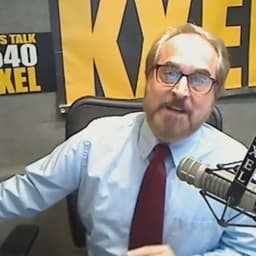
News Talk 1540, KXEL, where Iowa comes to talk.
A good Thursday morning to you.
I'm Jeff Stein.
Tuesdays and Thursdays during our KXEL Live and Local program, we are joined by Dustin Hoffman of the Iowa Agribusiness Radio Network for an extended conversation on pertinent topics.
It's our RFD 1540 conversation.
Of course, you hear reports from the network nine times each weekday here on the blowtorch.
Well, Dustin, we've heard a lot about problems in the cattle industry.
Things started to turn around.
It looked like a little, but now we're taking some steps back.
Give me the details, please.
Well, to be fair, Jeff, I mean, cattle have had high prices at the sale barns for quite a while.
I mean, we've seen some triple-digit gains.
We saw almost a rocket ship ride higher of some of these prices.
And cattle was one of the few commodities where farmers were actually making money.
But now you start to compare that to some of the high costs of the inputs, whether that's the corn, whether it's the feedstocks, whether it is getting hay, whether it is whatever have you.
While those prices have been good,
for farmers or also to restock their their herds especially if you're a feedlot producer those input costs
are basically eating up those higher profits that the farmers were getting.
And so it's been kind of a trade-off.
And cattle have been going for so many years operating at a negative balance, and they were barely hanging on some of these producers.
Those who have hung on were enjoying those high prices.
But again, the inputs are now eating into that.
And diesel is the big one.
I mean, you got to haul those animals or get them hauled to you.
You have to pay the diesel one way or the other.
And then you have the fertilizer costs for doing your...
planting for your corn or whatever you have to feed the animals, the soybean meal and all that kind of stuff, you have that.
And right now, I mean, the only way they could really earn some money just off of what diesel's eating into them would be if diesel dropped to $2 a gallon.
And that's something that's just not gonna happen right now, but we're looking at some really tough situations right now where cattle farmers are just trying to scrape by again in an era where they should be making money and it's just not working for them.
Well and the fact is the diesel prices are elevated to be sure they will roll back a bit to be sure but they're still going to be higher no doubt than they were a year a year and a half ago just because that's how the price of commodities and goods go.
We had 9% inflation during the prior administration.
It's not that bad now but it's not like the prices went back so what's it going to take?
from a balance sheet standpoint for the cattle industry to actually make money for the producers.
Well, honest to God, the thing is, the biggest deal is replacement.
You know, if you're a feedlot, yeah, you're, you're getting, as we've talked many times before, you're getting a dump truck full of money when you sell those cattle.
But then to reestablish that herd, you have to basically give back a dump truck of money to somebody else to get their calves.
The only people really truly making any decent money off of the cattle market right now are the cow calf producers.
you know, the ones that are selling the calves.
They're the ones making the money because they're not having to rebuy except if they've got to replace a heifer or replace a cow with a heifer or, you know, getting a bull, you know, if they're going to adjust their genetics at all.
But other than that, they're selling calves at pure profit.
And so the feedlot producers are having a tough time.
But even so, unless you've got a large area of range land for grazing and all of that, you're not making a lot of money.
And again, like we said, there's corn, there's diesel costs, there's veterinary costs, everything has gone up.
regardless of what it is you're looking for there, but when you're looking at all the things you need just to keep an animal alive, not much less how many animals you got to keep alive.
That's just eating into it.
I mean, you used to have, we're basically running the same margin that we were in the 80s.
You might get 80 to 90 dollars ahead, which is a little better than it was.
but it's not that far back, and we're seeing the same margins that we saw in the 80s, and we were seeing margins that were almost double that just a few years ago, but everything caught up.
The first year or so of the high cattle prices was great for those producers because they had already paid for all the inputs on those animals, and now they're...
making the money at a higher price and they bought them low and they're selling them high and that's great but after that it starts to eat away and it starts to catch up and you know it's just been one of those things of you know how do we get the herd built back up but you do that you're going to drop down the price of what they're getting if you build up you build up the supply the demand weakens and they can pay less for a herd of cattle and so
I had a cattle and so it's it's a really tough situation We know the administration is trying to boost the cattle herd But all it's really gonna do is drop the price of beef and it will drop the price of beef and that's great for the consumers But it's not good for the farmers because the fact that they're gonna have a high dollar amount invested into these animals And then if they see a market that bottoms out because of all the work being done to build up supply and build up the herd That's gonna be a just as big a hit for them to take as it was a big bonus for them to take when they had
the cattle lower at purchase time than they were selling them at the higher prices.
So it's going to be just a huge detriment to some of these.
So when you hear these things about, oh, this is going to help the cattle producers, I don't see how unless you're a cow calf operation where it's not going to hurt you one way or another, you know, because yeah, you'll have a little bit lower sale price, but you won't be, you know, you won't have still won't have anything investment.
So it's still invested.
So it's still like, you know, pure profit.
And so this is a tough situation we're finding ourselves in.
And of course,
like we've always talked about, the cattle producers get a certain percentage of that back when they sell.
We see a price at the meat counter that's considerably different per pound than what they're getting per pound.
Someone's making the money in the middle, and obviously everybody along the line has to make money.
That's how capitalism works.
And if you're doing a service, you need to make some of the money off of it.
But the margins for the people in the middle are quite higher than they are either end of that supply chain.
I saw some posts recently that
took the USDA secretary to task for talking about lower port prices and how that was a wonderful thing.
And the people who are the producers are saying, well, okay, it may be good when you go to the grocery store, but we're losing money over here.
Is it tricky balance in other words?
And why is it so much more difficult in the cattle industry as opposed to others?
Well, because the turnaround, I mean, look at the turnaround, I mean, hogs don't gestate a litter as much as a cow does, a cow or nine months, just like a human being.
Pigs also have, you know, multiple animals, multiple piglets every time they gestate.
Cows, one, maybe two, but most of the time, one.
And it takes nine to 10 months to a year to get that steer or heifer or whatever up to a market weight.
So,
Each head takes, you're looking at almost two years, 18 months to two years of time from breeding to get it sold.
So I mean, it takes time on cattle.
Hogs the turnaround is much quicker.
And so that's why it's a bigger problem there.
But again, you're absolutely right with the hog thing too.
Hogs are in a...
terrible spot right now compared to they were.
I mean, it's not quite half of what it was, but it's still definitely a shock, a sticker shock for the farmers.
You know, when we had hogs that were up in the 80s and 90s, high 80s, low 90s, and now we're talking mid 50s, that's a big deal.
Now mid 50s wasn't necessarily a bad price when, you know, 25 years ago when I was still home on the farm, 55, 60, 62, that was a good price.
Now we've been in the 90s.
and going back to 55 isn't that great, especially when you're talking about replacing the hog herd and all that as well.
So there is that ebb and flow, which we know the market's gonna have.
That's nothing that we're worried about.
It's the fact that all these things that are being introduced as a way to help boost our livestock producers, which are actually causing more harm than good in the long run.
Excellent insight as always Dustin.
Thanks so much for the update.
We'll talk again for the RFD 1540 conversation on KXC Live and local on Tuesday morning.
Sounds good Jeff.
Dustin Hoffman supervising editor senior farm broadcaster Iowa Agra Business Radio Network and don't forget the excellent half hour program each weekend.
appropriately called Weekend Ag Matters.
It airs on KXEL Saturday mornings at 6 or in addition or if you prefer Sunday mornings at 1130.
On News Talk 1540, KXEL, where Iowa comes to talk.
Pleased to welcome now on the news line, Gail Harriet.
Ms.
Harriet is the author of a new book published by our friends at Encounter Books.
It's called Why We Walk On Egg Shells, How Our Civil Rights Laws Stifle Our Civic Discourse.
Ms.
Harriet, good morning and welcome.
Good morning, Jeff.
Thanks for having me on.
Give us a little sense of your background that takes us to the place where this is your latest book.
Well, my background is this.
Right now, I'm a senior fellow at the Manhattan Institute, but I'm actually a retired law professor from the University of San Diego, and I also was a member of the U.S.
Commission on Civil Rights for, I think, about 18 years.
This is an issue that is tricky from a conversation in polite company standpoint.
It is also tricky and as a lawyer I'm familiar with some of the nuances of this and so it's again to some degree it's a minefield and I take it that's why the title of the book is why we walk on eggshells.
Exactly, yes.
You know the book is about
various, what I consider, wrong turns in civil rights law and policy that have kind of led us to the world that we're living in right now, where it's very difficult, particularly for conservatives, libertarians, and centrists, to talk about issues of race and sex for fear that they might cause a fence.
And there are a lot of reasons for that.
But one of the reasons can be found in past
law, essentially.
One of the things the book does is it identifies the Civil Rights Act of 1991 as a real turning point in our civil rights law.
And I'll bet that most of your listeners have never heard of the Civil Rights Act of 1991.
You know, they might know about the laws that were passed during the 1960s, but they don't really hear about the 91 Act.
And what the 91 Act did that I think is crucial
is that it made it lucrative for people to sue under Title VII.
We all know what Title VII is.
That's the one from 1964 where discrimination on the basis of race, sex, religion, or national origin in employment is prohibited.
But it wasn't until 1991 that you could get money for emotional distress and punitive damages if you could argue that you've been harassed.
on the job.
And when employers realized that they could have to fork over money for emotional distress, they started hiring people to train the employees, not to say anything offensive.
Avoid saying anything that somebody might think is offensive based on baser facts.
And that became a big business.
Well, as always, it's the money, right?
I mean, in one respect, it was, okay, now plaintiffs can
received damages so now we have the financial incentive on that side from the company standpoint I imagine and perhaps this is too cynical but there were some companies who said all right we'll hire a trainer and then our hands are clean in the event something happens we did everything we could we can't control these employees
And again, that may be a little cynical, but this became a cottage industry.
Did it
not?
That's right.
That's right.
Jeff, you got it exactly.
And the Supreme Court issued a couple of opinions that made it all the more likely the employer could say, you know, we did everything we could.
So the trainers start coming in and it becomes a big business and they need to keep coming up with new things to keep this going, you know, new things like microaggressions.
We wouldn't have had the whole microaggressions movement without the 1991 Act making employers worried about having to pay for emotional distress damages.
That then turns into a situation where the trainers have to come up with more and more new
things.
And they started telling employees, hey, you can't say things like America is the land of opportunity.
You can't say things like, you know,
I hire the person who I think is best qualified for the job, or I think that the most qualified person should get the job.
And that, of course, was the whole point of Title VII.
But they were turning Title VII upside down by saying, you shouldn't say that.
You shouldn't say that, because that's offensive.
People will think that you're against affirmative action.
And as a result, employees are hearing this.
And they're taking it in.
They know what their employer wants them to avoid doing.
Don't say anything that might, in your wildest dreams, be considered offensive.
And so eventually that leaks into not just the job, not just the workplace, but it becomes part of the culture.
And as a result, conservatives, libertarians, centrists, clam up.
And I think that's had a real effect
on the culture of the last decade or so.
The book is entitled Why We Walk on Eggshells.
The author, Gail Harriet, she's kind enough to join us live on News Talk 1540KXL.
So if we're not supposed to discriminate based upon certain characteristics of birth, that's my phrase, I don't think that's in the law anywhere, but the concept, we've wound up discriminating based upon
someone's whiteness, if you will, as opposed to being a member of a traditionally disadvantaged class.
In other words, we're discriminating all over the place, but if you call that out, you're then called names.
And this is where it just got turned upside down, correct?
Yep, it's a crazy old world,
Jeff.
Sadly, that's not new, is it?
No, no.
And, you know, as a result, you know, what happens when conservatives feel like they can't say things that are basic, like, you know, employers should hire the person who is most qualified for the job, or even, you know, things that are, things like America is a land of opportunity.
You know, what happens is like, let's send her ideas.
You know, they get progressively crazier because nobody's calling it out.
And so we got to the point a few years ago where you had people saying, you know, we should defund the police.
I don't think a lot of people think that's a good idea.
But a few people did, and they were much, much, much more likely to be speaking out than the people who realized, hey, that is a really dumb idea.
The problem we have with so much of this, I assume, is if you
Dare to raise the issue perhaps as bluntly as I just did in the workplace You're you're then shouted down.
You're the troublemaker You know you get branded It's it's a difficult thing and and as I think you note in the book there are many of these situations where you could stand up to it you could file an action
But that takes an awful lot, and who wants to be known as that person giving the prevailing winds of culture that may be blowing in the wrong direction, but you're still going to get caught up in it?
Yeah, exactly.
We all know what happens here.
It's very difficult on the job to take that position.
That preferential treatment based on race is a bad thing.
And the normal thing for people to do is just to clam up in those situations.
Somebody comes in and tells you that a man who has all the man's anatomical equipment, but who thinks to themselves as a woman, that that's a woman, you just say, OK.
And as a result, I think a lot of politicians, elected officials, had a very, very poor sense
of what the average American was actually thinking.
And so we have this age of wokeness where the politicians, even those, some Republicans, some who are right of center, just don't perceive what the average American really thinks.
And that was sort of interesting about the election last week, a blue wave.
lot of you know voters moving to the Democratic Party but on the popular initiatives referenda
yes
but it went the other way in many situations we had a couple of states had initiatives concerning transgenders in women's sports those passed you know to now forbid that in Wisconsin
There was a referendum to amend the state constitution to say the state shall not discriminate against or grant preferential treatment to any individual or group on the basis of race, sex, color, ethnicity, your national origin in the operation of public employment, public education, public contracting, or public administration.
So it basically was against race preferences in college admissions, in public contracting.
And it passed, it passed.
So these basic anti-woke initiatives and referenda, they passed, even though it was a blue wave.
And as I've noted on the air and the audience knows here in the state of Iowa, plenty of blue in terms of politicians getting elected, but yet, we also pretty handily approved a constitutional amendment to require a supermajority to raise income taxes.
That doesn't exactly, that's not part of the Democratic playbook.
And so again, you have to read more deeply into these things.
So how do we, quote, we turn this around?
You've laid it all out so well.
How do we turn it around?
And does this require legislative action?
Does it require judicial temperament or just people saying, okay, you're threatening to sue me?
Fine.
That's why we have lawyers.
It requires all of these things.
One thing, just individual citizens need to understand that there are these incentives and therefore they have to be braver.
They need to speak out for what they believe in politely in a civil way.
But if someone tells them that they are forbidden to say America is the land of opportunity, they should say, no, I'm going to keep saying that.
If someone tells them that they should not say that the person who's most qualified should get the job, they have to turn around and say, no, I'm going to keep saying that.
So they have to be braver.
But also, there are a number of incentives in the law that need to be dealt with.
It would be very difficult to get Congress, especially now, to repeal
the parts of the Civil Rights Act of 1991 that made it lucrative to sue, but there are other things that can be done.
The Supreme Court has issued its decision in the Harvard case a few years ago.
The Trump administration has been trying very hard to enforce that, but it's also important that we get legislation that brings accreditors under control so that they aren't insisting that
that colleges and universities discriminate on the basis of race and admissions.
There are things like that.
And the book has some of that in there.
But I think we need a lot more in the way of ideas for bringing wokeness under control.
I know a lot of people thought, well, it's over.
But no, it's not over.
That's still being pushed.
In my home state of California, our legislature cranked out
race and sex preferential legislation all the time.
And sometimes it gets through.
Sometimes it doesn't.
Sometimes it gets vetoed since our governor Newsom wants to be president of the United States.
And
I think he understands that that would not be helpful to him.
But other things he signs.
And right now there are all sorts of laws of this sort that need to be dealt with in court.
But again, it comes back to you have to bring the action and I recall when I was teaching communications law and that included First Amendment law and we would talk about K-12 free speech and Rules that schools would have about what you can and cannot have on a t-shirt for example and I'd go through dutifully all the court opinions and I'd every semester have a student who would raise their hand and say well But wait a minute.
You just said that that's not permissible for the school to do
But they did it at my school, how come?
And my answer was, well, you've got to file a lawsuit.
And how many of you want to go to your parents and say, please use my college fund to feed a lawsuit so I can wear a t-shirt with a questionable saying on it?
It just doesn't happen.
And this sort of thing is even worse, is it not?
Yeah, this is worse even.
But they're all related.
And there are public interest law firms that will deal with these.
It's going to take a lot.
It's going to take a lot.
I'm the chairman of the board of a very small public interest law firm.
And it deals mainly with issues of race and sex.
And I can tell you the lawyers that are working for this public interest law firm, they have plenty to do.
And, you know, we could use an army of lawyers.
But we got to deal with what we got.
No, yeah, absolutely.
Why we walk on eggshells, how our civil rights laws stifle our civic discourse.
Gail Harriet, the author, it was released last week on Encounterbooks.
You get it wherever you get your good books these days.
Fascinating conversation.
Thanks so much for taking the time to share it in book form and with us here today.
Thanks, Jeff.
Have a great day now.
And Gail Harriet joined us live on the news line.
On News Talk 1540, KXEL, where Iowa comes to talk.
We go live now to the news line and welcome David Sterrett.
Mr. Sterrett is Principal Research Scientist for Public Affairs and Media Research at the NORC, Center for Public Affairs Research at the University of Chicago.
That was originally the National Opinion Research Center, now going by NORC at the University of Chicago.
Mr. Sterrett, thanks so much for the time.
Welcome.
Thanks so much for having me, I really appreciate it.
Give us a sense, NORC, you're an independent affiliate of the University of Chicago, but for folks who are not familiar, give us a sense of what you folks do there.
Yeah, so it's great.
So NORC at the University of Chicago, we're a non-profit, non-partisan research organization.
We do a lot of work for the
So the government for foundations, we have media clients, and we are pretty lucky that this time around we were able to work with some universities and some foundations and conduct the Civic Health and Elections Project where we were able to interview more than 110,000 registered voters nationwide.
in the week leading up to the election, including about 2,500 interviews with registered voters in the great state of Iowa.
So we were able to really, you know, and the cool thing about the Civic Health and Elections Project is we were able to ask a lot of questions about kind of trying to understand people's vote, but really go beyond that and try to get into kind of
local issues about what people were interested in and understand, you know, what was on their minds and what was impacting their communities and, you know, go through things like in Iowa about tax-funded vouchers to help parents pay for tuition and, you know, prohibiting gender transition medications and procedures for people under 18.
So it was a really cool project to be able to kind of understand
what's on people's minds and affecting their daily lives.
And I think it's especially important at this point because those who are politicos or those who have agendas can simply look at election results and say, well, this is what the voters were saying.
Well, no, that was a vote for a candidate or an issue.
I don't think you can then extrapolate.
The only way to do it is through the research that you folks have done.
Give me a sense, first of all, was there a
any key distinctions between the national numbers and how voters in Iowa felt on any key issues?
Even though I think it's a really good question, so I think obviously when you see such a significant shift nationwide that was also apparent in Iowa where we're kind of a flipping from support to Republican candidates to Democratic candidates, I think one of the things to note is when you see such a significant shift, it's not
Likely that it's just one factor.
It seems like it's going to be multiple factors.
And then I think as, you know, I don't have to tell you all, I think the shift in Iowa was pretty pronounced and maybe even more pronounced than in other parts of the country.
And when we're looking at it, there's a few things that really kind of stand out.
And I think one was that desire for change.
We asked a question about, you know, how much change people want to see.
And, you know, it was more than 8 in 10 Iowa registered voters said that they would want to see either substantial change or total and complete upheaval.
So that was one big thing and, you know, maybe not surprising.
The people that wanted significant change were much more likely to say that they were voting for Democratic candidates for Senate, Governor, and House.
And one of the other things that
And that makes sense, but it was pretty striking.
And I would say it was even stronger in Iowa than other parts of the country where people kind of changing what party they supported from 2024.
So when we asked people about who they voted for in 2024 of those in Iowa who said that they voted for President Trump, about 17% of them said that they voted in 2026 for Rob Sand and 13% voted for Josh Turks.
I think one of the things you were seeing is that there was definitely people in Iowa switching parties.
And then I think the last thing that I would just highlight that, you
know, I
don't have to tell people about, but there was a huge issue with affordability.
And then we found that in Iowa, only 9% of people felt their family's financial situation was getting ahead, and 36% felt like they were falling behind, which was probably a little bit, you know, in a more pessimistic view than the rest of the country.
And I think this was a big driver, kind of a vote choice, too.
So, I mean, we found that those who selected the economy and jobs as the most important issue facing the country were much more likely to support the Democratic candidate for both governor, Senate, and even their House races.
And that does not surprise when you really think about it, because we have this huge number of independents in the state of Iowa, more independents than registered Democrats.
It's not a surprise that if people feel that the kitchen table issues, the pocketbook issues are squeezing them, they're going to say, well, we got to try something different.
We've got to change.
The trick is always change to what and the way our system is set up.
If you don't like the R's and they're in control of the change is the D's and vice versa could flip again in two years.
Not a big surprise in hindsight.
But there were a lot of folks, uh, politicos who were caught, uh, off guard by this, I think.
Yeah.
No, I think, I think that's true.
And I think, I think one of the things that was just just.
the scale of it, and especially the economy, was such a huge issue.
And one of the things we asked people trying to really understand their daily lives is, you know, kind of the financial challenges that they might have faced in the last year.
And we asked about things like, did you have to take, you know, not pay your credit card bill or borrow more money or delay a vacation or, you know, do those types of things or delay purchases.
And we found that about two in 10 Iowans said they had to do at least six of those things.
And when you look at those people who had so much financial troubles,
6 and 10 vote for the Democrats.
So as you said, I think that people were really motivated a little bit by their life experiences.
But I think you noted something that I think is important.
A vote in this election doesn't necessarily guarantee who people are voting for in the next election, just as we saw when I was talking
earlier
about how many people said they supported President Trump in 2024, but then voted for a Democratic candidate this year.
that would suggest and you may have done other research on this but it would suggest that yes we have partisans they were a red jersey or a blue jersey but there's an increasing number of people who don't find either of the traditional parties in this modern era serve their needs and that potentially leads to this kind of volatility election after election because if you don't have the allegiance
From a partisan standpoint, you're much likelier to flip to the other side every two years.
Yeah, I think that's a really good point.
And I think especially there's certain demographic groups that tend to be less partisan in theory.
And then people who vote infrequently tend to have less strong party allegiances.
And then people who are younger, especially young adults, 18 to 29-year-olds, or a group of people who, you know, their support for democratic candidates
in 2026 was much higher than it was in 2024.
And these are people, as you just said, that don't necessarily have these strong allegiances.
And you see it, especially in Iowa, where there's a good group of people who are not overly tied to one party or the other, and they're looking at their daily lives.
And that's one thing that was really interesting about the Norx Civic Health and Elections Project, is we were able to ask beyond just who you were voting for,
and really get into some of these other issues, whether it be healthcare or immigration, that you can really see that there's a lot of things that are going on here.
I know one of the things that I know was a big issue in Iowa before the election, it was kind of something that was talked about in some of the races was the vouchers.
And we found there was like 49% roughly of likely voters opposed tax-funded vouchers that help parents pay for tuition for their children to attend private religious schools.
you know, compared to about a third that said they supported this type of policy.
So whereas, yes, there is national issues.
And I think there's also important to remember, especially when you're looking at races for governor and not in those types of state races, that there are state issues that are really important to people.
And, you know, our hope with the civic health and elections project is that people can really try to understand these local issues as well.
David Sterrett is the principal research scientist
with NORC, N-O-R-C, NORC at the University of Chicago.
I've only got 60 seconds.
Overall, from the national standpoint, what jumped out or surprised you, either in something you didn't expect or something that was magnified more than you might have anticipated?
I think one thing just quickly is AI and data centers are clearly becoming a very important, you know, they're a national issue, but they're also a local issue when it comes to where people are doing data centers.
So I think that's something to look at.
The other thing that I think, you know, just quickly to know is kind of the polarization of this country and kind of views.
We found that about, you know, half of Republicans and Democrats think that people in the other party are living in a different world.
And that's obviously something that hopefully, you know, over time, we might be able to lessen a little bit because, you know, we all live in the same communities in the same world and kind of seeing how much, you know, sometimes there are for these strong persons to use about the other public.
The other people in the other party is kind of interesting.
Mr. Sterrant, fascinating stuff.
Thank you so much for the time.
Hope to talk to you again in the future.
Thanks so much.
I really appreciate
it.
Take good care now.
David Sterrett, Principal Research Scientist with NORC at the University of Chicago, N-O-R-C.
It was founded as the National Opinion Research Center, now known as NORC at the University of Chicago.
And if you'd like to learn more about all the results in the Civic Health and Elections Project, just go to NORCNORC.ORC.
And Mr. Sterrett joined us live on the news line on News Talk 1540, KXEL, where Iowa comes to talk.