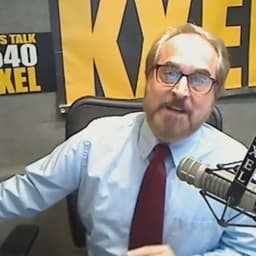
Transcript
Katie Jereza of the U.S. Department of Energy
KXEL Live & Local with Jeff Stein · Wed Oct 21, 2026
I am pleased to welcome now on the news line, Katie Haresa.
Ms.
Haresa is Assistant Secretary within the Office of Electricity at the U.S.
Department of Energy.
Madam Secretary, thank you for the time.
Thank you for being along on this Wednesday morning.
Very happy to be here.
Thank you.
So let's talk about money.
That's always a good thing.
You folks have found some funding and that's going to be nearly nine million in the state of Iowa alone.
Give us a sense of the scope of this funding, what the project is and what you hope to accomplish with it.
Well, what we hope to accomplish is to deliver more affordable, reliable, and secure electricity to all the communities, families, and businesses in Iowa and across America.
And what we plan to do with that is do some undergrounding, monitoring, and control the grid, and reconductoring.
So in simple terms, I would say, we're going to make the most of what we have in the grid by
replacing it with more advanced technologies and that in turn will save customers money and then in other ways we will add more advanced technology so that it can be a smarter more responsive grid to reduce those outages and ultimately the money that nine million that you were talking about are almost will be leveraged with our partners so that we can double that investment through public private partnerships and
get even more out of the investment than just what the federal government does.
Give me some examples if you could of how that might work.
The public-private partnership is that working with the existing utilities or electric cooperatives where they get some skin in the game in addition to the federal money or how is this going to play out for islands?
The utilities, they totally have skin in a game.
They're the ones who operate the grid.
They're the ones who live in the area, and they know what to do best.
So they have their priorities on where we can strategically make these investments.
And then we work with the state who has to approve these investments and ensure that the investments are in the best interest of the public.
they call it being prudent, which really means it's a worthwhile investment.
And through that partnership, through our investments and our technical expertise, we're able to ensure that we have pinpointed investments that have the greatest impact for the community.
From a business standpoint, how important is not only the stability of the grid, but the efficiency of the grid as well?
What's super important is when I think of Iowa I think of it as an area that sees a lot of storms you get tornadoes and so to have a very solid stable grid is of the utmost importance and there's a few ways that you can do that one you can avoid the wind altogether and Underground those power lines or the other ways to do it is to replace the wires with stronger martyr cables so that
When the storms come through, it'll hold better.
But let's say the storm does take the wire down.
We can send feedback to the control center so it automatically knows where to go and they can repair those areas so much faster than before.
Now, I live in a rural area and during one of the winter storms within this past year, power went out to the whole area.
And the first question we all have is, well, I wonder where that happened.
I got in the car and
not far from the house, I saw a tree that took down the line.
Well, that's pretty easy to determine.
What you're talking about is you don't have to drive around.
The cabling is smart, quote unquote, so that in essence, it reports the trouble spot for more efficiency in repair.
Yeah, that is such a great capability in terms of speed to return turning power, because you can that if you had to drive there, it could take depending how far away you are.
30 minutes or an hour and then you have to wait to get the power back on but now they They can pinpoint it and get there faster say 10 15 minutes or We have these things called reclosers and let's say that the the whole tree doesn't take the wire down but just a branch falls on it and you might get your life might flicker and in the old days you would it would cause an outage but today if it flickers and that tree branch gets blown off and
We can re-close the line, re-power it, and now in minutes you have your power back.
So the responsiveness of these capabilities really matters in terms of getting those lights on much faster than before.
And not to mention the safety element if you can do this remotely.
Absolutely.
Our line workers are amazing.
They go out in the ice, the snow, the hot heat, the pouring rain, and
For them, in particular, if we're able to do this remotely, that makes a huge difference for them.
And then for people, if you have the ability to put that back on faster as well, then they won't get towards any dangerous lines.
We're speaking with Katie Haresa.
Ms.
Haresa is Assistant Secretary at the U.S.
Department of Energy Office of Electricity.
She joins us live on the news line on News Talk 1540, KXCL.
One of the things you mentioned that this grant 8.8 plus million dollars will do this funding is to help modernize the infrastructure.
How does Iowa's infrastructure on the whole rank with either our peer states or with other parts of the nation?
It ranks pretty well.
I'd say the whole country has an agent infrastructure that was the last time we did this rebuilding was around the 70s.
all across America at around 50 years old, because we build to a very high standard.
And Iowans actually have some of the most affordable, reliable electricity in the country.
They have common sense policies, and they make the most of their infrastructure and do strategic investments they plan ahead.
So I think I was pretty impressive.
And the investments that are being made today are going to continue to help
Drop the cross pressures make the grid more affordable and look for growth in the future because more power means more jobs and a more prosperous community
Well, as you mentioned the last time there was a similar build out was some 50 years ago So yes, that does speak to the stability of the grid, but we're using I trust an awful lot more energy now because of
Devices, computers, et cetera.
In other words, the last time this was done, so much of what takes up electricity these days wasn't even invented.
Certainly not a common part of our homes, our farms, our businesses.
That's so true.
When I think of, I was reading about automation.
So if you're in a giant warehouse and you're installing robots to do some of the hard tasks for shipping,
Those electricity usages can go up three times.
So we have electric cars.
People are using that.
But industry, we're bringing industry back home.
And that manufacturing is going to have much greater demand.
So yes, all countries around the world, the ones that use more electricity have more prosperity.
It goes hand in hand.
We see growth across the board.
Electricity is definitely a big part of our lives and the way we live today.
nearly nine million dollars allocated in the state of Iowa.
This is part of nine hundred sixty seven million across the country.
It is the grid resilience state and tribal formula grant program.
What are some other areas of the country going to be able to do?
You described what's happening in Iowa is that
Simply the same thing that's being done in other states that are receiving this funding or are there some unique projects elsewhere that are of some interest?
We see a lot of similarities.
We're hitting all 50 states, all the territories, all the tribal lands that we are, our tribal nations that we're able to benefit because this is, electricity involves every community across the country.
There are some uniqueness where you might see in the west more re-conductoring and undergrounding because we have a wildfire risk, or you might see in the in the Atlantic you're worried about hurricanes.
So there may be more poles that get to be replaced because they need to meet a higher standard.
So we are seeing some similarities, but what's great is
This is affecting perhaps every state, every community across the country.
We need to modernize the grid everywhere.
This administration, I believe it is fair to say, has taken an approach of diversifying the sources of energy that we will use.
In other words, it is let's use a little bit of everything.
Let's bring back some of the methods that others have poo pooed in the past.
Kind of like the more we have, the more we have available for backstopping in case of an emergency or if there's a failure because of wind or solar, the lack of the items that you need, wind and sunlight for that.
Does this play into that the idea that we should sample
All of these different efficient methods in order in order to guarantee the stability of the system that Americans rely upon
Yeah, this time for stability we need as much energy as we can get especially to meet rising demand and what's happened over the years President Trump has recognized that we have to have all of what works 24 7 because that's how our lives roll.
It's 24 7
seven days a week.
And what we've done for the last, say, 10 years or so is energy subtraction policies.
But what we really need is energy addition because, as I mentioned earlier, more energy tends to follow with more growth, more prosperity.
And when it comes to Iowans, yes, we can have all types of resources, but really what we need is
energy that will be there when we need it most.
When there's a storm, when it gets very cold, we need to make sure that the energy is going to show up and that the scale of the problem that we have, we need sources that scale as well at a cost that we can afford.
Because the most costly electricity is the electricity that isn't there when you need it.
hyper focused on making sure that we have a reliable grid that when you flip that switch, the lights come on and it's at a price you can afford.
And we take it so much for granted.
And I know a couple of weeks ago I was replacing light fixtures in our house.
So you turn off the circuit breakers for safety.
Well, as I'm going into a nearby room to look for a tool, I instinctively flip on the light switch.
and then look at the light when it doesn't come on, forgetting for the moment that I'm the one who turned the breaker off.
In other words, we are just so used to it being there, we don't even know what to do when it isn't, and that's why projects like this are so important.
Let me ask you finally, and I'm appreciative for all the time you're giving us on this, how did folks, I want to say apply?
How did this money become available?
Did states make application?
Did the federal government do an assessment?
How did that work out?
Well, we try to have a pretty streamlined process.
And so what we're doing now is we're announcing that this funding is available and the states are the ones who manage it.
So the utilities who know what to do apply to the states and then they
We call it a formula grant process to be able to rank the projects according to the merit and impact because that's what it's all about.
How many Americans can we impact to help strengthen the grid and bring more affordable power to their communities?
Katie Haureza is Assistant Secretary, Department of Energy Office of Electricity at the federal level.
Thank you so much for sharing this good news and we look forward to seeing the fruits of this funding in the not-so-distant future.
Thanks again.
Thank you.
And Ms.
Haureza joined us live on the news line from the Department of Energy on News Talk 1540, KXEL, where Iowa comes to talk.
I am pleased to welcome back on the news line Rabbi Daniel Schoenbach.
Rabbi Schoenbach is online at Rabbi4America.com.
He is a therapist, writer and podcaster and these days he's talking about the dangers of certain political candidates.
Rabbi Schoenbach, thank you so much for taking the time.
Good to talk to you, sir.
Great to be here.
So here we on on October 21st.
We are what 13 days before the election later this week.
Former President Obama will campaign with the Democrat candidate Abdul El Sayed in Michigan.
You're hitting the road as well to talk about the realities of electing some of these candidates.
Give us a sense of what concerns you the most right now.
Well, I'm concerned that Abdul Al Sayyad has been implicated for having connections with the Muslim Brotherhood.
And not just him signing on a letter in 2012, supporting the Muslim Brotherhood in Egypt, it's also family connections.
So we're very concerned in our community and other places that a guy like that would get into the Senate and have a perspective which I don't think is very good for the United States of America.
And this is not just striking up fear or anything like that.
You're talking about reading back, in essence, the man's own words as spoken over a period of time that establishes quite a track record, correct?
Correct.
And when there was the terror incident in March in a synagogue in Michigan, and his only common was her people, her people,
Again, his instincts, I think, were very misplaced and were very concerned that that type of comment would be indicative of some of the policies he would implement or not defend the United States of America.
And again, his comment was to try to draw a parallel between Israeli action in Lebanon, but the fact of the matter is he was wrong.
He later apologized, but as with most situations, the false statement gets the headline, the apology gets the back page.
It's very concerning that his first instinct was to make the comment he did.
100% if Mike Rogers was asked that question, or Mike Rogers was asked to commend the United States government for taking up the leadership of Iran, he wouldn't be concerned that his constituents wouldn't be happy if he commented on that.
What happens if he gets to
on the federal level, and he's making major foreign policy decisions, and he's concerned about people in Dearborn, that's very concerning to me as well, and I'm concerned about who would support him and what he would do in the United States Senate.
He has not been very consistent over the course of time in a variety of ways, for example, loyalty and citizenship.
He has been very inconsistent, as you write, at Rabbi4America.com.
Where does he hold citizenship, Rabbi?
It sounds like two countries, both for Egypt and the United States of America.
And I think that dual legions could be problematic for a representative of the United States government.
Where would he support?
What if we went to war against the country in the Middle East?
Whose side would he be on?
So he makes these public statements.
a decade ago, but now the campaign says he never was an Egyptian citizen, just a misunderstanding.
You know, I mean, you've got these inconsistent statements.
Are you lying now or are you lying then?
Well, we see two different candidates wandering primaries and wandering election.
We have a video from saying he's a dual citizen.
So I think that's evidence enough, even if his campaign denies
it.
There are some.
who may say, well, talking about his family and their allegiances, he's the candidate, et cetera, et cetera, but it's not just as simple as that.
He's embraced these radical views over the course of time to get ahead and now where he needs to sort of tamp down his true feelings in a general election, we get, again, as you know, a very different candidate.
I mean, this is all connected, is it not?
Well, let's look at another some statement.
He made he says he's a capitalist and the next sentence He says he's for Medicare for all which would socialize medicine when I have somebody contradicting himself within 30 seconds There's something off.
It seems to be he's presenting himself in one way when he gets into power.
He'll lead in a very different direction
Rabbi Daniel Schoenbach is our guest Rabbi for America comm is the website I Have great concerns
That if someone with these views is elected to rather high public office one of 100 US senators There will be an implicit if not explicit endorsement of Terror within this country against Jews Is that unfounded on my part or is that a valid concern that that folks should take into account?
I think so.
I mean, it's a very valid concern.
We've seen that in New York.
We've seen it in other places where these types of people get into power.
We're seeing an explosion of anti-Semitism.
So the data is there.
It's happening in England.
It's happening in France.
It's happening here as well.
When these types of people take power in the country, we've seen an explosion of anti-Semitism.
It's something we're concerned about.
It's not just a feeling.
There's real data to back that up.
There's absolutely a whole list of atrocities that have been committed.
Why do you think so many people these days appear content to look the other direction if not actually endorse this kind of domestic terror?
I think Americans are very good people.
I think they're very innocent.
I don't think they understand some of the forces operating around the world.
and influencing their lives today.
And I think people in our community as well are more sensitive to international realities.
We've been around the world, we've seen what happened.
And these type of people get into power.
And I think we have a specific amount of insight and knowledge we want to share with people that things we're seeing around the world are happening here as well.
And there's reasons for this, and that's why we have to support Mike Rogers.
And again, as you see what's going on in Europe,
France but all manner of nations in Europe.
It's not limited to France That is evidence That makes the point sadly as clear as can be that happened there and we've laid the groundwork for it here unless we take action
There's no question about it what we're seeing happening in France will happen here We see the red-green alliance
emerging in France, 800,000 people demonstrating, you saw the types of flags on the streets, the types of people that were demonstrating, that same type of composition is coming to America, and if it does, we'll see the same type of demonstrations.
As we saw on October 7th and 8th at Columbia University, you'll see more of that again in the United States.
As you look at people like Barack Obama coming to support this al-Sayed in Michigan,
We are known by the company we keep.
And I just wonder if this is the true outcome of a person who in 2008 said he wanted to fundamentally change America, or if this is nothing more on his part, Mr. Obama's part, then, well, that guy's a Democrat, I'm a Democrat, and so therefore I have to support him.
I mean, it seems even deeper in Obama's case.
Is that misplaced?
No, it's not misplaced.
Well, this was something that people were warning about in 2008.
I think he, in these candidates, he's seeing the manifestation of his transformative politics right now.
But I think another thing is happening.
I think the Democrats are in trouble because the race is so incredibly close.
There hasn't been a Republican in the Senate for many years now.
And they should be way ahead in the polls.
If you remember the primaries, he was up on his, uh, the person he was competing with Stevens.
I'll say 15 points.
The only one by half a point or maybe one point.
So if they're down, if Rogers is down by maybe two and a half points right now, I think they're in big trouble.
That's what I'm just sending in the former president.
There are some of us from afar.
I'm in Iowa.
looking at Michigan, and we've heard about certain communities, Dearborn Others, where there has been, because of immigration, quite a change in the makeup of the communities.
And we've looked at this and thought, this could be problematic.
That, as you look at it in 2026 and beyond, is Michigan not the blueprint
for those who want to take us over from the inside, and this would be the crowning achievement for this individual to be elected to the U.S.
Senate?
A hundred percent.
There's no question that alliance that you're seeing forming is population-based.
It happened in New York.
It's happening in Michigan right now.
They have the winning alliance.
And don't forget, it's one on the primary level, primarily.
We're only 10% of the population votes.
And as you know, in primaries, it's more the stronger personalities in a party which tends to run and tend to vote as well, people more ideologically driven.
So all you need is that 10% of any population, if the geographical population is about 5% in that population, and they're highly organized, they can win, they can take over primaries,
and put candidates in the Senate as well.
So as we look at that part of it, obviously those in a primary these days, well, it's always been the case.
Those that are to the left side of the spectrum win the Democrat primary.
Those to the right side of the spectrum win the Republican primary.
And then both of those nominees sprint to the middle to try to get independence.
But the problem is that especially on the left,
That extreme is so far now to the left Will do you think the independence in Michigan Be awakened in time to not make what could be a rather grievous mistake in other words Politicos who are Democrats, you know, they're they're voting on the party label and that's it
the election will be decided by turnout and independence, do you think?
And you're not there yet, but you will be.
And obviously, I think that's part of your mission, but is are the independence in a position to do the right thing when when push comes to shove on election day?
I sure hope so.
But I'm seeing two movements taking place uniquely in Michigan, both the African American community, the Jewish community are now moving away from the Democratic Party for the first time, perhaps in decades.
So I think that's what we're seeing right now.
I think that's going to help Rogers win right now.
That's why I'm off to Michigan in October 6, 26 to help campaign for the Rogers campaign because I want to add my voice to a very important race, which I think would turn out to be devastating for the United States of America or very advantageous if Rogers wins.
How active are you being in some other races?
Because again, this one is
of prime interest and prime focus because of all of the aspects rabbi we just discussed but Do you see this mirrored in other places or is this really the?
Unique race because of the factors we've been discussing
We were seeing this breakout around the country in New York and Michigan in LA all around the country.
It's the same composition
The Red-Green Alliance is now cannibalizing the Democratic Party.
The DSA is going to take over the entire Democratic Party over the next few years.
They're moving fast.
They're highly organized.
They are gunning against all the moderate Democrats in power right now.
It's not 2026, 2028, and beyond.
This is happening rapidly.
So it's not a question of Republicans versus the Democrats anymore.
It's a question of Republicans and Democrats.
Versus a dsa to save this country
Rabbi for America comm is the website.
Tell us again when you're not Offering cautionary advice as you are today.
What do you do there at the website Rabbi for America comm?
I host a very popular YouTube channel or interview personalities around the world and politics and culture and in religion and spirituality So everybody to come to my website Rabbi for America comm to join the show
Rabbi Daniel Schoenbach, it is always a privilege, safe travels to Michigan.
I hope that you are quite successful in your efforts there to get people to be aware of the dangers that we will all face if this goes the wrong way.
Rabbi, thank you kindly,
sir.
and Rabbi Schoenbach joined us live on the news line on News Talk 1540 KXEL where Iowa comes to talk.
The statement right there on the Rabbi's website restoring the soul of a nation.
Rabbiforamerica.com
News Talk 1540 KXCL where Iowa comes to talk.
Author Roger Thurow has a new book and it's a book of interest to the Northeast Iowa Food Bank.
We're joined by the author this morning as well as Barb Prather, executive director of the Northeast Iowa Food Bank.
Roger, thanks for being with us.
Thanks for
having us.
Great to be
back
in Iowa.
And Barb, good to have you here as well again too.
Thanks Tim, I appreciate it.
The new book is called abiding hunger and examines a variety of topics in hunger when it comes to the United States and around the world abiding hunger and American paradox Roger tell us a little bit about this book and the topic in general which I think has been described this morning amongst ourselves as Frustrating to say the least
yeah, absolutely when you consider that of all places in the world and I was a foreign correspondent with the Wall Street Journal for
20 years, writing about hunger in some of the poorest places in the world.
And yeah, the frustrating and sad and horrible thing about it is that this is the one country in the world where there shouldn't be any hunger.
And so abiding hunger, kind of two meanings of abiding, one, it's abided.
Throughout our history all the way back at a time of Jamestown and the first English settlement They had Starvation almost ended the American experiment before it started that cannibalism There and then obviously throughout our history through COVID as we saw the huge epic line.
So it's abided
And the other meaning of abiding is we abide it as Americans.
We tolerate it.
We've seemingly have grown comfortable with it since it's here.
And despite all the pleas and the efforts of Barb and all the other magnificent people at the food banks and the food pantries around the country, it continues to abide and persist.
I'm sure Barbara has updated numbers on the situation in Iowa and across the country.
And the American paradox is the subtitle that
This hunger exists and abides in the world's wealthiest mightiest most abundant country at one time I thought about having a subtitle as what's wrong with us But figured that would even be more frustrating or depressing So an American paradox is like hey, what's going on here?
So that's what the books about
where do you see some through lines that
take this story from the 17th century to today because we can imagine, you know, Jamestown you made reference to not easy for colonists and settlers to arrive and create a viable food situation, but obviously things look a lot different today.
Right.
Well, and certainly for, I mean, even before the settlers arrived, or the colonists arrived, then certainly the Native Americans would have had, you know, struggled with hunger depending on the weather and their crop situation and, you know, conflict and all sorts of things.
And so, you know, when the settlers, when they came here, they thought this was a land of, you know, great riches.
And I think John Smith, you know, writes at one stage, one of the early, you know, leaders of the settlement.
Hardly any conversation went on without, you know, the repetition of the word gold, gold, gold.
That's what they...
were looking for precious metals so then they find tobacco and kind of other things.
So those were the dreams and the ambitions and then kind of this hunger then
persists throughout our history and is exacerbated and then is is manifest still today so the legacy of all these events so the forced removal of the Native Americans you know the Trail of Tears the destruction of all their agricultural practices and methods that we now call kind of regenerative agriculture and sustainable agricultural they were practicing that back then and then we kind of you know Moved them all you know, west of the Mississippi to what was then called Indian territory and the government
Vocabulary at the time so we still see the legacy of that You know and Bob knows this some of the the most food insecure the hungriest communities in the United States still are in Native American communities Certainly slavery the rise of the cotton economy on those stolen lands on the last
backs of the impounded and slave labor from from Africa and it created then this this huge economic disparity so it gives rise to this cotton economy and I'm now based in Auburn Alabama which was kind of fortunately unfortunately kind of an ideal place to kind of write this book because of the the history all kind of runs through Alabama and particularly through the through the deep south.
And this cotton economy that rises up, that really starts causing or creating this system of capitalism in this country, really sharp elbowed capitalism, which, you know, has evolved into this huge wealth gap between those with a lot of money in this country and those with very little, so between the haves and the have nots.
And it's this ever widening wealth gap that's here.
That is behind a lot of the poverty that then causes the food insecurity and the hunger and in most recently still kind of ongoing the discrimination by the government lending policies through the county lending aid USDA lending agencies just systemic discrimination against black farmers
So, like at one stage in 1910, there were maybe a million black farmers in the United States by the end of that century, so maybe by the year 2000 or so, it was down to maybe 18,000 or 20,000.
In Alabama, it, you know, shrunk from maybe 100,000 black farmers to less than 3,000 at a time.
When you look in their communities and those counties where they were concentrated and a lot of that farming activity by the black farmers were taking place, a lot of those counties are now food deserts.
So one of the other areas of great poverty and hunger in this country.
So you can see kind of the through line and the legacy of all this history then is still manifest today in a lot of the patterns of food insecurity and hunger in the United States.
Roger Thoreau is the author of Abiding Hunger and American Paradox.
We also have Barb Prather, executive director of the Northeast Iowa Food Bank in studio with us.
And Barb, before we started, you said that you opened this book, you started reading, you had to put it down at one point, which I don't know if I would call that necessarily an endorsement, but obviously a book that had some impact on you who is very familiar with this information in one regard or another.
Yeah, correct.
I started reading it and it got to the point where, okay, I need to either keep reading this or I need to put it down because I was getting very frustrated.
As you read the first part of it, it goes in depth into how black farmers were treated, especially in the South by USDA.
These people wanted to grow crops, make a living, they had a vision, and basically because they couldn't get financing, they...
had to stop farming for the most part.
And we think of America as the land of opportunity.
And when you think of it as the land of opportunity, why is it that way and why did that happen?
I'm gonna eventually finish this book, but I think hunger is similar.
With hunger, for 45,000 people in Northeast Iowa who are food insecure, one in five kids right here in Black Hawk County are food insecure.
I met Roger 20 years ago when he came to study hunger in America Right here and took him to show some programs and whatever and so we've known each other for a long time But then to come full circle 20 years later Read the book that he has researched for all these years of why that happens and now you know our goal Really is to make sure people have access to food and if we look at this book it really
explain some of the things that have happened in our country that have caused food insecurity that much more.
And so for me, I have to keep fighting, right?
We need to make sure people have access to food so they can go to school, so they can have good jobs, so they can make ends meet.
And this just heightens the awareness in our country of things that are happening.
Thank you, Barbara.
frustrating, and the reason that I wanted to write the book and continue with this, and Barbara asked me, right, this was one of the first stops after all my time reporting on hunger in some of the poorest places in the world, and when I started writing about it here in America, I was based in the Chicago Bureau of the Wall Street Journal, I'm from Northern Illinois, and figured I'd have to come to Iowa and look at the hunger and the food insecurity here, because of any place in the United States.
You know, and I went to the University of Iowa, you know, so you drive along I-80, it's corn, corn, corn, soybean, soybean, soybeans, you know, you exit Dubuque Street, there's Iowa City, and it's like surrounded by all of this, surely.
How can there be hunger and food insecurity in Iowa?
So that's why the reasons, you know, they came here and why kind of in now kind of promoting the book and wanted to make Waterloo one of the first stops to say, yeah, so the circle, you know, comes full.
And the frustrating nature, I think it's a lot of people who then donate to food banks and food pantries who may volunteer there who are concerned about this issue.
That's the frustrating question.
How does it continue to abide and persist?
And I think everybody recognizes these are great actions by the food banks and the food pantries, but they're kind of you know Band-Aids that they take care of the problem as it exists, but how do you deal with it?
And so that's why kind of in
to get to the root of that, to write this book.
And the second half of the book, so if you keep with the book,
everybody starts
reading the book and it's like, wow, you know, kind of a sadness or a frustration that how has this persisted and abided in this country?
The second half of the book then starts looking at.
you know, COVID should have been the time of reckoning in this country for our hungry.
We saw
the epic
food lines and we knew the demand that that's out and we couldn't deny it anymore.
It's in front of us.
So there's no hiding hunger.
So it came certainly really out into the open and into our faces.
So the second half of the book that here's kind of all the innovations, different kind of public policies, entrepreneurs coming up, students getting involved kind of across the sector that
Here's the potential and promise that we can actually do something about this.
And so the second half of the book then kind of picks up the pace with more optimism
and
bringing hunger out of the darkness in this country, out of the hidden nature of it into the full light.
What's the practical way that this book is going to help the Northeast Iowa Food Bank?
I understand that there's a connection there.
Yeah.
So we'll have books on sale.
And for a $20 donation to the food bank, you can get a copy of the book.
But really, for me, it's about how do we continue to raise awareness?
How do we continue to show people that hunger is an issue and there's ways to get involved?
Because for a lot of people, they don't need us that often.
They need us when their time of needs.
Four of our six program focus on kids.
So if we can help kids when they're young or through their college years, then they can get a good job.
and hopefully not be food insecure in the long run.
But for the practical nature for today, for $20 donation to the food bank, you can get a copy of the book and educate yourself more on hunger and the history of it in our country.
And I'll say, let's go to the food bank.
Well, Roger, I know that you alluded to having some more optimistic chapters as we get deeper into the book Give us a thought on something that can change this picture that again that you draw a line to going all the way back into the some of the earliest settlements of North America,
right?
You know, I think it would be really important and great and advantageous and basically take us perhaps to to finally end our abiding hunger if we have this, you know national
Certainly a conversation of this that's been going on, but then also a determination to finally let's do something about this, for goodness sakes.
I mean, we are the wealthiest, mightiest, most abundant country in the world.
I mean, we sing about it, right?
It's the amber waves of grain on the fruited plains from sea to shining sea.
Again, we can do something about it.
It doesn't have to be this way and so kind of finally in the epilogue I figure okay This is the 250th anniversary the Declaration of Independence in this country and that Declaration of Independence was against the tyranny and oppression of rule by foreign powers right to share to shed and throw off the the rule of the of the British in this country and in the other kind of foreign powers through the years preceding that
And I figure it's time for a new Declaration of Independence.
And that would be a Declaration of Independence from the tyranny and oppression of hunger.
And for all these families that, you know, Barbara talks about and that you see on a daily basis, you know, with the work here and not only in Northeast Iowa, but throughout the country, of these families, there's like 14% of American families.
And these are government statistics.
who at some stage during the year don't know where their next meal is coming from, but then also face this very sad, troubling...
perplexing decision regularly on a monthly basis of do we spend more money on food to feed our family?
Do we pay our rent bills, our utility bills, our overdue medical bills, and to shed and have a declaration of independence from the tyranny of having to face that awful decision for all these American families?
And so kind of this unity and this coming together and saying, this is one issue that we have the answers for.
We have the abundance and the wealth in this country to do.
Why do we tolerate?
Why does it continue to abide?
And we can actually do something about it and we can do better.
Roger Thoreau is the author of a new book, Abiding Hunger and American Paradox.
Thanks for being with us this morning.
Thanks for having us.
Great to be here.
And thanks for shedding light on this.
And as I say, raising the clamor.
It's what we can do as journalists and raise the clamor and say, hey, what's going on here?
And Barb Prather is executive director of the Northeast Iowa Food Bank, which has copies of the book available for a $20 donation.
Barb, thank you for your time this morning.
Thank you.
We really appreciate being on today.
This is the station where Iowa comes to talk.
News Talk 1540 KXCL.