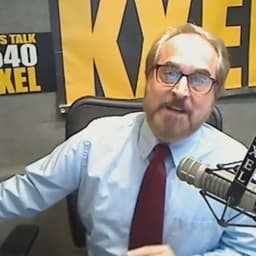
Let's go now to the Patriot Mobile Newsmaker line, and I'm pleased to welcome Todd Sheetz.
Mr. Sheetz is a retired real estate investment banker, and now he is an author and commentator.
You can read his work at his sub-stack site, which is toddsheetz.substack.com, or go to his website.
You can see it there as well, toddsheetzwriter.com.
Mr. Sheetz, Jeff Stein, filling in for Todd today.
Good to talk to you again, sir.
How are you?
Jeff, I'm doing fantastic.
It's great to be with you again.
Recently, you posted at your sub-stack an interesting piece about the China-U.S.
economic relationship in the wake of the Trump-G summit.
And there are some folks who are kind of taking jabs at it saying, well, it didn't do anything.
It wasn't important.
It was nothing more than photo ops.
What's your assessment of that?
Yeah, I think that the criticisms of Trump that kind of have come from both sides of the aisle in some cases are misplaced in that they failed to understand that what he's doing is managing the Xi and China relationship in the context of a total change in the geopolitical kind of global picture.
You know, and if you just think about it since his first term
First of all, we've significantly increased tariffs on China as a result of Trump's administrations from about 3% when he first came into office in Trump 1.0 to somewhere around 25 to 30% today, which I think is part of isolating China and help rebuilding America.
At the same time, we've seen a dramatic swing in Latin America away from
China influence, Russia's influence, away from left-oriented policies and back towards pro-American, pro-capitalism-oriented policies, largely because of the efforts of Trump.
And specifically, we've seen big changes happening there in Venezuela and more recently, we're looking at things in Cuba.
North of us, we've seen a big change with the recent agreement in Greenland.
where we've got perpetuity, exclusive rights to put military bases there and make a buildup that will help protect the North waterways that are so critical to the future up there.
We've seen it in Europe and we've seen it in the Middle East.
And so I think one of the big things that Trump is doing is he's dramatically resetting the chessboard, if you will, in our favor.
at the same time trying to make Xi feel like he's building a relationship and a friendship with America that helps keep that relationship in the best place it can possibly be while Trump is pushing through these other initiatives.
Too many times, it is my opinion, that folks who try to analyze this.
In other words, let's analyze the Chinese mindset.
They make the presumption that their system is like ours.
and that their people will respond as our people would and their leaders act as our leaders would.
You've got to understand the mindset of the system first and that makes a big difference in how you deal with them, correct?
My point is I don't think that people as they analyze it are coming at it the right way.
Yeah, I completely agree with you, Jeff.
I mean, you have to keep in mind in these kinds of communist controlled
authoritarian systems, you basically got a small group of about 10 people, which are basically or less, I think it's about seven at this point in time, that are really the inner circle for Xi and the people that are really making the decisions to run China.
And they have to repress basically 1.4 billion people and keep them from having the freedoms and the economic opportunities
that a system like ours would bring to them, which would be substantially better for them all the way across the board.
But they have to repress and suppress those freedoms and opportunities in order for them to stay in power.
And that creates a totally different equation in terms of the way they interact with their people, the decisions that they make, and really the reasons that they oppose us around the globe.
Because the more prosperous America is,
And the more aware their citizens are of that prosperity, and I don't just mean economic, but socially as well, and from a freedom perspective, the more difficult it is for that small body of seven to 10 people to keep control over the 1.4 billion, who they are repressing in order for them to stay in power.
Todd Sheets is our guest, his sub-stack newsletter on wealth and progress.
It's free of charge.
Mr. Sheets is also the author of the book 2008 What Really Happened.
He joins us on the Patriot Mobile Newsmaker Line on the Todd Starn Show.
Jeff Stein filling in for Todd today.
I have heard people again with their pop analysis of these things saying, well, obviously China will come to the table to buy US food and grains because otherwise their people will starve.
They don't care.
I mean, again, we're looking at it from the wrong perspective.
It's got to bring some level of broader glory to, again, the handful of people running things, correct?
I mean, there's not a situation where they sit back and say,
Well, we want to make sure the people are well-fed, not if it is contrary to their own personal goals to remain in dictatorial power.
Yeah, absolutely.
And it's shocking to me how frequently the mistake that you're alluding to gets made, and by some of the people that make it.
I mean, we recently saw Hillary Clinton within the last few weeks has talked about the importance of us
you know, having a dialogue with China about artificial intelligence, super intelligence, whichever you want to call it, so that we can work together to develop this for the benefit of mankind and prevent problems from occurring and that kind of thing.
And I had to take my head looking at that because, you know, we basically have 25 years of history at this point, where after we gave them an economic olive branch,
to help them try and recover from the massive destitution that communism created in that country.
And instead of accepting the olive branch and working with us under the kind of mutually beneficial Western standards that could have benefited both countries, basically what they chose to do was continue exploiting their own people, exploiting their relationship with us, and doing everything that they could
to manage that olive branch so that they could rebuild the Chinese Communist Party, they could undertake one of the greatest military buildups in history, and so that they could then stand up and oppose us everywhere around the globe.
So, you know, the idea that they're somehow going to work with us in a mutually beneficial way on anything, as I wrote in the piece that you were referring to, it's naive at best and dangerously foolhardy at worst.
The substack piece Todd sheets not substack.com Trump and G. It's not time to poke the panda mr. Sheets continues with us on the Patriot Mobile Newsmaker line There's a sense and again you've mentioned this but it's it is the kind of thing that just made me shake my head as well While why are we giving G all of the pomp and circumstance?
Why are we you know catering to him?
Well, it has to do with
the so-called charismatic leader approach.
He's got to feel important so that we can then keep him at arm's length while we take care of a few other things that may be even more central to our own security, both national security and economic security, correct?
Yeah, and you're right.
This is good.
This is so many people, you know, they get lost in
you know, what's happening on the surface and they miss the substance of what's happening underneath that.
And again, just to go back to a couple of things.
I mean, you know, we have taken away their control of the Panama Canal.
We have virtually kicked them out of Latin America and their influence there.
We have effectively frozen them out of future access to Northern waterways, which are very important by what we're doing in Greenland.
And at some point, we are going to have to confront them.
At some point, they are going to make a move, maybe gradual, maybe not so gradual, on Taiwan to try and get control of the shipping lanes in the South China Sea and throughout Southeast Asia, which are absolutely critical, not just to global commerce, but also to our commerce here and the buildout of our tech industry and those kinds of things, these areas where we lead the world.
But the last thing we want to do is to have to deal with them
right now on those issues, while we're still trying to resolve the conflict in the Middle East, and while I think Trump would very much like to turn his attention to Latin America and going after the drug cartels as a second focus right now.
But giving Xi the pomp and circumstance, making him feel like a big shot, being seen internationally on a stage with Trump,
You know, all those things are freebies that we can give them.
If you don't draw the wrong conclusion from it, it doesn't cost us anything.
We don't have to rescind anything on the Panama Canal or roll back any of the advancements we're making anywhere else.
That is a free way to try and make him feel like his standing is rising in the world.
He has a good relationship with us in spite of some of the things that are happening beneath the surface.
And so, yeah, I think I'm all for the approach that Trump is taking there.
This is probably an unfair question.
It will not stop me from asking it, but you're a person who deals with data and the impact of policies on markets, etc.
So I'm going to ask a political question.
If that wasn't Trump standing there next to Xi and everything else was the same in terms of the pageantry, in terms of the issues that we're facing, you wouldn't hear such criticism, would you?
From all
corners?
Absolutely not.
I mean, the traditional media, you know, which has very much been aligned with the Democratic Party for many years, would have been bending over backwards in order to portray this as a great moment of international diplomacy and building a relationship which is critical to the future and all those kinds of things.
It would have been the polar opposite of what we saw.
So with regard to superintelligence, what should the administration be doing now to
Maximize its potential for this country while minimizing harm and protecting that we are not at risk from those who might do us harm, like China.
Yeah, I think a great question, very important point right now, and I think this is being politicized to such detrimental effect for so many Americans.
And I think, fortunately, this is another thing.
I don't agree with what Trump is doing on everything.
But this is another area where I think they are right on the course that we need to be on.
This is the future.
Whether we are leading it or we're not, this is going to be the future.
And if we try and restrain and control our leading technology companies,
in a way that countries like China, Russia, or anywhere else in the world are not going to be controlling them, and we can't control what they do, then we will lose this race, and if we lose this race, we will lose the next 50 years or so.
And I think Trump, you know, he's boiled it down to a very good phrase, whoever wins AI wins.
He's right about that.
I believe that this is going to unlock a new industrial revolution in America and for the world.
And there will be difficulties.
Some of them will be dangerous that we will have to deal with if this moves forward.
But the best way for us to deal with those things is for us to remain in the lead so that our leading companies can not only be controlling the rollout in the safest and best way possible, but so that we can also be building the defensive mechanisms and tools that will help protect our systems from the potential downsides of all of this.
And I would just go back.
There are many false impressions that have been created of the Industrial Revolution.
Economic history is something I spend a great deal of my life and time on.
And those impressions are wrong.
What happened in the Industrial Revolution doesn't mean that there weren't anecdotal cases where people were exploited or taken advantage of.
But by and large, it was a period of time when rising worker productivity
led to falling prices for things like automobiles and other consumer products, which led to extraordinary increases in demand, which led to extraordinary increases in employment and workers' wages.
And it also led to things like shorter working weeks, and weekends off, and more leisure time, and the creation of the middle class.
And I believe in my part of heart.
That that is where properly managed which means first and foremost that we stay in the leading position that is where Artificial intelligence is going to lead us into the future as well
2008 what really happened understanding the great financial crisis That's the recent book authored by our guest Todd sheets on wealth and progress on Substack mr. Sheets great conversation really informative.
Thanks for the time.
We'll talk again soon
They are so great to be with you and I hope you have a great day
you as well and Todd sheets joined us on the Patriot Mobile Newsmaker line
News Talk 1540 KXEL, where Iowa comes to talk.
Janesville has been selected to participate in Iowa's Living Roadways Community Visioning for 2027.
That's a collaboration between the Iowa Department of Transportation, Iowa State University Extension and Trees Forever, an Iowa based non-profit environmental advocacy organization.
Of course, the city of Janesville as well.
And we're going to find out more this morning with Brenda Schmidt.
who's a member of the Janesville City Council and also works very closely with the Parks and Rec Department in Janesville.
Brenda, thanks for being with us.
Yeah, thank you for having me.
This is a long running program dating back to 1996, this living roadways effort.
What does Janesville hope to accomplish as part of it this coming year?
Yeah, the the history on this was pretty exciting to see.
I'd heard about this program several times and it always kind of sparked my interest of like, what could James will do?
And one of the biggest things that kept coming to mind for myself as being in this city council position for the first year was more like, what does the community want to see?
We've heard lots of things anywhere between a trail system that connects either to Cedar Falls or to Waverly or Denver or possibly updating some of our sidewalks and transportation.
Janesville is like no curb and gutter through most of it and so there's a lot of times where people are walking the roadways and that kind of deems for unsafety issues at times.
really it's giving the community the opportunity to talk.
That is my most exciting thing about this is that I get to hear from the community through town halls or surveys and then kind of see how this folds out.
What kinds of things has the community said to this point or is that still part of the process getting those surveys out to people?
Have you at least had some anecdotal feedback from folks about their excitement for this program which was announced
last week.
Yes.
So we went ahead and put a social media post out the end of September and we had an overwhelming amount of responses, you know, for the most part really positive.
And a lot of that was anywhere from walking trails.
We just had a new bridge completed here within the last few years.
And then if you know, Jamesville, we have a walking pedestrian bridge.
on our north side, they are not connected.
And so that was one of the biggest things that people kept saying is some walking trails, maybe a dog park.
They maybe just some improvements to our city park that we have against some landscaping features, things like that.
So there's really been some good positive feedback provided already.
We're talking with Brenda Schmidt Key of the Janesville City Council who works with the Parks and Recreation Department in Janesville as well overseeing that with her role in the City Council and Janesville selected for Iowa's Living Roadways Community Visioning Program for 2027 finding out about that one thing I didn't hear you mention is of course a lot of folks know that Highway 218 runs
right along the edge of Jamesville as well.
It's probably got more traffic than any other single road in or around the community.
Is that something that's separate from the program as it's been described to you?
Is there anything with the highway that people might notice if they're driving by in future years?
Yeah, so one of the biggest things, like you said, is the construction going on.
The partnership that they have with IO DOT is actually pretty cool because that allows opportunity for us to learn more about the projects, the construction, what possibly could be when I first moved to Janesville.
back, you know, about 2017.
I noticed that our community sign was still on the Old Waverly Road Highway, and so it's a beautiful sign, but with this new construction or new development in highway, no one was really seeing it if they were coming in from that part of town.
And so back then we pulled the committee together to start putting, we put in the news.
Welcome to Jamesville Sign.
And so one of the things that we had to do is work with the DOT and if people have worked with those type of entities before, it's kind of a process and you learn kind of what you can and can't do.
And I think with having this community visioning program and its long history, this allows opportunity for partnerships, possibly grants.
That's one of the biggest things is once the community will speak on what they're interested in, show some of the data,
This partnering program will come in, provide feedback, feasibility studies, surveys, and then really that's, I think, where partnerships will start to bloom.
You know, what does JANS will have to offer?
What does our county have to offer?
How can we utilize the partnerships that are already in place?
Seems like there's a combination of different possibilities between very functional things that you alluded to earlier like sidewalks or improving trails to things like beautification and community branding like the signage that you mentioned.
Do you have a sense of how other communities have used this and have they been able to kind of strike a balance between those couple of different goals and probably a few others besides?
Yeah, so one of the things my
Employment on my full time site is going to different rural communities in Parkersburg has been one that has utilized this program twice.
You know, obviously.
in the results of the tornadoes, but one of the biggest things that they provided in this program was a walking trail that had a lot of beautification.
You'll see that as you come in on that main corridor.
And so it just, it opens up the community to show more, just highlights it.
I think it becomes very welcoming.
And that is the hope is that, you know, we, Janesville is between two larger communities.
And oftentimes we have a lot of what we need in our community, but sometimes people go to other communities and we would just love to have this as being an opportunity for people to see what Jamesville has to offer.
We have a great river system and we often see that parking lot full of kayaks and trailers every weekend in the summer.
The hope is that like Parkersburg, we can maybe use it more than once.
That this will generate enough interest that we can see what other relationships need to be made.
Currently, Dumont is also working on a trail system and connecting.
And so I think that's just a big piece of it is if trails are so big and Waverly and Cedar Falls, what would this look like if Jamesville could connect that?
I know we have biking groups that pass through Jamesville all the time.
And it would just be great for them to have a formal system to use.
We're talking with Brenda Schmidt Key of the Janesville City Council after Janesville was selected to participate in Iowa's Living Roadways Community Visioning Program for 2027 and that was going to be my next question.
Some of what you mentioned about Parkersburg being another community that's been part of this in the years since the Iowa Living Roadways Program was introduced in 1996.
Are there some other places that you look to that have gone through this that you'd really like to use as a model or where you can potentially be partnered with them to find out more about their experience, kind of like a mentor from someone that's already been through this?
Yeah, so I would say.
Looking at kind of the list and you can find it on the communityvisioning.org page, the list of community projects that have happened in the past, as well as other communities that have partnered with this program.
You have a lot of kind of different opportunities for any more kind of streetscapes.
to even just trail paths.
Tripola was one of them that we were looking at as kind of they have this kind of it's called Tripola Sweetwater Trail and so it opens up as an opportunity for kind of a gathering space.
They use it also as a place where people can meet but then it gives like kind of a like a Q&A provides information on the community and I think it's just a really good opportunity.
trying to learn more from some of these that are about the same size as Janesville were a little over a thousand people and just seeing what they were able to do both from community input but then financial and financial investments as well including grant funding.
When it comes to grant funding I think we'll definitely be looking at some of those other communities the same size to learn more about which grants they applied for and maybe some points or some some advice that they can give to us.
One of the conditions for any town to be part of this Iowa's Living Roadways Community Visioning program is to have a committee of volunteers who are willing to be participants and to offer their input and perspectives.
Is that still an opportunity that's out there or what's the timeline if that even is at a stage where it's still coming together when you'd like to have folks who would step up and be part of that?
Yeah, so part of the application process.
So in order to be part of this program, you had to apply answer several questions on, you know, highlighting your, your community, but then also what are the major needs that it has?
One of the things that they asked for was the name of committee members between eight and 10 people.
They really wanted to see a diversity as far as, you know, do you have business owners?
Do you have?
youth they even emphasize youth having different students provide their input as well as you know people of different abilities whether they're elderly or retired or just even younger and wanting to see what does the community need to have to thrive.
We did pull together a group of I think there's a little over eight people
worked with the city council, worked with other community members, asked them who they felt like would be a good fit.
And so we have a group of about 10 people and this varies anywhere from several retired folks to individuals who own their own business in Janesville, have a storefront as well as we have two youth, including my son.
I did not rope him into it, but I definitely told him about it.
And through my time with city council and
other activities he's learned a lot about advocacy and so he thought this would be something cool just to learn more about and instead of just telling what he thinks he now has a voice at a table so I'm excited for him and the other student that's sitting on this committee.
And beyond that, you know, we also have someone who is, has been working with the train system, the Canadian railroad train system.
And so I think that's going to be a huge asset along with our police chief, just to know codes and to understand more about the city pieces of it, as well as the railroad, since that goes right through Jamesville.
Well, finally, Brenda, I know this is dependent on what sort of projects the group decides to take on and where the whole direction of this visioning goes, but do you have a rough timeline in your mind for when people in and around Janesville might start seeing some of the impacts when they actually look out and around at the community and whatever may happen with this project?
Yeah, so that's one of the exciting things about this program is it has a deadline.
It's an it's an 11 month program.
So when I was able to ask committee members kind of their timelines, that was something that was really exciting to share because sometimes committees can seem like they can go on, but the main part of it.
the community visioning program itself does a lot of the work up front to ask the community what they want to see.
So already from that social post, we were able to get community members.
We have well over 37 comments on what they would like to see.
We will be meeting here at the end of October as a committee group just to learn more about these beginning stages.
And then starting in January and February is when they really start doing some of that surveying.
And then so we'll see actionable work happening to actually see a program come together.
I think that would look more like the end of summer to have a definite idea of, okay, this is what we're going to be doing.
this is, you know, we've worked with all the numbers and here's some of the grants that we can start applying for.
So while it's an 11 month program, there's still work to be done and my hope is that it'll give us the opportunity to not just look within the next year but possibly the next five years as a way to grow Janesville.
Brenda Schmidt Key is on the Janesville City Council.
She's been with us this morning talking about Janesville selection to participate in the Iowa's Living Roadways Community Visioning Program.
Brenda, thanks so much and congratulations.
Good luck with this project.
Thank you so much.
This is the station where Iowa comes to talk.
News Talk 1540 KXCL.
And we are joined by Hans von Spakowski.
Mr. Von Spakowski is senior legal fellow at Advancing American Freedom.
They're online at advancingamericanfreedom.com.
Mr. Von Spakowski, good to talk to you again.
Jeff Stein in Iowa filling in for Todd.
How are you?
Jeff, it's nice to talk to you too.
And yeah, you definitely are.
You are the heart of the country outside of the heart of darkness, as I call Washington, DC.
Well, you're welcome to move your base of operations here to God's country anytime, sir.
I'm really struck by this legal decision that came down last week.
It's a Biden appointee, a federal judge who says apparently it's okay for illegals to vote.
Tell us what the situation is and how did this ruling come slithering on through?
Well, this is a theory being tried out by, frankly, the left.
There's a number of these cases going on.
And the way this is coming up is that, as you know, the Justice Department has really stepped up criminal prosecution of aliens who register or vote.
And it's not just illegal aliens.
It's any alien.
You know, if an alien is illegally, they're also prohibited from registering and voting.
In fact, the felony under federal law.
And so this one particular alien down in Florida was being criminally prosecuted.
And this Biden judge said, oh, no, you can't prosecute her.
This federal criminal statute is unconstitutional.
And the reason he gives, he gets a little bit right, but he gets the whole thing wrong.
He says, look, the Constitution says that the ability, the power to determine the qualifications of a voter, whether you're eligible vote, in federal elections is given to the state.
He's right about that.
But he dismisses the fact that Congress has 100% power over aliens, naturalization, and most importantly, the conditions under which
They are admitted to the U.S.
And he says, well, that doesn't override this other constitutional provision.
Jeff, but look, he's wrong.
How do I know he's wrong?
Because the Supreme Court has issued a whole series of cases in which they have said federal, state, and local governments have the ability to keep aliens out of the democratic
self-government process.
And this decision goes against that.
I think it'll get overturned very quickly, hopefully, in the Eleventh Circuit Court of Appeals, but it's just wrong.
Well, you and I went to different law schools at about the same time as I look at your bio.
And as I recall, the judges at a district court level were supposed to follow the precedent of the U.S.
Supreme Court.
They are supposed to review statues in the light favorable to them being Constitutional as opposed to coming in with the presumption it must be flawed and have to be fixed What is it other than political?
What is it that has led to all of these judges?
sticking an elbow in the ribs of the Trump administration on all manner of things, and then we're supposed to say, oh, the judge said so.
It must be the case.
Well, I think there are two things going on here.
I mean, first of all, everyone should realize that Barack Obama and Joe Biden, without question, nominated and got confirmed to the federal bench, the most left-wing radical ideologues that have ever sat on
the benches of the federal judiciary.
But the other thing is, look, you and I went to law school about the same time.
I don't want to say how long ago that was, but a year and a half ago, Christian Adams and I co-authored, we did a series where we took a look at the top 10 law schools, rated by US News World Report, mostly Ivy League.
what they're actually teaching and Those law schools have turned into social warrior training camps and Those are the kind of individuals that are coming out of those law schools and then are getting appointed to be judges throughout the federal system and Look, there's been case after case after case in the last two years where
These federal judges, almost all of them Biden judges, have violated federal law, ignored federal law, twisted federal law in order to get the social policy or ideological result they want.
And this is happening constantly.
We're speaking on the Patriot Mobile Newsmaker Line with Hans von Spakowski of Advancing American Freedom, advancingamericanfreedom.com.
the website for the organization.
He joins us on the Todd Starn Show.
Jeff Stein filling in for Todd today.
Now you noted that this will very likely be overturned by the 11th Circuit.
Well, if you're a judge with an agenda to some degree, what do you care?
Right?
You have an appointment to the federal bench and
Even though you may know that you're going to get overturned, you've just caused all manner of problem, especially with an election in 29 days.
Again, they're not keeping score of whether you're overturned or not on appeal.
I mean, this is truly, and again, it's not just this incident, but this is truly taking this system
that is necessary for our self-governance and just turning it on its head.
Well, look, unfortunately, I agree with you.
And these judges, many of them know they'll get overturned and they issue these decisions anyway because the more they can delay the effect of Trump policies, even though they're they're legal, the greater they believe the chances are that hopefully a Democrat takes over either
in the president's presidential election or democrats take over congress and will stop these policies uh... i i look i'd like to be a kind of quick example please one of the worst judges in the country is a federal judge appointed by biden in massachusetts named brian murphy uh... the supreme court just accepted a case coming out of his court this is the issue of whether
illegal aliens are being removed from the country can be returned by the U.S.
to third countries, right?
Not the original country they came from.
One of the reasons the court, I think, finally took the case is that they had to stay his injunctions, which said the government couldn't do this three different times.
They enjoined it the first time, and he basically slightly changed his order and enjoined the government again
They stayed in a second time.
He did the same thing again.
I mean, that is the kind of defiance we are seeing in the federal courts.
I also learned, and I went to school most days, I've also learned that a federal or any judge's jurisdiction is limited.
In other words, if some of these judges issue these sweeping injunctions,
That's not exactly legal to begin with because then you are literally holding the country hostage based upon the whims of an individual federal court judge in an ultra liberal district.
So how is this even being given credence?
Well, you know, what happened was, as you know, the idea of national junctions came up.
a while ago, and the Supreme Court issued a decision saying these are not favored, these are not something that judges should be issuing with one exception.
And the one exception is if a class of plaintiffs is certified under the federal rule that applies.
Now, you and I both know the standards for that are really strict.
Right?
You have to meet very high standards before you can classify an entire group of people as a class, and therefore you can enjoin what's happening with them across the country.
Well, as soon as the Supreme Court issued that decision about, well, you're not supposed to do national injunctions unless you certify a class, these same judges started immediately, willy-nilly, certifying classes.
to get around it.
And in fact, you know, Justice Alito in that decision pointed out that they, the Supreme Court had left that big hole in their decision.
And that's that's how they've been getting around it.
It is discouraging to say the least when you see the system that and again, I go back to a kid in elementary school, you know, the system.
presupposes that justice is blind and these folks may have different interpretations but it's not political and oh how far we have fallen from that.
Hans von Spakowski of Advancing American Freedom, thank you kindly for the excellent analysis and conversation as always.
Look forward to talking to you again sooner than later.
Sure, thanks for having me.
But right now I want to go to the Patriot Mobile Newsmaker line and welcome journalist and author Kevin Mooney.
Mr. Mooney is the author of a book released earlier this year entitled Climate Porn, How and Why Antipopulation Zealots Fabricate Science While Targeting American Capitalism, Freedom and Independence.
Kevin Mooney, Jeff Stein, filling in for Todd Starnes today.
Good to talk to you again, sir.
How are you?
Thank you so much.
Thanks
for having me.
Glad to be here.
I wanted to talk to you today because the US Supreme Court back in session first Monday in October and all of that and there is a case that's pending called Suncore Energy versus Boulder County.
It comes from the Colorado Supreme Court.
Give us a sense of what this case is and what it might mean based upon the arguments that have been laid out in front of the court.
It also means that our constitutional order, under our federal system, all states are treated equally.
But what climate activists are trying to do here in this particular case, I think it's quite scary, they're trying to put one state, or if that matter, one municipality, one city in position to superimpose their policy preferences on the rest of the country.
So essentially, because climate activists couldn't get what they wanted legislatively through Congress, they're now trying to work through the court system.
And in filing this lawsuit against the Sunpoor Energy Company in Colorado and also ExxonMobil's defendant Nisu, too, they're trying to make the argument that fossil fuel companies, through global warming, are harming people across state lines.
And therefore, one state should be able to superimpose their policy preferences on the rest of us.
I mean, there are several problems with that.
uh... their arguments are scientifically involved with all the updated scientific research points out correctly that carbon dioxide is not a pollute but it's actually essential for human life on earth so white away the science behind their they're already been a pure book uh... but beyond that uh... they've seized on the strategy where you know but they a governor gavin newson could uh... basically tell people in west virginia uh... vermont or texas what do in terms of their energy policy that's really what the state here it's also a case about federalism in the structure of our constitution
And again, it's the balance of powers you accurately noted.
We have a certain amount of states' rights that are involved.
Again, this is a republic, a representative democracy.
And for any one jurisdiction, we talked about it in the last hour, or the last half hour, I guess, for any one judge, for example, to be able to have this national authority was never contemplated by the founders.
And in this case, the Colorado Supreme Court
uh... were you surprised given that it's colorado that the ruling came down it did when he did uh... months ago
uh... is somewhat although again you know anyone in the position authority is going to want to a grand prize themselves uh... and and maybe that's not so you can usual for the colorado supreme court to do that uh... they would only make themselves more important but they've opened up this argument uh...
And I hope the court takes on the structural constitutional argument.
The other part of this case is federal preemption.
The defendants are arguing, I think correctly, that there's federal preemption involved, that the Clean Air Act is actually what covers some of these climate and nuisance claims, and that the states really don't have the authority in this area under our federal system.
And that's a fair argument, but I think the more compelling argument, like I say, is sort of this extraterritorial state overreach.
uh... where you're trying it like that you did your authority at the state boundaries or you know for example if you're someone in texas filling up your gas bank to figure stuff you voted for a state legislature that uh... support the portable energy but my gas prices are so high and that could be because all of a sudden california or washington state or oregon are in position to impose their policy preferences on the rest of us to say that uh... we're gonna use these nuisance laws to translate across state lines
and use the court to the back door really to put our policy preferences on top of the rest of it.
So there's a lot hanging in the balance with this case, there's huge ramifications.
Kevin Mooney, journalist and author is our guest.
His website is kevinmooney.info and again the book released earlier this year, Climate Porn, The Good Folks at Bombadier Books.
Put that out for our information and enjoyment last February.
Mr. Mooney joins us on the Patreon Mobile Newsmaker Line.
That really is, to me, one of the interesting things about the case.
They could either decide it very narrowly based on just the four corners of the Colorado dispute, but because there are these broader implications at work, the court has an opportunity, appropriate opportunity, totally within their purview to say, we're deciding it this way.
for the Colorado case, but by the way, this is not the vehicle by which you are going to drive into court in the future.
We're putting a halt to this right now.
What do you think the chances that they will, again, based on the oral arguments, which I believe were held today, what do you think the chances that they may go with the broader, more wide ranging
decision as opposed to limited just to the merits of this case?
It's somewhat less likely that they would go in the direction I prefer they go in on this broader question because Justice Alito recused himself because he owns a lot of shares and that's on mobile.
That's come up with the order, probably with the epically right thing to do, which means that you really can't have any defections from what I'll call the constitutional side.
that could be the temptation to issue a more narrow ruling if you want to keep uh... any coming back to happen on board with the majority that's just me speculating a little bit uh... but like i said because you're down one judge there could be the temptation to have a much more narrow ruling which i don't think it is incorrect i think that we have to look at the clean list and let's carers specifically so so uh... the clean air act is what would govern a question like this and not state court law
So, you know, the case could be settled in favor of the defendant that way, but it's a decision that's already pregnant with more litigation.
That's the problem with it.
And given Chief Justice Robert's propensity to try to work a broader majority with a less impactful, if that's even a word, ruling, I mean, that's what he has done in the past is try to steer toward
something that's not such a far wide-ranging ruling.
When you only have the eight, as you say, you can't have any defections just on the core to begin with, then you get the Roberts behind the scenes influence, I would suggest, that makes it less likely.
Yeah, that certainly is a logical way of looking at it.
That's kind of the way I'm looking at it right now.
However, if you listen to oral arguments this morning, of course, you can't take everything out of oral arguments.
Let's just, for arguments that you say is giving us some indicators.
deletion the question that any kind of error at this morning she did uh... indicate to the uh... to the defendant's attorney that she did she agreed with the concerns about uh... extra state influence or extra territorial influence of that was a valid argument from her point of view that he seemed on board with that uh... have all made the point you know there's two you know concurrent argument you're the one about preemption and one about
the structural constitutional questions and yet why can't are you suddenly leading now with the structural constitutional questions when your brief seem to emphasize mostly the preemption question as if to have no sort of signal and that if you stick with us on the preemption question that we may act you can probably win handily uh... where as you do if you don't try to put a touchdown passable that it's a little more dicey uh... that's that's just one way of looking at it like i think you can't take everything out of oral arguments
you can see where there's sort of like a lot of posturing and jockeying and worst trading going on here which argument is going to carry today i will say one thing it gives me some hope that structural argument is that the climate activists have overreached so much
You think about it, there will be no limit at all to climate litigation and where it goes.
If you want to make the global warming argument, well, that's international, not natural.
Every energy company will be open for liability all across the whole company, or all across the whole globe, rather, based on what I think is a very wrong theory about global warming.
But with that in the box for a minute, I don't think this was really about the climate or the environment as such.
It's really about climate activists and trial lawyers trying to create new revenue streams.
That's what it's about at the bottom.
Why climate porn?
Why that for the name for the book?
Well, that comes back to one of the chapters that explored what was happening in our educational system.
During the COVID-19 shutdown, a lot of parents, for the first time, really saw it was being taught in their schools.
And of course, a lot of it got into questions of conventional pornography.
If you look in the textbooks, what was being co-worked on these students, it was really terrible.
My argument is the same thing was happening with how they were teaching science.
you know it's with what's happened with climate science the activists are trying to teach kids do you have the ending written and you court your way to the to the preferred outcome that is not the scientific method the scientific method to take a hypothesis tested and see that hold up on the scrutiny the process matters so in my view uh... what what is happening with so-called climate scientists really an exercise in pornography that every bit of damaging young students at the conventional version it's a distortion of the scientific method
And certainly in the public schools, especially if we should get back to teaching hardcore science and not politicize it and not push this political agenda upon our students.
And again, the the folks who have shall we say an addiction to certain types of information.
I mean, it's the same thing here.
I mean, they get so fired up and excited and devoted to it.
And again, it has the detrimental.
affect to our young people as well.
So the US Supreme Court heard oral argument in Suncore versus Boulder today.
As you wait for the ruling, go online, Amazon or wherever you get your good books and pick up a copy of Climate Porn by our guest Kevin Mooney.
Mr. Mooney, thanks so much for the excellent insight and we'll be watching as this case moves through the court.
Thank you, sir.
Thanks so much for having me.