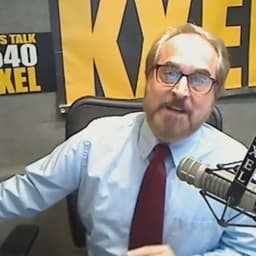
News Talk 1540 KXCL where Iowa comes to talk.
If you're a farmer or rancher who feels like the global food system is stacked against you, our next guest would likely agree that you're maybe on to something.
Austin Frerick will be making a presentation at the University of Northern Iowa Wednesday evening called Game Over and Incorporate Agriculture's
Game of Monopoly.
He's the author of Barron's Money, Power, and the Corruption of America's Food Industry.
We talk with Austin Freirek.
Now, thank you for being with us.
Yeah, thanks for having me on, Tim.
So I mentioned farmers and ranchers.
I also suspect that you would say maybe consumers are just as likely to be feeling the impacts of food industry corporatization.
Oh, yeah.
So I mean, honestly, the first slide I show people when I start talking is what the average American spends at the grocery store compared to other countries.
And USA actually just released new data last month on this, where of the 100 countries that tracks in the world, we spend the six highest in the world.
That's kind of the excuse for the longest time.
Well, hey, all this destruction from these production models, at least it made us cheap food.
And that's just not true anymore.
And here's the thing, most people feel that like you just feel like you're paying more.
also for lower quality stuff at the grocery store.
And USA data backs that up now.
And we're about dollar for dollar even now with Italy.
Anyone that's been to Italy knows when a dollar gets you there, it's very different than a dollar here.
Well, let's talk about those other five countries.
Let me ask about them.
I'm guessing that maybe there's some mitigating circumstances when it comes to why their food prices are higher that just wouldn't make sense trying to apply the same rationale to our food costs.
Yeah, so actually, I know, I believe Israel has the most expensive food in the world, which given the current war is not shocking.
Other countries higher than America right now are Switzerland.
Makes sense.
Switzerland is one of the most expensive places in the world.
Norway, Denmark, and Portugal.
And let me come back to farmers as well on the other side of the equation, even though food prices are high, I don't think there are a lot of farmers out there that feel like things are easy right now and that that food dollar is coming to them.
Oh
yeah, so I mean to me, actually speaking of the food dollar, to me, the food dollar is the best.
metric to use of the failure of USDA to maintain competition in these markets, where for every dollar Americans spent at the grocery store, farmers in America received the lowest ever recorded in American history.
It's about 11 cents.
After New Deal reforms of President FDR, I think it was like 52 cents in the dollar.
So first of all, imagine what rule I would be if 30 cents in the dollar went back to them.
But keep in mind, too, with farmers, they're getting hit both on the input and output side.
There's consolidation on the seed and inputs, but then also like who are their buyers.
So it's like they're really being hit hard here.
We're talking with author Austin Frerick.
He's a native Iowan and author of the book Barons, Money, Power, and Corruption of America's Food Industry, and he'll be making a presentation at the University of Northern Iowa on Wednesday.
This coming Wednesday, that presentation titled Game Over, and Incorporate Agriculture's Game of Monopoly.
So 89 cents that's not going to farmers in that food dollar.
Where is that money going?
It's going to a few...
all garks or, you know, I used to term monopoly, but it's just honestly large or parentheses that concentrate and dominate a market.
And to me, the best example of this is meatpacking.
The meat industry in America is now more concentrated than, you know, when we broke it up a century ago.
I mean, you've had stories the last few years, middle schoolers working in these slaughterhouses.
The largest meat packer in the world has been accused of bribing meat inspectors, engaging slave labor in the Amazon rainforest.
I mean, the amount of corruption and the low quality-ness and the decay of the space is everything right now.
And the other thing to keep in mind here, too, is we talked about how you're paying more for this stuff at the store.
You know, they're swindling farmers, but then it's also the workers.
They're really gouging the workers or underpaying the workers.
There's been a lot of lawsuits over this in the last few years, too, here.
When it comes to, again, those prices, that $0.89, do you see retailers taking an exorbitant share of that as well?
Or is this strictly in that middleman area between when this product leaves the farm and gets to the store?
So I joke.
So my book profiles ate Robert Barron's in the food system.
And I joke to people that Walmart is the king of kings here.
Like Walmart would be the head baron because
I mean, to be honest, when I started this, I didn't think of Walmart as a grocery store, but they're the largest grocery store in this country.
I mean, they sell one in three groceries.
The most powerful person in the American food system is Walmart buyer because you're buying food for one in three people in the country.
And a phrase someone in the grocery industry told me is big begets big, big boys like to play with big boys.
So the creation of Walmart means all these other companies get big too or buy other companies.
So they have some competing power against Walmart.
But yeah, I mean, that is what's going on here too is like.
there was a lawsuit that the Biden administration started, the Trump administration later dropped where Pepsi was accused of essentially one grocery store in North Carolina was trying to lower prices for consumers.
And Pepsi was so afraid of Walmart's largest customer.
So Pepsi started purposely raising the prices on this grocery store so it wouldn't be price competitive of Walmart, because they're so afraid of upsetting its largest customer.
But first of all, what kind of world we live in, we're now Pepsi is scared, you know, or Pepsi is running scared, but
That's where we are.
And so that's the scary thing here too is we're seeing these big boys really undermine these competitive markets because let's never forget the goal of any corporate executive is monopoly.
That's where profits are.
You don't want competitive markets.
We want competitive markets because that's how farmers get a fair price, workers get a fair price, and you pay a fair price in the store.
And I just think it's gone too far one direction.
We're talking with author Austin Frerick.
His book is
Barons, money, power, and the corruption of America's food industry.
It's been out for a couple of years.
But Austin Frerick will be at the University of Northern Iowa for a presentation which is hosted by UNI's Center for Energy and Environmental Education.
It's Wednesday, the presentation called Game Over and Incorporate Agriculture's Game of Monopoly.
And that would suggest that there are some strategies that you think can work to change the status quo.
Give us an example.
Oh, yeah.
I mean, so much of
For me, this book is, how do we get to this moment?
But then you have to understand how you got to a moment in order to fix it.
And that's what I want to focus on.
And that's, I'm working on my next book, and it kind of really expands on the idea.
But there's a lot of cool stuff going on in this country.
How do we take those people doing a right in scale?
And like, in the Iowa context, I mean, Iowa has the best soil in North America.
Yet, to me, I was the candidate in the coal mine for the food system.
We have a second highest cancer rate.
We have a water crisis.
We have an obesity crisis.
But it doesn't have to be this way.
We should be the Tuscany of North America.
And there's a lot of people in Iowa doing cool things.
It's edgy to say this in Iowa, but to me, the best thing we can do in Iowa is phase out ethanol and put animals back on the land.
We're taking the best farmland in the world and we're wasting it in our car instead of growing food.
It's making food more expensive than the sort because you're not growing food.
But I really, to me, my big focus is putting animals back on the land.
The best example of this is butter.
Americans love Keri Gold butter.
It's number two butter in America right now in the grocery store.
It will soon be number one.
Whereas most butter in America has come from Bakersfield, California, is cousing on industrial feedlot next to oil rigs, eating ethanol byproduct.
Because of a lot of corn in their diet, that's why it's fiber.
That's why it doesn't spread well.
It's why it doesn't have good flavor.
And so like that carryable butter people love is that's just the butter most people grew up on.
Like that's why butter used to be made in Iowa.
Let's go back to that.
Because here's the thing.
Most corn and soy production in Iowa in the future will be robotics.
That's not maybe a bad thing.
But to me, there's only so many animals on land one person can look after.
Like that's why I want to focus on is putting the family farms back on the landscape in Iowa because that's how you stabilize rural communities.
They pay taxes.
They send their kids to local schools instead of these industrial models where essentially a few people benefit from and they take all the money out of these these communities.
Well, let me ask about practical strategies from a consumer standpoint.
And if I'm going to the grocery store and I've got the butter that's there on the shelf, I may not have a lot of selection.
What's a realistic way for me as a consumer to encourage, for the lack of a better way to put it, better behavior?
Yeah.
So let me just start by saying that we heavily subsidize chips and pop.
Like it takes money to be healthy in this country.
That carry-gold butter is not getting subsidized, that pasture butter.
That industrial butter from Bakersfield, California is.
That is really screwed up.
And that's also why I think the current Farm Bill Coalition is breaking down in America.
I think it's been under-appreciated how much Joe Rogan has really changed the diets of young men.
It's what you can do at the grocery store is I kind of want to go back.
My whole book is like individual consumption won't change stuff.
We got to change these structures.
And I think the best thing you can do locally is really
Colleges and schools buy a lot of food, pair up the farmer doing it right with these colleges.
And a really good example of this is actually Maine and West Virginia.
Both states require that all presidents, colleges, schools in the state have to buy from a certain percentage of their food from local farmers.
And it scales up year after year.
By the way, what I love about this is the politics are everywhere here.
It's not just like one party or the other.
I mean, I'm working with Texas Republicans.
I'm doing something similar.
Why is Iowa not doing this?
I mean,
Why are we serving in, you know, Amazon rainforest beef in our local schools?
We should be having Iowa beef service, especially right now, given the struggle cattle ranchers are facing.
So that's what I'd rather do is like, most people are barely getting by, food's expensive, you're being gouged.
I want to focus on that procurement stuff because it really helps drive down those economies of scale, build up that local system as we face out this old system.
At the same time too, we really need our state AGs and our department of justice to step up and police these markets.
Like there is, you know, the amount of self-dealing corruption.
It's just so rampant in this space.
It's just a pinata saying hit me hit me at this point
What you allude to doing some things with levers at the macro level the state level for example Let me just come back though to that that farmer that rancher that we started with What can he or she do?
Is there anything that they can do to try to help the situation look any better?
Most of them are juggling like 20 different balls.
I don't want to put it on them I really think you see a farmer
you like it, the farmers market, a friend that's a farmer, go advocate for them, pressure your school, like really pushing you and I to buy look like why is the UNI cafeteria, we should serve more food, more local Iowa food.
Luther college up in the core is actually really good at this.
Life is hard right now.
They're doing a lot.
It's more of our our lawmakers are just failing us right now.
Why is this not a piece of legislation and I will, you know, why is this not being passed and signed by the governor?
Well, the presentation at the University of Northern Iowa on Wednesday this week, game over, ending corporate agriculture's game of monopoly.
There is registration that's required, but it is a free program to attend in the evening on Wednesday, October the 14th at the University of Northern Iowa Center for Energy and Environmental Education.
Our guest this morning, Austin Frerick will be there and he'll have a lot more to say.
He is the author of Barron's Money, Power and the Corruption of America's Food Industry.
Austin, thanks for being with us.
Yeah, thanks for having me on.
This is the station where Iowa comes to talk.
News Talk 1540 KXEL.