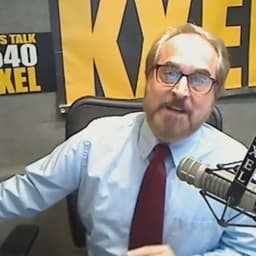
Hey, my pleasure, Jeff.
We hear a lot about affordability.
We have all sorts of folks saying that the economy is bad, the economy is horrible.
All right, what's the truth about all this, please?
Well, we have an economy that in many ways is very, very strong.
We have, we had very, very strong record income growth in 2025.
We've got a pretty strong GDP growth right now, just revised up to 2.2% for the last
quarter which is a pretty substantial upward revision we've got a lot of business investment we've got a huge boom in business investment that tends to flow through to higher productivity and higher wages so they're a lot of positive of course there's one very very obvious negative which is we're dealing with a supply shock price shock in oil and we already had high prices from a crude oil shock in the middle east when we got a second shock a shock on top of the shock of this one specific to diesel because of the ukrainians
bombing all those refineries in russia that specialize in producing diesel and so now we've got this sort of this double price shock and that hurt and uh... for the past several months we've now been in the situation where prices are rising faster than income so people are falling behind a little bit again if they were in the biden years after the opposite last year so this is the challenge we've got we've got a lot of very strong elements uh... economically and even in the employment report they came out today jeff we saw these headlines about how
so few jobs were created but you know they they produce two different survey from the bureau of labor statistics and the establishment survey the one with a survey employers was weak but the one with a survey household was actually very strong so a lot more people said they were working and you know that that kind of a dichotomy makes you scratch your head because you know which one telling the truth it's hard to say uh... but that kind of a story of the economy right now we've got
kind of a lot of very good indicators and we've got this one big, very negative one with the energy price situation.
And as I mentioned last hour, yes the jobs numbers overall fell short of expectations, but when you factor how many government jobs were lost, the actual private sector gains
We're even stronger, certainly not what the so-called analysts wanted, but still not bad when the private sector gain is, what, 46,000 in a month?
Yeah, that's right.
We need to have private sector job growth and, you know, government sector, public sector decreases, which, any time that happens, it's good because it means you have more people kind of holding the wagon if you were riding inside and they know
that
it improves the outlook going forward.
We would like to see a bigger number, of course.
But as I said, we did have a big number on the household survey, which kind of suggests that you've got a lot of people that are doing something that they consider employment, but are not showing up on a payroll somewhere.
So they might be doing some kind of a geek economy thing or working something app-based or whatever it might be.
they're reporting that they are employed uh... and uh... you know that may be a better indicator than what we're seeing in the other survey united may be because it's hard to say with these things but uh... you know i can't say either matter which survey you're looking at the employment situation very strong we have very low unemployment country there are a lot of job openings our challenge is not that people can't find work our challenge is that prices are now again rising faster than incomes are rising and that's entirely
because of the energy price spike and so if we could get these conflicts resulting at that back to normal i actually think the economic outlook would be extremely strong but because it's been difficult to resolve the geopolitical situations we've now got the federal reserve saying we don't want these higher-energy prices spread to other things we're going to start raising rates and that could pull the economy overall and so that's i think uh... you know that you can only go so long with these conflicts before you you start to uh... it starts to become harder to just be passed on and i think that that's the challenge we've got right now so i really hope
you know we can get a resolution in around there get a resolution obviously that's much harder in uh... in ukraine and russia that one seems like it might go on forever but uh... it it's important for people to keep in mind the problem is not trump administration policies the tax policies have been very good the energy policies have been very good the regulatory policies have been very good uh... we've just got these geopolitical situation but of course it's like an energy prices but even with that
They're not as high as they were under Obama and under Biden when you had an intentional policy of thinking energy more expensive to save us from global warming.
And so this political idea that we keep seeing everywhere that things are unaffordable and you should vote for the Democrats, I have to kind of scratch my head and say the only reason some things are unaffordable is this energy price spike.
And the Democrats favor high energy prices as a matter of ideology.
So I don't think you can get a solution at the ballot box.
In less than a minute, how long will it take for things to write
themselves once the Iran situation is resolved.
Is that a six-month recovery, 12-month recovery, or what?
It probably takes six months to a year.
They say in the oil industry they say the prices go up like a rocket and float down like a feather.
There are just a lot of things involved in working through the supply chain and private inventories.
have been drawn down dramatically as well as you know government strategic reserves and so it's going to take a long time you know right now uh... uh... the latest information i've seen is that oil transiting straight-to-form moves is back to about seventy five percent of pre-war levels and so you know they did it largely getting closer to back to normal but it did take a very long time for inventory three bills and supply chain to return to normal and of course
diesel is now greatly complicated even beyond that because we've got so many of the Russian refineries that supply so much of the global export markets that are now offline.
I'm good, Jeff.
Thanks for having me.
All right.
So you're my neighbor to the north.
What in the blazes?
What's the worst atrocity of this fraud that you've heard of most recently?
And then we'll ask how you're going to fix this.
Oh, my goodness.
I don't even know where to start.
I mean, you know, it's $18 billion, you know, high risk programs.
And we had a former acting U.S.
attorney say he thought maybe even half of that.
uh... was fraudulent you know not billions and billions of dollars of our of our tax dollars and billions and billions of what should have gone to you know folks who really need it uh... stolen by criminals under the nose of keith ellison and peggy flanagan and and keith ellison uh... you know i think
The worst thing is Tim Wallace decided to fire himself, but Taggy Flanagan is looking for a promotion and Keith Ellison is looking for another chance at it.
Minnesota voters have a big choice in front of them.
Every office in Minnesota state government is up for election here in 32 days.
How do you turn it around?
I mean, obviously it didn't happen overnight.
Some of these bad actors, they've already funneled the cash out of the country.
It's not that you shouldn't go after what was stolen, but you have to look forward to how to prevent it in the future.
So what do you and like-minded Republicans in Minnesota hope to do to make sure we're not still having this conversation in one, two, or five years?
You know, we have to fundamentally change the culture of state government here.
We have too many folks in these agencies that are handling these programs that think spending money is the goal or spending money is the achievement instead of trying to make sure that we're actually, you know, impacting people's lives who truly need it.
And, you know, this happened really because of, you know, a perfect storm of
woke ideology and incompetence in Minnesota state government.
You have folks who, if they did notice there was a problem, were shouted down because there was racist to question whether certain organizations were breaking the law.
That's gotta be frustrating as all get out because if you are shouted down and again the tag of racist when all you're doing is asking a question about what happened to the money,
I mean, is there a tipping point now where Minnesotans are saying, okay, we get what you were saying and we want you to do something about it?
Yeah, absolutely.
And that's why we're seeing a very different environment here in Minnesota than we're seeing in a lot of other places around the country.
Minnesotans are furious about it.
We like to think of ourselves as generous people, but we like to think of or have thought of our government as being clean and we learned otherwise.
brutally over the last a few years the federal government and the federal you know the u.s.
attorney's office has been prosecuting uh... these cases for uh... the last few years and then we finally you know that the cover has kind of really been blown off of it uh... in these last couple years when we uh... got to a tie in the minnesota house we made a priority to have a fraud prevention committee uh... that continued to you know expose some of this stuff
There was the Nick Shirley video at the end of last year with the infamous Leering Center that I think really, you know, put a fine point on a lot of this stuff that the state government was giving money to something that, you know, some child care center that couldn't even spell learning correctly.
And then just continue, the hips have continued to come.
We just got
for example recently uh... the news that uh... uh... uh... uh... program in hennepin county to give money to businesses for operation metro search even hennepin county that you know uh... woke uh... uh... lefty is running back back county had a shut down this program when they realized how many of those applications were fraudulent we just have this culture fraud here uh... in the state of minnesota that has taken root and uh... we have to deal with that
The Minnesota Senate has a very narrow Democrat farmer labor, DFL majority.
As you've noted, you've got a flat out tie in the house.
I imagine that's, you know, a lot of us think of Minnesota.
It's like, all right, there's Minneapolis, St.
Paul, and you've got, you know, Duluth and some of these other areas.
But.
It's largely a rural state.
I mean, are the good rural citizens of Minnesota figuring it out and that's why the legislature is so close and perhaps we'll tip in 32 days?
Well, most of the rural areas of Minnesota now are represented by Republicans in the state legislature.
Like you mentioned, we have the closely divided state legislature in the country.
201 legislators, 101 Democrats, and 100 Republicans.
And so we do, you know, and when it comes to winning a majority, we're going to have to win some seats in the suburbs that have been closed in the past.
We're going to have to win some seats near a couple of regional centers.
But we've had some really, really close elections.
Last year, when it came down to the difference between us having a one-seat majority or a tie, we lost one seat by 13 votes and 20 ballots were thrown away.
We contested that, the court ruled against us, and that was kind of a fight at the beginning of the legislative session as well about what to do about that race.
But this is a very, very close.
Last election was very close.
This election is going to be very, very close for both the House.
And I'm optimistic that we're going to have a chance to win.
We've got great candidates working really, really hard.
He's the GOP floor leader of the Minnesota House, Harry Niska, joining us for another minute or two here on the Todd Starn Show.
And I just wonder, I mean, I understand these statewide office holders, they're Democrats, they're doubling down on it.
I wonder if you're getting any sort of cooperation from Democrats in the legislature, given the balance of power, given the fact that they're more directly accountable to citizens as opposed to a statewide elected official.
I'm just looking to see how quickly you folks can turn this thing around and if you're going to get any help from the other side.
Well, we'll see how things shake out in 32 days.
We definitely have seen Democrats acting like they've gotten religion on the topic.
We did pass
uh... bipartisan on a bipartisan basis independent inspector general uh... bill last uh... this this last year uh... where we finally got democrats to be on board with getting tougher on product but we didn't get all the way there there are accountability measures we want to pass
against bureaucrats who allow fraud to happen.
We want to do more to help prosecute these fraud cases on a state level.
But Democrats certainly are going to voters right now and trying to pretend like they're really serious about the fraud.
And hopefully we have, we do win both chambers and we have great governor candidate, the strongest governor candidate that I think we've had in a very long time here on our side.
So we just have to win this election.
Hopefully we'll be able to get some stuff done here next year.
News Talk 1540 KXCL where Iowa comes to talk.
The University of Northern Iowa has been highlighting lots of favorable news this fall from a best ever ranking by US News and World Report to wrapping up a year long 150th anniversary commemoration.
UNI has seemingly been on a winning streak and during today's program we talk with UNI spokesman Pete Morris.
Pete, thanks for being back with us.
Yeah, you bet.
Tim, it's always great to talk about the wonderful things we've got going on here at the University of Northern Iowa.
Well, remind us about the details of last month's US News and World Report rankings as a starting point.
Yeah, absolutely.
We were pretty excited to move into the top spot as the number one regional public in the Midwest is ranked by US News and World Report and really that's a reflection of a lot of things, but you know, two of the factors that really weigh in our affordability, you know, the value that folks are getting here, but also our graduation rates.
you know, one in eight UNI students now graduates in three years and our average graduation rate is about 25% higher than our national peers.
So, you know, we're really excited about the value, but also the fact that students are, you know, getting out into the workforce even more quickly than before.
So number one, regional public university in the Midwest.
So the peers that we're talking about for that are, I assume, schools like Illinois State and Nebraska Omaha and those types of universities rather than University of Iowa or University of Minnesota, those bigger schools.
Yeah, you'll also get some of the, you know, the Minnesota schools in there, folks like the Wisconsin schools, Wisconsin lacrosse, that sort of thing, Mankato.
So, yeah, it's really a good measure of institutions that are very much like us in the Midwest.
So what other factors are significant when you look at those rankings and as you make the appeal to students whether they're local or whether they're a little more further afield that UNI offers good value that UNI provides the type of educational experience that they're looking for?
Yeah, one of the things that we just had family weekend here recently and we had a lot of families from the neighboring states were who are taking advantage of that neighboring state rate, which means they can pay that same.
You know, around $10,000 in tuition and fees is Iowa residents.
And so I think that's one of the things that in conversations with those families was the price point was where they started.
But then they really found that we had the academic programs that their students wanted.
And so.
whether it's nursing in the health fields, elementary education, business accounting, engineering, construction management, the list goes on, but those are the programs that are not only in demand that we're hearing from the Iowa workforce.
Business leaders that are programs that they want graduates in, they're also the programs that students want to pursue.
We're talking with the University of Northern Iowa spokesman Pete Morris about a sequence of good news for the University of Northern Iowa, highlighted by last month's rankings from US News and World Report, which put UNI at the top when it comes to regional Midwest public universities.
And I know graduation rates are a big deal when it comes to both the
Value proposition that the university makes to students and families and in terms of these rankings as well and it seems like students are graduating on schedule or maybe even a little bit ahead of the traditional schedule.
Yeah, what we found is about one in eight of our students now graduating three years and that's a combination of factors.
They're obviously bringing in some credit with them that they accrued during high school.
But what it's also allowing students to do is, hey, do I want to?
pick up another minor or do I want to take another major?
So we're finding a lot of students, you know, are not graduating with maybe one or two majors.
We've got some high achievers who got three minors.
So, you know, they're getting a lot of very useful credentials and experience during their time here.
And the other piece that I think is important in those US news rankings is the fact that our perception among the public and peers
into that as well and so UNI's reputation not only here in the state of Iowa but across the Midwest is very solid and I think employers know that if you're going to hire a UNI accounting major they know what they're going to get and so that's what we hear across a number of disciplines is it's a known commodity that when you get a UNI alum that they're going to bring skills and experience to the table to make them really being able to contribute to
the workplace immediately.
Let me come back to that three-year track, which I know the university has worked on for a while, and you made reference to the advance placement credits that a lot of college-bound students are able to earn now in advance.
Has that changed anything on campus or with advisors or just the whole campus experience, knowing that there are at least a fair portion of students?
You said one in eight that are going to maybe not be there as long as what would have been expected.
generations ago.
Yeah, there's a couple pieces to that.
Number one, if you decide to come here and you're able to finish in three years.
Obviously, that's a significant decrease in the cost to the student.
But what we're also finding is that students want to accumulate additional, whether it's credentials or an additional degree that's complementary to what they originally planned to study.
So the other factor is that we've got a lot of students who want to live on campus.
We're very close to capacity in terms of our residence halls and just the demand of students who
who wanna live on campus, who wanna be part of college activities, who enjoy our great food and our dining halls.
And so what the data will show you is the longer that a student lives on campus, they have better outcomes, whether it's graduation rates or career placement.
So yeah, that's a good problem to have is we've got a lot of students who wanna be here, wanna be engaged on campus.
And of course our folks in housing and dining,
an excellent job of making them feel very welcome here at their college home in Cedar Falls.
Talking with Pete Morris, spokesman for the University of Northern Iowa about a number of news stories that have come out over the last several months that have been good news for UNI trending positively, whether that's the US News and World Report rankings, or news about enrollment, which has been up.
There was a sequence of academic years where that enrollment number was declining, but it seems to have turned a corner.
Yeah, absolutely.
And that's exactly how we feel.
We've got in this fall census over 9,300 students, which is our biggest total since 2020.
But really the biggest piece of encouraging news there is we've got our largest freshman class since 2017.
So that influx of students is traditionally Iowa students.
And that's typically our bread and butter.
We've got students from all 99 of Iowa's counties, which we're pretty proud of.
But yeah, we had around 300 neighboring state rate students as well.
So those six states that border Iowa, those folks can get the same tuition and fees as Iowa residents.
And so that's brought a new dynamic to campus with a lot of folks from Minnesota, Illinois, Wisconsin, and the other bordering states here on campus as well.
If I've got the numbers right, that seems like about 20% of that incoming freshman class for the fall of 26.
Is that about right?
Yeah, so that's 300 total students from neighboring states.
So that's new freshmen as well as transfers.
And I know that that neighboring states news came out last year.
It's sort of a longer term plan because it was offered to the freshman incoming from the neighboring states and we'll probably have some other impacts as the years go by.
Are there some other things that you attribute that growth to?
Some other factors that seem to suggest that trend and how does it compare with broader?
Higher educational trends because over the years we've heard that the numbers have been declining for a lot of colleges and universities.
Yeah, it's an ongoing conversation in terms of not only how do you do this, you know, one or two years, but how do you sustain that sort of growth over an extended period?
And I think we've really bucked the trend in higher ed, particularly for mid and smaller size institutions.
You know, if you look across the state and across the region, those numbers have been going down just because of, you know, there's declining numbers of high school
graduates in large spaces across the Midwest but you know I think those academic programs you know I talked to a student yesterday from Wisconsin and she's like well my sister came here and had a great experience and I'm having a good time here now and I'm in the program that I want to be in so I think
That's our best recruiting tool is when students come here and they have a really good experience both in the classroom and on campus and form relationships that are really meaningful.
That's what I say to students when I'm talking periodically in classrooms is you're our best recruiters.
So we've got a very vested interest in making sure you succeed not only academically, but in your personal goals and in your life goals.
And so I think that's what we're seeing is students who are really and families who have had a good experience here who are spreading that word and helping a new generation of families experience you and I.
talking with University of Northern Iowa spokesman Pete Morris and I alluded to the 150th anniversary that UNI has been celebrating for almost a full year now dating back to homecoming last year.
What sort of momentum has that provided?
Are students interested in the fact that UNI has that sort of longevity?
Absolutely, and I think that's one of the fun things that we've experienced over the last year with the sesquicentennial celebration is it's not just been alums.
It's not just been staff, but the students have been very engaged.
We just celebrated the 100th anniversary of the Campanile and we've got a great group of students who who are able to play that.
The Carolina and the Campanile we've got homecoming coming up and talk to some students yesterday who were very.
interested in all the various traditions around homecoming and so yeah homecoming the parade is on October 10th 11 a.m.
on Main Street and Cedar Falls and that'll really kind of be the culmination of our year-long sesquicentennial celebration and it's been great to celebrate not only the 100th anniversary of the Campanile but it's the 50th anniversary of the Unidome and we've had folks reach out to us about hey
That's one of Iowa's iconic spaces.
And so we'll have a film crew here in October coming up from Iowa Public Television to do a segment on the unidome and its history and its place in Iowa and the Cedar Valley is really an iconic building with a really interesting history.
So, Pete, let me wrap up with you and I on this winning streak of good news.
And again, we're not talking necessarily about athletics, but obviously some good athletics news that's been coming you and I's way as well.
On top of all this, how do you keep it going?
What's on the horizon for you and I that you and the leadership on campus are excited about?
Yeah, absolutely and of course we had the football team knockoff number three Illinois State and they'll be back for homecoming against North Dakota So that's the great thing about playing in Missouri Valley football conference You're gonna see a ranked opponent just about every week But that's one of the things that you know president nook and other campus leaders have talked about is how do we sustain this momentum?
Going forward now that we've you know, we've had this very wonderful our tomorrow
campaign that's just exceeded expectations from a fundraising standpoint.
So again, I think now getting new families engaged from different markets.
Again, at family weekend, we had folks here from Chicago, Minneapolis, Omaha, Kansas City, Madison, Milwaukee.
And so we're getting new folks that are going back home and saying, wow, my students having a great time at UNI and maybe you should check it out.
So I think just expand.
standing that footprint a little bit beyond our traditional bread and butter, which is Iowa's 99 counties and welcoming new folks to the Cedar Valley who hopefully come and stay overnight and enjoy all of our great activities here and the restaurants and shopping and all that goes with it.
So I think getting folks to come and visit and stay for a couple of days is a great thing, not only for you and I, but the entire Cedar Valley.
Pete Morris, spokesman for the University of Northern Iowa.
Last month, UNI ranked number one by U.S.
News and World Report for Regional Midwestern Public Universities.
The latest news that's been news that the campus community has had cause to celebrate.
And Pete, thanks for being with us to share some of the details about all that.
Yeah, you bet, Tim.
And again, look forward to hopefully seeing a lot of folks at homecoming during that weekend of October 10th.
This is the station where Iowa comes to talk.
News Talk 1540 KXEL.