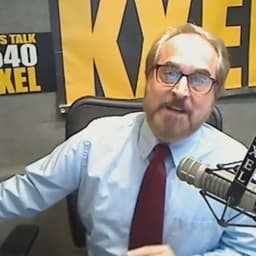
And as KXEL Live and Local continues in this 9 o'clock hour on a Tuesday, that's when you're hearing the conversation for convenience of schedules.
It's one we recorded yesterday, early afternoon.
It's our monthly conversation with the Auditor of the State of Iowa, the Honorable Rob Sand.
Auditor Sand, thank you for the time, sir.
You bet.
Thanks for having me, Jeff.
Again, the auditor, as do other state officials, joins us on a monthly basis.
This has nothing to do with the current campaign.
You know Mr. Sand is a candidate for governor.
That's not the topic of this conversation.
We'll do that another time.
This has to do with the office of the state auditor.
A couple of reports came out of your office recently, including one on
salaries in the executive branch, and this is interesting stuff over the past decade.
I know the folks at Common Sense Institute Iowa picked up on some of this as well, but give us a sense of what you piece together through this data that I guess is publicly available, obviously.
Yeah, that's right.
Public data.
Overall, from over the last decade, we've seen the executive branch
salaries go down by 7.6% when adjusting for inflation.
So that's everybody that is a state employee.
Could be guys at DOT, could be folks at the Attorney General's Office, just everyone working for state government.
We also, but we had a state government reorganization bill that made it kind of hard to measure
And so we looked at the offices that didn't change.
Those are the constitutional ones, plus the Department of Agriculture and Land Stewardship.
And those we saw the salaries go down in four, 35% and the Secretary of State's office by 10% over the last decade.
Look, as taxpayers watchdog, there's obviously a lot of important work to be done everywhere, but at a point where the
State's got a $1.4 billion budget deficit and regular Iowans are hurting it.
I don't think it makes sense to have salaries go up by 35% in the governor's office.
So again, of the statewide elected offices.
four of the six showed inflation adjusted salaries overall went down or were plus or minus relatively unchanged but the exception secretary of state up 10 percent governor's office up 35 percent is this
an
increase in person power or just the the salaries in other words those who are there are making that much more than they would have at the beginning of the of the reporting period
A little bit of column A, a little bit of column B. A lot of it is increases in salaries for the same people.
The other thing to keep in mind overall for the entire executive branches, part of the reason that the funding has gone down is much more reliant now on temporary workers and seasonal workers.
So those folks are going to have lower salaries, but they're also going to have higher turnover.
And as anybody who's ever had to train somebody on the job knows, when you're doing that training, you're usually got people working and not getting the job of one person done because you got one person walking and another one through it.
So there's costs there that we aren't necessarily able to measure.
But whether or not that's a smart idea sort of depends on the specific situation.
I'm curious as to why there is greater reliance on temporary and seasonal workers and what that even means.
I mean, for example, if you told me it was a farming operation, I could understand that.
I guess I don't understand how government has this ebb and flow.
Well, it's a good question.
It just totally depends.
I think the word seasonal to me, I think sounds off.
You know, a lot of times you think of farm workers.
In California for that, but I just think if you think about it as part-time that makes more sense or contractors that makes more sense
And if they are part-time then they are not receiving benefits Typically and so therefore I suppose Someone who is just looking straight at the bottom line could say well, we're saving money because we're not having to pay benefits.
We're not Making people full-time etc
But to your point, there's an awful lot of loss of knowledge of how to do the job, et cetera, when you continuously have churn.
Yes.
Yes.
And when you lose the know-how and maybe the memory of what you did when something like this happened five years ago, that can have costs
as well.
Obviously, with the COVID pandemic, that changed how a lot of people do business.
There's not as much travel.
We had never heard of the phrase many of us zoom until before The thing started and so now there's
all this
remote technology has that impacted travel at the state level as well because Some of us still think face-to-face matters, but you may not have
to
write for everything
Yeah, it has in fact
we
and the auditor's office will to our own horn here.
We reduced our travel billing 72%.
A lot of that was actually stuff that we put in motion before the pandemic began.
We did two things.
We changed our rules so that our employees no longer have to live in Des Moines.
So if they want to live in a small town in Iowa, we know that we've been letting them do that.
We signed them to more local audits and so that reduces their
travel costs and their travel frequency.
And then the other thing was just reducing travel overall because I opened up the office.
Same way I have 100 public town halls every year.
Jeff, I also care about the folks that are working inside the office.
And so I always had an open office policy.
And in 2019 had a lot of folks come in for a little one-on-one and a lot of them said,
Hey, we lose talented people because we make them travel more than they would have to in the private sector.
And I looked into it and kept hearing the complaint and they were right.
So we had a 72% reduction and a lot of that was stuff that we put in motion before the pandemic happened.
And again, this is the information that anybody can get from the state employee salary book.
Had there been prior 10 year looks?
like this one?
I don't know.
We hadn't done one prior, whether or not a different state auditor had done one.
It would be a good question.
And did this have markedly different results from the last time you did such a study?
Well, that I couldn't tell you.
I don't think that we've done one.
I think we would have had some of the folks who have been around the office for a few decades probably recall that.
Rob Sand is the auditor of the state of Iowa.
He joins us on a monthly basis here on News Talk 1540, KXEL.
You also recently penned an op-ed piece on a topic that we have talked about with a variety of people on this program, the Medicaid Fraud Elimination Task Force.
We've had some folks on who have said that wasn't such a great idea.
There are other ways of getting at things other than a task force itself.
Give us a sense of your view based on the op-ed that you put out.
Sure.
Well, this is pretty simple.
I mean, Task Force is just a bunch of people getting meetings and I think in this case what they're doing is they're just having meetings so that they can put out a press release and make it sound like they're doing something.
We have the Medicaid fraud control unit.
This is something that every state has.
That's the path to stopping Medicaid fraud, as you might imagine, and they've been underfunding it for years.
They know this if they wanted to really do something about fraud that would be an easy way to do it and Instead they just I think are looking to have meetings so they can get some headlines to make it sound like they're going to do something about fraud but this isn't complicated You also can look at the task force here and see who's sitting on it to see what they're focused on They had a seat for managed care organizations.
Those are the MCOs the for-profit companies that are running it
um, but Medicaid members and healthcare providers and here at the auditor's office, uh, none of, none of those folks, uh, had an opportunity to participate.
Were there other state officials involved?
The auditor's office was not given a seat.
I know the attorney general was asked to chair it, but are there other officials involved?
No, I mean, I think that's the bottom line is, uh, sure, the AG's office makes sense, but.
Medicaid fraud control unit typically works more often with the federal government.
And you would think if you were genuinely interested in cutting waste fraud and abuse, you'd probably invite the taxpayers, watchdogs, someone to be there from the state auditor's office and try to make sure that you also have an opportunity.
If you're serious about fraud, you wouldn't want to take away the power of the auditor's office to find it in the first place.
But here we are.
I think there have been some who have said, well sure, there's the Medicaid Fraud Control Unit, but there's nothing wrong with another set of eyes, namely a task force.
You're suggesting, okay, that may be fine, but you're duplicating efforts and you're not really addressing it well from either side.
In other words, the task force is not appropriately constituted and the Medicaid Fraud Control Unit hasn't been fully staffed, so really what you're doing is not
getting too good looks at it, you got too bad looks at it.
Am I misinterpreting?
Well, you know, look, we'll see what kind of recommendations the task force comes up with.
But I could think of a bunch that are common sense that you don't need to convene a bunch of meetings for.
Fund the Medicaid fraud control unit.
That would reduce fraud.
Everybody understands that when you have people doing the job of working against fraud, they'll find it and they'll send the message that it's
get them tackled and that'll also discourage people from doing it.
And then obviously, you know, let the auditor's office do our job.
Those are two pretty big differences you can make right there.
And I don't think you need to have a task force to tell you
that.
In the framework of government, under whose purview is the Medicaid Fraud Control
Unit?
The Medicaid Fraud Control Unit is required by the, by federal law.
And it's a piece that operates under, it's called DIAL, the Department of Inspections, Appeals, and Licensing.
Okay, so it lives
in... A state entity.
It lives within inspection, appeals, and licensing.
That's right.
State Hon.
Rob Sand joining us on News Talk 1540, KXEL.
I mentioned to the audience, you and I are speaking Monday early afternoon, and I'm going to ask a final...
Question which may be unfair because you're on the road and may not have much information on it but the White House is announcing a 15 billion dollar steel plant to be put in I believe Southeast Iowa
There's also been talk we had heard last week about the legislature potentially coming back into special session To look at an incentives package for that and I'm just looking for your reaction again You may not have had time to really study it and I don't want to catch you off guard with it But I'm just curious as to your reaction of that news that we are
expecting.
Sure I mean my growth has been at the bottom for the entire country for years
So about time, I'm glad to see an exciting opportunity.
But as everybody knows, the devil's in the details and it'll be interesting to see what it is exactly that they're considering in the special session and why they feel they need to have one and what the terms of the deal is being proposed.
You know, development's good.
Iowa's a great place to build and a great place to grow.
But, you know, we've seen this administration giving the farm away on data centers, so I'm hoping they put together something responsible.
He is the auditor of the state of Iowa.
You learn much more at their website, auditor.iowa.gov.
That's auditor.iowa.gov.
Mr. Sand's personal site is robsand.com.
Rob Sand, thanks so much for taking the time, sir.
I always appreciate
it.
Thanks for having me, Jeff.
That's Rob Sand.
He is the auditor of the state of Iowa.
Again, he has joined us throughout his term in office on a monthly basis, as do so many of the state office holders.
So yes, this is an election season, but...
This conversation was about things straight from the auditor's office, auditor.iowa.gov, and he was kind enough to join us in a conversation we recorded yesterday afternoon so you can hear it now on a Tuesday on News Talk 1540, KXEL, where Iowa comes to talk.
In the Cedar Valley at FM 100.5 and everywhere at AM 1540 and KXEL.com.
News Talk 1540 KXCL where Iowa comes to talk Westminster Presbyterian Church is the scene for the annual Fall Garden Symposium which is hosted by
Iowa State Outreach and Extension, the Blackhawk County Office, hosting that event on Halloween Saturday.
It's the 31st of October.
The Halloween date may be a little different for Stephen Eilers and company.
We're going to find out about that now as we welcome Stephen to talk about this event, which is just more than a month away.
Thanks for being back with us.
Well, good morning.
Yes, Halloween, huh?
Who, who knew?
Yeah, so do you have anything special that's planned for this?
Because it is Halloween.
Can you find some ways to incorporate that?
Well, I'm jokingly told some people that costumes are required, and when they show up, nobody else be wearing costumes, so that'll be fun.
No, it is non-costume, non-Halloween.
It is our fall symposium, normally the first weekend of November, but we moved it up to the last day of October with circumstances, but we're excited.
That's just one day early, but we are ready for it.
another really great garden symposium.
Now, Halloween, of course, people would be typically handing out candy.
You're going to be handing out all sorts of valuable information for gardeners.
Correct.
All sorts of stuff.
I mean, you know.
kind of like full-sized candy bars full of information.
It's going to be, we have four great speakers.
We start off in the morning.
It starts at nine.
People get their 8.30, you know, get checked in.
We have wonderful t-shirts for sale for the event.
They're long sleeves.
We have a great response to those.
We have a light breakfast and coffee.
We have wonderful coffee.
We have coffee all day.
You'd be amazed the amount of coffee we go through.
You'll be sitting in a great room.
You'll pick your table.
with your friends, and that's where you'll be for the whole day, for your lunch, for all of your seminars.
Again, four speakers throughout the day.
So we start at nine, we have two, then we have lunch, and it is catered lunch right there in the building, and then we have two speakers for the afternoon.
We have some vendors, and it's just a really great day of learning.
So if you like to garden, this is a place to be.
Maybe since the folks that are going to be enjoying the new information coming to them are staying in the same place, you should ask the speakers to be in costumes.
They're the
ones that are going to be
coming in.
Kind of like coming to the door on Halloween night.
Yeah, I'm sure they'd appreciate that.
I have a chicken costume I could wear, so I could...
jazz it up a little bit.
We're talking with Steven Eilers, Iowa State University Extension in Blackhawk County, the annual Master Gardeners Symposium.
The Fall Garden Symposium is going to be coming up on Halloween morning, and that's just a little more than a month away.
The Symposium theme, Life is Short by the Plants.
Exactly.
You know, as gardeners...
We do that we know we can't wait for spring to come so we can buy way too many plants and of course we see something this summer and
Then we see some on the clearance rack and then even now we're still buying things that they put on sale, you know, and rarely does a gardener regret buying a plant.
We regret not buying a plant.
You know, we weep for the ones left behind.
So that is certainly a theme and the people that come to this, this is not for superb gardeners.
This is for people who like gardening.
So if you're kind of basic, if you're just starting out,
Come to this, if you're really into it, come to this.
We try to find speakers every year who are very diverse.
We don't have it, it's not all vegetables one year and all flowers one year.
So this year we have AJ Schultz from Convivium in Dubuque, the farm manager talking about that wonderful operation in their gardens.
Chip Morrow from the Urban Forsy Program, the Iowa DNR talking about trees.
We have a Lynn County Master Gardener, a lot of people know, Deb Walzer, she does a great presentation.
and statewide specialist Randall Vosk, and we're talking about Point Zetas.
So we have trees, we have vegetables, we have flowers, we have Point Zetas, we have a whole bunch of stuff, so we covered all the bases.
Point Zetas on Halloween, it sounds like we're mixing holidays.
Well, you know, all the Christmas decorations are out already, so you might as well jump into it, right?
Well, I guess I'm curious too, and obviously you have to go to hear the presentation to find out, but...
This is going to be really a long form presentation on point setters.
What kinds of information can be in there that's going to take up a whole presentation space?
I've heard him do this presentation and it's wonderful.
That's why I went to Randall.
I'm like, this is a great presentation.
The level of knowledge these our presenters have on things, you know, these are people that could talk for hours on a topic.
They really have to condense it down to 45 minutes to get it all in.
You know, our speaker, we try to find speakers who are personable, who are fun, who are very knowledgeable about what they're talking about, and they love to share their knowledge and their passion for all these different topics.
They take questions so you can ask, you know, at the end, we always leave room so you can ask a few questions on what's, you know, okay, can you clarify that?
or what about this what about that so all of these speakers are just top-notch we're very
excited so you mentioned AJ Schultz of convivium urban farmstead in Dubuque I'm not familiar can you give us some background
yeah we went with a group last year on a tour and discovered this place which is
amazing this place in Dubuque and they have a little restaurant and they grow all their stuff and they have spread from just one lot to several lots around them and they use it to feed the community and to food for the restaurant and it's just truly
this grassroots, if you will, effort to start this amazing business slash community garden slash whatever and how they grow and their business models and how they help feed the community is great.
Again, something when I discovered it, I was just amazed that such a great place can exist right in the middle of a neighborhood.
We're talking with Steven Eilers, Horticulture and Natural Resources Coordinator for Iowa State University Extension in Blackwok County, and looking ahead to this year's Fall Garden Symposium, which is scheduled for Halloween morning Saturday the 31st with 9 o'clock start time.
It runs through 330 at Westminster Presbyterian Church in Waterloo.
Let's just talk a little more about the other two primary speakers that will be featured.
Deb Walzer, you mentioned from
County and you alluded to her being someone that people may know.
How is she connected with people before?
She does a lot of speaking so she does some radio herself and she does live presentations and she's great to listen to.
She's just I heard her speak a couple times and she's just fantastic.
It has so much knowledge and again passion but does a very very fun way so she's
Just neat to listen to.
Again, so much knowledge and so much passion.
Same with chip.
You know, talking about trees, we get so many calls about trees.
And, you know, gardens come and go.
You can do a garden in a year.
You can do some perennials with trees.
You know, when you're planting a tree, you want to make sure you're doing it right, getting the right tree, right place, right planting, right everything.
So having a guy who can talk about trees and urban forestry as well.
So this is for those of us who live in town, this is not, you know,
doing a forest out in the country.
This is urban forestry.
So living with trees in town, what's the goods, the bad, the uglies, all that.
Just really, really hitting a wide range of people.
So if you are someone who is just starting out gardening, yes, come to this.
If you are someone who's been gardening for years.
come to this if you are someone who's kind of quit gardening and has a smaller sweet but still loves the topic come to this this is a great day again if you're a master gardener you can actually get education hours for this so that is always a big draw too at the end of the season that people can come and get their education hours in
as a master gardener and we welcome people we've had people from as far away as Iowa City and Mason City and Fort Dodge that have come to this you know bring some friends this is a great thing so fill up the car fill up the SUV with your friends you're gonna make a day of it you're gonna be done early enough you can probably still stop
you know somewhere to do a little shopping you still be home for trick-or-treats if you need to be so it doesn't interfere with anything that you're doing for the for the evening but again you're going to sit you're going to learn you're going to meet great people the people at the
event are always nice.
You're going to be sitting at the tables and meeting new people.
You're going to be talking with great people and great speakers.
Wonderful coffee.
Did I mention coffee?
We have a lot of coffee, Tim.
We keep them happy all day long.
So they're learning.
They're caffeinated.
They're happy.
They're learning about gardening and it's all for 40 bucks.
40 bucks for the whole day.
We try to keep it.
That includes lunch.
We try to keep it as...
narrow of a profit margin as we can.
So we want everybody to be able to afford this.
That's only 10 bucks a speaker, right?
And you know, even it's only eight bucks a speaker and eight bucks for lunch if you want to look at it that way.
So what a great way for $40 to spend a whole day.
So you know, bring your mom, bring your dad, bring your neighbor who likes to garden and come and see us in Waterloo.
It's easy to find great parking, great bathrooms.
Just really, there's no reason not to come.
Again, the Blackhawk County Master Gardeners hosting the annual Fall Garden Symposium Halloween morning.
That's Saturday, October the 31st at Westminster Presbyterian Church.
Stephen Eilers, Horticulture and Natural Resources Coordinator for Iowa State University Extension's Blackhawk County Office.
Thanks for being with us.
OK, contact us at Iowa State Extension of Blackhawk County.
Ask for Stephen.
We'll get you set up and we'll get you on the list.
We want to see you.
This is the station where Iowa comes to talk News Talk 1540 KXCL.
News Talk 1540, KXEL, where Iowa comes to talk.
Hello, I'm Jeff Stein, another in a series of conversations we recorded on Thursday, September 10th at the Borlaug Learning Center, actually on the porch of the Learning Center, part of the ISU Northeast Research Farm near Nashua, and I'm joined by Joe Sherbron.
He is vice chair of the board of this operation, correct?
That's correct.
Welcome here, Jeff.
Thank you all for the invitation.
Give us a sense of what got you involved with this in particular.
Northeast Research Farm.
Well I came to the annual meeting that we have every March and we go through our item of business and they were looking for representation for Clayton County so I was asked if I would consider it and I said certainly.
I enjoy research.
I like Guarani and myself personally and so that's how I ended up here today with you today Jeff.
Well we've talked with folks about
the test plots.
We've talked about some of the research being done with the soil and nutrients, etc.
But behind me here is the Borlaug Learning Center, and that's got a much broader mandate that allows even young people to be involved, does it not?
Oh, it definitely does.
You know, the center, it's got a classroom in there, and I believe in education constantly, not just once in a while, all the time.
And to give you an example, my wife and I, Suzanne, we
run a crop scouting competition team with other four-haters in FFA, kids across state Iowa once a year.
And we have used the Borlaug Center to extend our cropping knowledge with our students.
So whether it's practicing our weed IDs, insect collections, Ken Panosky, the superintendent here has kept a jar of bugs and we throw them out on the table and we sort through them to see who can identify them.
And it's a pretty good little competition.
So it's kind of cool to see a thousand bugs laying out on the table and sort them out and see what we got for insects.
So and then with that, we
educate how to manage the past.
And so the Borlaug Center offers educational tools that this is fun.
We want to learn more so we come here every year with students.
It's a beautiful facility and again you mentioned the classroom
setting.
I
mean just stay the art.
It's a it's a wonderful place to encourage this kind of conversation and yes even sorting bugs I assume.
Crop scouting.
and bringing young people in.
Help me out.
Those of us without the background.
What does that mean?
Well Iowa State has a program.
It's called Youth Crop Scouting and it's a program that's open up to anyone in the state of Iowa with 4-H or FFA and it takes a minimum of three to be a team and what we do is our club decides to we start practicing last week of May
We practice every Wednesday night throughout the whole summer.
Competition is usually last week of July and then we go down to Iowa State and compete with, it's usually 12 teams across state Iowa.
And then we will go to the field and it's usually 10 stations that we go to, whether it's disorders, trying to figure out why the crop died or what's going on here.
Another station is identify the weeds.
Another station is to
look at a herbicide label, pick the correct nozzle, help them understand the reasons why we have the label, whether it's drift control or, you know, entering back into the field.
And we go on and on different stations, then we have testing of our knowledge and how to calculate growing degree units or basic ground re-questions.
So that is our day in the field when we go to compete with other students.
What I really
love about that is
It's one thing to know that you need to have the knowledge.
It's another to take it out of a textbook, if you will, and actually put it in practice.
And I can think about all manner of other professions where people will do this sort of thing.
They job shadow, they
do
all manner of things literally with the skilled individual.
I'm not sure enough people think about the fact that
This is going to be the same thing on an Iowa farm, and you're bringing up the next generation the right
way.
Oh, yeah.
And definitely, you know, I think over the last 16 years I've done this, we've had 12 of them become future agronomists, and our industry is just short on good leaders in the agronomy world.
And what's more fun is to get a young kid started, a young girl or a young man to get fired up about it.
And the Board Lock Center has been part of that, girls.
You know, we come out here on a field day, Allison Roberts
We'll be here and we do fungicide studies or we look at diseases and and use the extension to help broaden the knowledge of our students that need that.
And then we'll use the YouTube tools to help.
So it's just a great center for us to get what we're trying to achieve and that's educating our future kids.
Well, I think the tractor may have arrived.
Oh, no, I guess that's
Yeah it is the tractor semi-carrier bringing that ethanol tractor or something similar.
Joe Sherbron is our guest.
He is the Clayton County representative on the Northeast Iowa Research and Demonstration Farm Board and we're having this conversation as part of the golden anniversary of this great facility near Nashua here on News Talk 1540 KXL.
Tell us about the operation that you have.
I know it's from talking to your wife in other capacities.
It's a broad, diverse operation.
Yeah,
we do corn and soy beans and yeah, we're blessed.
We have a good crop this year and always seems to be pretty good up in the corner of northeast Iowa and we have a sun that's in our operation.
So we enjoyed growing the crops.
Love the challenge of it.
So, how many generations are you in this whole
thing?
My wife and I would be number seven.
Wow.
Yeah.
That is fantastic.
And about how large an operation these days, I mean it just has to keep growing in order
to be competitive, doesn't it?
I mean
that's really the
key.
Exactly, yeah.
Supporting three families and so we work hard for that and we're fortunate to do that.
Now that and that's the key point that I don't know that people fully
understand and I keep referring because I fully believe this is a business.
What y'all do is a business and so you know my family ran a business and you had to think about okay if the next generation wants to come in and there are multiple members of that generation
you've
got to find a way and that leads a lot of folks to diversify and to find efficiencies.
It's no different and I say that as somebody without a direct egg background.
It's no different.
Absolutely.
Nope.
We all have our roles and we review them and then ask what it takes to make ourselves better and we hire a third party to help us advise a little bit.
Sometimes I don't see everything and others can help me be better and and that's kind of how we look at it for a business standpoint
Okay, so first 50 years of this facility.
Mm-hmm.
Where do you think that it goes in the next five ten however many years?
I mean it it just again It's out here and some have said it's one of the best secrets of the area not to you folks who are involved But a lot of folks don't even know it's here.
Where does this go?
Well, I
It's changing constantly and we can pick any topic whether it's the weeds, using this station for continual ed for future products that will be tested to advance.
Yeah, we got genetics are coming down the line that have better light interception on corn.
My guess is that this station will be part of that research for the future.
We've got short corn that's being researched out here, and we don't know if that will be a big part of the future, but that's part of research.
You've got to test the screen and see if it has any pertinent value, and if it passes, awesome.
Then we know it works in this corn world, and if not, well, it didn't hurt very many of us.
Well, and the key of it is these research projects, the ideas come
from folks like you
who
say, let's try this.
It's not like somebody's sitting in a room saying, well, let's come up with an idea.
This is generated by folks working on the farm who say, I'd like to know more about X, Y, or Z.
Exactly.
Wes Everman was here for a meeting a year ago last summer and invited a half a dozen people to come in and visit about what problems do you have on your farm?
It wasn't just the research farm but just in northeast Iowa and he went through and asked pertinent questions of what's your number one pass?
What can we do to be better?
What has failed for you?
What has won for you?
And he was you know compliments gathering information so that he can go back and formulate some other thoughts but people push back in a good way that hey you've got to consider this too whether it's more herbicide down on the crop or
higher rates, lots of things, a lot of good discussion.
So that's what's nice.
We can test it here before go a larger scale.
Joe Sherbron, thanks so much for taking the time.
He's the representative from Clayton County and Vice President of the Board on the Northeast Iowa Research Demonstration Farm.
What a wonderful day for this event.
Thanks for having us.
You're certainly welcome.
I enjoyed this.
This is where Iowa comes to talk, News Talk 1540, KXEL.
News Talk 1540, KXEL, where Iowa comes to talk.
Good Tuesday morning to you.
I'm Jeff Stein.
Time for today's RFD 1540 conversation and for that we draw upon the insight of Dustin Hoffman, supervising editor, senior farm broadcaster Iowa Agribusiness Radio Network.
You hear their reports nine times each weekday here on KXEL and Dustin joins us here for this extended conversation Tuesdays and Thursdays.
President Xi of China was in Washington meeting
with President Trump of the US, other high-ranking officials from both nations got together, and they had a great time, but I'm not sure much came of it, especially with regard to agribusiness.
What's your assessment?
Well, Jeff, I mean, there's things that could come out of that that are positive for the ag industry, definitely, and there were a lot of things that just didn't come out at all.
You know, there was a lot of, you know,
Talk about of course production of tariffs.
I think was another 30% They're gonna do and they're gonna you know keep us a ceasefire on this tariff war for at least until January That's good news and I mean that's good news for the economy as a whole because Agriculture as much as we focus on it is just a small chunk of that whole economy and so progress is progress But the same token there was discussions on some of those ag products that are gonna be Going to China, but soybeans were a glaring absence from the list
You had corn, you had cotton, you had canola, you had pork and beef and all kinds of things.
But like I said, soybeans were a glaring, you know, glaringly absent from the list.
And that is why we saw Monday, you know, we saw the day start off with beans 35, 40 cents lower.
And the market had a lot of high hopes that this was going to be a discussion.
There may not be a lot discussed, but they were hoping some positive momentum would come out of that.
And the market took that risk and, you know,
and ran with it that there was going to be talk about it.
Not the fact that we didn't even get any information, but that the fact that soybeans weren't even mentioned at all, it seems, or at least at this point, did not sit well with the markets.
That's why we've seen that drop back.
However...
There is good news on soybeans there.
There are roughly around 12 million metric tons of the 25 million metric tons they were going to be purchasing.
So they're about halfway, you know, just a little under halfway there.
And that's good because people also are wondering what's taking so long.
Well, a lot of those purchases that they agreed to make were for new crop purchases.
So now you're talking about the harvest in the United States.
And so that's when they're going to this is when they're going to come to the table.
Problem is, as anybody knows right now in the corn belt, we're not getting into the fields.
And so that's also slowing.
things down because there are elevators right now because of this need and China wants some and the markets are asking for where's the US beans and so these elevators are starting to pay a high premium on the basis too.
We've heard of a couple elevators in fact just across the street from us in Des Moines paying a buck over the board to get some bushels in because old crop bushels have dried up and new crop bushels are very hard to come by right now and so there's definitely a need for it.
There's definitely a desire to get some more of it shipped out but
We're in a situation right now where they're not coming to the table because we just can't get in the fields and get them.
Obviously, it's disappointing if it appears that they didn't get around to or forgot or just ignored soybeans, but was that a big surprise given where we are, the things you just mentioned in terms of purchase of prior commitments?
Well, you look at the fact that corn was on the list and sorghum was on the list and these are grown in areas.
Obviously, corn is all over the Midwest here and so that right there, we're not getting any corn out either.
Sorghum isn't coming out in some of these areas.
Wheat has been a struggle in some areas because of the wetness.
In fact, we're getting reports, Jeff, in some places and even into parts of southern Iowa where some of the corn kernels have started to sprout on the ears because of all this wet moisture and so we're starting to see them sprout and that's not a good thing either because now that cuts into a
or are yielded as well because who's gonna wanna buy a soybean, sorry, a kernel of corn that's already sprouted, it's useless.
And so that's also a problem as well.
Yes, soybeans being on it and with us not harvesting would seem like it would make sense.
But you also got to figure this is supposed to tide us over until at least January.
And so, you know, we need to think of something beyond that.
So maybe the soybean commitment is where they want to be right now.
And they considered, hey, we've made progress on that.
Let's just hold off on that for now.
But, you know, it also is like I said, the market took a risk, and the risk did not pay off.
And so that's the situation we're in at least right now.
And, you know, hopefully as the day goes on today and turn
around Tuesday is always a thing.
Maybe we'll see that bounce back a little bit here, but it's gonna be interesting for these next couple of days, because like I said, there was a lot of talking, but there wasn't a lot of answers coming out of that meeting.
Well, that did seem to be the case in a variety of respects.
I've had one analyst tell me that, well, that's okay, because it was basically just a check-in meeting.
That doesn't move markets very much, I guess.
Yeah, but the thing is, it also moved him lower though.
So I mean, you know, but again, this again goes back to the whole freak, the whole, the whole, you know, capitalistic economy.
The markets took a risk.
I mean, there's always risk in these things.
The markets took a risk that soybeans were going to get talked about.
There might be some good news on soybeans and nothing.
came out.
I mean, not even that nothing came out less than nothing came out for soybeans.
And so that's that's the risk that happens.
So yes, maybe that moves markets much, but it moves them may snap them back to reality of some of the lofty dreams aren't realized.
There's also some concern about the tariff situation.
Did anybody in the markets get real excited about what appears to be another kick the can down the road moment?
I suppose it's good that it was, but to amplify on what you earlier said, is this really much that we can hang our hats on?
Well, you know, the thing is right now, we pretty well price that in the last time around when they when they came to this decision that we were going to suspend it.
So continue, I think we're in a good shape because by not continuing it, we would have sent the markets lower or sent the markets in a bad spot.
And so by not doing that, I think in keeping it in place has given market stability because markets don't move a lot when things are stable.
So the status quo is let's leave it where it is right now.
There is talk of bilateral trade talks commencing sooner rather
And then later between the two countries, there's a conference about AI going to start happening between the two countries.
But again, that's in a situation where maybe no news is good news because at least there wasn't negative news.
You know, so you got to kind of take that with a grain of salt.
I'm intrigued by the fact and you've covered the markets for a very long time, but it seems more and more now, whether we're talking about commodity markets, whether we're talking about the stock market, there's so much Intel.
Granted, much of it is not worth anything, but there's so much intel in advance of announcements that announcements are made and they generally don't have any impact because it was already baked in.
The expectation was there before the official announcement was made.
Are you feeling that's the sense more and more with the commodity markets or am I just misinterpreting all this?
No, very much so I would say that that is very much what I have seen too I mean information just floats and of course the lovely you know was Information came from a source who cannot be named You know always bodes well because someone's getting the information or at least the idea has been floated the markets get the information as they look at things now But don't get me wrong you can be a good market analyst and look at that and say hey the trend the setup is kind of following this pattern that we've seen before and We could easily see this happen again.
So to be prepared for it
There's nothing wrong with that, but it seems like there's so many analysts and so many people saying, hey, we've heard that this is gonna happen.
We heard this might happen when they talk in four days or this might happen and the market reacts already.
That's a little bit, but that's the way the market is.
You always kind of play the forecast of what's going to happen.
And so sometimes it pays off in big dividends and sometimes you lose your shirt.
So I mean, there's some give and take on that, but no, I totally agree.
I mean, it used to be the markets reacted
to what's happening today, because information also didn't flow as fast.
I mean, I remember growing up on the farm, and Dad would look at his DTN monitor and say, oh, someone must have left the lawn sprinkler on in Chicago.
They think we're going to get a bumper crop because it's raining.
And so those things happen.
You just said, OK, what's today bringing us?
Now, today has been booked into the market for the last week and a half.
And so that's where things get a little trickier.
And like I said, there's money to be made if those profits are realized, but it's a
big risk if you don't react well enough or fast enough if things aren't realized.
And I think that's kind of what we saw with the soybean market here with this meeting between the two presidents.
Excellent insight, as always, Dustin.
Thanks for the time.
We'll do it again Thursday.
Sounds
good, Jeff.
Dustin Hoffman, supervising editor, senior farm broadcaster Iowa Agribusiness Radio Network.
He joins us for this extended RFD 1540 conversation Tuesdays and Thursdays on News Talk 1540, KXEL, where Iowa comes to talk.