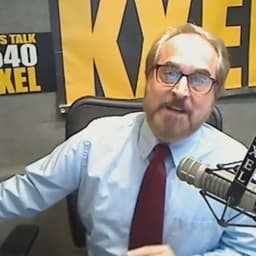
News Talk 1540 KXEL, where Iowa comes to talk.
Hello, I'm Jeff Stein.
One of the great businesses of the Cedar Valley is VGM.
It has a very interesting story, the growth of the company over the course of time, what they do now.
You drive by it, you may not know what's inside.
And I'm joined now by Mike Malaro.
Mr. Malaro is the author of a brand new book entitled VGM Stories and Lessons of a Great American Esop Company.
Mike, thanks so much for coming into the studio.
Thanks, Jeff.
Glad to be here.
Well, you seem to be the perfect person to write a book like this because
How long did you work for VGM?
Well, I worked at VGM 24 years.
And so the company's 40 years old, but I align, share the company's history.
I worked there.
And this is a book designed to do what in your mind as the author?
Well, you know, I work for the two guys that really were the entrepreneurs behind the company are Van Miller and Jim Walsh, two, two great local guys who were.
just super neat people and brilliant people, great entrepreneurs.
And I worked for Jim and Van for years.
Both now are gone.
And as I got to the point of retiring at the end of 23 from VGM, I was struck by this thing of, hey, there's these stories that happened when I worked there, but also all these stories that happened in the decade before I worked there at VGM, or 15 years.
that company existed before I was there.
I heard from Van and Jim and other people and I thought, you know, with them gone and other people aging that work there, I think it's important to get some of these stories down because there's just some fantastic stories about how this company was built and I thought it was important to get them down on paper and so I started not knowing if I'd ever finish because this is the first book I've ever written.
But I just work my way through and really that's why I title it Stories and Lessons.
It's a collection of stories that happened and the things that we learned from them.
It's important because once you would have retired and left, you would have taken the stories with you had you not had this plan.
And so we lose institutional memory so quickly, generationally and pretty soon the folks who are there now don't really have the connection to someone.
who was there at the beginning.
But what I also found interesting is you're not just telling the stories, which are very interesting in and of themselves, but there are business model takeaways and suggestions.
So for example, this has great history for someone interested.
But if you're thinking of altering your current business or if you are thinking of starting a business, there are some really good tips to help people avoid potholes along the way.
Yeah, there are and I I I didn't start that way start writing it that way But as I get these stories done written down, I thought you know, I think it's clear what what a reader might take away from this but Let me just make a note of the takeaway and I ended up in the book calling them takeaways at the end of each chapter two or three Points that I thought were really pertinent in and hey, this is a lesson that this is what we learned from
from what happened and some of the, you know, I don't just tell the good stories to tell things that, that got all botched up and mistakes that were made, um, all part of normal business and, uh, but always lessons to be learned from there.
Well, you can't be in business 40 years and have a 100% success rate.
That's revisionist history because you have to learn from the failures and adapt for even greater successes.
So what was the most difficult thing for you?
as you were putting pen to paper or banging it out on the keyboard, was it organization or was it trying to decide what to put in, what maybe to leave out because it didn't warrant between the covers?
Yeah, I mean, I originally made a list of the way I wrote the book because I made a list of stories over about a 30 day period that I remembered that were, you know, kind of key stories and I just would make this list and add to it each day.
And when I was done with that list, at least the first iteration of it, I had about 90 things on the list.
My book has 51 chapters, which sounds long, but most of the chapters are pretty short.
So I really have 51 stories in the book, if you will.
And so some of those additional stories were still good stories, important things that happened in the company.
I couldn't make the book any longer and sometimes I would go to write a particular story and it just didn't feel like, unless you really understood all the nuances and backstory, it probably wouldn't mean anything to you or be as interesting.
So those things got left on the cutting room floor.
There are certain things that you think in your mind.
This is a great story.
And then you start to tell it to somebody else and you can see a blank expression on their face like,
That's not really that great a story.
It was in the moment, but maybe not at a later time.
You get it at Amazon and again, it's VGM stories and lessons of a great American eSOP company.
Mike Millar was the author and our guest on KXEL.
So how did VGM get started?
I think I can figure out how the name came to be, but it was a very, very interesting and to some degrees rather sad.
founding of this company.
It really is, I think it's fascinating.
Van Miller, relatively young entrepreneur in 1986, Waterloo, Iowa, he started a business and his business is about 10 years old.
It's in the whole medical equipment space.
He's providing oxygen to people that need oxygen at home mostly as well as other medical equipment.
And Van gets successful business.
They've got
a couple dozen locations around the Midwest, and Van ends up getting into a disagreement, a set of disagreements over many, many months with his three brothers who are also in the business.
And it culminates in the summer of 86.
They call a board meeting at Miller Medical, which was his company, and they fire Van.
And the only other vote on the board that voted to keep Van,
was the company lawyer who was a gentleman named Jim Walsh.
And Jim and Van were good friends.
And so Jim had to give Van a ride home that day because Van had a company car and they took that keys from him.
So Van's
unemployed.
Just imagine that moment by the way.
And I interrupt only because you're in a business with family members, siblings.
You get ousted right down to the point where they say,
We're taking the keys to the company car.
Good luck finding a ride home.
I mean, it sounds, and I'm sure it was quite a cold, cold moment in that room.
It was.
And if I can digress almost 25 years later, we, VGM bought a building.
We needed a warehouse with a little bit of office space.
And we looked around and there was a couple of options and we went to one.
And we thought we were going to buy it.
We ended up touring at Van Jim, myself and Ron Bendall.
And we went into this conference room.
Well, Ron and I had come along and later in the company, we knew these stories, but the place didn't matter.
We went in this conference room and Jim pulled out his phone and he took a picture of Van and he said,
Van, I wanted to get a picture because remember you and I both remember this is the boardroom that was Miller medical on that building back in the day.
This is the boardroom you were fired in back in 86.
And you know, Van and Jim had a very good relationship.
Jovial always joking back and forth with each other.
Van didn't take that as a joke.
That was typical Jim, but Van did not take it as a joke.
He, he was really piqued by that comment and.
And he was in a bad mood the rest of that tour.
And Ron and I kind of looked at each other like this is, this is 20 some years later, he's not over it.
It still hurts.
And
to your
point on how big of a deal it was when he got fired.
And
so he, and again, it's like returning to the scene of the crime.
And he obviously knew it because he knew the building.
He knew you folks were looking at it.
It wasn't like that was a surprise, but.
whatever emotions he had been holding inside got triggered by that comment designed to make the moment a little lighter.
Yeah, I don't think he had the opposite going
in.
I don't think he realized he was going to have that emotional impact.
But, but so he's got so, so van is fired.
He goes home.
He lives in Waterloo.
He wants to stay at his hometown.
He grew up south of town and he loves Waterloo and he's got some job offers because he's kind of a
He's known in the home medical equipment space and somebody in Chicago calls him and here's he's available and they offer him a job.
Well, mind you, this is 1986.
And some of the folks listening might not know, but 1986 was the heart of the farm crisis in Iowa.
And things were a disaster economically in the 80s due to a whole bunch of factors, farmwise.
But both farmers, a lot of banks were closing, farms were being foreclosed on, but also ag manufacturing, of course, devastated.
John Deere being the leading employer in Waterloo area, they have a huge cutback from, you know, nine or 10,000 people, get down as low as 3,000 at some points in the 80s.
I think by 86, they were at about 5,000.
Another legendary Waterloo company's Rath packing.
Rath didn't.
They weren't really a victim of the farm crisis of the 80s, but they went out of business at the same time.
And I think in 84 or 85, they'd finally closed their doors.
So Waterloo was the epicenter of this economic catastrophe that was going on in the farm country.
And here comes a crazy guy named Van Miller.
And he wants to start a new business after being fired and he's got no money because his equity in the company, they refuse to give him back at that time.
So van goes around, he's got an idea.
It's not a flushed out idea.
It's a loose idea.
And he goes to all the banks in town and banks, banks are looking at this guy like, what's this guy on?
He, he doesn't even have a real business plan.
He's asking us to lend money.
It's 1986 in Waterloo.
And one legendary guy who was a prominent banker says, man, I'm just going to let you in on something.
This is never going to work.
And if you have anybody that's willing to hire you for a job, you'd be smart to take it.
Well, Van Miller.
He wasn't the kind of guy that listened to advice like that.
He was undeterred by that and he went to a couple of his friends.
He went to four of his friends and he asked him for some money and two of the four decided, you know, I'll give him some money to get started.
John Deerey Jr., who's an auto dealer across the state of Iowa, and as well as Jim Walsh, who was his buddy, and those two put money in.
Van got started with this idea about six weeks after he got fired, this idea of VGM
and
the rest is history.
VGM today has a very large footprint off San Marne in Waterloo and has a huge national presence.
And I've just skipped 40 years of very hard work in there.
But for those who may not again be aware as you drive by,
What does VGM do today?
What is the company today?
Well, VGM is a company of about 1600 employees.
About a thousand of them are in the Cedar Valley or office in the Cedar Valley and the rest are around the country.
We're a national company, do a whole bunch of different businesses, but they're all business to business services.
And most of our business is related to home medical equipment.
So we provide services to other businesses who
who provide medical equipment to people that needed at home like ventilators and oxygen wheelchairs and those sorts of things.
Very much like the original Miller Medical.
Yes,
yes.
That is our customer base mostly and then we have other businesses that serve other customers too.
And different ways that we do that, but it was all built off of, Van's idea was I was in the home medical equipment space as a relatively small business entrepreneur.
I know the challenges of that business owner.
And I can help that business owner, and his original idea was, I will be like a home office.
So let's say there's somebody up in Albert Lee, Minnesota that's got a home medical equipment dealership or Lincoln, Nebraska, and they're a one or two location business, and the people that own it may be a couple or a family or an individual.
And they're fighting the fight every day, trying to make a living and figure out regulation and complexity and get the product, the right product and the new product and what the different payers might be telling them.
And Van thought, you know what, I can be a service to those folks.
So everything that came after that, he didn't have all these ideas of what we are today back then, but he knew I'm gonna serve that customer.
And he always believed, I'll figure out something I can do for the customer.
that I can perform on and that they'll pay me for.
And then I'll also look for other things that they need.
And if they need something else, I'll figure out a way to provide it.
And a good example of that is in the late 80s, I'm sorry, there was a hard market in the insurance market.
And a lot of home medical equipment providers, they don't have medical malpractice insurance, but it's a similar insurance.
to protect them against if something happens to a patient or whatever.
And it was a hard market, which meant rates were going way up, and it was hard to get coverage for a lot of these small businesses.
And Van decides, we've got to get an insurance business, because that's what our customer needs.
And how tough could that be?
Well, very tough.
But he turned to his buddy and right-hand man, Jim Walsh, and he said, Jimmy, try to figure this out.
Well, they hire this, uh, they hire this consultant out of New York city.
And they say, Jim Hyatt finds this guy and he says, here's our, here's our situation.
Here's what we want to do.
Can you do a project to figure out how we do this?
And this gentleman, um, super smart calculus, math genius, actuary.
So he invites, he gets done with his work and he invites them out to New York city to.
to present his findings and so van and jim travel in new york city and they go up in the the 70th floor of some building big conference room with you know glass you can see out into the city great skyline.
And there's a big white board up there and the guy starts doing calculus and writing on the board and talking really fast and they can't understand they don't even know half the words he's using and he goes and goes for about couple hours and eventually gets to the end and he says so.
So you can see there's no way you guys can start insurance company and.
They're they're dejected and they think the guy and shake his hand and they leave the conference room getting the elevator.
And they get in the elevator and door closes and Jim looks over at van and he says, well, van, what are we going to do?
And then says, well, I'll tell you what we're going to do.
First, we're going to go back to the hotel and get a drink.
Then we're going to go home tomorrow and you're going to figure out how we started our insurance company.
And he was undeterred and they went back and they did that.
And Jim did a whole bunch, talked to a whole bunch of other people and ultimately with the help of a guy named John Spragile, they figured it out, created an agency first, then they did more than that and created a risk taking insurer that still exists today.
And today VGM insurance, which is a part of the VGM family that you mentioned, VGM insurance ensures about 8,000 businesses, mostly
healthcare businesses, home medical equipment, orthotics and prosthetic, physical therapy, home health, hospice, those kind of specialty medical businesses, VGM ensures about 8,000 of them.
But it started really on that elevator ride down in New York City when Van decided, you know what, I don't know how we're gonna do it, but we're gonna do it.
And they did figure it out.
It's such a great story because to me, the broad takeaway to use the phrase is,
He knew home medical equipment.
So he started a company to not only provide services in that wheelhouse, but to help others who had been like him at a different point in the business life.
So you go with a core that you know and you add to it as your current customer base suggests you should.
You're not adding to your brick and mortar store and putting in a whole new line of things unless your customer said, how come you don't sell this?
That's how it then builds from insurance to communications to everything else under the umbrella because again, it all can go back to, I imagine if you had a diagram, you could see everything with a straight line back to the core principles and the core business.
That's very true, Jeff.
That's exactly how it came down.
So as you're constructing the stories Obviously you're hearing some of these second hand, but for 23 years you knew them firsthand What led you to join the company at the point that you did and what did you find when you get there?
Where were they in the life of the organization at the time you joined?
Well, they start in 86 and
They get going and it takes about a year before they can know that they're going to make it.
And I tell a great story in there about the day they van kind of saved the company with the flight to Cleveland.
And that was in 87.
And once they got past that day, everything was pretty good.
Through the 90s, they started growing and became very successful.
Late 90s, success set in.
Maybe some complacency and they'd also grown pretty fast and it was an entirely entrepreneurial business and sort of got out over their skis a little bit and all of a sudden in 98 business wasn't as good.
There's a little bit of downturn 99 was a real bad year and then 2000 was a terrible year for the company and
And it was a multitude of factors.
Some of the businesses that had been created weren't performing and were losing money.
Others were doing okay, but like the insurance business, but were consuming capital.
And there wasn't a lot of sort of professionalization and discipline that had been brought into the business.
It was still very entrepreneurial and kind of loose and little bit seedier pants.
And I was thinking seat of the pants, just as you were saying it, which I think the stories you will tell about various businesses, you find the founder does a lot of seat of their pants.
It's what's necessary for it to get off the ground.
They've got the guts that so many of us wouldn't, but to take it to the next level, sometimes you need to modify that a little bit.
You need to have the financial
stewardship that is necessary so that then the founder can still pull one out of their back pocket when necessary.
Absolutely.
A very consistent story that happens a lot with an entrepreneur.
The
business grows to a certain size.
So 2000, they're scared.
They almost go out of business.
Van's got a mortgage his house to make payroll.
And, and he's scared.
He had built something great, was doing really well.
And at that point in the middle of 2000, they're thinking, boy, things aren't good.
The CFO leaves the company, resigns and takes a different job.
That happens in the world.
But this was the first time that anyone at a higher level of the company had ever left VGM.
And it hit Van.
It knocked him back a step along with having to mortgage his house.
He was scared.
He knew he was going to have to make some changes.
And one of the, he made a decision in that timeframe to seek some, um, a different kind of, um, leadership and support within the company to, because he recognized that there needed to be more, more discipline and controls and, and, uh, rigor toward how they were running the business.
And the first decision he made in that regard is there was a guy, uh, he decided to.
make a change at the president of the core company, VGM and associates.
And Van had always up to that point only hired people that he knew that he trusted.
That was how he did it.
And all the hires up to that point were done that way.
He made a different decision and he went to a guy in Canada that he didn't know well, a guy named Ron Bendle.
And he hired Ron to be the president and Ron moved with his family down to Waterloo and,
took over the job in 2001 of president and and he had a very strong commanding sort of command and control disciplined approach to the business, which was very much unlike there was a lot of great people in the company that were great business people.
But Ron had a different approach and it was an approach that was really needed at that time and around the same time.
2001, they started looking for a CFO to replace the guy who had left, and I was over in Omaha, Nebraska, and trying to get, for some family reasons, I grew up in Charles City, and I was trying to get to Eastern Iowa, and I got connected to them, interviewed for the job, it was a pretty good fit for both of us, and I ended up taking the job in the middle of 2001, but I was also somebody they'd never met or didn't know, and so,
kind of me and Ron, and then there was another probably six or eight hires around that time in 2001, 2002, maybe even into three that were sort of brought in under this new approach of, gee, we almost lost the company.
We have to do some things different.
We're not going to throw the baby out with the bathwater.
This is a neat company with a lot of great customers, but we're going to need more rigor, more discipline, more controls.
And that was really 2001 to three was kind of a turnaround period for the company.
We've got everything back on track, everything.
Businesses were good, but we had to make some fundamental changes in that era and then got things on track and then took off again on another growth run.
It's sort of like the company, any company, but we're talking about VGM.
You could only grow so big hiring only people you knew.
because again, you only know so many people.
And if you want to then go into different realms or take on different challenges, you've got to bring in a wider circle of people, some of whom maybe aren't afraid to say no to the founder because that's a hard thing to do to say no to the boss.
Yeah.
And also people that have seen other things that I think of like Ron Bandle, who had been in the home medical equipment industry, van had been in it forever too, but Ron had
And Ron had, but different set of perspectives, different experiences.
I had different experiences in business.
I had worked in a turnaround situation before I came to VGM.
So it wasn't, I knew, I knew when I took, when I interviewed for the job, they showed me the financials and I, wow, this is, this is pretty skinny.
This isn't in great shape.
But I had just been in a retail company with a significant turnaround and comparing the
the financial situation of VGM at that time to where I'd come from.
I was like, yeah, this isn't, this isn't going to be impossible to do.
They've got enough here that, and they're not in that bad of shape.
We can get this figured out.
You looked at it and said, well, it's not great, but I've seen worse.
Yes.
Yes.
Mike Malara was our guest and the author of VGM stories and lessons of a great American ESOP company recently released.
Get it at amazon.com.
And as the company then really took off this last two decades, what all does the company do, the various companies?
Again, it's VGM Group and you've got all these different things, but you've got home medical, you've got the insurance.
What are some other things that the average person, and again, I go back to driving down the road, sees this big growing building and this big growing company they may not know is part of the whole thing?
Oh, we've got another business called HomeLink, and it's one of our bigger businesses.
And we, in that business, we manage patients.
We do a lot of things, but the core thing is we manage patients who have been injured at work, and we work on behalf of the workers' comp insurance company, and say somebody gets it.
I'm not talking about twisting their ankle, but somebody has a serious injury at work.
They're going to have medical interventions.
We will.
will be asked by the insurance company to help lead that person through the medical care system so they get the care they need and they can get back to work as soon as possible so they can support their family.
And things that might happen is maybe somebody has a bad accident and maybe they have a surgery but they're out of the hospital, that's kind of when we would take over.
The person's gonna have to go to physical therapy three times a week.
They also need some medical imaging done and they're gonna need a wheelchair for a little while.
We will coordinate all that stuff for them and if they need a ride to maybe they need a ride to their PT every week or every every other day and will arrange the ride.
Maybe they don't speak English and will arrange a translator when they go into the doctor the PT or whatever so it's basically a way to.
Accelerate because anyone anyone out there who's been through the healthcare system.
It's vaccine and and complicated and aggravating now picture yourself.
You've had a serious work injury You're scared.
You're you know, you're worried about whether you're gonna be able to support your family because you're off work and You know, you want to get well and you want to get the right situation the right doctors follow your therapy regimen
And it's nice to have a hand that helps you get through that system who's been there a hundred times.
And we have people, a lot of people that have done it and are great at it.
And that's one of our businesses.
Another big business I'll just mention, Jeff, is we distribute CPAP masks to patients' homes on behalf of medical equipment providers.
And we probably, we have four warehouses across the country, Waterloo, also Nashville.
Eastern Pennsylvania and the Phoenix area, we distribute probably between 25 and 30% of all CPAP masks in the United States.
We're the biggest player in that space in the country.
Again, it comes out of this idea of all these medical equipment providers could do this themselves.
But what if somebody came along who did it on behalf of hundreds of them and
had all the right warehouses where they can get to all the patients within two days, had all the technology and the equipment and the people and the know-how to make sure that we can do it efficiently and cost effectively.
And that's what VGM we built, did.
We built those systems and that process and that warehouse network so that all these home medical equipment providers across the country sort of looked at.
the landscape and said, well, we could keep doing it ourselves.
And maybe it costs us, you know, $20 a shipment to do all the work and the warehousing and ship it, or we can pay VGM to do it for, you know, $13.
And we're going to save all that money and all that headache and all that.
So that's another big business we have.
Well, again, it's economy of scale.
And when you're able to set up the networks and provide it for people at a
I mean, everybody wins, including not incidentally the patient.
The subtitle of the book is Stories and Lessons of a Great American E-SOP Company.
When did we get to employee stock ownership?
At what point?
Because a lot of companies, they roll along and at some point you figure out succession is necessary.
We don't live forever.
And if you value your employees, you could just keep compensating them or you could say, how about
you own a piece of this because it's a whole different mindset for an employee if they think they have a true stake or skin in the game.
So 2008, VGM, the owners of VGM make a decision, they actually made it in 2007, but in 2008 we executed the transaction to sell 100% of their stock to the ESOP, which is a trust entity, essentially means that
everybody who works at the company now is going to be a small owner of the company.
So that's what an ESOP is, Employee Stock Ownership Plan.
Great vehicle for broad-based employee ownership.
It was a great fit for VGM.
It's a great fit for a lot of businesses.
But yet there's only about 3,000 companies in the United States that are 100% ESOP owned.
And VGM is one of them.
But this happens in 2008.
At that time, there's about 400 people.
that work at VGM.
It's a successful company.
It's a good company.
Van doesn't have kit.
You know, he doesn't, he doesn't, he's not going to pass it on within the family.
Um, he looks at options to sell the business.
He, I mentioned earlier, he loves Waterloo.
He's a Waterloo guy.
His name's on the building, his initials anyway.
He doesn't want all that changed in us outsourced to China and whatever.
I mean, he, he wants the thing to keep going.
He also wants to keep running it and the ESOP allows has a vehicle to allow that.
So he decides to sell the company at that time.
Now the employees own it from 2008 forward.
It's an inflection point company had been successful.
I mentioned, but it goes from 400 employees to today.
There's 1600 employees.
So those 1200 jobs were created post ESOP.
And it wasn't only because of ESOP.
It was for a bunch of reasons.
But being employee owned, it turned out, and this is, VGM is not the only company like this, it turned out it was a driver of tremendous success.
And then later, you know, the first few years we're trying to figure out what it is and what it's gonna mean and does it mean anything to our employees and our customers and so forth.
When I became CEO and at the beginning, end of 2015, Van dies, I become CEO.
I really thought, you know, we got an opportunity to lean into employee ownership more than what we're doing.
And so we decide to make employee ownership part and parcel with everything that we do.
We go to market, we tell our customers about our employee ownership.
We lead with it when we're talking to anybody about a job that we want to hire or we're trying to recruit people or trying to retain people.
And employee ownership becomes this
dominant theme at VGM starting in 2016 and it still is today and that helps ignite another level of growth and service and expansion that really helped the company.
There's nothing wrong with working for someone who's a billionaire.
There's nothing wrong with working for
Private equity owners who are out in in New York and San Francisco and they're trying to make as much money as they can and you're working there Nothing wrong with that.
It's still a good job if you have a good job But when you own something that's different Ownership is different ownership changes people and it changes people not just financially and it has a huge effect financially But it also affects who they are
How they carry themselves how they parent how they exist and live their life and it's we ended up calling the phrase life-changing employee ownership is life-changing and it's it's been life-changing and and I mentioned you know wanting to tell these stories of EGM because I love the company I love what happened and it's really interesting but also it's important to tell the story of employee ownership because employee ownership
It's been a big part of this VGM story, and it's part of some other companies, but it's important that more people understand what it can mean.
And I'll just jump into a couple things, Jeff.
Financially, we've been in ESOP since 2008, VGM has.
And I went back and looked at a bunch of numbers when I was preparing to write the book, but one of the measures, there's a lot of different ways to look at it, but financially,
I looked at a group of people that made between 40,000 a year and $125,000 a year.
So kind of think of that as you're the middle of America, if you will, the middle class.
I don't know if that's exactly right, but 40 to 125,000, if you'd worked there eight years or longer, what did that mean?
And the average person that falls into that parameter at VGM has today in their ESOP,
10 times their annual salary.
So if that person, say, makes $75,000 a year, on average they've got $750,000 in their ESOP, which you might think of it as a retirement account.
It's an account with VGM stock in it.
10 times their salary.
There's been over 100 millionaires made at VGM.
Over 500 people have more than $350,000.
A lot of wealth created when you
take, and again, nothing wrong with one family or one person owning a business and growing it and being very successful and making all the money, but it's just different and it's better when the whole group can participate in the ownership.
And I like to say ESOPs are capitalism for people who don't have the
luxury of capital.
That's such a great way to phrase it.
And as you're talking about how it changes the individual, they stand up straighter.
because, again, they don't feel the burden of being an employee.
They see the opportunity of being an owner.
And I've analogized with ESOPs in the past, and it's not a very good analogy, but it's the difference between renting a car or buying a car.
There are certain people who take care of anything, but there are others where that's a rental.
I don't need to worry too much about that.
But this car I bought, I'm going to take care of it.
I'm going to service it and I'm going to clean it.
When you own it you take even better care of it to some degree and one of the things that is fascinating about you've got a wonderful photo on the front of and this is not the whole workforce by any stretch but hundreds of people and I'm guessing if you zoomed in on that you probably knew just about every one at the time that photo was taken
Most of
them.
Yeah.
Yeah
But that's also what's kind of important.
And you mentioned you became the CEO.
You had been CFO, you became CEO.
And again, it's under circumstances that we're not anticipated.
Sunday afternoon in October of 2015, Van Miller, sitting, watching football game and has a heart attack and dies.
Dead when he gets to the hospital.
And, you know, Van was larger than life.
And just the kind of person that he just had a way that made you love the guy and everybody loved him.
And tremendous loss, a shocking loss.
And we are trying to absorb the grief of the loss of our friend and this guy that we, most of us love this guy.
And he was also our leader of our company.
he was invincible and now he was gone.
And it was a very, it was the most difficult period in the company's history.
All of a sudden we're without, without our leader.
And Jim Walsh as his number two and best friend and long time investor with him, Jim became the chairman of the board and Jim,
ultimately decided to appoint me to be the CEO, to follow Van.
And we had to get through this grief, this transition period, this difficult period.
People were upset.
People didn't know what was gonna happen.
Some people thought the company was gonna close.
A lot of people thought that.
And it was just a lot to get through.
And then I was coming in.
to be a CEO for the first time in very unexpected and quick circumstances and so there's
a
lot that goes with that and you know we did some things well we did other things wrong but it all worked out good and it ended up having a happy ending but for the the year or so of the transition that was really hard it was the toughest time in my career and
But we all pulled together and I think people wanted to, obviously people wanted the company to still do well and their jobs depended on it and all that.
And they were owners, but also, you know what?
We got to make Van proud too.
And this is the thing that it's one thing to succeed someone who had a larger than life persona within the business and beyond.
But to have to for all of you folks who have been working so closely together for so many years You can't take the time to deal with your own grief and process that in a proper manner Because you still have to open the door of the business the next day you've got customers across the country and again with home medical You can't stop you can't take time off and again all of these employees depending upon it
And that's what I think, why I think a lot of people be very grateful to you, Mike Malaro, for putting the book together because it lets people understand those who know this situation, they understand it better.
But those who are on the outside can appreciate what actually happens in some of these businesses.
What's been the reaction so far to the book in the few weeks that it has been out?
You know, I didn't know what to expect to have because like I said, this is the first book I've written.
I wanted to get it out there.
And I've gotten a ton of really neat feedback from people that have either read all the book or gotten through part of it so far and sending me texts or emails or calling and saying, hey, I
I'd forgotten all about that story, that thing that happened, that was great.
I just love that you put everything together.
I think it's fair to say that even people that know the company well, one of the things I'm proud of in the book is I've got a lot of detail in the book because I ended up talking to a lot of people that either knew Van, knew VGM, worked at VGM.
I probably talked to 50 or 60 people to get information for this book.
Sometimes it was just to confirm a memory that I had.
Other times it was to add color.
I, one of the people I got a chance to talk to was a guy named Mike Hansen who was Van's best friend growing up.
And Mike told me a whole bunch of things about Van when he was a kid and I was able to get some of those into the book.
So a lot of good detail there, but to your point also this is a
Iowa's got some great businesses.
And we're rightly proud of some of the great businesses across our state.
A lot of our small towns have a great business in them, maybe two.
Some of our bigger areas might have four or five or 10 great businesses.
This is a great Iowa business that started in 86 and has run and done really well and became this icon for employee ownership as well.
So I think it touches a lot of different people that might be interested in reading this story.
And again.
more than 50 chapters, but they are stories.
And so you can, because again, our lives are so full of distraction.
You just look for 10 minutes when you can sit alone and read a book, or at least I do.
And so you don't have to, you can take it in bites and really be able to reflect on it, especially with the takeaways at the end of each chapter.
VGM, stories and lessons of a great American ESOP company.
Mike Malaro is the author, former
CFO and CEO of the company and you get it at amazon.com.
Mike, thanks so much for preserving this important part of the business history of the Cedar Valley and beyond, but also sharing the stories with us today.
Thank you so much, Jeff.
I enjoyed talking to you.
It was great fun.
This is where Iowa comes to talk.
News talk 1540 KXEL.
News Talk 1540, KXCL, where Iowa comes to talk.
Hello, I'm Jeff Stein.
Each month, U.S.
Senator Charles Grassley joins us on the news line.
This month's conversation was recorded Tuesday afternoon.
The senator called in from Capitol Hill in Washington.
Senator, since we last spoke, the Farm Bill made it through the Ag Committee, give us your sense of the positives that are in the Senate version of the bill, and what do you think might be the path forward?
The Farm Bill?
Well, first of all, thankfully got out of committee.
What's really different about this Farm Bill than any of the seven I've been involved in?
This is the first Farm Bill that didn't get out of committee on a bipartisan basis.
Democrats want us to undo some of the things that we're taking out of took the fraud out of the food stamp bell in the tax bill of last year.
They want to undo some of it.
And I want to just tell you how ridiculous that is.
Some states have an error rate of 20%.
Several states do.
A lot of states over 13%.
So we said, you got to get that air rate down to at least 6% or you're going to have to pay for out of your state treasury.
They want us to undo that.
Well, how do you undo people that aren't supposed to getting food stamps and violating the law, getting them?
It's because the state's not doing their job of vetting.
And that's why Democrats all voted against it and why it's not a bipartisan bail.
Now, we'll never get it up unless we get Democrats to see how wrong they are.
Now, we gave them half of what they were asking for.
There still wasn't enough.
It compromises what Congress is all about, specifically the Senate, with the 60-volt requirement to get bipartisanship.
So that wasn't enough.
And that's an $8 billion figure just for the one year delay.
Uh, so we gotta get it.
Now, if we don't get it, we won't get the 60 votes to get it up if they don't go along with us.
So I'm suggesting to Thune, leader of the Senate, that he needs to bring it up and see if all the Democrats would really vote against three-and-three-tenths million farmers in the United States.
I don't think they would, but if they did, then we know who to blame for not getting a
five-year farm bill.
What do you think the chances that this gets put on the Senate floor before the October break or is this one of these things where because the Democrats are so entrenched they're not going to want to show any conciliatory move until after the election in the lame duck session?
Well, then maybe we won't get a farm bill until next year and
And then if they control one house or the other, and you don't get the bipartisanship we need, you might go on nine and a 10 and an 11-year period of time without a five-year farm bill.
But remember, the last one was in 2018.
Just think how the price of everything's going up.
There's several reasons for writing a new five-year farm bill.
But one is that inflation requires that we up the loan limits in the farm program.
Another thing that is really of concern as harvest is coming near is the cost of fuel.
And I know you've called on the president to take some action to help help farmers in particular with the high cost of diesel that they absolutely need in order to get the crop in.
So I'm calling for Bargo.
by President Trump on an exported diesel.
It's very similar to the fact that he embargoes some chips to China.
It's very similar to what Nixon did when inflation was driving up food prices.
He put an embargo on soybeans.
I'm asking the president to put an embargo on a diesel that ought to drive the price down.
What do you think the chance is that
the White House will go along with that proposal.
I think it doubtful that they will.
I hope that they will.
He says all the time he loves the farmers.
I'm sure he loves the truckers as well.
And this is something you can really do to help farmers.
And he said that he's open to it.
but that's far cry from being poor.
Obviously farming and ranching two different things, but as we look toward the ranch aspect of things, there have been some movements made that might help the beef industry.
Now this is something I know you've been very focused on with regard to access to market, but the administration did take some action that I presume you would approve of that is a positive for beef producers of all sizes.
The Justice Department on its own is investigating, see if there's a cohesion and violation of the antitrust laws.
Then the President issued an executive order that said that he's going to make it possible for farmers to do more of their own processing.
of the beef.
Now that could be through the local lockers, that could be through cooperatives, things of that nature, so that the Big Four don't dominate the cattle business.
We're also taking some action within the Farm Bell to open up more areas for grazing.
I said Farm Bell, but also the President has by executive order
open up some public lands for grazing.
We're trying to give more flexibility to the CRP for grazing as well.
President Trump will be meeting with President Xi of China this Thursday.
What do you hope comes out of that meeting?
If there will be anything of substance, sometimes these are just, they lay the groundwork for other things.
But what do you hope comes out of that meeting this week?
I would like to see some cooperation and concern on the part of both policies about the dangers of IT or AI, artificial intelligence.
I'd like to see China recommit itself to importation of more agricultural products, particularly soybeans.
I
would
hope that
We would get some commitments out of China, not to help Iran, which seems like that they're doing in kind of a secret way.
Things of that nature is what I would hope.
Obviously, China had agreed to increase the purchase of American agricultural products, particularly soybeans.
I'm not sure that they lived up to the promises that they made a few months ago.
You would know better than I on that.
Is this the right time to press China a little bit in terms of purchasing some of our good American products and crops and other farm related commodities?
Well, they promise to take more ethanol.
They promise to take more beef.
And I think they're doing a pretty good job of taking soybeans.
But in the other areas, I think they're coming up short.
Before the House left town on a voice vote, they passed their version of the AM Radio and Every Vehicle Act.
Now, that is something that there's a separate or a companion Senate bill.
It's something you and I have talked about previously, and I'm just wondering what you think may be the future of the AM Radio and Every Vehicle Act in the Senate.
Well, I would hope we could get it up on what we call unanimous consent.
If it's going to take a lot of debate to get it done,
There isn't time for that.
And I hope the people on the Commerce Committee will take the lead in trying to get it up.
I don't know where the opposition would come from, but I presume car manufacturers, electric car manufacturers, things of that nature.
But I think we need EM in all cars because that's where the news comes when you're going down the highway.
particularly for natural disasters
and
dangerous disasters.
What do you think that the Senate will be able to accomplish yet before the election?
Anything of great substance based upon what you hear or are we just at loggerheads on so many issues?
I think we finally got up on a wide bipartisan vote.
The issue of controlling pay for
college football players and basketball players I think that we're making great progress on that
and that's the
only thing that I can Guarantee you will probably get done before the election, but there's all I'll learn an hour from now Whether or not there's an agreement for a change of progress on permitting
making, have the government make decisions quicker on whether you want to build a highway here or put up a transmission line over there.
And some of those take years and years.
And the environmentalists use the existing law to slow everything up because they don't want change.
And we're close to getting about
bipartisan agreement on that, and that'd be another one that we'd want to get done if we can get it out.
Finally, Senator, you were back on campus and Cedar Falls this past Friday, the official end of the 150th for the university and formal recognition of a new entity that ultimately will be called the Chuck and Barbara Grassley Center.
And I'm just wondering your reaction to all of that.
It was a happy day on campus.
A very happy day.
I had an opportunity to speak about my reminiscings of the times I was working on my bachelor or master's degree there and between 1951 and 1956 I had a chance to tell them how it was student first in that day and that's the word student first is what they brag about now that UNI is up to.
And I gave plenty of examples of how I thought it was that way when I was there and there were only about 2,500 students compared to about 9,000 now.
And I'm very proud that they would take my papers when I retire from the Senate.
As they did already take my papers and they have them very well organized so you can get almost any information you want about the years I spent in the state legislature and the US House of Representatives.
I did that way back in 1986.
So this is a continuation of that and we would hope that my papers would be used to promote civic education.
Senator, always much to discuss.
Thank you for being so generous with your time today.
We'll talk again next month as per custom, if not before.
Thank you very much.
Goodbye.
U.S.
Senator Charles Grassley called in on the news line Tuesday afternoon of this week so you could hear the conversation now on News Talk 1540, KXEL, where Iowa comes to talk.
In the Cedar Valley at FM 100.5 and everywhere at AM 1540 and KXEL.com.