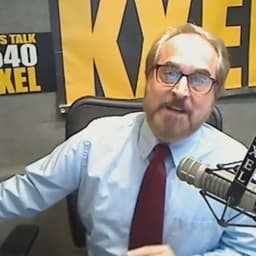
It is a privilege to be joined now live on the news line by Pastor Paul Begley.
Pastor Begley and Troy Anderson are the co-authors of a new book holding a copy right here.
It's called Trump versus the Beast, The Ten Kings Prophecy and Bible's Revelation of Coming Final Days.
Pastor Paul Begley, good morning and welcome to KXEL.
Good morning, Jeff.
Great to be on the air with you.
This is a very important topic, but I have to ask what led you and Mr. Anderson to put pen to paper and put this together for us.
A couple different things.
One, I was watching the law fair, the assault on President Trump between his first term and his second term, and I kept saying to myself, man, they're coming at him from every direction, seven different directions, like a beast.
It popped in my head that he is literally fighting a beast, and he's not the only one.
All of us who are Christians and the Jewish community, certainly with the anti-Semitism going on, there is an assault on Trump, and that's why it brought me to the title.
But the 10 kings also, because I got thinking about the 10 kings, Jeff, I used to think that there'd be 10 presidents chosen by the Antichrist to be the 10 kings, but I noticed there's 10 categories.
major categories where their leaders are more powerful than presidents and prime ministers.
And so began to research that and put together a book that prophetically speaks to these areas.
Now again, this is not for the faint of heart.
This is for folks who want to take this topic seriously.
We've got a wonderful forward here by the great Kevin Sorbo.
The forces of evil
always have motivation, don't they, to take on the forces of good because good is complacent, right?
When things are going well, we just take it for granted.
Is that one of the problems in a good versus evil fight?
Yes, it is.
We have a tendency.
When things are good, we have a tendency, let's enjoy the moment and we get complacent.
And in the book,
started looking at the categories that are taking, while we're being complacent, there's conglomerates being formed.
And so I looked at the categories, big pharma, big bank, the military industrial complex, big tech, big food, big education, big government, all across the earth.
And I began to notice that there were at least 10 categories that these leaders of these categories
were more powerful than any 10 presidents or prime ministers.
And I begin to think to myself, what if the Antichrist or in the process of coming closer to the Antichrist, these can become the real kings of the earth that would answer to the beast.
We're speaking with Pastor Paul Begley, he and journalist Troy Anderson, the authors of, you may remember the past book, Revelation 911, the brand new one,
Through our Good Friends at Humanix books is called Trump versus the Beast, the Ten Kings Prophecy and Bible's Revelation of Coming Final Days.
And again, Pastor Begley joins us live on News Talk 1540, KXEL.
What is the simplest way?
I mean, folks who read this book will learn, but what is the simplest way for folks to be ready for the end times?
What can they do right now?
Because that's what I often hear from folks.
who listen to conversations I'm blessed to have here on the radio with folks like you.
They say, well, that's good to hear about this thing or that thing, but what can we do?
What can they do to be ready?
Let's see, that's a great question, Jeff.
And first of all and foremost is to give our lives to Jesus Christ, to be born again, to be filled with the spirit of the Lord and to know who you are in Christ Jesus.
Number two, do not walk in fear, but with Christ you walk in faith.
And don't be complacent.
Be prepared.
And be preparing means spiritually being prepared and even physically.
It's okay.
I know there's people who are preppers.
They're prepping for a lot of different reasons.
And it's okay to have backup for earthquakes, tornadoes, hurricanes, volcanoes and such as these types of things.
But reality is this.
You have to put yourself, your family first,
centered around the gospel of Jesus Christ.
And then once you get centered around Jesus Christ, then this Holy Spirit will begin to lead you and guide you in the past to go.
And that doesn't mean crawl under a rock.
You know, we're to share the gospel to the whole world.
It doesn't matter what's happening around us if we walk in the faith of the Lord.
This book, Trump versus the Beast, will be released on October 6th.
You can order it now.
Go to Amazon or wherever you get your good books.
It looks like it is the number one new release in prophecies, that category at Amazon.
So congratulations, sir, on that.
We'll see if we can keep that level up there with the good folks listening.
Go to Amazon for the book Trump versus the Beast, which will be released on October the 6th.
Now, as you identify these kings, as you were putting it together, were there some that surprised you?
I mean, for example, King number nine, big banking and financial bondage, King 10, big religion and spiritual corruption.
So there are a whole list of these, obviously the 10 where there's some that as you put it together, you even had to sit back a little bit at your notes and say, wow, I didn't realize it was this deep.
Yeah, a big food was one of them.
You know, I can understand big pharma and and the big banks and big tech.
But when I saw Big Food and saw that most of those small farmers in Iowa is a prime example, how the small farmer has just been gobbled up by these conglomerates, which are big corporations, and including China, that's buying up a lot of the livestock, the beef, the pork, the poultry, buying these other corporations one by one, I began to realize that even the Americans,
will be very susceptible to food distribution.
During a time when you begin to see a one-world governance forming, food will be a weapon.
You know, you don't have to round people up and put them in a camp.
You just make it difficult for people to be able to get their food or the things they need, their medical supplies, unless they follow the commandments or the ordinances of the bee system.
And this is all going to happen before we have an antichrist.
This conglomerate power of these 10 categories are going to be intertwined working together.
And AI is the part of that reason that puts it together.
So yeah, I was a state.
I'm from Indiana, so I know all about big farm countries.
And the little farmers are being gobbled up.
And that's a danger when you look at the big picture.
Well, and again, and you folks wrote this book in order to get a book in my hands, this far out from the release date, your text was set long before these AI giants said to the government, please protect us from ourselves.
So this has been brewing.
This is nothing brand new.
And obviously you've been warning about it in other contexts.
But I mean, this truly is, all of these forces lined up
To have us destroy ourselves.
I mean, that's really what it what it comes down to does it not is that Through a man's inability to to Be good stewards of the earth that God provided.
I mean, we're gonna destroy it for ourselves
Well, you're exactly right Jeff and we've allowed and again, it's that complacency.
We've allowed ourselves Especially in America
where we've been the land of the free and the home of the brave, but we've also been the land of plenty.
And so we've never worried about it.
We just assume that the supermarket's always going to have everything I want on it.
I just scroll in there with my little cart, and it always, everything's going to be great.
And we have slowly destroyed ourselves.
Look, you know, with big food, most of the food now is GMO.
It's a genetically modified organism.
It doesn't have the nutrients that it wants to have.
When I was a kid,
I used to look at the big cornfields of Indiana.
The corn was different, tight.
The ears on the corn were in different locations on the stock because they were growing naturally.
Now I look at a cornfield, every stock is exactly 11 foot tall.
There's four ears of corn that are in the exact same place so that when the combines go through it, the yield is higher, less waste, but by the way, but what are we eating?
What is the nutrients?
What are we actually getting?
And so we have done it to ourselves.
We've been like frogs boiling in water.
But it was prophesied in the Bible that this is exactly how things would start to wind down just before the coming of Jesus Christ.
So really we're on track.
I'm looking for the great revival now.
I can see how the devil's hand is playing.
Now I want to see the rest of God's hand to play and we speak about that in the book.
Do you get a sense that that is actually happening?
Because again, as a response to all the evil and lack of foundation in the world, do you actually feel that there is this revival?
I would suggest I see it more among young people, but you're closer to it than I am.
No, you know, you're right.
Young people are going to be the ones I think that bring it on.
There's an explosion of youth getting saved in our universities and colleges, especially in the southern, you know, Midwest and the southern universities.
They're baptizing them in the ocean.
They're baptizing them in the back of pickup trucks.
There's a move of God happening, especially after the assassination of Charlie Kirk.
We've seen the uptick in the youth returning to church by 25%.
The number of
Bibles being bought is up by 20% across America.
And so there is certainly a revival spirit brewing.
What it is, the young people that have been stuck in a computer, they grew up with an iPad.
And they really want to know what is real.
They have really seen the virtual world.
They're interested in, somebody tell me something authentic, something that's real, something tangible.
And I believe that's what's drawing them back.
and bringing them into the fold.
So I see a great revival coming across America.
The youth will start it, but the middle age and the elderly will get involved as well.
As they see the young people coming to Jesus, I think you're going
to see a resurgence of the middle age.
There is a chapter that is titled Trump and the role of divine providence and I would suggest that even the Those who hate this president the most have to concede That this is more than just luck, which is probably why they are so vehemently opposed But talk if you will about the role of providence and the role of this president
at this unique point
in time.
God has taken different individuals and said, I see your strengths, I see your weaknesses, but I need you to carry out a specific mission.
Donald Trump, even when Donald Trump was in his 30s, I remember watching him on the Dick Cabot show and they would talk about all of his business and they would say,
Some people think one day you might run for president.
I'm thinking why would you ask a guy that builds buildings in New York about running for president?
There was something that was divinely already, even the media, even the left didn't realize that they were talking in a divine providence way that God had his hand on this man and he has proven to be a friend of all Christianity.
He has proven to be a friend of Israel.
And in no matter what, we're all sinners saved by grace.
I think there's a, and when the bullet in Butler, Pennsylvania hit his ear instead of hitting him, God's hand, every assassination temp has failed.
All the law fair has failed.
All of the left wing liberal attacks have failed.
President Trump, there's a hand on him and God is directing his path.
And I pray for him daily and his family.
I really do.
Yes, should we all.
The brand new book comes out on October 6th.
You can order it now, so you have it on day one at Amazon.
Trump versus the Beast.
The Forward is by Kevin Sorbo.
The book co-authored by Troy Anderson and our guest, Pastor Paul Begley.
Fascinating conversation, Pastor.
I hope we talk again soon.
Thanks for the time today.
Love to do it Jeff.
Thank you so much.
All right.
Take good care and Pastor Begley joined us live on the news line on News Talk 1540 KXEL where Iowa comes to talk.
News Talk 1540 KXEL, where Iowa comes to talk.
Hello, I'm Jeff Stein.
A lot of towns throughout the state have wonderful historic old movie theaters.
Some of them were
opera houses that were converted at one time and many communities have enjoyed restoring these facilities for live performances, motion pictures, etc.
There's a situation in our neighboring town of Hampton where they need to repair the wonderful old Windsor and I'm joined on the news line now by Jim Davies.
Tell me first of all, what is the Windsor?
Well, the Windsor Theater, well, construction began and I'm quoting on a modern, splendidly constructed and handsome opera house in 1912.
And the building was made possible through the efforts of the members of the Knights of Pithius Lodge.
And the building was completed in 1913.
Then for many years, about from 1970, when the first
Films were shown but prior to that the Knights of Pythias continued to use the building until 1938 as a lodge and they also brought in traveling road shows and entertainment for the community and so I guess fast forward the Peterson family of three generations worked there I think from like 1917 and owned it until the 1970s and
The theater itself then closed for showing movies in May of 1996.
And at
that time, the Dick and Verla Waugh family had owned that.
And facing an uncertain future, residents and students organized the nonprofit Windsor Theater Development Corporation.
And they purchased the building in December of 1998.
And then following extensive renovations,
The theater reopened May 28th in 1999, so they not only show first-run movies, but they also host live performances, particularly from the Franklin County Arts Council, and then monthly hoedowns, and then other community events such as, you know, rentals for businesses, for maybe meetings, things like that.
So that gives you just a history of the theater from 1912 to the present time.
that's a wonderful history and again if you go online to Windsortheatre.com Windsortheatre.com you can learn more about it and where's it located in Hampton I mean it's got a pretty prime spot right there downtown does it not?
Right it's downtown where north and east of the courthouse which the courthouse is just on highway three.
Now
things were rolling along fine at the Windsor until something happened this summer, Jim.
What happened?
Well, the first incident occurred on July 18th, a small section of the ceiling fell that was on like the front west seating section of the auditorium.
And then as a precaution, we closed down the first three rows in that section and then
not too long after that sometime between July 26th and the morning of July 29th some two larger sections of the ceiling fell and That falling plaster affected the front center part of the auditorium as well as the stage and We did some inspection and revealed some additional cracks in other areas of the ceiling and because of the potential for more falling plaster
We've limited the seating in the auditorium to the 116 seats that are underneath a balcony that we have.
So there wouldn't be any danger to anyone that came to watch the movie.
So we're still continuing to show movies on a regular schedule.
However, we had to pause or suspend all live performances and other events that require use of the stage.
Well, obviously you have to have safety first and the mere fact that you do have that seating under the balcony, that allows you to continue showing movies, correct?
That is correct, yes.
Okay, so the theater is not closed.
You are still showing movies.
People can get all the information at WindsorTheatre.com, but again, you've lost a lot of the spirit in the life with live performances, etc.
I'm guessing as a non-profit, and again, you're the manager of the theater, as a non-profit Windsor Theater Development Corporation doesn't just have hundreds of thousands of dollars lying around to fix the ceiling.
No, we don't.
All right, so that's the key point right now is we need to raise money so that you can fix this.
What kind of money are we talking about?
This doesn't come cheap.
Well, we initially have a quote
to replace the plaster in all the plaster on the ceiling.
And that's for $115,000.
However, we don't know what the condition of the laugh and the joists are because there's possibility you take the plaster down that the laugh might need replacing also.
So I mean, if you're looking at that expense and there's also would be
like repairing and cleaning the seats, checking the carpet, probably cleaning, maybe replacing, fixing any damage to the carpet and to the floor.
We could expect up to, you know, maybe $200,000.
But again, there's so many unknowns.
And I think if your listeners have ever had a project maybe in their house with plaster and lath
and
like an older historic building, you usually
unfortunately get some extra surprises in there that you have to plan for.
And so that's what we're planning for.
But the initial cost just for the ceiling replacement is 115,000, but we're looking to try to raise more to try to cover any unexpected costs as well as like cleaning and things like that.
Well, you said if anyone's ever done a project with
plaster and lath.
I'd say if you've done any project, often the costs just get out of hand just because you don't know what you're finding.
So there are a number of ways that people can help.
Now, first of all, I want to remind folks we're talking with Jim Davies.
He is the manager of the Windsor Theater in Hampton.
right downtown in Franklin County.
It's more than a century old building and the plaster ceiling began to fall.
They've got to repair the ceiling so that generations can continue to enjoy this unique experience and community theater.
They have a GoFundMe, so if you go to gofundme.com and search for Windsor Theater and Hampton, you'll see that they have the fundraising going on right now through that.
Now folks can also, if they prefer, make a direct
tax deductible contribution because the Windsor Theater Development Corporation is a 501c3 nonprofit.
You can make that to the Windsor Theater Development Corporation in Hampton.
The PO Box is 303 and any help is appreciated.
Is there a
timeframe that you're looking at in order to be able to go forward with this, or is there a certain amount that you have to get in hand before you can authorize repairs to begin with the hope that then the rest of the money comes later?
Well, the contractor that we work with, the earliest they could start would be Monday, September 21st.
However, we're also pursuing
some grant opportunities.
And, of course, we want to respect what the contractors' schedule and their other commitments are, but we want to be careful, many of those grants, that if you start to work before the grants awarded the amount of expense that
would have already taken place prior to the award of the grant would not be covered.
And
so we are pursuing some grants, one including like from the state of Iowa.
And so I anticipate that, you know, we hopefully can get started by September 21st, but we need to make sure that we have enough funds on hand because again, many of these grants are reimbursable.
You have to spend the money
before they pay it back.
That's one of the real troublesome things about grants that people may not realize.
You can't go forward with work because then it looks like you're presuming you're getting a grant and that adversely affects the grant.
But by the same token, the longer you go with a problem,
potentially the worst it could get and again the longer that you're without use of the facility.
It's a very complicated thing that that I'm guessing you got quite an education yourself this summer unfortunately.
Yeah I'm just very fortunate to have been experienced had experience working on other projects and that I'm
So I am aware of a lot of those considerations, so that's helped a lot.
How did you first get involved with the theater to where you get to be the theater manager now?
Well, and yeah, and I'm also the president of the Development Corporation.
I was involved in that original group of students and community members that formed the Windsor Theater Development Corporation and
I ended up applying to be the first manager, so I was actually, they opened in Memorial Day of 1999, but I was brought on as manager in March of 99.
It was just more of a part-time job.
I've had other full-time jobs at the time, but it's just always been fascinating and a love of mine to be involved with the theater.
I had attended the theater as a kid.
and do the Peterson family well.
And so that's just how I got involved in.
I've just been involved ever since.
More than a quarter century.
So this is personal in addition to being such a great asset for the community.
Once again, we need to help the folks in Hampton with the Windsor Theater.
They've had a bad break with the ceiling and need
While the initial ceiling replacement project estimate is nearly 114,000 but we all know that that
often goes higher.
And so if you'd like to contribute, you can go to GoFundMe.com and look for Windsor Theater and Hampton.
You can make a contribution there.
Many of your friends and neighbors I see already have.
Or you can make a tax deductible contribution directly to the Windsor Theater Development Corporation in Hampton.
It's PO Box 303.
But if you go to WindsorTheatre.com, you will see all the information there, the message centers where I'm going to give
you this information.
It's also got a way you can contact Jim Davies, the theater manager, for more information.
So if we're talking, let's say the first of the year, where do you hope this project is?
Are we hoping to be completed by then with restoration or what's the timetable on this?
Well, I'm looking at trying to get started by September 21st
and
I think that's quite possible.
The estimated time on the project is five to six weeks, and maybe assuming that there isn't more repair work that needs to be done, so it could go longer.
So if we're very fortunate and can get everything done, maybe we would be back open by November, the first part of November.
But again, if we find that there's more extensive repairs that need to be done, it could go much longer.
Well the first thing to do is go to WindsorTheatre.com and get yourself educated about this and I really hope you'll keep us posted but more importantly I hope that this works out well because again these are the facilities that are such great assets to communities in my hometown of Toledo they did a wonderful restoration and it is just really been a shot in the arm for that
part of the county and it is no different for the Windsor and its role that it plays in Hampton.
Jim Davies, thanks so much for sharing this information and best of luck.
We really hope this comes across the finish line sooner than later for you.
Well, I appreciate it and I might add one quick thing at the end.
Yes.
If
you're looking for, we do spell theater on our website with an R-E, like the historic spelling as opposed to E-R.
So that might possibly
help you define the website quicker.
Now that's a good idea to mention that.
It looks like Theatree is opposed to Theatur.
Right.
We're going historic.
That's the best way to be.
Thanks again for all the time.
I appreciate it.
Yeah, thank you very much.
Jim Davies, the longtime manager of the Windsor Theater in Hampton, and again,
Got a ceiling issue, need your help for that non-profit, keep that valuable community resource going.
WindsorTheatre.com, again theater is spelled R-E at the end, WindsorTheatre.com, go to the notes section that you'll see there on the website, message center and
You'll see the link for GoFundMe or the address if you want to make a direct contribution or just learn more.
WindsorTheatre.com Mr. Davies was kind enough to join us on the news line from his home base in Hampton on News Talk 1540 KXEL where Iowa comes to talk.
News Talk 1540 KXCL, where Iowa comes to talk, you might have a good idea what Thomas Jefferson thought about life, liberty, and the pursuit of happiness.
But Jefferson wrote a lot more than the Declaration of Independence.
A new book explores some of that writing, which looked at other important topics of Jefferson's time.
The other declarations, Thomas Jefferson and the Language of American Democracy, the author is Professor Jeremy Bailey and he joins us this morning.
Thanks for being with us.
Thank you.
Good morning.
So the Declaration of Independence was obviously a watershed document and it was signed by dozens of other founding fathers.
It carries a lot of weight and has a mystique in American history.
What's similar or what's different when you analyze Jefferson's other political writing?
Yeah, so the idea of the book is this, that Jefferson of the founders was most convinced of the ability to change the world through words.
And so, for example, many of the designers of the Constitution were suspicious of what we might call declarations on paper.
For example, we didn't have a bill of rights in the original Constitution.
do anything.
Jefferson was different.
He insists on a bill of rights, for example.
And it's my sense that the Declaration of Independence is only the Declaration of Independence because of Jefferson and his ability with words.
But here's the catch is that he didn't spend his life thinking about the Declaration.
And as important as for us Americans to think about the declaration and its meaning, it's one of the most important things we can do, we miss, I think, Jefferson's contributions if we stop there because he spent this whole life writing declarations.
So anytime there's a political problem, a serious political problem, Jefferson would kind of tuck himself away and write up a declaration to solve it.
And so the book is a beginning attempt to try to make sense and introduce some of these moments.
So I suspect and you can certainly tell me that this is not the case, but I suspect that these other declarations weren't signed by 55 other people What does this document look like?
How does it get out to people when he writes one of these and we can certainly talk about some of the topics to like to do that with you but just in terms of the form and The way that the information was shared with people.
How does that work?
We don't have social media and newspapers in quite the same way that
do we do today?
They take a number of forms.
For example, one form that they take is, and we're used to as Americans, is the first inaugural.
Jefferson really created the first inaugural.
It's an opportunity where a new administration would declare the principles by which it would govern.
And so we're used to a kind of regular pattern of a new set of principles.
Jefferson created that.
Other forms would be public letters, and there's one that's going to be familiar to your audience, and that's the phrase, a wall of separation.
Jefferson creates that in a public letter to Dan Berry Baptist, who write to him thanking him for his work on religious liberty, and he responds deliberately with a letter that's meant to be public.
And in that letter, he uses this phrase, a wall of separation, to characterize his understanding of the First Amendment.
And that phrase stuck.
And Jefferson put it there in order for it to stick.
And so it became a part of the American understanding of the First Amendment, for example, because of this response that Dan Barry Baptist.
So you have public letters.
You have inaugural addresses.
You have things like that are meant to be, let's say,
protest documents sometimes written anonymously.
For example, his draft of the Kentucky resolutions, very important document in the American understandings of states' rights and resistance to the Sedition Act in 1798.
He wrote a similar letter in a similar protest document in the 1820s.
It's possible that he wrote most of the French Declaration of Rights, for example.
And so he was busy writing these things all the time.
What this book does, it spends a lot of time on the second inaugural around three issues.
We can talk about that.
But it also shows, and this really surprised me, how much of his political life was dealing with letters that were always semi-public.
And that's because he wrote an important letter to a black mathematician in 1791.
that was leaked to the press and both his friends and his enemies used it in the press many, many times throughout the 1790s and the elections of the 1790s.
And I believe he learned something from that about the press and how he could use the press and how he can get his words out there by way of this media.
We're talking with Professor Jeremy Bailey of the University of Florida his recent book the other declarations Thomas Jefferson and the language of American democracy the book is just out and I Can find the text of the Declaration of Independence with a couple of keystrokes I can find some other really well-known Jefferson writings pretty easily how difficult is it to find some of the things that you looked at when you were doing the research for this book is is this
information that's writing from Jefferson pretty easily accessible today?
You know, it's funny you asked.
This is as a scholar of the American founding.
I'm just blown away at how easy this has become.
So my first my first book was on Jefferson that was published in 2007.
And it's based on my doctoral dissertation and I had to spend some time, you know, with manuscripts in the Library of Congress and in Charlottesville, Virginia, to crack down stuff that was unavailable is, you know, very, very difficult.
Now it's essentially all online, which ever since a bit complicated, they haven't finished that as in its editor's papers yet.
It's going to take over a hundred years to finish that project.
But nevertheless, it's almost all online and founders online, which many universities have access to, you can essentially do word searches for the key American founders for all their papers.
I'm editing the Madison's papers for our selected writings projects right now and we're going to introduce to the public maybe a hundred important documents that I don't think people are used to seeing and so we're seeing an explosion in terms of what you can get your hands on now.
Well in terms of the work that you've done here in this book on Jefferson and some of the topics that you take up these
as you've phrased them, other declarations, what are some of the topics that intrigued you and that seem particularly relevant to where we are today in 2026?
Yeah, so
the book came to be organized around really three enduring topics.
One is the freedom of the press and the problem of misinformation or disinformation.
The second is a westward expansion and native land claims and the question of assimilation.
And thirdly, the missing declaration, I call it, and that's the declaration that Jefferson didn't give on slavery.
And he had people writing him throughout his career, especially during his presidency and retirement periods, asking him to say more about slavery.
And he just didn't.
He just stayed quiet.
So the press.
Western expansion of native nations and the missing declaration.
And this all comes to a head really with the second inaugural, which is given in March of 1805, in which he writes this really fascinating set of paragraphs that he spent a lot of time revising that the question of native nations and the press is sort of put together in this description of what he called the union of sentiment going forward, which is meant to be
confident prediction that the opposition party, the federalist, will become good Republicans.
Native nations will assimilate and become good Americans.
And you really get a sense of that Jeffersonian optimism in this really, really remarkable document.
Professor Jeremy Bailey is the author of the other declarations Thomas Jefferson in the language of American democracy the book is just out this month and Let's talk about the press because in 1805 we can imagine that information was tough to get accurate information especially
We have plenty of information now, but accurate information still can be a challenge in 2026.
How similar or different would Jefferson have found this environment when it comes to the press?
Jefferson wrestles with something that he calls false opinions and lead with false facts.
And this is a problem for him because it raises the question whether or not a democratic or politics are possible, given that
people might have the wrong set of facts and therefore arrive at the wrong set of opinions.
So this really jeopardizes, we might say more broadly the Enlightenment project that given science and liberty, you're gonna all arrive at somewhere that's closer to truth.
And so that raises the question is, does the Enlightenment require a kind of heavy hand with respect to information in order to protect what is truth with the capital T?
So that's one bit of what's going on.
The other bit is the Federalist Passed the Sedition Act of 1798, which is meant to silence the Jeffersonian opposition.
And these are mostly the American founders.
Some of them would have been around when writing the First Amendment.
And their understanding of the Sedition Act was that the Sedition Act, which forbid criticism of the federal government, was perfectly compatible with the First Amendment.
And so it's Jefferson and his party who create the understanding of a free press, which
We would find more familiar today in which a free press requires the press to be able to criticize officers in the federal government.
Now, the story here is it took Jefferson a while to come to this position.
Some of his friends and allies came to it much quicker than him in 1799, let's say.
But my argument is, and this is breaking ground, is that by 1804, by 1805, Jefferson had arrived at this new position and he thought through it and you see it in the second inaugural.
You may mention that the arguments he makes about the freedom of the press, the role of the press, were in some ways in tandem, entwined with the situation that was going on at that time with Westward expansion.
How do you see that playing out in this writing that he did, and how is that still relevant today?
Yeah, so this will take me a second to get there, but so one of the grand discoveries of this book is for me is When I was looking at so Jefferson writes an amendment to the Constitution for the Louisiana Purchase Because he thought that Louis the Louisiana Purchase is beyond the Constitution That was a big part of my my first book in over 20 years ago now and
What I didn't realize then and what I notice now is that the text of that amendment, the actual text, was mostly about constitutionalizing native land claims.
For example, had Jefferson gotten his amendment, there would be no westward expansion with respect to statehood unless there was another constitutional amendment to give that state statehood.
So you're thinking quickly, it's no Missouri compromise.
So the crisis over Missouri in 1820 would have never happened.
because it would have required a constitutional amendment, or it would have happened much differently to allow for statehood in that territory.
Or to put it differently, had Jefferson gotten his way, the land essentially from the Louisiana border with Arkansas, all the way up to Montana, would have been cabined off from white settlement and reserved for either future settlement way down the road, but at the same time constitutionalizing current native land claims.
So he never got it.
And so I argue that this remarkable statement that he gives in the second inaugural, which I call the first land acknowledgement statement, which he recognizes the injustice of the history of what he called the aboriginal inhabitants of these countries, is a recognition that he's missed this moment for the country to figure out a resolution for this encounter, which they all knew.
People in Washington recognizes unjust.
It was it was a violation of rights to take away the this property They're trying to figure it out.
So so there's this remarkable statement a second inaugural which which I see is he didn't recognize and he just missed America's last chance And then he does something weird That's it that's bumped up against the section on on the press and in between he talks about an obstacle to the situation with with native
nations, and he goes after these men and he calls anti-philosophist.
This is a Jeffersonian sort of invention, anti-philosophist.
And anti-philosophists are men who are trying to keep the world in their present state, as he puts it, to remain as their creator made them, rather than embracing science and progress.
And it's clear, and he writes in his notes, that this was meant by an ironical inference of a larger extension.
In other words, the anti-philosophists are not only the religious leaders among native nations.
Think of, to come Sir Tenskotawa down the road, who are trying to have a kind of nativist renaissance and reject European ways.
But it's also New England clergy who are teaching their federalist congregations, which Jefferson sees as an anti-philosophic teaching.
And so,
the shift from this land acknowledgement to the attack on the anti-philosophist leads to this extended discussion of a free press in democratic life.
Sorry, there's a long answer, but I warned you.
Well, that's part of the territory when looking at some scholarly work like this, but let me wrap up.
We are getting short on time, but I want to give you an opportunity, Professor Bailey, to talk about
Your thoughts on what I believe you described as the the unwritten declaration from Jefferson on slavery and so much of the way Jefferson is viewed in the 21st century is through the prism of his relationship with slavery.
How do you see that as you take up the topic in this book?
So let me first say this.
Jefferson was anti-slavery.
He was in the anti-slavery vanguard in the 1770s and 1780s, let's say.
And he always included gradual abolition or gradually emancipation with mandatory relocation, so recolonization.
After he's present, and even while he's present, people, including, for example, likely Tom Paine under a pseudonym, are writing him, urging him to say, look, you need to take up this work the start of the 1770s.
Your name is associated with anti-slavery everywhere.
Only you have the political capital to move public opinion on this.
And he responds again and again, either he ignores the person or he responds with something like this.
Asking me to enter this fight is like asking old prime to take up Hector's armor, a reference to ancient Troy.
And this is a young man's fight.
This is not my fight.
I'm too tired.
They already know what my opinions are on the subject, et cetera, et cetera.
Now, truth be told, he wasn't doing nothing.
He wasn't in his lazy boy reading newspapers.
He was found in the University of Virginia.
And so what Jefferson essentially did, I see it as he chose to work on the University of Virginia instead of anti-slavery.
He believed he couldn't do both.
That's an interesting question of prudential judgment that Americans can evaluate that on their own.
Professor Jeremy Bailey of the University of Florida is the author of the recent book, The Other Declarations, Thomas Jefferson and the Language of American Democracy.
Thank you for being with us and sharing some insights about this topic.
Thank you for having me.
This was fun.
This is the station where Iowa comes to talk, News Talk 1540 KXCL.