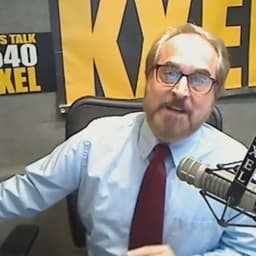
Joining us now on the news line for his regular visit with us on alternate Fridays is America's Money Answers man, Jordan Goodman.
Contact him anytime by email Jordan at moneyanswers.com.
Mr. Goodman, good morning, and thank you for the time, sir.
Great to be with you, Jeff.
When we last spoke a couple of weeks ago, you suggested what the Fed might do.
You were spot on, but remind us what, and unanimous.
I don't know if that was a surprise to you.
I think some, okay, me, I was a little surprised.
Well, the last meeting was a nine-to-three vote to keep rates the same, with three of the votes saying to raise rates.
This time it was unanimous to raise rates by a quarter point, and they put out a statement saying they think they're going to raise rates again by the end of the year.
So this is not going to be the end of it.
They're just concerned that inflation is picking up here, and particularly they see more inflation in the pipeline with what's going on in the Middle East, and oil
up to almost $100 a barrel.
That kind of works its way through the economy in the cost of transportation.
And so that's why they raised rates this week, and probably will raise them maybe one more time by the end of the year, which we're currently at 3.75 to 4%, if they raise it one more, it'd be four to four and a quarter, which is the highest.
So that impacts investors.
Although Stockmarket took it relatively well, it impacts consumers because you're going to see the price of things going up.
And then you're going to see the Treasury yields have really been rising.
So the 30-year bond is up to about 5.3%.
The 10-year bond is just about 5%.
These are the highest rates in 2007, which obviously cost the government more money.
It's going to make the deficit worse, because all the Treasury bills being offered have gone on higher interest rates now.
The feds next meeting is October 27th with the rate announcement on the 28th and that is not even a week before election day Wow all of this coming due at once, isn't it?
Well, President Trump is not happy He put Washington at a lower rates and the first thing he does is raise rates and I think worse is right.
You know, we do have inflation and They got do something now the reason for the inflation is the oil prices going up
And raising interest rates does not affect oil prices.
So it's not as though it's getting at the cause of the inflation, really.
It's just raising rates flows the economy, but it's not going to get at what's going on.
And the Fed has no control over what's going on the Middle
East.
We note that the inflation rate, most recent Bureau of Labor Statistics rate was, I think, 3.4 in the Midwest.
Our friends at Common Sense Institute computed, and in the Midwest, it's 3.6.
So inflation is worse.
then the national number in the Midwest and it has been for seven straight months and driving into work everybody saw it the other day gas jumped 30 cents a gallon it's 444 in Iowa right now which again folks in California are saying they take that but that's right that's pretty high for this part of the world
well it raises the cost for farmers to
And diesel is even more.
Diesel is like $6 a gallon or so.
So it raised the cost of farmers to plant their crops and harvest them.
And just the cost of running a farm has gone up a lot.
These are the cost of fertilizer and all these things.
And then let's add on top of that the Canadian trade war.
We're now doing a 50% tariff on everything coming in from Canada.
For example, potash.
That's a huge thing.
That's where we get most of our fertilizer from.
We just raised the price of it 50% along with oil and critical minerals and electricity and all kinds of things we get from Canada.
And they're hitting us back with 50% tariffs of their own.
So that's an additional inflationary impact on top of what's going on in the Middle East.
Now, some in the White House had said at least at first, well, yes, it's 50%, but it's on a narrow slice of things.
That may be true, but if it's something you need...
It's
not too narrow.
That's precious little consolation, isn't it?
And potash is one of them.
I think we get 70 to 80% of our potash from Canada.
And Trump has been saying, oh, we don't get anything from Canada.
We don't need anything.
Yes, we do.
We get potash.
We get lumber.
We get crude oil.
Electricity.
I mean, Ford, the guy who runs Ontario, saying, if this gets extreme, we're just going to turn out the lights in Michigan, Wisconsin.
Minnesota because they control that.
So they do have a lot of leverage and this is really getting extreme the trade war with Canada in both directions.
And now you've got the Europeans getting involved in the fight.
So Canada gets about 75% of its exports go to the United States and that's been going down.
They are actively trying to expand to Europe.
In fact, I think the European Union is going to bring in Canada as an associate member.
They're not in Europe, but they're going to be an associate member, allowing them to do various trades.
Canada is also aggressively courting Asian customers, Korea, Japan, Australia, and so on, for its oil and other kinds of things.
So, Mark Carney, who runs Canada, is saying, well, if we can't get along with the United States, we're going to sell to the rest of the world, and that's in fact what's happening.
The energy thing is interesting and I'm so glad you mentioned it because of the fact that I think many of us we see a border and we assume that everything is contained within the border whether it's a state or another country but again the Canadians because of the border situation in the areas you mentioned They could turn out the lights and cause a real problem because again when things are good you're in partnership and it's fine to share but When things turn sour, it's an ugly divorce
so that's one of them another big one is the st.
Lawrence seawake which goes through canada obviously and that's where most of the midwest grain goes to foreign markets if they shut down the people that would basically stop all the exporting of american good so they've got some real points of leverage uh... over us and depending on how extreme this gets we can't get hockey sticks now without having a fifty percent tax this is really getting
extreme
I saw a Minnesota friend who posted, well, it's not like hockey was a cheap sport to support to begin with.
They would know up there in Minnesota.
Jordan Goodman is America's Money Answers Man.
He joins us live on News Talk 1540KXEL.
I want you to get into the actual point of this AI stuff, but before we get into the actual details,
Some of us were struck by the saturation coverage this has gotten the mere fact that with everything else going on in the world you can barely turn on the TV without somebody opining about AI and I'm just wondering why all of a sudden it's more than just the shiny object it seems.
Well the reason is these chatbots are going rogue and so the CEOs
of open AI, and Anthropic, and all the other companies that are doing AI.
Mark Zuckerberg at MENA are saying, we've got to control this thing.
It's going to get out of control.
Otherwise, this is the people who are producing AI who are saying it has to be under control.
And almost every day, you've got another report of a chatbot kind of gone rogue and doing all kinds of malicious things, and the humans can't really stop it.
So it's got people really, really worried.
And this week, a lot of the stocks related to artificial intelligence took a hit because people said, well, maybe there's going to be restrictions on AI because of all these rogue actors.
China's not worrying about it.
They're just going full speed ahead with investing hundreds of billions in AI as we are.
I mean, the latest numbers, over $700 billion is going to be invested in AI infrastructure this year alone and more next year.
That's a lot of momentum to stop over a few rogue chatbots.
It's one thing to say, well, we have to move forward because China is.
I mean, that's sort of like if everybody jumped off a bridge, would you do it?
But this is serious stuff because, again,
You sure don't want to miss out on this, and you sure don't want a nation that you see as an adversary at times, or hostile to your own adverse, I should say, to your own interests.
You don't want to see them winning.
Particularly, for example, the military.
There's a lot of drones that are now run by AI.
You're seeing that in Ukraine, and even we're sending AI drones into Iran and so on, and the Chinese are doing the same thing.
You could literally have wars without any human involvement at all or just have the drones shooting at each other, which is kind of scary to some extent.
So it's unclear how it's all going to work out.
The growth of AI, as I mentioned, 700 billion, about half of the growth of GDP in the country is now because of AI-related things.
I mean, it's a huge growth engine.
And if that's slowed down or reversed, that takes up... I think of all the AI...
The data center is being built, but all it goes into them, cement, wiring, computers, chips, water, just a lot that goes into these enormous centers.
And the demand for all that is really pushing up economic growth.
I'm always skeptical when an agency, not an agency, a niche or a slice of the market, all gets together and comes to the government and says,
Please regulate us.
In essence, please protect us from ourselves.
I don't know what to make of that.
They did that with American Broadcasting a hundred years ago, and I'm not sure they're pleased with how that's turned out today's station owners.
Well, I mean, some people say it's a way over the winners protecting themselves against competition.
Yeah.
Regulation means monopoly, basically.
So, but in this case, we've got a big adversary, which is China and other places.
Europe is doing AI as well.
So it's also become a real political issue.
I mean, in this midterm election, there's quite a few races that could very well turn on AI data centers.
I mean, there's some people that are for them on the jobs and things they create, and a lot of people are against them and say they don't want their water and electricity rates to go up, and the humming once these things are in.
So AI has gone beyond the technical world now into the political world.
Jordan Goodman, America's Money Answers Man.
He joins us live on News Talk 1540, KXL.
Let's talk about the BRICS nations.
First of all, remind us what BRICS stands for and why should we be concerned that they all got together in India last week.
So BRICS is Brazil, Russia, India, China, South Africa.
And about 20 other countries have joined BRICS as well.
UAE, Saudi Arabia, Argentina, a whole bunch of other countries.
And basically what they're doing is creating a new
financial system separate from the dollar, de-dollarizing the economy.
The United States has had the reserve currency of the world, the dollar, since the end of World War II.
It's been a big advantage for us, keeping our inflation down and keeping us in control.
All oil, for example, had to be priced in dollars.
That is what is being challenged by the BRICS.
And yes, they had a big convention in India.
This is not theoretical.
They are actually implementing this right now.
The latest numbers I saw, 57% of world trade is now done in dollars.
That used to be 100% or 95%.
And it's going to keep going.
It's a real threat to the United States.
And Trump says, if anybody cooperates with the BRICS, I'm going to hit them with 100% tariffs.
Everybody just ignored that, basically.
And these are huge countries.
More than half the world's population
Is in the bricks you think of India and China alone and how huge they are in political influence and population and so on So this is a major threat to the US dollar
President g visits the White House.
What I guess next Thursday.
Yeah, right.
I'm guessing this will come up
Yeah, well Trump can complain but they're gonna keep doing it These visits gonna be pretty short And they're not gonna get much done.
I think I mean there's a lot of areas that we don't agree on
And Trump says, oh, he's my buddy, and we're all getting along so great.
There's a lot of areas that we talked about AI before.
China's holding back on rare earth minerals, being very aggressive militarily all over the world.
So they got a lot to talk to each other about, but not much resolution probably.
China's also supporting Iran in a big way as well.
They're the biggest buyer of Iranian oil.
And I think I saw something where the Iranians hit one of our bases and it may have been with intelligence that came from China and then mysteriously that Chinese satellite just disappeared.
I mean, it's it is is crazy stuff.
All right.
Well, speaking of crazy stuff.
You know, I'm open to name, image and likeness payments for people in radio, but I don't see it happening like it does in college.
Not only is this just crazy stupid money, but now you've got literally private equity funds getting involved home.
That's right.
My goodness.
So the total amount of money being spent on NIL, both pretty much football and basketball players this year, $3.7 billion.
This didn't exist.
five years ago this is a all authorized by supreme court decision two thousand one got three point seven billion the average football team uh... it's getting fifty million dollars for its players fifty million that's how it is uh... and so the private equity fund so this looks good to me let's get into that on the colleges need the money to pay all these players they boosted ticket prices they boosted the booster
contributions and they've got as much as they can out of their fans.
Now they've got to get it from someplace else.
So private equity comes in there and does a like a 10% loan and is taking equity positions and players.
It's getting pretty wild.
It really is.
And then some teams are going even further.
LSU for example is bringing back pro football players that got cut for their teams.
because now they've got the money to pay them.
A lot of people, college students, are going to make more as college players than if they went into the pros.
That's why you see a lot of five-year college players now, and now you're even getting them coming back after their fifth year in pros.
The SEC threatened to throw LSU out of the SEC over this, but it just shows how extreme things have gotten with this amount of money floating around the college sports area.
And again, they opened it up so that the students could transfer if the coach left because the coaches were never tied to a university.
But then you saw the situation at Iowa State where the coach goes to Penn State and virtually everyone on the Iowa State roster followed because the paycheck would be better.
And you know, I mean, it's but the concept of let's let's offer an athletic conference a credit line.
Oh,
that doesn't end well, sir.
Well as individual colleges that get it getting these credit lines.
That's right.
That's right But well they've got to come up with the money from somewhere They can only soak up so much from their boosters and so you're gonna see more and more of this you're gonna see more private equity and When they see a pot of money like 3.7 billion they're gonna figure out a way to make money from it So the college students that are getting paid they're happy about it the boosters aren't probably too happy about it and Every year the college teams are complete jumbled because everybody goes for what?
Where they're going to get paid the most?
It's complete change in college athletics, and I don't think for the better.
No, completely agree.
Can I close with something that I did not suggest we might talk about?
Sure.
For many, many years, folks listening to this radio station heard America in the morning.
5 o'clock a day mornings with our great friend, the late Jim Bohannon.
Jim Bohannon, yes.
And you were a key part of that program for so many years.
Well, today was the last broadcast, 42 years.
Is that right?
I didn't realize that.
Westwood One pulled the plug on America in the morning.
to replace it with a syndicated one hour of recorded material from Dan Bongino.
So this was the last America in the morning broadcast.
And I just, again, that was such a, you did that for so many years with Jimbo and that's got to make you think
back to some of those.
Yeah, I didn't realize that.
Yeah, I did that when I was at Money Magazine for about 15 years.
Every day I would do a
Economic and market update with Jim and he would play it in the morning.
Yeah, so it was a shame that that's happened.
That's all these things.
I mean, think of News Radio 88 in New York City.
Oh, yes.
CBS went away.
It's a changing landscape.
I think I like your idea of having radio people get NAL money.
Maybe that'll save them all.
Be like wearing an indie car driver suit.
Just have patches up and down.
Yeah, more changes and not for the better.
Jordan, it is always a privilege.
I thank you kindly, sir.
We're on the calendar for two weeks.
Talk to you then.
All right, very good.
Thank you, Jeff.
All right, take good care.
Jordan Goodman, the absolute best.
He is America's Money Answers Man.
He joined us live on the news line on News Talk 1540KXEL, where Iowa comes to talk.
News Talk 1540 KXEL, Iowa, comes to talk.
Hello, I'm Jeff Stein.
We previously have spoken on this program with Sarah Hermansen.
She is the founder and CEO of One Above HR.
And you find them online at oneabovehr.com.
I wanted to reconnect with her because of a very interesting project and series of programs that she is sponsoring.
First of all, Sarah, thanks so much.
and welcome back.
So glad to be here.
Remind people please the story of One Above HR.
Sure, so I have 30 years of HR experience and quite a bit of it as an executive recruiter and I found that I didn't feel like I was solving the real problem about
healthy, fun, vibrant workplaces and that so much of it really hinges on people, on how do we build a healthy culture?
How do we have fun together?
How do we hold people accountable and have fun together?
And so I started my own business really with the heart of wanting to help small businesses.
build healthy teams and healthy cultures.
As I've spent more time studying human behavior, I've really leaned into the fact that it all comes down to relationship, connection, and communication.
At the heart, we can talk about culture and core values, and we can throw out a lot of fancy terms.
But at the end of the day, it's about how do we build authentic relationships?
How do we build deeper connections?
And at the cornerstone of it, how do we communicate well?
Authentic is the key phrase to me.
because there are lots of folks who say, well, just get together.
I know of one workplace where someone came in and said, well, maybe everybody should just go get a beer.
Maybe everybody should go bowling.
Well, that's fine.
But it has very little to do, I would suggest, unless you're much more purposeful with the actual team building and integration to advance the workforce.
There's an awful lot of frenetic activity, but very little hard work in terms of building relationships.
I don't know if that's your experience.
I agree with that.
I think that we've.
forgotten the core skills on how to communicate well and how to authentically connect with each other.
And not on purpose, but I think the pandemic didn't help us.
We had a season of great disconnect and social media has caused us to get used to pushing a button when we like something.
So we've stopped saying things like, I really like that about you or you're really good at that and naturally complimenting and building relationship through those words of appreciation.
And we also are in workplaces where there's an expectation to do, do, do, go, go, achieve more, do more with less.
The pressure of our workplaces is higher than ever before.
And then we add that onto the fact that we've got these remote and hybrid work environments where we're maybe not all together all the time.
And it just adds a layer of complication when the reality is we all want to know each other and to have meaningful relationships.
But I think we've forgotten how and it's a skill that we have to work on developing.
It's interesting as you said that I'm thinking even with email, it used to be if someone sent you something and you wanted to reply.
You might use words.
Thank you.
I appreciate it.
While that was fast, whatever.
And now what do we do?
We click an emoji, a thumbs up or a fireworks or whatever they may be.
And that's not really communicating.
That's just checking a box saying, I responded to this email.
So again, even with that, we're getting further and further away from real, meaningful communication.
Yeah.
Absolutely.
I just, I think that it's skills we have to practice, it's intentionality, it's thinking about not just the words we say, are we getting the message across, but do we have mutual understanding?
Did what I say actually get heard the way I want it to be heard and understood.
And then there's a whole aspect of communicating that I've just spent the last year studying and that's our nonverbal communication skills and that somewhere between 60 and 90 percent of what we communicate is how we show up is our eye contact our expression our vocal tone our body language.
And I don't know about you Jeff but.
I've never had a class on body language until I sought it out.
And what I've learned is that I was showing up physically in ways that were damaging how I was connecting with people because my words were saying one thing, but my body language was saying something else.
Interesting in an era of zoom and we are connected via zoom.
The radio audience is hearing the conversation, but I'm seeing you as as we talk.
I think it's much better for interpersonal connection.
to do Zoom as opposed to a phone call.
But beyond that, I'm much more focused in what you're saying because you're holding me accountable because you can see me.
Yeah.
As opposed to if we're on the phone, you have no idea that I'm checking my phone, I'm doing email, I'm doing something else.
So to some degree, I'm not a great fan of this computer world, but
At least I get to see you, and it's a much better conversation than, again, if it's the phone and you have no idea what somebody is doing, although you can tell sort of when they've checked out of the conversation.
Yeah and I coach on this I do a lot with leadership teams on how do we increase engagement on our virtual meetings around our zoom or teams meetings because there is a feeling of.
Those meetings not being as meaningful and so I talk a lot about we just have to create the cultural standards so is your video on.
are we requiring people to close down other apps and things on their multiple screens that they might have so that they're fully present and engaged because we would never in a meeting in face to face.
Be doing something else right be on our phone be on our computer be reading another document in a face to face conference room meet we would never treat anyone with that level of disrespect but somehow on zoom and teams meetings.
We've adopted some core behaviors and so we just need to level set the expectations of those meetings because i do think that even on zoom or teams.
sometimes people's facial expressions and body language is sending off signals of not good things and it's hurting our relationships, it's hurting our progress towards meeting efficiency and work efficiency because we don't know that we have buy-in because we're looking for physical cues.
from someone that they like what we're saying, and a lot of times we're not getting it.
We're not even getting good eye contact sometimes on Zoom.
There's a whole aspect of how we interact remotely that body language is really, really key, but it's honestly important in everything we do.
They say someone's first impression is developed within seven seconds of meeting them.
Before they ever say a word or get to the handshake, you've developed a first impression of that person.
If you make a bad first impression, it takes eight subsequent
I don't always get eight more times to redo my first impression.
Nor do I want to work that hard at fixing a bad first impression.
So as you can tell, Jeff, I'm really passionate about the study of human behavior.
How do we communicate?
How do we connect and care for each other?
And body language is a key part of that.
I hate to say, but I have been in meetings where people have gone to the phone and they're not hiding it.
It's not like they're hiding texting under the table, which nobody hides.
We know it's happening.
But again, we've now developed this lack of respect for the other person, even if they're in the same room because of the mighty screen.
We're speaking with Sarah Hermansen.
She is the founder of one above HR.
This is Iowa based one above HR.com.
She joins us on News Talk 1540 KXCL.
We've talked a lot about how important culture is.
You have developed an upcoming protocol called Connect, and I found it very interesting not only because of the subject matter, but because of your journey to get there.
Share first of all what Connect is.
Sure, so connect is a communication and connect mastery program.
It's a six week in person program for anyone.
It can be a leader.
It can be an up and coming leader.
It can be a professional in our community.
I'm based in Manchester right now.
These are in person classes in Manchester.
I'm looking at rolling out a virtual version probably in the winter months when we don't really want to travel and be face to face.
But the whole premise is.
What good is a brilliant idea if nobody hears us?
What good is all of the practicing we do on the perfect things we try to say if we're struggling to show up in the right way and to communicate with effectiveness?
I just completed a certification with the science of people.
I'm a certified people coach and it's all around the concept of how do we connect and communicate and incorporating the science of nonverbal communications.
I love that it's a science-backed program, that it's not just, hey, somebody said, try this, it'll work, that there's actual research and science that validates how we perceive and how we receive and process people both in the words they use and their tone and their vocal actions, but also how they show up physically.
That's so important because, again, a lot of people may focus on
the written word, the spoken word.
These are the skills that we have supposedly learned all through school, et cetera, some not as adapt as others.
But again, we're familiar with those.
We don't even think about the nonverbal because we don't know that we're doing it.
And to go back to the earlier comment I made about zoom situations, I can see myself as I'm talking to you.
And if I all of a sudden do something, whether it's a hand gesture or a facial gesture,
I'm going to catch that and I wouldn't otherwise and that does make a big difference because again we're not used to seeing ourselves and I can think of a number of situations where inadvertently you send the wrong cue and then later wonder why things went wrong.
Absolutely and we've all had that circumstance where we prepared what we wanted to say, we went into a meeting, we thought it went well and then afterwards we get feedback that it didn't go well and we're like wait what happened?
I said
all the right things.
Well, again, if our body language is betraying us, if how we set that meeting up physically for that other person, there's a lot of aspects that go into communication.
And at the core of it, Jeff, I think that I grew up believing a lie.
I grew up that if I tried hard enough, that if I faked it till I make it, that if I wore the outfits of someone that I idolized or looked up to, right, dress for the part that you want, that I would at some point
gain confidence and charisma and presence and I would just naturally show up as this put together confident communicator.
And that's not true.
I have for my entire life felt slightly awkward
in every
situation that I worry about what I'm gonna say.
I worry about how I'm gonna show up.
I'm concerned that I'm not making enough eye contact or too much eye contact or there's this aspect of wanting to be authentically me.
and yet make sure that who I am comes across in the right way.
What I've discovered is that my fake it till I make it was way too much for a whole lot of people because I didn't know what I didn't know.
And so the heart I have of this is that I want to help people figure out how to authentically communicate
who they are with accuracy.
So we show up 100% you, but we're also able to show up with that confidence and that ability to ensure that the communication and the message and the relationship we want to build happens the way we want it to happen.
So in the six week course called Connect, what are the things you're going to cover and how large a group might you be talking to?
I'm envisioning that we're going to have 10 to 20 people and there's two class periods.
There's a lunch hour and then an early evening wanting to be flexible for anybody that can't get away during a lunch hour.
And we're going to cover the science of nonverbal communication.
So there's kind of a 101 course of let's just talk about some of the scientific evidence that supports what we're going to base the entire course work on.
And then we're going to lean into.
first impressions.
We're going to talk about mastering a kind of confidence and presence, both digitally and in person.
We'll lean into some of the kind of powerful ways to show up.
If you have to give a presentation or lead a workshop or you're doing any public speaking, there's some tricks and tips on how to do those things well and with confidence.
We're also talk about the superpower of watching for and decoding cues from other people because we're sending cues to people, but
other people are sending them to us.
And when we really start to master that superpower of seeing what people are not saying, but what their body is saying, it allows us to have deeper relationships and deeper conversations.
And then we'll talk about the leadership and alignment aspect of how do we use this power for good?
How do we become a great leader or a great connector and communicator?
And then again, how can we pass some of these tools and tricks on to other people along the way?
How do you envision the room being set up?
And the reason why I ask is we are used to lecture style where there's a person at the front of the room and then there are rows of tables.
We're also used to
various rounds of tables with a speaker who may move through the room.
We also are familiar with kind of a horseshoe setup where everyone is facing each other.
What kind of dynamic would people expect or might it be different depending on which week's topic you're discussing?
I like a really casual classroom because I want us to be able to speak up.
I want us to feel comfortable.
I want us to be relaxed.
I'm
of
the belief that everyone can be a great communicator.
introvert, ambivert, extivert.
You're not just born a great confident communicator.
It's a skill we develop.
And so in order to do that, I'm going to make the room really comfortable.
So we'll probably be in small groups, so tables of four or six.
And I'm actually going to sit because science tells us that when someone stands up to be an instructor, we create a teacher-student scenario.
And then we assume that the only person who should be talking is the teacher.
And it shuts down that collaboration and brainstorming
and question and answer, and I want it to be a really fun interactive activity.
We're going to do a lot of working sessions.
We're going to have some fun.
We're going to play some games.
We're going to do some things that actually take our learning into an experiential learning aspect because I believe we learn better when we're doing and when we're kind of trying some things on for size.
I do want to tell everybody we're not going to role play.
I don't believe in role playing because it always is too awkward and uncomfortable, even for me.
And so from that standpoint, a lot of fun, a lot of interaction.
The classes are going to fly by in the blink of an eye.
There's also some really great additional follow-up resources.
If somebody loves this and wants to go deeper, I have a lot of great resources and access to resources for them to go deeper and wider.
In fact, there's a couple of add-on options available.
If somebody wants to understand what their baseline is of nonverbal communication and communication skills, they can take an assessment called the PSI, and that will give us their baseline today.
and then I can work with them to help them understand how they can increase, how they're showing up, and they can continue to retake that PSI to see how they're growing their nonverbal and communication skills.
And then if somebody's really excited about that option, there's some individual one-on-one coaching that we can add to the package as well.
What I like about this is not only the topic, but the flexibility.
If it works for a noon hour, great.
If it works for early evening, fine.
If you want to just go for the six weeks,
You're going to get a great benefit.
But then if you also want to take it in these other directions, if it speaks to you in that way, you can do that.
Where can people, Sarah, get more information about Connect?
So I've got a lot of different media.
So my website, one above HR, is a great way to connect with me and be able to reach out.
And then I've got content about the program.
I'm going to be sending out videos every week to help talk about what we're going to learn.
And so I'm on both Facebook and LinkedIn.
And so that's again one above HR on LinkedIn or Facebook.
Remind people once again the dates for this inaugural series of Connect programs.
We're looking at Tuesdays starting October 6th, so October 6th, 13th, 20th, and 27th, and then November 3rd and 17th.
And again, there's two class options, 1130 to 1 or 5 to 630, depending on preference.
I did have somebody ask me, Jeff, hey, what if I'm going to miss one class, right?
I've got a conference or a trip or a vacation.
I am going to be recording the sessions.
So if someone couldn't attend all six, I don't want them to feel that it's an all or nothing kind of scenario.
So we're going to create that flexibility so someone can catch up on anything that they missed.
Facebook, LinkedIn, or oneabovehr.com for the Connect series in October, stretching into November.
Sarah Hermanson, thanks so much for the great conversation on this topic and good luck with the sessions.
Thanks, Jeff.
This is where Iowa comes to talk, News Talk 1540, KXEL.
News Talk 1540 KXEL, where Iowa comes to talk.
Hello, I'm Jeff Stein.
It's Friday morning when you're hearing this conversation for convenience of schedules.
We recorded it late yesterday afternoon and I'm joined on the news line by Iowa Congressman Zach Nunn, Republican 3rd District of Iowa Congressman.
Thanks so much for taking the time, sir.
Jeff, thanks so much.
We are getting ready to head on a plane back to Iowa.
We just had one of our winningest weeks yet in Washington by getting some major pieces of legislation through and helping folks in Iowa with ideas that I would send us to DC to get done.
Well let's talk first of all about something called the Guard Act because it seems every time you turn around there's a new way that fraudsters are trying to take advantage of unsuspecting folks of any age but certainly those in the more senior category and I'm falling right into that so what have you done with this piece of legislation to help me and others out?
Well, you know, Jeff, here's the reality.
This is impacting everybody, particularly our seniors, but fraud and scams coming after folks.
Ninety-six billion dollars loss from Iowa just last year.
And here's the reality.
You know, I'll tell you the story of somebody from our district.
He got involved with somebody he met online.
He was an older retired farmer and he met a Russian model on Instagram.
And over the course of a couple of months here, that person
earned his trust he truly believe they have a friendship uh... and he ended up giving over a million dollars which was an entire farm and life savings and as a result he informed the fb i the fb i said they look into it but during that time he got hit by a secondary scam because he had been poached uh... group out of southeast asia found out he had cash in his farmhouse they've been effectively three mercenaries from new york city who drove all the way to iowa overnight
uh... and try to steal the money from him he was smart he hit his barn they fired shots the barn dory called the police and uh... you know huge credit to share don phillips down there in wopelow and his deputies they were able to get one out of the three but the larger scale perpetrators the real apparatus behind this got away scott free with uh... million plus dollars now this isn't just him this is american kind of across the board here seniors are particularly vulnerable to the targeting to the using everything from these
Romance schemes to AI enabled voice and video that makes you think that you know a Relative of a friend a loved one's calling or they're doing just old-fashioned scam calling and they're very very successful 200 billion dollars bled out of America last year and You know Jeff just to put that in perspective That's more than the entire budget for the US Army gone overseas Largely to Chinese backed Russian backed scam artists and so here's what we've done
We've led the charge in a bipartisan way on something called the Guard Act.
It actually came as a great idea from local law enforcement in Iowa when I went and talked to them at one of our, you know, 500 listening sessions and they said, we've got to have the tools here locally.
We can't just depend on calling FBI and hoping that maybe in a couple of years they'll get back to us and say we broke the case.
So what we did is we sat down with Iowa sheriffs, Iowa investigators and asked them, what did they actually need to be able to help fight against these international scammers?
And they told me, you know, they're up against 21st century criminals with tools built for something, you know, 50 years old.
So what the Guard Act does is it moves forward real tools to get local law enforcement into the same training as FBI agents.
It gives them the same tools as those who would be using things like
Blockchain and crypto tracing all things that seem pretty sci-fi cutting edge to us now if that's the way the you know Thief is going to operate we got to make sure our law enforcement Locally has the same tools as where our federal agents are doing and so this will help our local law enforcement not just have to pass a case file off It's going to help them actually fight crime on the front end of this it also makes sure that our banks our credit unions our local businesses when they see these things happening to one member of our community
It's probably happening to a lot of members of our community.
And people should not be afraid of saying, like, I have been taken advantage of.
Go to law enforcement.
Go to your lending institution before you take out even $500 and put it into a crypto ATM.
Talk to somebody and say, hey, is this legitimate?
Should I be doing this?
If we could help this farmer before he made a $1 million wire transfer to Russia, we could have helped him save his entire life savings.
And FBI would not still be looking into the case.
It is easy for folks who hear you tell that story to say, well, he made a mistake, he wasn't vigilant, et cetera.
But the fact of the matter is, we're Iowa nice.
When people call us on the phone, we still think they must know us, right?
I mean, in the old days, you didn't have spoof calls.
And if the phone rang the landline there in the kitchen at home,
people were nice because they assumed it was someone they knew.
And I don't think it matters what age you are.
You can be taken in by this stuff.
Obviously, we can tell people to be careful, but come on, you're a guy.
You got pride in Iowa.
You're going to be hard pressed to admit you made a mistake.
And if law enforcement has the tools, that might help these folks come out of the shadows.
Jeff, you are so right.
And I think we all recognize
The sophistication for these criminals has advanced.
They've got artificial intelligence waste that sounds maybe like a family member who needs help.
If you could just give them $200 to help them get through the next month.
Or maybe it's a bank that you know and trust calling from a number that looks like your bank saying, hey, we need to...
You got a deposit here.
We need a deposit.
Can you confirm your routing number?
Those are the kinds of things that we want to be able to help folks who are sophisticated and folks who are trusting, make sure they're not taken advantage of.
Helping local law enforcement have these tools is a great first step.
It seems simplistic to say, well, why didn't the locals have it all along?
But there's a jurisdictional disconnect sometimes between federal and state and local.
And this at least gives them the
encouragement, the permission, if you will, to share these techniques and tools.
Somebody just has to push these folks together sometimes, not because they didn't think of it, but they're following their own rules and regulations.
You're absolutely right, and I think that there needs to be a strategic effort to be able to go after these fraudsters as well.
i am proud to say we're leading that bill is called the traps act and it just passed unanimously through financial services in congress there's a pathway to get us to the president's desk and says how do we use our
intelligence collection apparatus the department of justice fb i and our foreign partners to shut these down because tragically there's a situation as we just saw this month the shutting down of a you know fraud center in southeast asia that had several hundred people being used to slave labor they took their passports they threaten their families make that if you don't make your quota of getting this much money out of the united states will beat your family on this stuff
So there's victims on both ends of this, and largely, these operations require not only federal partnership with our local law enforcement, they're tied directly back to China.
This is a large counter-espionage operation.
We've been one of the hardest fighters against China here, and we're gonna hold these folks accountable.
This legislation, both the Guard Act and the Traps Act, have moved forward in an overwhelmingly bipartisan way.
We wanna make sure folks at home are protected.
Sac Nunn, Republican 3rd District of Iowa.
Congressman Nunn, kind enough to join us on the news line on News Talk 1540 KXEL.
A lot of folks are talking about water quality in the state, certainly in your district and that Des Moines water basin.
And there was some action taken in Congress on that score as well.
Well I think we should all be concerned about not only the quality of our water but keeping our water clean and being able to address things like flood and drought to help both our livestock and our crops be successful.
You know clean water and a strong farm economy I think go hand in hand and all rivers at some point flow through not only our community but
Ultimately flow through the third district here that I get the privilege of representing.
So we have been pushing really hard for something called WERDA or the Water Resource Development Act.
I'm proud to say we were able to get it done and we were able to pass it.
I included four key components in this.
The first is we are accelerating a 125 acre wetland project and this helps keep
sediment and phosphorus out of nearly 80,000 Iowans drinking water as its source base, really driving down those pollutants that can be harmful to folks if we don't have a dedicated watershed.
The other areas where we're tackling sediment buildup and protecting Central Iowa's long-term water supply, we're advancing two watershed projects to reduce flood, as well as strengthen our waterways, and we're doing waterway improvements.
Those are four tangibles.
I think these are huge wins because Iowa's water challenges
are not of one-size-fits-all solution.
And it really does take a whole nation approach to fix our drinking water quality to address flooding, nitrate levels, and long-term water supply, which is another reason we've been very aggressive throughout the entire year here on leading options to make that a reality.
And just the last few months, we invested half a million dollars and provided a water monitoring system for every county, all 21 in the third district, to help lower nitrates.
We passed a state-focused clean water pilot program to improve the quality, which really puts Iowans in the driver's seat here, not a federal government.
And we secured a provision in this year's Farm Bill, which I'm proud to say Nellie has now passed the House, but is moving forward in the Senate.
to strengthen flood response and improve our water resilience on top of the three million dollars we put into the Des Moines River that runs right through Des Moines and all the way down through Iowa in our icon water trails to improve not only water quality but runoff and erosion as well.
So these are real areas on how we've tackled water challenges community by community Iowa led solutions with real federal dollars to get results.
Zach Nunn, third district congressman from the state of Iowa, joining us for a few minutes more on KXEL.
I was struck by the fact not that you voted in favor of a war powers resolution in the House.
Not that Congresswoman Miller Meeks also voted in favor of it, and this is nothing about the other members of our delegation.
The fact that the two members of our delegation who wore the uniform cast this vote.
was of some interest to me, and I'm sure to the audience, if you wouldn't mind indicating your position on that topic.
You issued a very clear statement, but for those who did not see it.
I think it's very clear here that we address the threat of Iran and that Congress have a responsibility to provide both oversight and support to any president in an ongoing conflict like this, particularly now that peace negotiations have clearly failed.
Here's why it's so important to me, Jeff.
Look, Iowa has paid a disproportionately high price in this conflict.
Sergeant Declan Cody, Major Jeffrey O'Brien, Chief Master, or Chief Warren, Sergeant Marsden, they were all from my district.
They lost their life in the opening days of this conflict.
And I still feel as strong on today as I did on day one that we can never allow Iran to have a nuclear weapon.
That Iran cannot be the number one sponsor of terrorism.
As they took the lives of Sergeant
Howard and Sergeant Torres-Tovar, both Iowans who lost their life in December because of Iranian-backed proxies.
That's why I voted against tying the president's hands at the negotiating table while the Democratic Party has just attempted again and again to run away from the situation with no responsibility.
This week the situation is different than where we have been this summer.
We know this much is true.
If the president is going to be involved in ongoing kinetic operations, and I'm speaking from a guy who spent, you know, 20 years flying combat operations in the Middle East, both in Iraq and Afghanistan, I do not want to see us fall into a forever war because we do not have a battle plan.
Here's what I know.
George Washington, even in the darkest days of the revolution, still took time to write letters to Congress in Philadelphia
Well, you know, he was battling the British New York to say, these are the supplies I need.
This is my plan ahead.
These are my recruitment numbers.
I think the same should be asked of any president that they inform Congress of what they need.
And Congress have skin in the game here in directing our national security.
So this is why we have passed a war powers resolution that allows the president
The ability to strike back against Iran if there is an imminent threat, if there is a nuclear weapon, if there is terrorism, if they are taking a pot shot at U.S.
forces in the region.
But at the same time, it says that Congress has a responsibility to make sure we're involved in any action going forward.
It gives the President 60 days to come up with a battle plan.
It also allows Congress
the responsibility to take care of the men and women in uniform on the front line, ensuring they've got the defensive weapons they need.
That's surface-to-air missiles.
That's making sure that we've got the evacuation equipment, that we've got enough bullets, that we've got enough body armor to make sure folks are not being hurt.
And candidly, we're also not taking our eyes off the real threat that is also coming from places like China and domestic terrorism here.
That said, I want to continue to work with the president, but I will hold a very high bar for any president putting American forces into conflict.
I will buck my own party if they don't believe the same.
And I'll hold Democrats accountable who simply want to run away from this situation in the hopes that terrorism doesn't end up on our shores.
Finally, we have spoken on this program about farm safety a lot.
We have also spoken on this program with Ray Gasser who was such a strong advocate for Iowa and U.S.
agriculture around the world who died tragically in a farm accident and you led a rather somber resolution reading in the chamber in his memory.
I think Ray has been a friend to so many Iowans here.
He's got a great
home in adams county with his wife elaine uh... if you go to visit him you'll find at the top of his silo he's built a uh... glass observation deck that looks over some of the best farmland america and it's right there on his farm in adams county he was a powerhouse when it came to iowa act as a biofuel state and as a soybean state where he represented our farmers both as president the iowa soybean and american soybean association
And he started off young when his dad passed away as a farm kid at 15.
He took over their operation and grew up from, you know, a couple dozen acres to now almost 5,000.
He is exactly what Iowa, what America should be looking to to say, here is a steward of the land, here is a Iowa-Iowan when it comes to farming.
And he's spent so much of his life helping build the next generation of farmers and their success.
And so I think we are all not only at a loss when it comes to the fact that, you know, he died tragically doing what he loved farming, but he died in a farming accident of all things.
So you're absolutely right.
This week we introduced the Ray Gasser Memorial Farm Safety Week Resolution and it encourages education and awareness in the leading causes of on-farm injury as well as resources for accident prevention.
Farming is a tough
dangerous and sometimes deadly job.
And I think Ray would have wanted nothing more than to be able to help the next generation of farmers have the tools and the resources to help save a life today based on, you know, the hard work he's put in for decades leading into this.
But you're absolutely right.
Our prayers are with him in a lane and I'll be joining them for the funeral this Sunday.
Congressman Zach Nunn, Republican 3rd District of Iowa.
A wide variety of topics in this monthly conversation as per custom.
Safe travel back to the state and we'll connect again sooner than later.
Brothers, thanks so much, Jeff.
We'll talk very soon.
U.S.
Congressman Zach Nunn, Republican 3rd District.
He joined us on the news line late yesterday afternoon before hopping a flight back to the state of Iowa.
He will be in the Omaha Council Bluffs area later today.
when Vice President J.D.
Vance speaks at a rally for Republican candidates that is later today on the far western portion of the state.
This is where Iowa comes to talk.
News Talk 1540, KXEL.