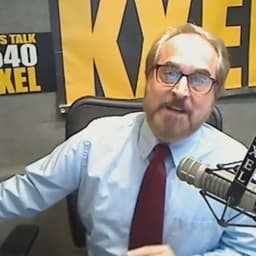
News Talk, 1540 KXEL, where Iowa comes to talk.
Hello, I'm Jeff Stein.
This is another in our series of conversations that we conducted on Thursday, September 10th, near Nashua.
Part of the Golden Anniversary celebration of the Northeast Iowa Research and Demonstration Farm, the Norman Borlaug Learning Center, and I'm pleased to be joined at our broadcast position on the patio, on the porch, looking out over this great facility.
I'm joined by USDA Deputy Secretary Stephen Vaden,
Secretary Vaden, thanks so much for taking the time, sir.
Welcome to Iowa.
Great to be here.
brought some beautiful weather for me.
Well I dare say you're the one who brought it because it hasn't been this nice here.
I know you've been suffering from a heat wave like we've been down in my home state of Tennessee so it's great to see it break.
Well our great friend Todd Starnes keeps us posted on what goes on down there in Memphis and West Tennessee and he's kind enough to allow me to host his program on occasion so we're we're well familiar with you folks down there in the volunteer state.
Now you got here and the first thing you did was take a tour of the grounds and I'm just curious what you
found what you were looking for and what you found?
Well I was looking to see what projects were important to Iowa farmers and it was really interesting to me the length of some of the plots that they've had in continuous research here.
There were just multiple plots that they've been doing the same thing to since 1979.
Either applying no potassium, no nitrogen,
or applying it at different rates going back nearly 50 years at this point and so the crop that we're looking at today looks different than the crop that they were looking at under those same conditions 20 or 25 years ago and what it means over time and then the data that they have here of course informs farmers not just all over Iowa but all over the United States when they're going in and testing the soils about what that means.
It was really instructive.
The Iowa State folks have a series of similar research farmers
all across Iowa, because again, Northeast Iowa, not the same as Northwest, Southwest, etc., no different in many other states, but I'm curious from your experience, do other states have as broad a network of these research farms
as we do here in Iowa?
So we think Iowa is very special, and that's why we at USDA are seeking to redirect more research money to this state.
We're going to put $12 million in a facility in Ames that is going to end up being our germplastic
Center for the entire United States so that we are no longer reliant on, believe it or not, a facility in Central America to be our primary germplasm center.
One would be one here in Iowa that we control and that we don't have to ask anybody's permission for and no other foreign country has any say so over.
But we're also going to take additional millions of dollars and invest in other research stations that we have here with the Agricultural Research Service in order to keep our focus and our money on actual research.
For far too long,
a lot of our money that has been earmarked by the Congress for research has instead gone to patching roofs and trying to keep buildings that are falling down and are deficient, operational for another 12 months to get to the next year.
And every dollar that we spend on a deficient, dilapidated building is a dollar that we can't spend on actual research, which is what the Congress, the farmers, and the taxpayer actually expects us to spend it on.
So we're making decisions and some of them are tough.
involve leaving facilities that 50 or more years ago were state of the art.
but no longer are and shifting the funds that were used for upkeep of those aging outdated facilities into more modern facilities like we're going to build here in Iowa, like we're going to build in North Dakota, like we're going to build in Georgia and doing the research closer to where farming is actually happening and getting more bang for our buck.
You don't
get off track in one year or one administration or one cycle and it therefore takes time to come back but you mentioned the situation with the Germ Center in
Central America.
I'm sure people listening, and you had a little sound of incredulity in your voice as well, and I'm sure many listeners were probably thinking, why in the world did that ever happen?
How deep is some of that that you're with Secretary Rollins going to have to pull back so that we control our own food supply?
You know, scientists are good people, and they are united by a belief in fact and truth and experimentation.
And for many years, there was a belief that nationalism and kind of geopolitical factors weren't going to come into play in these scientific arenas.
And unfortunately, as the world has become a more interesting place, shall we say, it's become clear that that's not the case.
And people are jealous of the scientific advancements that we have here, particularly in agriculture.
This is not just about economics.
This is honestly about national security.
And so when you're playing at that level and you realize that though we may all be scientists and we may all believe in the scientific method, the flag that flies over our lab can make a difference, you have to take that factor into play.
So it might not have been the case 30 years ago as the Cold War was ending and there was a different geopolitical moment and a different ethos internationally.
It might have made sense not to worry so much about this.
But today, unfortunately, we don't have that luxury.
We're speaking with Deputy USDA Secretary Stephen Vaden on News Talk 1540KXEL.
When you come to an event like this and I can tell you like getting out into the field literally in this case and talking to people and it's a multi-day visit to Iowa but...
you went from the tent across the parking lot to get here to where we are on the porch and I don't know a half dozen people wanted the secretaries here which is great because you get to hear things but I wonder as you're hearing things what are people saying to you when folks who have given their lives to the land literally
get to talk to a deputy USDA secretary, what are you hearing and what can you say to them to respond to concerns that they may have on a topic?
So I think it's a mixture at this point of optimism tinged with the harsh reality of the past several years for the farm economy.
So obviously your listeners who are farmers know we've seen a very welcome uptick in commodity prices as we head toward harvest here in 2026.
We're seeing whether it's beans or corn, your primary crops here in Iowa, wheat,
for those who are harvesting or have harvested their winter wheat, they have seen prices that they haven't seen in several years.
It's long past time for that to happen.
A lot of that's due to increased exports, a lot of that's due to better biofuel policy under this administration.
But they also know that the challenges that they have faced with input costs, they haven't gone away.
Fortunately, we're now deep enough into the president's second term where we have some actual physical wins on the table, like the two new fertilizer production plants that Secretary Rollins and I jointly broke ground on in Louisiana.
That's 1.4 million metric tons of ammonia coming online in 2029, the world's largest by nameplate capacity ammonia facility right here in the United States.
Similarly, we broke ground on a 1.3 million metric ton phosphate fertilizer plant.
The first new phosphate fertilizer manufacturing facility here in the United States since 1984, 42 years ago.
And 1.3 million metric tons is market moving.
That's more than a quarter of the entire United States' total annual usage of phosphate fertilizer.
And on top of that, the two companies that are building it, CHS, a farmer-owned cooperative from Minnesota,
And OCP, an industrial international leader in fertilizer mining from Morocco, neither one of them are the two companies that currently control the vast majority of the market.
So we're not only injecting new supply, we're injecting something even more difficult to achieve.
Competition.
for the farmer's dollar.
And so that plant's going to come online in the fourth quarter of 2028.
So when you have that much new supply coming on board from new market participants, I'm expecting the beginning of a different market dynamic than farmers have grown weirdly used to over the past 10 years.
That will change come 2028.
Let
me ask lastly, because
It is wonderful to break ground and control, as you just mentioned, but it takes little time.
Those things aren't just built in a day
or a
year.
And so much of this is a, we're on the way, just hold on.
What do you say to the farmer who says, I hope I can hold on?
because you're doing two different things.
You're working for the future, but you have to take care of today as well.
That's a difficult needle to thread.
Absolutely.
And that's why I'll use fertilizer example if you don't mind.
Please.
Why the president agreed with us that the duties that were keeping Moroccan fertilizer, fertilizer imported from Morocco out of the United States, needed to be suspended.
The first ship in years from Morocco, a fertilizer, reached the port of New Orleans several weeks ago.
There are nearly a dozen more of those ships behind it, shipping new fertilizer supply for use for farmers for fall application.
and the 2027 crop year heading and already at New Orleans to be distributed up the Mississippi River system and the rest of the transportation channel.
So you're correct.
It's a matter of balancing the long term with the need for here and now.
And we're working not just in the United States, but we've had American companies come to us with our new relationship with Venezuela.
Believe it or not, Venezuela used to be a meaningful fertilizer exporter to the United States.
It hasn't been because of the horrible decisions that its former social
government made over the past quarter century.
There's a new regime in place there.
They have a new openness to American investment.
We've had American companies come to us and say we think we can get some fertilizer out of there on a pretty quick timeline if we have the right backing of both the Venezuelan and American governments.
So we're working with the State Department on that.
So it's a matter of balancing a number of things but understanding that when you're talking to your banker they're most interested in your cash flow.
That's why we had the bridge payments earlier
this year.
That's why Congress is looking at a potential ag supplemental package as part of a larger defense spending package that I'm certain you talk about on News Talk 1540.
And if that passes, that will kind of be the final piece.
that will help get farmers to our next growing season and with these higher commodity prices thanks to higher exports and a biofuels regime where you have an administration that supports ethanol, that supports biodiesel, that's reallocating wave volumes instead of letting that volume go away.
It's the reason why we're not talking about beans in the $13 range instead of the $10 range and corn heading closer to $6 instead of $4.
and that's a big difference.
I sense, and this is meant in a very positive way, you have passion for this work, don't you?
I do.
You know, I didn't come to this just because somebody plopped me in here.
My family has been involved in agriculture in northwest Tennessee and southwest Kentucky for 200 years at this point.
The farm that my brother and I own in Fulton County, Kentucky
which is on the border of Tennessee.
That has been in our family longer than Fulton County has been in existence.
It predates the establishment of that county by the Kentucky State Legislature.
We on land in our home in Obine County, Tennessee as well.
So these issues are personal to us.
The economics of farming that affects the people here in Iowa affects my bottom line and my family's bottom line too and so that's why I'm passionate about it.
I'm passionate for the same reason your listeners are.
This is how my family makes a living.
This is how your listeners make a living and when it's about how you
make a living, you got a lot of passion behind
it.
As you should, Deputy A.G.
Secretary Stephen Vaden, pleasure speaking with you.
Come back again any time.
Thank you for having me, sir.
This is where Iowa comes to talk, News Talk 1540, KXEL.
News Talk 1540, KXEL, where Iowa comes to talk.
Hello, I'm Jeff Stein.
Another conversation that we recorded at the Golden Anniversary event of the Iowa State University Research and Demonstration Farms, the Borlaug Learning Center near Nashua.
It's always good to see somebody from Bremer County join us at the table.
Mark Mueller is past president of the Iowa Corn Growers Association, and you're on the board of the research farm, correct?
Not exactly.
I was the past president of the Research Farm Association.
as well, and I'm part of the planning committee for this particular event, but my duties as an exec for Iowa Corn Growers Association have kept me from even doing that small amount, so I basically here as a guest.
That is no small feat running an organization like Iowa Corn.
Give us a sense from the rear view mirror of the year in that position.
We've talked on the radio a time or two, but give us a sense now having had that experience in transitioning
into other roles.
Okay I had the the hot button issues in my particular year as president were getting year-round E-15 across the finish line.
Now we got it through the house which nobody thought we could do.
Our congressional staffs have been working on this for 15 years and I got to give full credit to the Iowa
representatives in Congress and especially Randy Feenstra who paid a pretty big price for spending his time in DC trying to get year round E-15 done.
As you know he did not come in first place in the gubernatorial race of the nomination but we do appreciate his efforts and
We never got E-round E-15 this far before.
Now it's in the Senate.
It's awaiting a positive vote in the Senate Ag Committee.
There were two yes votes that were not healthy enough to attend.
So they kind of put the vote on hold.
And when those two people are able to come back, they will presumably vote yes, and then it'll get passed out of the Senate Ag Committee to the Senate, where there will be negotiating back and forth.
If it gets passed in the Senate, it'll go to President Trump's desk, who has said he will sign it.
My personal thoughts are that nothing will happen until after the elections, and it'll be part of a lame duck Congress, and it'll be a bunch
among a bunch of things to get rushed through.
President Trump has said that don't worry after the midterm elections happen gas prices will come back down but he hasn't said what's going to bring them down.
I can only think of two things an immediate peace in the Middle East which I don't see is going to happen or
Year round D15 is going to be approved, which is a win-win for consumers.
It doesn't cost the government anything.
It'll save consumers money and it'll create another market for farmers and we need another market because we're growing more corn than we know what to do with now.
And to the point that's very important that I think some from the oil patch states kind of gloss over.
This is not a mandate by any stretch.
This is consumers an option and opportunity.
And yes, it might take a little bite out of those who don't care for blended fuels because of where they live.
But this has to do
with freedom of choice.
Oh, I agree with you.
But if you're running an oil company, do you want to give up another 5% of the gas tank?
No.
So that's why we have some opposition there.
And that opposition has very deep pockets.
We also, okay, I mentioned the year round D15.
We had an unexpected wrench thrown into the works by the American Soybean Association.
And they said they couldn't support the bill.
They were still in favor of year round D15, but I think they were letting the perfect be the enemy of the good.
And if our congressional delegations
Well, they were quite angry with the American Soybean Association.
Some of them said, frankly, you know, 15 years worth of work, they thought they could do better in 15 days.
I think that was a very big miscalculation on the part of the American Soybean Association.
We've had discussions with our Iowa counterparts.
They seem to be coming around, but
It made an uphill climb in the Senate even steeper, and it should never have happened in the first place.
Anyway, that's E-15.
We're also fighting fertilizer.
You and I discussed that before this interview.
Fertilizer prices are not supported by market forces.
It almost appears as if there's some collusion between the four fertilizer companies that control 90% of the three major fertilizers I need as a farmer.
Nitrogen, phosphorus, and potassium.
I can't get by without those three, and most crops need those.
So the fact is that, you know, did they
on a golf course and just say hey farmers are getting another emergency bailout payment let's stick it to them one more time and it's not like I sent back a single government check but it's in my hands for about five minutes and then I got to turn right around and pass it on to my landlord my chemical dealer my fertilizer dealer whoever everybody knows if we're getting money and they pretty much tighten the screws irregardless of whether or not the world economic forces
make that happen.
I will say about the fertilizer industry, when COVID came along, there was an excuse to raise prices.
And then when the invasion of Ukraine came around, oops, there's another excuse to raise prices even higher.
And then the war on Iran has provided another excuse, and prices rise up.
Very fast, they come down like a feather.
I was going to
say, when was the last time you saw prices go down?
This isn't your first day on the farm, they don't go down.
No, they do not.
The American farmers in a tight squeeze, I think I'll make it through this year in the black, and I think I'll do that without government.
intervention, government payments, all the same.
I'm not going to send any of those checks back, but I will say that I've gotten phone calls from more farmers in distress than I have in 30 years of farming.
It's like, hey Mark, my bankers closed off my line of credit.
whom I got who do you bank with you know I've never gotten those phone calls before things are tight on the farm and I would say that a government investigation into high commodity high input prices but fertilizer in particular and a few trade deals that might move some of our grain outside the country and year-round E15 which wouldn't cost the government anything are three quick things that would at least make an impact on my bottom line
So as we're out here at the research farm, there are all manner of things that help someone like you on the farm, all of these other things that are vitally important outwithstanding.
This is the important stuff of why you got into the business because of being able to grow food and now that also is fuel.
How does a facility like this help you with greater efficiencies, better bottom
line?
The short answer is that this is research in the public domain and there is less and less of that all the time.
The primary economic driver of Iowa is agriculture.
Whether it's the grains we produce and the livestock that eats those grains or the machinery and the inputs, the chemicals, the fertilizers, the things like that that go into farming.
Agriculture is the lifeblood of Iowa and corn is number one amongst those.
Soybeans are number two and you still got cattle and hogs.
But research in the public domain is what got all this started.
You know, from our land
Grant University System, which Iowa State University was the first one in the country.
There is less publicly available information and a lot more private information, but the fact is that the information that comes out of this, the information I get from an agronomist or that comes from a C company or a chemical company or a fertilizer company, that all started with public research, publicly funded research that is non-biased.
And that's what this is.
These guys are cranking out data that's, they're not trying to sell me anything.
That gives it a tremendous, it gives me a lot of credibility.
Gives it a lot of credibility.
Iowa State University, when I went to school, my tuition was 75% state and 25% student.
when my daughter went to Iowa State 30 plus years later, it was reversed.
So the students picking up 75%, the United States picking up 25%, and that's just getting tighter.
So the fact that Iowa State can do as much research as they do on a tightened budget is even more of a testament to the skills and to the people that we have here.
Frankly, public education has been getting short shrift for years.
Our legislators have been
saying, oh, we're going to cut the fat out of things.
And my god, they've been cutting the, they cut the fat out decades ago.
They've been cutting in the muscle and bone ever since then.
Iowa State is part of the muscle and bone that keeps the economic engine of this country going, of this state in particular.
And this is a celebration of what it can do, but it's like fighting with one hand behind its back already.
Sorry to be preachy on that, but the fact is that
We have a tremendously wonderful education system in this country that we're allowing to deteriorate through underfunding or steering tax dollars to other private ventures.
That's my personal opinion.
That is not the opinion of the research farm of Iowa corn or anybody else.
That is why I asked you directly to get your opinion.
Mr. Wheeler, thank you so much.
Mark Wheeler from Irwaverly Bremer County.
Appreciate the time and all of your advocacy on behalf of the industry.
It is something vitally important and I appreciate you taking the time.
Thank you very much for having
me.
This is where Iowa comes to talk.
News Talk 1540 KXEL.
News Talk 1540 KXCL, where Iowa comes to talk.
The sixth annual Hickory Hills Holiday Light Show is coming this winter.
Blackhawk County is already at work organizing the event, and we're going to find out more about the project from Carl Kozak of Blackhawk County Conservation.
Thanks for being with us, Carl.
Hey there.
So is it a tough assignment to work on this when it's still 70 degrees outside?
Absolutely, absolutely.
It's tough to get into the mode sometimes, but it's all
part of the planning process of getting this light show and making it successful.
So this dates back to 2020.
Take us back to that point.
I know you've been involved over the long term.
What was the original idea?
So the idea was so at the time we were looking for fundraisers and so with all of our staff we
decided to move forward that this was an option that we had come forward with that there wasn't a lot of these in the area around Black Hawk County to have a drive-through light show display.
And with COVID in full force, we were looking for ways for families to be able to spend time together but not have to
be around a lot of other people at the same time.
And so it was our opportunity to be able to start building our light show and make it so people can come and enjoy and be a part of the holiday spirit, but and also be a fundraiser for us as with Blackock County Conservation.
Now Hickory Hills Park in southern Black Hawk County is relatively remote compared to just about anywhere else in Black Hawk County.
Seems like that could be a good thing because with a light show it's not going to disturb other people.
It's going to be something where you can really appreciate it in the evenings.
Also a little challenging to get to.
Yes, absolutely.
So there was a lot of planning that went
trying to figure out what was the best place for us to have it.
The layout of Hickory Hills Park was fantastic for us because it has an individual loop that just goes through the campground.
That allows us to be able to isolate the light show into that park so the rest of the park is still usable.
It's just the campground we use for the light show and we're able to just have people make the loop in and out of the park.
The other side of that too is a lot of our other parks flood and so that was always a concern for us.
with that is that if we had a late fall flood, what would happen with the light show if we had everything set up and ready to go in December?
And so that went into it.
As you had mentioned, the ambient lighting from the community down at Hickory Hills, you get 20 miles south of Waterloo Cedar Falls area, there's a lot less light, so it's very dark down there.
So it makes the light show that much brighter down there as well.
We're hearing from Carl Kozak of Blackhawk County Conservation with work underway already for the sixth annual Hickory Hills Holiday Light Show at Hickory Hills Park in Southern Blackhawk County.
And even though we're still in mid-September, December won't be that far away for getting out to see this.
December the 4th is the first date to see the light show.
And you mentioned that this was originally intended as a fundraiser for Blackhawk County Conservation.
worked in terms of fundraising?
So it's
done very well for us.
Each year it continues to grow a little bit but it's pretty well maintained with the amount of vehicles you know putting somewhere around 3,000 vehicles through it each year which is over you know between nine and ten days is pretty fantastic.
You're able to get a lot of cars through there and a lot of people from the community that are able to come out and see it and it's that we charge ten dollars per car to get through it and it's been a great fundraiser for the Conservation Board.
Now, I have to assume that park traffic is quite a bit different in the winter time than it would be in the summer.
What do the buffalo think of all this traffic coming through when it's otherwise very quiet the rest of the winter?
Well, as far as we know, they're all right with it.
They see cars year round.
And so they definitely just hang out and watch them go by.
But they're always there if anybody wants to stop by and see them.
Are there some other things that you like about bringing people into the parks at a time when people, I won't say that they forget about them, but they may not have them quite in the same routine that they would have in the summertime or the springtime getting out to see things in the parks.
Yes, coming out into the parks in the winter is very different because a lot of the foliage is off, you're able to see a lot more in the parks, you're able to see a lot more wildlife and just the exposure of the park and so Hickory Hills, of course,
Like we talked about quite a bit further south and a lot of people don't even know that the park is down there It's a beautiful park down there and we just we've put Lake restoration project that just got completed out there And so it's just been a great project to be able to include this into that down there and Hopefully get more exposure for the park and continue to grow that park as well
Well, since you mentioned that lake project, that was really substantial.
It covered a full year, and I think parts of another year.
How has that worked compared to what the goal was to try to revitalize the lake at Hickory Hills?
So as
far as we can tell, everything is...
been fantastic.
So the clarity of the water has been great.
And the project is pretty much completed.
We've got just a little bit left to do on it.
But for the most part, the lake itself is in great shape.
We've got everything stocked.
And the fishing is slowly picking up.
So a couple more years we'll have a fantastic fishery down there on the south side of the county.
talking with Carl Kozak of Blackwatt County Conservation with the sixth annual Hickory Hills holiday light show coming up and it's a little ways off but the preparation is going on now and you're looking for folks to help with this project in a couple of different ways.
How can people get involved other than of course going down and driving through the park in December?
Yes, so we have a couple of sponsorship opportunities that are if anybody is interested in doing it.
One of them is
Just a cash sponsor so we're asking for $500 cash sponsor and we'll
put you on our social media and then we have some signage that we'll put out throughout the park in the light display as well.
The other thing that we have as well also are offering if you want to help with a display.
So we have put together a sponsorship program where using like a metal art display, yard displays that you can purchase online and we will actually do the setup and take down of them.
for the life of the PC equipment and actually do the storage for you.
So all you have to do is buy the light display and we'll provide a sign for you to put out in front of it.
And then from there, we'll take care of the rest of it.
Are there a lot of vendors out there that provide this sort of thing, or is this artists' craftsmen?
Where would you go to find something like this when the county is shopping around to try to find these pieces?
Yeah, so there's actually a lot of different online sources that you're able to find them on.
A lot of them, there's a few that are locally sourced throughout Iowa, and then quite a few of them across the country.
probably six or eight different websites that I'm aware of that you can actually order these from price ranging from a few hundred dollars which we ask that it be at least five hundred dollars up to as much as you want to spend on them and as big as you want to get them so.
I know that you'd love to have more of these.
You're looking for people to get involved and provide a few more of these displays.
Is there sort of a top end limit that you've thought about where at some point Hickory Hills just wouldn't have enough space to pack them all in?
So I don't know that we have that.
So the nice part about Hickory Hills is there's a lot of green space out there.
And so there's a lot of area throughout the loop that we can
put sponsors and we can put different displays in and we can also expand it in the park itself if that's what it come down to.
If we got to the point where it was big enough we'll be able to expand it quite a bit so and to make the loop even longer to get more more people into it.
Well, again, folks, we'll see these displays during December.
The first three weekends in December, starting with the fourth, is when folks can drive through 6 to 9 p.m.
each night, those Fridays, Saturdays, and Sundays.
And what's different today, going back, thinking about 2020 and that original effort, if someone had only been there for that year?
What would they see in 2026 that would be different?
So each year we try to grow.
We try to add more lights, try to make the displays better, try to make them brighter.
Every year we...
Change it up.
We try to add more to it from our side of it and now also trying to get more people involved with it and try to get more businesses and Families or anything else that we can get to come out and put up lights and and all of that is free if you just want to do a light display you can certainly come out and and sign up for it and and just put a display up but Throughout the year is a lot of it has been just adding more lights That's been the ticket with it and changing up the displays and it has grown significantly since the
our first year in 2020 to what it is today.
Well more details available at BlackhawkCountyParks.com about the sixth annual Hickory Hills holiday light show which is coming up this December and before you go Carl just anything else that you guys are working on in the fall that people should be aware of between now and then with the end of camping season start of this light display there's got to be a few things that are going on.
Absolutely so one of the
biggest things actually for everybody is the Blackhawk Park has a culvert replacement coming.
up starting in the first week of October and so the campground at Blackhawk Park will be closed for the most of the month of October until the culvert replacement so that's one of the big projects we have coming up.
Otherwise it's just fall camping so come out and enjoy the parks.
It's a beautiful time to year to come out and enjoy the park and spend time with the family.
Carl Kozak of Blackwok County Conservation with us and a reminder the sixth annual Hickory Hills Holiday Lights show starts December 4th and there are some sponsorship opportunities available to help with this fundraiser for Blackwok County Conservation.
Carl, thanks for your time this morning.
Thank you.
This is the station where Iowa comes to talk.
News Talk 1540 KXCL.