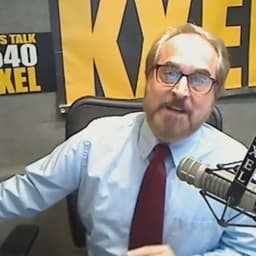
News Talk 1540 KXL, where Iowa comes to talk.
Hello, I'm Jeff Stein.
Another conversation we recorded on September 10th near Nashua at the ISU Northeast Research Farm Borlaug Learning Center Golden Anniversary.
And I'm joined now by the president of your Iowa State University, Dr. David Cook.
Mr. President, thanks for the time, sir.
Oh, my pleasure.
Thanks
for the
opportunity.
I taught at Iowa State for a number of years, a long time ago, but your background with Ames and ISU is much more solid than my
This is this is old home for you.
Yeah, that's right.
My wife and I were both born in Ames, Iowa.
We went to Ames High School and then we're graduates of Iowa State University back in the early 90s and we're pretty fortunate and blessed to be back home.
So we're pretty excited.
So six months almost to the day since you officially became president.
What did you find when you got to Iowa State?
that plays to some of the strengths you've had in your other academic positions?
Oh, well, you know, I was the president of North Dakota State University, so another land grant.
Land grants are really founded on agriculture and engineering, the mechanistic arts, and a well-rounded education.
And I would tell you that Iowa State's, from its beginning, been a leader in that regard and well-known and how we lead in agriculture.
I think ranked seventh in the world, which is unbelievable.
really strong engineering school and of course just a real rounded, well-rounded opportunities for our students so that's very exciting.
our motto science to practice being very applied and the kind of work that we do matters and you throw an extension where we have you know offices across the state what we do matters to Iowa and so those are all the things that I have always known but it's great to see it firsthand again a few decades later.
And
speaking of firsthand everything you just said dovetails to this research farm.
Give us a sense of the role a facility like this plays in the overall mission of Iowa State and as we've talked with others there are all manner of different farms like this because Iowa
may be the land between two rivers, but that land is not the same up here as it is in southwest Iowa.
Yeah, that's right.
The great value of having these research farms all over the state allows us to do research that's critical to that particular geography, topography, soil, and so on.
And so that's what makes it so valuable to Iowa State, the kind of research we want to do, but obviously back to the state.
So we can advance research that matters.
And that's what's critical about the research
here is that we have an incredibly engaged board that's very involved asking and driving the kind of research questions that matter and it's the essence of what a land grant does.
It's where our faculty, staff and even students get involved talking with community members, having them help drive the questions that will make a difference in the region and so that's the critical role that these research farms play.
What are some of the challenges facing higher education?
in particular a land grant regents institution today as opposed to say 10, 15, 20 years ago when either you were a student or as you were growing up.
It's a very different climate and culture is it not?
Yeah
so higher ed you know is I love higher ed I love how education you know changes lives and I often say generations of lives and I love how the research we do drives innovation with what makes America such an incredible country so amazing things happen
happening, not to mention workforce and talent and what we're producing every day with our students.
So amazing things happening.
Love and have a great passion for it.
But of course, as you alluded to, real challenges, there's always going to be challenges.
I like to think of those always as opportunities.
So in the Midwest, in the upper Midwest, we have an enrollment cliff, which just simply means 20 years ago fewer babies were born.
And enrollment is critical to driving everything
that we do at Iowa State, but across all universities, and so that's a real challenge.
We're adapting and doing great things, so proud of that.
Federal research dollars are always kind of shifting and waning, and so there's an agenda right now that I think Iowa State aligns really well with, but it's expecting us to pivot a little bit.
We've had a great year in terms of the number of proposals we submitted, I think almost 2,000.
1,999 to be exact, so.
You
couldn't get
one more.
I know I
got to talk to somebody to step up but you know those things are always going to be changing their challenges for sure and Iowa State needs to just continue to do what it's best at and that's that land grant mission.
We're speaking with the president of Iowa State University Dr. David Cook on News Talk 1540 KXEL.
Obviously coming home
to Iowa State, two aims.
That was of great appeal to you, as I recall you saying when you were selected for the position.
But now you've had a little chance to evaluate things over six months.
You've now got your first full academic year started.
Where do you see things going in the short term?
Again, you can't move an institution like that.
It doesn't turn on a dime.
It moves like a glacier.
But there are things a president can do in terms of tone or the direction
that you want folks to go.
So what's on the shortlist for the first few years of your time as president?
Yeah, I'll throw out a few things.
And first and foremost, so March 1st was day one, and I made a real commitment to get out and listen and learn, talk to people, knowing someone who is from Ames, from Iowa State, always been a cyclone fan from the beginning, following what Iowa State does because it's such a great university.
But that said, I've also been gone for a couple of decades, and so I thought it was very important
important to.
on campus really learn all the critical things that we're doing, understand the challenges, but also crisscross the state, so I think I've been to 40 or so communities so far, getting a feel for what Iowa State does well, what we can do better, what are the challenges, and what are people looking for, moving forward, thinking about the future.
So that's been a big part of how I've spent my first few months on the job.
As far as priorities from that, on the agriculture front, it's critical that Iowa State continue to think about
value-added agriculture, what's our role there?
We've got some amazing industry partnerships and significant research grants in that space recently that we're very proud of.
Thinking about the role of digital agriculture, ag tech, and we are ranked number one in the country in terms of the kind of research and education programs we provide in that space.
Productivity is going to be important to farming and growers.
We know that.
So continuing some of those topics are critical, and then I'll circle back around to work
and talent starting with, in our case, 4-H.
Let's make sure that our youth are thinking about the future of their communities and rural vitality, but also the future of agriculture, making sure that we're stepping up and preparing them for the future of agriculture.
And so those are at least some of the things that are top of mind for me.
So let's close with, you just talked about the future of agriculture.
50 years ago they set up this research farm.
What do you hope to learn from your time here either through
on-site touring the facility or talking with some of the great Northeast Iowans who are on the board and who are members here.
It's always fun to get out and see things firsthand to kind of put your hands on it to meet people to have good strong personal relationships so relationship building is certainly a big part of why I'm here.
understanding the research that we do, the history of that research, the impact it's had and then listening to them in terms of what research we're doing now but really where we need to go and how that can inform Iowa State's agriculture research priorities and those are the kind of things that I'm hoping to get out of today and I most certainly will.
and the steak dinner and the steak dinner there you go and I'm looking forward to the steak dinner that's that's the best part there you go
I had to focus on that because I have to leave and I'm gonna miss it so you can have mine okay I'll take your steak there you go Dr. David Cook president Iowa State University thank you for the time welcome to Northeast Iowa we'll see you back here again soon
thank you
this is News Talk 1540 KXEL where Iowa comes to talk
News Talk 1540, KXEL, where Iowa comes to talk.
Hello, I'm Jeff Stein.
This is another in a series of conversations we recorded just outside of Nashua on Thursday, September the 10th.
We're at the Iowa State University Northeast Research Farm, the Borlaug Learning Center, and it's the 50th anniversary celebration of NEIAEA.
And I am joined by Tim Brack.
Mr. Brack is president of the Northeast Iowa Ag Experimental Association.
Thanks so much for joining us here on The Porch.
Jeff, thank you for having me.
What a great day.
The weather's perfect.
We're looking for a great crowd this afternoon.
And I would like to talk to all the people that listen to you and encourage them to do more research on the Nashua Research Farm.
I consider it Iowa's best kept secret.
Well, I will concede.
I figured out how to get here, but I didn't know what I'd find when I got here.
And you folks were kind enough to say, would you like to do this on the porch?
Look out over everything.
Boy, what a setting.
I could get used to this.
Tell us what it is.
For those who have heard us talk a bit about it on the radio, the Northeast Iowa Research and Demonstration Farm and the Borlaug Learning Center.
What
is it?
So what we're doing today, we're celebrating 50 years of research at this location.
Back in the early 70s, farmers came together, pooled their money and bought this farm.
got Iowa State University to come partner with them and they are basically the managers today there's 61 research projects some of them go back to the origination 50 years that would be on fertility plots nitrogen plots and as technology has progressed so has the research that's being done today so anything that
that people think is important in agriculture.
And what Iowa State thinks is important, they try to research it here.
And what makes it so unique, I can do it on my farm, a lot of the things that we research here.
But what's unique here is replicated from three to six times.
So we know that this year, that item performed, and then we'll do it for three years.
So we generate a lot of research data.
over the years that people can look up and determine could this fungicide, could this herbicide, could this variety, would this planting date, could this tillage practice, could this biological, would that be something that would work on my farm?
As we have had explained to us in other conversations, this is a wonderful facility here, but it's not the only one in the state to your point, what works up here
that you can translate to your piece of ground, but it may be very different in Southwest Iowa.
Yes, there's 12 research farms in the state and that Iowa State manages.
But the folks in Northeast Iowa said, we want a farm that matches our soil type and our climate.
And they found it here at Nashua with some Iowa State alumni that were very generous selling them 280 acres back in 1974.
And so as a result, that's why the farm is here.
So what we see today 50 years later
280 acres is that right?
That's correct.
There's 280 acres today of research being done and we've got Ken Petnowski who is just the best research manager of all the farms Can't speak highly enough of him and Ralph White who had just retired last month been here 47 years think about that Jeff 47 years he's done work here at research
And that kind of experience is very helpful when you're doing the research because, again, someone listening who has a parcel of ground, they do their own research, they keep notes, they know what has happened there decade after decade.
They may be the second, third, or fifth generation.
They've got all the records from a period of time.
That's very helpful to have that kind of institutional memory here.
that then can be used to compare with your parcel of ground?
Great point and if they want to look back every year a book is printed that has the research projects of the year and that book compares the last three years of research on that item.
So they can look back and see what climate, how that impacted that project.
over the last three years.
Some of the board members provided me with one of these research summaries for the most recent year, a few weeks ago, and it's going through and studying it.
I mean, the wide variety of projects, things that the layperson like me just wouldn't even think of.
What are some of the things that you can look at here and take back home?
and and directly use the information.
I think a couple of the most practical are the nitrogen studies, you know, how much nitrogen you can put on corn fungicides, but one of the more interesting ones, we've got 25 years of water quality research where we've been tapping into the underground tie lines and checking the nitrates and phosphorus and so we know over 25 years what's happening underground as well and that's that you know as part of the things that
You can't see but that goes on Jeff I want to comment on this so you know we've we're talking about the last 50 years and It's amazing in my lifetime because I've been farming for this period But I wonder what the next 50 years will look like how will we be farming in 50 years?
Well, what will this research farm look like?
I think about the vision the forefathers had when they put this together 50 years ago, and I wonder
who will have that vision going forward.
And that's why I reach out to the listeners because it takes people that are willing to get involved with this farm and say, I've got this idea that I can bring forth.
I'd like to have you look at it.
I'd like to be a representative of my county.
There's 21 counties involved that support this farm in Northeast style.
Or I'd like to be on the executive board and really give direction.
That's how this research farm is going to go forward by the people that are involved.
So how did you first get involved with it to be to this point where you get to be the president of the Experimental Association?
Big campaign was there for that?
A lot of a
lot of
politics.
Not quite.
But it's an interesting story.
So my father was the vice president 50 years ago when they organized this.
And he said, I had just graduated from Iowa State and he said, you go out and sell memberships to help get this thing going.
So I went around to the neighbors and asked them to sign up to support this new research firm, having no clue what I was actually doing.
But then a few years ago, I'm from Fayette County and they needed a representative.
Every county has a representative and I said, yeah, I could do that.
And I got involved and I forgot just how valuable what is going on here.
How important this place is to agriculture.
And so the more I got involved and eventually I reached the 50 years, now my dad was vice president, now I'm president and this will be my last year and someone else will step in.
What I love about that, and again, I've lived in Iowa my entire life, but I don't have an ag background.
But what I love about it is, this is a family business, like so many other family businesses that we may have grown up with.
They have brick and mortar stores.
you have the land.
And again, that is a unique Iowa way of life that I hope we don't lose.
Yep.
And let's talk about the land.
So going forward, there's still going to be variety selections.
There's still going to be herbicide selections.
There's going to be biological selections.
There's going to be machinery choices.
There's going to be fertility choices.
But you know what they all have in common?
They still need soil.
to do the research.
The things we do here at this Borlaug Center know next week they're bringing in all the high schools in the region that have been contacted and all the young people are coming from the high schools and they're going to have a learning day here.
You know they're going to go out in the fields and check for yields, look for bugs, look for disease, and learn about marketing and gronomy.
And that's just an example.
We also rent out the facility.
People can rent this facility and have their meetings here.
And especially if it's connected with research, they can go out in the fields and see what's going on.
So there'll be a lot of tours today.
This will be aired, you know, the show's over.
But, you know, if people ever have a chance and they want to learn more, we're open.
And that's what I wanted to focus on.
I want to remind the audience, I'm speaking with Tim Burrack.
He is the president of the Northeast Iowa Ag Experimental Association.
We're out here at the ISU Northeast Research Farm, the Borlaug Learning Center near Nashua.
Conversation we recorded as part of their golden anniversary on September 10th, so you could hear it now on News Talk 1540KXEL.
And we talked to the audience in advance of the event.
inviting people to come out may not work for everybody that's their that's their loss because
it's
beautiful out here and I know you've got a steak fry coming up and I'm jealous I have to miss that
but
if you knew how much I enjoyed a good
steak
but the the facility is here for the public it's easy to find right off of the the main road what
opportunities are there for people listening, whether they're involved in agriculture daily or not, to say, you know, I'd like to just take a look and see what those folks in Cardinal and Gold are doing.
Well, they can drive in and knock on the door.
I think one of the interesting things that they could see right off the parking lot, 10 feet from the parking lot, is the corn heritage plot.
There's a hundred years of genetics.
that we planted for this day.
And you can look at corn that was planted 100 years ago before hybrids and then the first hybrids and now today and famous hybrids between from the 30s, 40s, 50s, 60s, 70s, 80s, 90s up till today.
That's fascinating.
There's flowers planted here plus soybeans, corn, you know, the oats are gone.
So, but there's just different plots that they can look at.
And as we're sitting
here on the porch,
and we've got all manner of natural plantings around.
And as you and I are having this conversation, I'm kind of looking beyond you and I'm seeing all manner of butterflies and other things.
I mean, this is a very purposeful restoration to a natural bit of foliage.
Absolutely.
And Ken and crew do a great job of keeping this place looking really great.
And Ken Petkinaski, I can't say enough about him.
He's been here 35 years or more and he just does a great job.
It was often said that the 1900s, starting maybe about 100 years ago, that was the century of agriculture because prior to that time,
There hadn't been a lot of change.
Well, you get back to the past 50, 75, 100 years.
The equipment changed, the seed changed, the technology in terms of monitoring changed.
I mean, to your earlier point about the folks 50 years ago who had the vision, I don't know that they would have expected we'd be to this point, and they were right in the heart of it.
Yeah, I'm sure that they would be totally surprised when when my father started farming He was using horses and pit corn by hand and today I do more in a half hour at harvest than he did in his whole season by hand and I just think about that and he he ran combines, you know before he passed and But you know the changes since then, you know the capacity so
Technology has moved on and who knows what it'll look like, you know.
50 years from now.
It'll be really fascinating.
Well hard to tell five years from now, but I hear
that's true.
I hear there's gonna be an ethanol power tractor out here today for folks to review and everything else and you wouldn't have thought of that 30 years ago.
That is so true.
I actually had a chance to drive that tractor and use it on my farm last fall for five days.
And that's a great, it performs great.
It's got power.
I had it on the green card for four days.
I put it on tillage for one day and it just
Really works well, and it's a spark powered tractor.
It's not diesel.
You know it runs more like a gasoline engine So it'll be interesting to see where John Deere takes it, but I hope it shows up today I haven't seen it yet, so let's hope it comes because it's an interesting piece of technology
So much out here is interesting, and again, it's the Northeast Iowa Research and Demonstration Farm from Iowa State University, the Borlaug Learning Center near Nashua, and again, you can learn much more about it online through the Iowa State websites, and come on out and knock on the door, they'll give you the tour.
Tim Burke, thanks so much for taking the time, and congratulations on all the work you and everyone else have done.
to get to 50 years.
Thank you, Jeff, for coming.
I just got to thank the board and all the people and all the extension folks and the ISU folks for making this day be what it is.
It's a beautiful day out here in Nashua.
Great day in rural Iowa anytime.
This is News Talk 1540 KXEL, where Iowa comes to talk.
Newstalk 1540 KXEL, where Iowa comes to talk.
Hello, I'm Jeff Stein.
A restaurant in downtown Des Moines just celebrated its 10th anniversary.
Its name is Bubba and it's right downtown and a lot of folks have enjoyed it over the past 10 years.
Chris Diebel is operating partner of Bubba.
We connected via Zoom recently and he told me how the restaurant got started.
Bubba started as a pop-up back in 2013.
That was a point in the hospitality world where a lot of folks were making news, doing pop-ups of different kinds all around the country.
And it kind of became a term that was sort of ubiquitous in the community at that time.
And I was working with clients over at Orchestrate Hospitality and the team at Orchestrate challenged their
various managers and culinary experts to start thinking in terms of doing a pop-up of their own.
And when you do pop-ups, you do them for a couple reasons.
You do them just for creative expression.
You do them to prevent boredom amongst your team.
You know, if you're making pasta every single day, you might get bored and you might want to do something just for a culinary outlet.
creative outlet, if you will.
And then also you do it to vet concepts.
And my family moved here in the 90s from Texas.
Southern cuisine is the food that I grew up on.
And at that time, it really was not represented here.
You had, you know, a couple little moments here and there, whether that might be a small Cajun restaurant or soul food spot or something like that.
But there really wasn't a
cohesive southern restaurant that celebrated everything from the southeast all the way through Texas.
So I raised my hand and said I would love to do a pop-up.
They were nice enough to play along and at the time the corporate chef for orchestrate partnered with me to do this as a pop-up and we did Bubba at Hoyt Sherman Place in their gallery there.
It's sold out every night.
And every local media outlet covered it at least once we started thinking ourselves wait there might be something here people might actually want to do this for real.
So that's where it started you know we got a burner cell phone and we took reservations and we turn tables just like you would at a restaurant and try to make it as real as possible.
People that have been to Bubba might notice that there's.
a heavy presence of bow ties.
And that is because my dad, my great grandfather wore them.
So dad came every night at the pop up and helped the servers tie their bow ties.
Because of course, these were people from all over town that were just doing this for fun.
You know, they didn't yet know how to tie bow ties, nor did they own any.
And so dad brought a big bag of his and everybody could pick their own bow ties each night.
And it was a blast.
And we spent a couple years after that really thinking through how we might do Bubba as a brick and mortar.
We kissed a lot of frogs, looked at a lot of real estate, got close on a couple of them.
We had some heartbreaking deals fall through for one reason or another.
You know, we had to go solicit investors to be a part of this, to make this dream a reality.
And it took years.
Finally, we opened Bubba at Tenton Mulberry next to the Hotel Fort Des Moines in 2016.
Now that's great visibility.
That is a location to my memory that has had a variety of interesting and memorable eateries, for lack of a better phrase.
But you've been there now 10 years.
What has been the secret to the success?
Obviously what you've described is a unique premise, but a unique premise only gets you so far.
Yeah, people might remember that before Bubba Raccoon River Brewing Company was there for 18 years.
So it was then a great corner and it remains a great corner.
That's a historic building.
It's over 100 years old.
It's called the Clemens building.
So I think first and foremost, there's character there.
And I truly believe that customers
eat with their eyes first, and their nose second, and then their mouth third.
And I think the ambiance matters.
And so when you go in and just the skeletal footprint of a place has history and character to it, it matters.
It really can't be replicated.
There's 100-year-old tile floors and exposed brick walls.
And so what we tried to do
was celebrate those moments that had been left intact, but also make it our own.
It was very important that this did not feel like a retread of the former brew pub.
And to that end, we physically moved the bar.
We moved the staircase.
Obviously they had to take out a whole bunch of tanks where they were brewing beer.
So visually that was going to change.
But I wanted it to feel like the living room of an old Southern mansion.
So to that end, there's big.
Swagged curtains in the windows.
We had custom giant chandeliers put in and from a business point I love to talk about the chandeliers because you know, everybody has a budget we certainly did as well and We opted to spend really splurge on two large chandeliers and then everything else is very modest
can lights that just blend away.
You don't even notice them.
But we centered those in the two big front windows and they act as a billboard for the restaurant.
They were worth the splurge and we saved in other places so that we could buy them.
And I think they've really paid off, especially when the sun sets.
They just glow from outside.
And it's this fun high low because here you've got these giant five foot
chandeliers, and then you're eating fried chicken underneath them.
And I just think that's perfect.
Well, and it also, as you've described what you would see as you're going down the street, it draws you in.
It's a sign of welcoming, because as opposed to a harsh light that might be outside the door, it is inside.
And so it's literally drawing people inside, which sets the mood that you're trying to establish as you've described it.
Yes, so that's a big part of it and then you know we built out a bar program ten years ago whiskey was really just starting to take hold of course now there's.
fanatics all over the place.
We were at the very front end of that bell curve and we lucked out in a lot of ways that we had that sort of built into the restaurant's DNA early on.
We've become a place that people know that there's always at least 100 whiskies on our shelf, usually more like 150 at every different price point.
And so that's something that has made us stay in that cultural zeitgeist from the bar aspect of things.
From a food standpoint,
You know, there's a lot of dotted line connectivity.
from southern food to what I would call Iowa-based farm food.
If you are used to your grandmother's meatloaf and you love it, you'll probably like ours too.
It's just got a little more kick to it because it's got a zing of barbecue.
You know, who doesn't like a chicken fried steak, fried chicken, that sort of thing.
And then there are some things that are a little different.
Shrimp and grits, for instance.
I bet a lot of folks in Iowa have enjoyed grits.
Maybe they haven't had them with shrimp.
And this is an opportunity where it's not too
far of a stray from food that people are familiar with.
And it's just done with a little bit of a twist.
And I think that's been a part of the successful sauce that we've made there, so to speak, is keeping true to things that people can recognize, but also pushing the boundaries on about 20% of the menu.
That's such a great point, in my view, because for certain restaurants that are specializing in a certain cuisine,
and it may be something from the other side of the globe, something I've never had, and I'm apprehensive about trying it because it seems so different.
And what you're doing is saying, here's something that you're familiar with, and this is our unique take on it, much as you described how you renovated the space.
You certainly don't want it to be compared with what was there before, but you also did not want to make it so clinical that no one recognized it as a historic building.
That's right.
That's absolutely right.
So you're underway and the end of the 2010s comes and COVID hits had to be quite a speed bump in your five-year marketing plan.
Absolutely, it was.
That was a very scary time for so many of us, but definitely in the hospitality world.
We were well on our way to paying off our loans and we were in a very good position.
Downtown was humming and so
We did not know what was going to happen there.
Of course, we tried everything.
We were doing pop-ups throughout the pandemic, anything we could think of, the to-go cocktails that became legal.
As soon as we could do in-house dining with six-foot social distancing, we were doing that.
And we took it all very seriously.
We tried to stay as safe as we possibly could, but we were all learning at the same time on what was okay and what wasn't.
If I knew then that it was all going to end up okay, there was actually some beautiful times at that period.
You know, people were coming in and getting to go food and they were oftentimes tipping as much as their entire bill was.
And they were saying things like, we just don't want you to go away.
You know, we want to support you all.
We want you to be here.
It was such an interesting time because there were people who were doing extremely well at that time and then people who were really suffering.
It restored your faith.
humanity to see folks care that much about the service industry.
And they really did.
So that was lovely.
But when the lights were officially turned back on, hybrid and remote was here to stay.
And that fundamentally changed the workforce downtown.
And that's been a really tough thing to overcome because lunches just aren't what they were.
Business travel at the hotel next door and across downtown.
Not what it was.
And so things have changed and you constantly have to evolve.
Thankfully, we did pay off our loans and Bubba is debt free.
I can tell you if I still had a giant bank note, I don't know that I could say that.
That is how tight those margins are in this industry in general.
But when you're used to a workforce being there, it's tough.
And the ones that are coming back two or three times a week, demand has changed to a place where people really want quick counter service and they want to get back to their desk or get back to their computer and get on with their day.
I don't believe that that means that sit down dining is dead.
during the lunch hour, there will always be a place for it.
We probably just don't need as many seats.
And so that's where it becomes a real competition to stick it out.
And us business owners have to decide, are we going to be the ones that want to be the last man standing during that day part?
Or do we just cut our losses and say, we'll only be open at night and that's just fine.
I don't want to give up lunch.
We are proudly open.
seven days a week, 14 shifts, you know, brunch on the weekend.
I never want a customer to say to themselves, are they open today?
So as long as I can, we're going to hold out and be open every single day of the week so that we can serve our customers when they want us.
When I saw that Bubba had celebrated 10 years, well, that's a marker in the
restaurant business to begin with.
I don't know much about it, but I know that the failure rate in those first few years is higher than in other businesses.
Yes.
But then when I thought right in the middle of the 10 years was the shutdown, this truly must lead you and the others to feel not only a great sense of accomplishment 10 years later, but as you've already suggested, gratitude for being able to
live out this dream and move forward into a second decade.
Absolutely.
That was one of those moments for a few months there where we got back to being a bipartisan country because we did see such collaboration and we could not have done it without our leaders that were pushing in their all their various ways.
You know, PPP, especially the first round, was absolutely necessary.
None of us would exist without that first round of PPP.
All of our vendors, you know, that gave us the grace.
And mind you, they had their own debts too.
So, you know, that was incredible.
We just can't thank people enough for sticking with us.
You're right.
This next decade would not be possible without a lot of people saying collectively, we got to save our hospitality industry.
So we're very lucky in that regard.
What's the next five years hold?
Because again, you would never have predicted what happened.
So it's a bit of folly, but your business planners and your partners and you as the managing partner, you got to have a plan.
So what do we think we'll be talking about regarding Bubba in five years?
You know, one of the things that went away during the pandemic was our lounge.
We had a beautiful lounge with tufted leather couches and wingback chairs, and it was a special place.
And that had to go into storage because of six foot social distancing.
You just couldn't socially distance the lounge.
And so we spread out the tables accordingly to adhere to the law.
And then people kind of got used to that setup on our team.
I really would love to see our lounge come back.
I think it was a really special spot downtown.
So we're going to go assess that furniture has been sitting in storage for six years.
We're going to assess if that's something that we can salvage and bring back.
And what's the state of that?
What does that look like?
Would we want to bring it back the same way or do something different?
That is definitely on my list of things to review.
And I would love to say within five years that lounges back hopefully sooner than that.
I believe that downtown will
continue to come back.
Whether that is on the back of residential or on the back of business or combination of both, I'm not sure.
But we'll see.
It really is a delicate ecosystem.
If you put too many apartments in, then that only does so much.
If you put too many condos in, it only does so much.
If it's just too much business, then you don't have any night activity.
So I really hope that
We'll have some small role in working with our city leaders to figure out what that means for the hospitality sector downtown.
We're having a lot of dialogue right now on getting the big street closures for events out of the core of downtown because it's really tough on our business.
So I hope in the next five years we see a more positive location for those big festivals somewhere off the main streets.
I hope we see that.
in the next five years.
As far as growing the brand itself, you know, never say never, I would certainly entertain the idea of doing another Bubba somewhere.
But the reality is construction prices are really high right now.
Bubba was around 1.2 million dollars to do 10 years ago.
I think today it would be every bit of 2 million.
And that's pretty cost prohibitive when you're selling fried chicken.
I also think that the demand for a space that large, Bubba is 7,000 square feet when you factor in our storage and such.
I don't know that the consumer wants many more 7,000 square foot restaurants.
I think we're seeing people, especially Jen Ziers.
They're looking for these intimate, cozy, unique opportunities.
So I'll be watching trends over the next five years to see what I think the consumer wants.
And also, what's the demand for guilty pleasure food?
We do have some healthier things on our menu, but look, the core of our menu is fried chicken, meatloaf, shrimp and grits, chicken fried steak.
It's comfort food.
And so we also have to be really honest that demand may shift in a way that
There doesn't need to be more Bubba's out there.
There needs to be some other concept.
And so we're constantly looking at that as well.
But we should always have a place that people can go and enjoy some comfort food.
Chris Diebel, operating partner of Bubba, right there in downtown Des Moines, just marking 10 years in business.
And as noted, it has changed over time, but the comforts of home still right there on the menu.
The restaurant's name, Bubba.
in downtown Des Moines.
And Chris Diebel joined me via Zoom on September 1st so you could hear the conversation now on News Talk 1540, KXEL, where Iowa comes to talk.
In the Cedar Valley at FM 100.5 and everywhere at AM 1540 and KXEL.com.