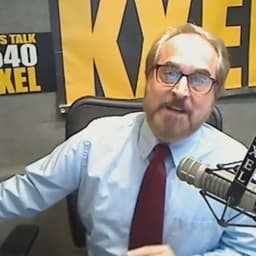
And as KXEL Live and Local continues, I'm joined on the news line by Peachy Keenan.
Ms.
Keenan is the author of a new book released earlier this month.
It's called Super Villains, Architects of America's Decline.
Ms.
Keenan, thanks so much for taking the time.
Thank
you for having me today.
People know you, I think, initially from social media and other postings, and now it has become more formalized in book form, etc.
What led you to start speaking out about public issues?
Yeah, I've always been a professional writer, but I wasn't online.
I wasn't on Twitter.
I didn't write articles or books.
But I was working in Hollywood at a very large studio, a very large studio that runs a lot of family-friendly theme parks.
And I just sort of see what was going on, like in my company with my coworkers and how things were built a little bit upside down.
And this is pre-pandemic and things got progressively more woke, I guess you could say.
And so I had a friend who worked at a magazine and he invited me to write something for him because all day long I was writing for, you know, these sort of big corporations that I didn't agree with politically.
And so it was sort of like a great outlet for me.
And, but of course I had to write under a pseudonym.
And that's I chose the name peachy Keenan because I thought it was fun.
But if they had found out who was who they had working in their midst, I would have been like, you know, not just fired.
I thought it would have been, you know, burned at a stake.
You wouldn't just get a cardboard box and an escort to the door.
It would have been far worse than that.
I
think so.
I think so.
And I also think and correct me if I'm wrong.
This is also for protection these days because again if you take certain stands on issues there are no doubt people who Would mean you harm just because of the fact that you've taken the positions you have and that's not fair to someone with a family
Yes, that's absolutely true and I really started writing was sort of like 2020 2021 and there were a lot of
He's sort of like left-wing violence, left-wing writers.
All those things were happening in the cities, and I live outside Los Angeles.
So yes, it was a safety issue.
And speaking of that, tomorrow is a very sad anniversary.
It's the one-year anniversary of Charlie Kirk's assassination.
And I actually dedicated my book to him because I knew him.
I would go on his program.
I still do, but he's obviously not there anymore.
And really the left wing violence just sort of kept building and building.
And so yes, part of my reason for having a pseudonym, I have five children.
I want to sort of keep my political professional world at arm's length from them as much as I can.
But I have been doxxed.
My address is probably out there somewhere, and goodness knows who is looking me up.
Peechie Keenan is our guest.
The new book is called Super Villains, Architects of America's Decline.
What led to this book at this time and what will we find within the pages?
That's a great question.
My first book, Domestic Extremists, was sort of like a humorous critique of modern day feminism.
You know, what the repercussions have been of so many women kind of rejecting American family in favor of
career or whatever their liberal identity is leading them to And I think we can see some ramifications of that even today with the Lindsay Clancy trial and the plummeting birth rate And so that book was in response to that with this book I really kind of took that approach and that sort of like a little bit satirical tongue-in-cheek tone and I wanted it to apply it to sort of everything like that plus everything else so there's chapters in here on big pharma and
sick doctors, we've seen the medical industry has become very interested in harming children with gender reforming treatments and all of those irreversible surgeries, politics, media, the justice system.
I do talk about feminism and I have a very big chapter, a very juicy chapter on Hollywood.
And the thing about this book is I wanted to sort of name the names because this is not a book about regular people on the left.
I wanted to really target the elites, the people who are kind of like in the shadows, who are these people who are making life so difficult for regular families and regular Americans.
And while I, as America, felt like it's not itself, at least not, it's not the America that I knew growing up, maybe not you either.
And so this was my response to that.
I just wanted to raise awareness of certain archetypes and categories of people who do not seem to have our best interests at heart.
It used to be very limited, I dare say.
But it seems that, and I think COVID did a lot of this, allowed us to wake up especially with regard to indoctrination in the schools.
I don't have kids, but I understand from friends who are parents, they were watching their kids do remote learning and for the first time realized what in the blazes are these people doing?
It's just mushroom to where it used to be off in this little quaint corner of the world and now it's
permeated because I suppose we weren't paying attention.
Now it's permeated all aspects of our lives, including pop culture.
Yeah, I have a chapter called The Rainbow Goon Squad.
And that's sort of my funny name for what we would call groomers or these grown men and women who are very, very interested in talking to young children about things that we would consider inappropriate or topics that we as parents would rather teach them ourselves.
sex education about their gender, and they're telling them lies that you can choose your own gender, and you can choose your own family, and you can change your identity, and you don't need to talk to your parents.
We can keep the secret for you.
And there's a lot of these characters, not only are these some of their teachers, but there's a lot of these characters on the internet and on TikTok, and they have massive followings, and these kids, maybe confused preteen kids or teenagers, are finding these people
and being affirmed that yes all my parents are the ones you know kind of keeping me from my true identity and my new friend a strange man on the internet he's the one who's going to you know show me the way to like liberate myself
we're speaking with peachy kenan her first book domestic extremists the new book released earlier this month super villains architects of america's decline she's kind enough to join us on news talk 1540 kxl
without getting into details because again I'm sensitive to privacy issues but I don't know if your kids are getting to an age where they bring certain things home and you as the parent then have to say where in the world did you learn that?
Are there some extreme examples of that living out there where you do that maybe we here in the Midwest should watch out for?
Well I think because of the internet things have been flattened and so I think that kids are all kind of hearing the same messages
here in Los Angeles and also in the Midwest.
There's really no escape from the pervasiveness of these sort of like progressive and really kind of extremely radical messages.
They're going to get them on YouTube.
They're watching YouTube shorts.
They get them in Marvel movies.
They get them in every big Hollywood blockbuster.
They're getting them in TV commercials.
They're hearing them at school from their friends.
Any kid who has access to a phone is not going to be immune.
It's impossible to kind of bubble wrap your child these days.
So my approach has been, um, I mean, my extreme examples are my kids, you know, went to a day camp a few years ago.
I have children from the ages of 10 to 20.
When they were younger and at the day camp was their first encounter with a little boy who wore a dress and had a girl's name.
I mean,
there's really
no escape unless you are in a very, very, you know, protective, like maybe religious community or something.
And so my approach to this, this is what I talk about in both, both of my books is your best.
your best um antidote for this is to prepare your kids yourself and to not bubble wrap them and let them know like yes you're going to be exposed to this but i want you to hear it from me and here's our response to it and why we think these are not great ideas i you know i'm not saying brainwash your kids but i am saying to brainwash your kids to believe in the truth
well and again and i knew this as a college professor whatever
I told these kids sitting there, and they're not kids, they're young adults crying out loud.
That's what they got to know about a topic, right?
They walk in and it might be that they had no knowledge of the topic and then I give a lecture and that's what they're going to take away from the conversation.
Whatever I told them, that's an awesome responsibility, but it's also quite nefarious if you have
an agenda, and that's really what's happened within not just education, obviously, but so much of our, the institutions we used to rely on as pillars of society.
I mean, if they've got the agenda and they've got your attention, look out.
Yeah.
I mean, sadly, I hear so many stories.
I'm a devout Catholic, and most of my friends are, and these are big Catholic families.
And I've just heard so many stories of, you know, they raised their child, they graduate high school, and they go off to college.
And up until that point, they're completely on board with the family's values and going to Mass every Sunday and all that.
And they go to college and they are transformed.
And they kind of ditch all of that formation from their family and their church.
And they come back and they're now arguing with their parents and telling them how wrong they are.
They just learned the truth about the world, and they kind of reject all of these, all their religious values.
And it's really tragic that that's happening.
And I'm not saying you can prevent it in every case, but I think there are practical things you can do as a parent to protect your children.
I mean, part of that is be careful where you send them to college.
And it starts in high school.
Make sure you know who their friends are.
And the key to our lives, at least, has been
being blessed with like-minded families.
And it's not always possible, depending on where you live.
Here in Los Angeles, it's actually really hard because we are so incredibly outnumbered.
But you know, you find your little community and it really becomes like your, quote, safe space, so to speak.
Supervillains is the new book by our guest, Peachy Keenan, who joins us for a few more minutes here on News Talk 1540, KXEL.
It's harder to write satire these days, isn't it?
Yes, comedy and humor has become very, very dicey territory.
And I say that because it used to be that you could use satire or you could use exaggeration to make a point.
But frankly, you look around and it's like the world is so darn crazy in so many respects.
It's like what you write as satire that used to be...
They're just to make a point.
It pales in comparison to the reality that we see in news clips, sadly.
Right.
How can you make fun of something that's already so insane?
It's kind of like the jokes write themselves,
but it's
like the reality is scarier than jokes.
But I feel like with my writing, I have really tried to use humor, you know, pointed comments, maybe like some light mockery because
In terms of the weapons I have, what am I going to do?
I can vote, or maybe I can use a little bit of mockery or expose people's behaviors and actions that are quite destructive with rhetoric, with persuasion, with argument, and with humor.
And I feel like humor can be so powerful as a weapon.
It's the only weapon I really have are my words.
And when we lose the ability, even the freedom, to make fun of things that are ridiculous,
We are kind of powerless because the thing is that we forget humor and mockery is so powerful.
And I really can kind of like, people are kind of like trying to hurt you or take away your children or whatever they're doing.
If you can kind of laugh at them, laugh in their faces, you are not only like empowering yourself, but you also are kind of blocking them from doing it.
And we have lost, I think, the ability to write that way.
Everything is very, very serious, especially on the right and the left.
And so with my books, I am trying to, I am trying to educate, but I also really want to entertain.
I think that's very important.
The cover of the book, Super Villains, obviously for someone of my age, reminds me of Saturday morning cartoon superheroes, right?
And I'm right down, I think to the type font.
So it's designed to draw people in.
What do you hope that someone listening to this conversation, when they pick up a copy of your new book, Super Villains, what do you hope that they either
learn, or perhaps more importantly, what can they do with it?
And I ask the question that odd way because a lot of folks, they hear me talk to folks on the radio and they say, well, that's nice that you told us about it, but what can we do?
So hence the awkward question.
Yeah, like I said, I really want to raise awareness.
I want people to recognize these types and these names.
And even though someone that, you know, I didn't write about
But someone you might meet in your life who's in a position of power, you can recognize what category they belong to.
And you can just be wary and maybe take their words with a grain of salt and have a better idea of what you're dealing with and not be intimidated because they have some position of authority or some kind of power.
I mean, really, we're very blessed with enemies that are quite ridiculous and easy to make fun of, I mean, frankly.
And what they can do, I mean, the book does end in a hopeful note.
What do we do?
How do we stop supervillain proliferation, so to speak?
Comments and supervillain control.
And my real advice is we need more superheroes.
So
we need people who are sane, the few of us who will remain sane in this country, need to be working to promote people and to raise children who will be their own form of hero.
And I'm not saying go and like save the world, but to be strong in their own identity.
to know maybe embrace their faith, raise their children to kind of be in that, have their faith and grow up and be good and decent Americans, be patriotic.
I mean, all of those old fashioned things, we dismiss them as, oh, come on, those are just like old and boring.
There all we have at this point.
And so I would urge people to just double down and embrace that and know who you are and don't let people tell you, oh, you are a conservative.
You must be a racist.
You must be a bigot.
No, you're an American and there's a lot to be proud of.
Three years ago, the book was entitled Domestic Extremist, a practical guide to winning the culture war.
The new book released this month is Super Villains, Architects of America's Decline.
The author, Peachy Keenan, thanks so much for the informative and fun conversation, and best of luck with this book.
Thank you so much, Jeff.
And Peachy Keenan, again, a pseudonym for the author.
for her own protection and that of her family as explained.
Peachy Keenan joined us on the news line yesterday midday so you could hear the conversation now in this eight o'clock hour on a Thursday on News Talk 1540 KXEL where Iowa comes to talk in the Cedar Valley at FM 100.5 and everywhere at AM 1540 and KXEL.com.
Every month we have the opportunity for an extended conversation with the Attorney General of the state of Iowa, the Honorable Brenna Byrd.
The website for all information about the activities of the office is IowaAttorneyGeneral.gov.
Attorney General Byrd joins us now live on the news line.
Good morning and thanks again for the time.
Yeah, good morning.
So you were on a plane yesterday for a very important activity that took you to Washington DC.
Tell me about that please.
Well, yesterday was a very special day.
It was the first ever Back the Blue Flight, and it was sponsored by folks from the Quad Cities, and that's a flight that honors, just like the honor flights that honor veterans.
This one honors law enforcement, and so we had Gold Star family members with us.
We had retired law enforcement, active law enforcement, and their spouses, and we got to have an incredible day together that started with the Law Enforcement Memorial in Washington, D.C.
It's truly an amazing thing that they did in the Quad Cities.
It's all privately funded, all volunteers, and they did it to show their law enforcement just how much they honor and appreciate them.
And I know many departments have recognition locally on an annual basis, but this is quite meaningful to have all of this gathered at one place, the National Memorial.
And this was no small little flight.
You had hundreds of people involved.
Yeah, I think the final count was 171.
And so we went together on the back of the blue flight and
It's the only place where you can see all of the names of the fallen on that memorial wall.
And so it was very significant, very special.
And I'm so glad to be invited to be along on that first day so that we could be part of their first flight.
They're planning on doing others.
And I have to say this, Jeff, boy, I can think of a lot of Iowa communities
that would like to have a flight like that and have something like that for their law enforcement for their gold star families and their retired officers
well i was going to ask is this a common thing across the country i've never heard of it myself
i have never heard of it before this is the first one i've heard of for iowa and as far as i know uh... i don't know that this has been going on so a great idea that came out of iowa out of the quad cities and
uh... i hope other communities are inspired by it because it was really special you know one thing i've noticed is sometimes our law enforcement they're stepping back because they are there to serve and protect but they're not there to get credit being able to be with them on a day uh... where we were all together and celebrating their service and they were seeing that strong support for their community uh... it was a very very special day they even got a tour of the u.s.
capital in the lincoln memorial we got to go to the law enforcement museum together
it was a very very special trip and it it really warms my heart to know that this was all funded by people who donated in the quad cities who wanted to make sure their law enforcement i would have an experience like this method gold star families would know that uh... that they were never forgotten i sat next to a lady that with a uh... teenager when her brother was killed in the line of duty and she talked to me about what it was like to be out there for police week and now she's uh... grown woman with children of her own and she's still with us together on that
uh... honor play with very special
this is a registered five one c three non-profit the quad city blue flight and you can learn more and if you're a community out there who thinks hey let's uh... let's get some information on this and do one of our own they're online at q c blue flight dot org i'll say it again q c blue flight dot org continuing the conversation live on the news line with attorney general brena bird
And Amazon, this is just more and more popular.
People just say, well, I'm going to look online to shop for something.
First place they go is Amazon, but they haven't always played by the rules.
And there's a suit that's been filed since you and I last talked.
Well, we filed a lawsuit against them because one of my jobs as attorney general, when there's a company
That's not doing the right thing and it's hurting Iowans.
I can go to court on behalf of Iowans.
Each person wouldn't be able to file their own lawsuit because of how difficult that is.
But here what happened was Amazon was secretly and systematically overcharging for their advertising.
And so we've joined, along with many other states, a lawsuit against Amazon.
This also led to increased prices that people would pay for goods on Amazon.
And it hurt a lot of small businesses who use Amazon for advertising.
So how does this work?
Is it if you set up a store on Amazon or you're posting things for sale?
How is it that this was buried or hidden and not above board?
Because of how they conduct their pricing on the platform, they use a type of auction in order to sell advertising.
And of course, if nobody knows you exist when you're a small business, you're not going to be able to sell any products.
And so by overcharging for their advertising, it hurt a lot of small businesses.
And we also know that when there's overcharging that happens, that gets passed along to everybody who buys products.
So it also increased the cost of products
on Amazon and hurt Iowans that way.
So that's why we're going there to protect Iowans wallet to make sure they're going to engage in aboveboard business practices.
That's why we have that lawsuit.
And again, if you're a business and your costs go up.
whether it's the cost of the product, electricity, labor, whatever it is, typically you wind up having to pass that on to the consumer.
It's no different here.
How big an issue is it in the state of Iowa?
I just alluded to the fact that Amazon is massive and it's what people think of first when they go to shop for things online, but how much does this affect Iowa in particular?
Well, it affects any Iowans that would buy anything from Amazon, which is quite a few people since it's such a big company.
It also affects all the Iowa small businesses that use Amazon to get access to sell their products.
And we know of a lot of small businesses in Iowa that sell on Amazon.
They sell all over the country.
And so it affects a lot of Iowans.
And most importantly, this secret systematic overcharging because of how they set their so-called auction prices for ads
I mean, that's something they shouldn't be doing.
And so we're holding them accountable, working with other states and the federal government to make sure that we put a stop to this.
And again, as I look at the list of attorneys general who have signed on, this is not a red state, blue state thing.
You have quite a bipartisan coalition of states listed here.
We do.
We have quite a few states involved, absolutely.
And if I'm not mistaken,
In last year alone, Iowa independent sellers on Amazon sold more than 14 million items and the average sale per seller was more than $300,000.
So again, not just me as a consumer, but this impacts businesses to a large degree, which obviously gets a lot of people's attention.
Yeah, it affects small businesses all over Iowa.
Iowa Attorney General Brenna Byrd joining us live on KXEL.
We have spoken previously about your role as the chair of the Medicaid fraud task force that was established by the governor and there have been some folks who have called the
Propriety of this task force into question indicating there are other ways to get at things that there may be other reasons politically motivated Donor motivated as to why there is such a thing and I want to give you a chance to respond to These assertions that have been made we've had the folks on this program People listening have seen other news coverage.
I just want to give you a chance to respond to what you've seen
Well, Governor Reynolds instituted the Medicaid fraud elimination task force and asked me to be chair of the task force, which I'm glad to do.
I think it's important that we root out all types of fraud that happens with taxpayer dollars and that we constantly look for ways to eliminate fraud.
So I'm glad to be chairing the task force.
We had several meetings already.
And, you know, one of the things that has come up are some different ways that we can fight Medicaid fraud in Iowa, ways that we can find it, prevent it, and to hold those who commit fraud accountable, because they are basically stealing from the taxpayer, and they're also stealing from the Medicaid program, which is there for the most vulnerable Iowans.
And so we want to make sure that Medicaid is there for people who need it, but that our hard earned tax dollars are not going to enrich people who commit
fraud.
So we want to hold them accountable in criminal court if they have committed a crime.
We want to see that they are prosecuted and that justice is served.
And also on the civil side, we can go and work to recover the money that they took from the taxpayers and put it back in the public treasury.
So really important work that we're doing.
We're still getting input.
If anybody has thoughts, reach out to my office and let us know if you have some ideas of some ways that we can work to
to fight fraud and what we can do.
There's just no acceptable amount of fraud with Iowa's taxpayers' money.
Iowa is a good state.
I think we've been good as far as stopping fraud, but I'm somebody who thinks we can always do better and we should always work to do better.
So I'm really glad to be part of this task force.
We'll be announcing our conclusions and some ideas we have for how to eliminate Medicaid fraud in Iowa towards the end of October at the timeline.
And I have a very bad habit of mistating and confusing when I'm speaking Medicaid and Medicare.
So if I misspoke a moment ago, folks, I'm sorry, Medicaid is what we're talking about here.
And what can the task force do that isn't already available to either the state broadly or to the office of the attorney general?
Because again, fraud's been going on for decades, forever.
And so
there have
been other, there's other tools out there, but what does the task force do that
That was important to augment what was already there, I guess I'll phrase it.
Well, the task force is there to study and make recommendations to the governor.
So we're looking at what other states do, what Iowa does, ways that we can work together to...
to prevent fraud from happening in the first place, but also how to find it, detect it, and hold those people who are committing fraud accountable for what they've done.
So the Task Force is focused on the recommendations and what we can do to make things better, and those recommendations will be made at the end of October.
And then my understanding is then the Task Force has concluded, and we'll move on to the next step of implementing the ideas that we have, working with the legislature or others,
to work with them to see what can we do?
What laws can we pass to help to strengthen our fraud fighting here in Iowa?
Changing topics now to opioids and there was a major settlement that the state was involved in.
The legislature got involved in terms of how to direct use of these proceeds and now money is actually getting out to help folks across the state fight opioid addiction and it's no small amount of money.
It is no small amount of money, so we just announced last week $1.6 million in grants that go from the Opioid Settlement Fund to folks who help prevent opioid addiction or help to treat folks who are addicted to opioids.
And so a number of different programs that we're funding, they're still funding available, so I would encourage
If there's a community group or a part of the state that has something that's working well or they need additional funding in order to help people to apply for a grant through our office, we make those grants on a rolling basis.
So everything from a jail program that helps people in jail to, they call it reentry, meaning re-entering society outside of jail to help them get a job, a place to live, treatment services, help to have that kind of stability so they don't turn back to substance abuse and addiction,
and also other programs around the state including you know one one sheriff's office needed a drug incinerator that's basically something that illegal drugs or other drugs can be put into and they are incinerated and destroyed so that they're no longer a danger to anyone that was a need that the johnson county sheriff's office had so we were able to fund that as well
and again the money comes from uh...
legal settlement and that was no easy operation either for a group of attorneys general to take on an industry like this that is well-funded.
Well that was a big one and went on for years and many of these companies knew how addictive their product was but it was profitable and so you know there are so many people around Iowa that have been hurt by by opioids including prescriptions from their own doctors that they didn't realize
the danger there of becoming addicted.
And so I'm glad to see this money going to some good use.
You know, the number of deaths that we've had from an opioid overdose have really gone down in our state, which I'm really very thankful for.
But we want to do everything we can to prevent every single death and to make sure we're serving every single person.
We know how
how tough it is for someone going through addiction and also for their family members and others.
So we're hoping that more folks from around the state will apply for the funds so that we can continue to serve every part of Iowa.
IowaAttorneyGeneral.gov is the website and you mentioned in a few of these comments today that folks can contact the office.
What's the best way to do so?
Well, it depends on what they're wanting to do.
Either contact the office at IowaTourneyGeneral.gov.
The website is a great place to go because there's good information on there.
Welcome to do that.
Lots of information, and if people want to fill out forms or that's where our grant information is for the opioids, or if you're not sure, you can always just give our office a call and we'll try to direct you in the right place.
And again, you can write on the main page, file a consumer complaint, get access to the crime victims helpline, all manner of things at IowaAttorneyGeneral.gov.
Attorney General Brenne Bird, thanks so much for the conversation.
We'll do it again next month, if not before.
Looking forward to it.
Thank you.
All right.
Take good care.
And Attorney General Bird joined us live on the news line on News Talk 1540KXEL, where Iowa comes to talk.
Newstalk 1540 KXEL, where Iowa comes to talk in 1926.
Cedar Falls author Ruth Suko published an acclaimed collection of short stories called Iowa Interiors.
At the 100th anniversary of that book, a new edition is coming out and artist
Claudia McGhee has created the illustrations.
Besides seeing them in the book, you can also see them on exhibit at the Hearst Center for the Arts, starting this week and lasting through December.
And we connect with the artist now.
Good morning, Claudia.
Hi, Tim.
So tell us what brought you to this project.
I know you've done a number of other book illustrations in your careers.
This one might be a little different than some of those.
Right.
Well, I have a long established connection with the University of Iowa Press, and I'd done my first children's book with them 20 plus years ago.
And several covers of their adult books as well.
One of them was Ruth Zuko's New Hope.
That was done in 1998, and I did just the cover for it then.
So that was out there in the world and last January I got a call from Jim O'Loughlin at the University of Northern Iowa and he
had an interesting project with this new Rusuko's Iowa interiors reissue and would I be interested in doing the cover and 15 chapter heads for each of the stories and I leapt at the idea.
I have been in Iowa for 30 years now and still feel like an outsider in a way so I'm always yearning to learn more about Iowa and even though these
Short stories are set in the 20s and 30s.
I still gleaned a lot from what I read, and that always helps when you're creating art for any piece, as if your heart is in what you're reading.
So you mentioned having worked on a cover for another reissue previously, but in general, how familiar were you with Ruth Suko and her work?
Not familiar.
Just enough to know that she had had one novel that I knew of, at least, New Hope.
But I did a really quick study after Jim proposed this to me to see what she was about and found how prolific she was and how seated she was in the literature community.
And because we live here in the city of literature, I wanted to know more.
I know the University of Iowa has a collection of her papers and etc.
too.
So I learned quickly that she was
quite a woman of substance.
And then I started reading her stories, which catapulted me into a real fan, a real fan girl.
We're talking with artist Claudia McGhee who has created the new illustrations for a 100th anniversary edition of Iowa Interiors.
It's a collection of short stories by Ruth Sukho and the artwork will be on display at the Hearst Center for the Arts in Cedar Falls starting this week and running through December.
You're an artist.
You're working with someone else's art in the form of writing.
What fits well there?
What's easy to do when you're in a sense collaborating with this person who is no longer with us?
But what's challenging when you have to try to also pair your art with hers?
Oh, that's such a great question.
I look at it like...
Like a silent conversation in a way.
I try not to interpret, you know, word for word or literally at least.
I think some of what I want to illustrate is my own feelings for the words that I'm reading and her words are so eloquent and so moving and tender.
They're stark and they also had an element of
surprise for me so that I hope generated into the initial energies of my work at least that I wanted all that to be in there.
I come from a children's book illustration background so I think also I want to tell quick stories for the reader to be able to immerse themselves into the story quickly with a flash of this illustration but not tell it all.
you know, just an intrigue is what I'm after.
I'm sure a lot of the folks who pick up a copy of this book will have seen it before.
Not everybody.
That's part of the point of having a reissue like this is to introduce it to a new audience.
But for those readers that do have some background with Iowa interiors, how do you work through the possibility that they may have their own image of what these stories, what these scenes, what these characters look like when you're creating the artwork?
Well, that's always a possibility and I'm sure that Rusuko would have something to say about my illustrations too.
Oh, I think they're just like an illustration serve as
A jumping off point, I guess, especially as a chapter head.
I think we've all read children's books in our past and remember like Charlotte's Web was heavily illustrated by Garth Williams, beautiful illustrations.
And it gives you just enough, you see the joyous pig dancing in the background and it puts it in your mind and you go on and you create your own scenes.
just from that.
So I feel again, like my illustrations are jumping off points for people, I hope at least.
We're talking with artist Claudia McGhee.
She is the illustrator of a new edition, a 100th anniversary edition of Iowa Interiors, a collection of short stories by Cedar Falls author Ruth Suko.
And you can see the artwork that has gone into this new edition of the book at the Hearst Center for the Arts in Cedar Falls.
It's on display in an exhibition that runs from this week through early December and...
Art for a book is a little different than art that is going to be hanging on a wall, but in this case, your art is doing both of those things.
How do you work through that sort of challenge, knowing that you are going to have people who primarily are viewing this as created for the book, but now people are seeing it in a much different
context?
To me, my first responsibility was to the book, so I don't even think about anything like an exhibit or these small pieces becoming larger pieces.
And that's the way I think I proceed with most things too.
You get an assignment or I do at least, I work with publishers, they give me a job.
And that's it, that's my first responsibility is to those words and to the story itself.
And exhibits or any other second use of illustration or art, it's just a happy circumstance and it's nice because people do get to see it in a different kind of form.
A book is one thing, it's intimate, you're sitting there with a book and the illustrations are inches from your face, whereas an exhibit is a little more of a presence, you know?
So I'm looking forward to seeing that too.
You mentioned that these pieces are small to use your words.
So when you're creating these illustrations, are they roughly to the same size as what will appear in the book?
Do the publishers ask for them to be pretty precise to that size that they need?
Or do you have some flexibility to be larger or smaller based on what's comfortable to show the detail you want to include?
Right, well I work in a medium called scratch board, and it's pretty precise.
It looks like woodcut at the end of the process, but it's called scratch board for a reason.
It has a black surface on the top, a white clay surface down below, and I scratch with a really sharp implement in the chalk surface.
So the resulting lines kind of look a little scritchy-scratchy, very textural, but very much like an old-fashioned woodcut if you can imagine that.
So scratch board is very very precise drawing because I am using a blade and so it reproduces really well but I still like to work a little bigger so I might for a piece that's going to be in a book at
five by three or something, I will work about 125% bigger.
So about twice as big so I can get all the details.
And then when those illustrations are reduced, all the details nice and precise.
So, and that's where I work with even larger pieces too.
So they're not very big.
I think the biggest I ever go is, oh, a little bigger than a dinner plate size, you know, so.
but they're fairly small pieces.
So you alluded to seeing this exhibition for the first time coming up a little later on this week.
Do you have some of the same sort of sense that I would assume that maybe an actor or a director might have going to the premiere of their movie?
Because this is something where you're going to not only get to see what the final product looks like in that context, but you're also going to kind of get the reaction of the audience too, all at the same time.
I guess.
I haven't really thought that through.
It is, I think, in my career.
The first time I'll see some of my process displayed.
That would be interesting to see process, meaning some of the pencil sketches that go in before I actually work on the final art.
So that'll be something, because I'm used to going to larger museums and seeing, you know, Van Gogh's scribblings of early stages of his paintings or Gauguin or something.
You see a lot of journals, which are so interesting to me.
I think seeing the process is that way.
That will be cool.
And no, it's just another interpretation.
I think that exhibit design is just another art form like writing or illustrations.
So I'm looking forward to their interpretation of the illustrations for the book's creation.
A 100th anniversary edition of Ruth Sukho's Iowa Interiors is out here in 2026 and the illustrations were created by artist Claudia McGhee.
Those illustrations will also be on display at the Hearst Center for the Arts starting this week and running through early December.
We've been finding out more about the process and the artwork from the illustrator, Claudia McGhee.
Thank you for being with us.
Thank you, Tim.
This was wonderful.
This is the station where Iowa comes to talk.
News Talk 1540 KXCL.
It is always a privilege to be joined on the news line by Drew Thomas Allen.
Drew Allen is these days the co-founder and CEO of Bando Public Relations.
He's also the author of multiple books, including this one released 11 months ago.
It's called For Christ and Country, the Martyrdom of Charlie Kirk.
And Drew Allen joins us now live on the news line.
Mr. Allen, thanks so much for coming back on KXL.
I appreciate it.
Hey, Jeff, it's always my honor to get to speak with you.
We've talked before about this book, which was a very personal undertaking for you in a number of respects.
Let's talk about why after the tragic events of one year ago today when Mr. Kirk was murdered, what led you to, in essence, put pen to paper and create the book for Christ in country?
Well, I was moved to, you know, basically uncontrollable tears after he was assassinated.
And, you know, I'm not really given to crying.
I mean, people die around you that you know that are in your life.
And for specific reasons, I discovered, you know, Charlie Kirk's death had a profound impact on my life.
changed who I was for the better.
That's not any exaggeration.
You know, it was, and it wasn't, you know, a lot of people, you know, we lost this great political mind, this conservative leader, somebody who could galvanize young people.
I mean, that's not what, what I was feeling in the beginning.
It was that, it was just that my heart broke for a family.
You know, this was a guy, a guy who, it was a husband and father, you know, and his kids were my kids' ages.
And I just,
couldn't believe that he was going to be absent from the dinner table, absent from picking his kids up from school and all that sort of stuff.
And so I was trying to understand my emotions and understand it.
And that's kind of what it was.
And then it just teed up something that had been set up with for a long time, and that was left wing violence in this country.
And to see people that I went to high school with, people that weren't so-called radicals that were actually celebrating his death,
And I saw things that I believed I could not unsee, and I hoped that this country would have a conversation about it.
We haven't had the conversation, actually, a year later.
And that is about the rhetoric on the left and how it's a dangerous ideology that is producing these killers and assassins.
And, of course, 910 today runs up tomorrow to 911, and there were just too many parallels.
And I realized what a serious problem we have in this country.
and it can't go unaddressed.
And 9-11 changed the world for everyone, right?
Before that day, before that moment, you felt safe still, right?
It's like the 1800s feeling.
We got these oceans protecting us on both sides.
We cannot be touched by foreign powers.
And then of course, a terrorist attack changed that for everybody.
And then in the Middle East, people celebrated our pain.
People were giving out candy to kids in Pakistan.
And I thought, this is so disgusting.
It's so evil that they would then celebrate the murder of 3,000-plus Americans.
And then when Charlie Kirk was killed, they weren't celebrating the Middle East.
They were celebrating in the streets of America at our universities, online, on social media posts, people who were like police officers at schools.
I mean, there were so many examples of even first responders that were in... A lot of these people were fired and whatnot.
But I realized you know kind of like Houston we have a problem like this this radicalizations on happening in some mosque in Some place we've never heard of and can't pronounce.
It's actually happening like universities.
It's happening in our And below it's happening when people tune into CNN and I was fed up so so I really take a look at the left-wing violence and and and the origins of that and the ideology of the left as well
Drew Allen is our guest the book for Christ and country the martyrdom of Charlie Kirke joins us live on kxl by the way our kxl poll question of the day today sort of ties into this because we're asking you folks to assess the level of political discourse now compared with one year ago kxl.com slash poll to weigh in about whether it's less toxic more toxic no change etc
I have seen and you indicate this was a good time for a conversation.
It was never had.
I've seen some posts by those on the right who say this was an opportunity.
His death, his murder was an opportunity to help.
take charge of a narrative and explain just what you have talked about, but it's been a missed opportunity and I'd be interested in your reaction.
Not in an opportunistic way.
I don't think the poster meant that, but it just seems like, again, nothing good comes of this and certainly no one took the opportunity
to have the kind of conversation that's necessary in order to restore political discourse to a more civil state.
No, no, and I've used that word to opportunity.
I've hedged it and said, you know, I don't I don't mean that this is a positive thing in terms of Charlie Kirk time.
But, you know, there was there was a an opportunity to expose the left for what they are and do real political damage to them in a way that we haven't effectively done.
Because it needs to happen because people are dying like Charlie Kirk because of the rhetoric and by the way 54% of Democrats in a poll recently said that political rhetoric was partly responsible for Charlie Kirk's assassination So majority Americans believe that there's a correlation between the rhetoric even Democrats and now you can look at other polls by the way Jeff and you'll find that a Great number of Democrats also think that it's justifiable to kill somebody for for these sorts of reasons at least one time so
take that, you know, what you want with that.
We're still in a scary place.
But yeah, I mean, look, it's kind of like, I mean, I just, I think there's so many, there's so many parallels to 9-11 because think about what happened 9-11.
We get attacked by, you know, radical Islam.
And we know there's an issue with Islam in general.
Look where we are now, right?
25 years later, you have a Muslim mayor of New York City.
And it's not just that he's Muslim, it's that he's a radical.
It's that his wife and his friends and those people around him that are working in his administration in New York City, they celebrated October 7th the massacre of Jews.
They're anti-Semitic.
They hate Jews.
So that's the problem, right?
And how can that happen 25 years later, after 9-11, after in the name of Islam, we had...
That's crazy to me, but what we put up with for the last 20 years too was this oh, you know this downplaying of the threat of of these jihadists But especially in the Obama administration, but you weren't allowed to actually address the issue You know it was a you know Obama went to a to speak to a bunch of Christians at the National Prayer Breakfast one year And he starts out effectively by saying well, you know Christians have done a lot of bad things too
But that's his response to radical Islam, like, like, is if there are groups of Christians out there in the name of Jesus Christ going around and beheading people and putting, you know, their equivalent of Sharia, I mean, it's insane.
And so the same thing happened after Charlie Kirk's assassination with the help of, you know, Candice Owens and Tucker Carlson and a lot of other people.
And basically they left the left off the hook because, you know, instead of
Analyzing the fact of who we believe you know who was obviously apprehended who's gonna go to trial soon and the free trial was effectively a trial and it was pretty clear the evidence against Tyler Robinson and They're they're saying well, you know the Jews killed Charlie Kirk or you know There's a lot of this is Candace, you know, but Egyptian planes or the French foreign Legion was involved or Erica Kirk was involved in some conspiracy to kill her own husband And I was like who's the beneficiary of this right and it's the left
And I'm so glad you mentioned
what you just did because it appears.
Now I'm on the outside.
I'm in a different demographic than Mr. Kirk was speaking to, although his message resonated no matter your age.
But again, this was a voice that galvanized young people.
And I would dare say it was a voice and a personality that could take some of these disparate elements within quote unquote the movement
whatever that really means and and and was able to kind of keep things if you will controlled and in light of his murder I don't even like to say passing or death because it was an assassination in light of his murder some of these folks who you mentioned by name have decided that you know nature abhors a vacuum and so we can't have silence and so they've just gone off with these
really odd approaches in order to get clicks and get notice as opposed to a movement being galvanized in the name and the spirit of the founder.
And that's again, it's not just a missed opportunity, but it's it's tremendously detrimental to the next generation of potential political leaders.
Is it not?
Yeah, it is.
And I don't think it's a coincidence, Jeff, that all of these
individuals who once claimed to be allies of ours or friends of Charlie Kirk, the aforementioned names, plus others.
I don't think it's a coincidence that they suddenly took these kind of radical positions and tried to destroy the maggot movement.
Tucker Carlson and MTG and others going so far as to say, basically, don't vote in midterms, which hands the Democrats a victory, and saying, we're going to start a third political party, which we know is suicide, just if you do basic arithmetic.
and I don't think it's a coincidence they did this after Charlie Kirk died.
They wouldn't have dared to do this kind of thing while he was alive.
And there's something people should understand about Charlie.
Yes, he was a wonderful guy, a talented and all these things, but he was also scared people.
And I don't mean that in a bad way.
I mean, that's how you hold this movement together.
That's how he was able to hold this movement together is because people feared him.
Charlie Kirk would pick up the phone if he saw something online by some
influence or something like that that went against or hurt Magra he'd pick up the phone or he'd have somebody call them and tell them like he was upset like hey you know what are you doing here like this is undermining our movement I mean this is just like he was literally steering the ship woke up and I mean God bless him like he
He took that job seriously and he stood up and he was willing to cap in the ship and he had the direct line to President Trump and he had a, you know, JD Vance was his friend.
And I mean, this is a guy who was just sitting and the unique advantage that Charlie had that nobody else did is that by virtue of his passion, his occupation, what he was doing, his debating, he was traveling the country basically on like a permanent tour of the country.
Like if you're running for a presidential race to go and meet constituents,
So he was out there.
He was talking to his adversaries.
He was talking to young people.
He was hearing even when he debated them what their issues were and problems were.
So he actually had his finger on the pulse.
of what was going on in this country, especially in that younger demographic.
And that gave him an advantage that nobody else really had.
It gave him an insight that other people couldn't have because if you're in the Trump administration even, you're in Washington DC working.
I mean, you're not out there.
You don't know really what these people think.
You depend on people like Charlie to give you that feedback.
We're speaking with Drew Allen.
You might remember, we first met him prior to the 2024 election, his book America's Last Stand.
Earlier last year, I guess this was this year, Clinton hoax Obama coup came out, the declassification story of the Trump-Russia delusion.
And the book that we're talking about today, the one that was published just 11 months ago, For Christ in Country, the martyrdom of Charlie Kirk.
And again, you get these wherever you get your good books these days.
For Christ in Country, Drew Thomas Allen, the author.
And as we're talking about this, a lot of folks have phrased it as, well, who's the next Charlie Kirk?
And that's where I get, I guess a lot of these people start raising their hands saying, well, you know, I've got the mantle.
No, I knew one better, et cetera, et cetera.
I think that's the wrong question because there was one Charlie Kirk.
The question is, who's the next person who can drive a movement?
You don't want to try to be Charlie Kirk.
That worked once.
Is that, are we asking the right question, I guess?
Yeah, look at somebody asked me that the other day drew you know gee I'm so disappointed I'm so you know I feel some despair because it's been a year and and no there's no new Charlie Kirk And I said well you're gonna be waiting a long time to find a new Charlie Kirk because you're gonna have to go to heaven and meet him because there's no other Charlie Kirk coming and it is the wrong question the question is First it it's okay.
Look what Charlie did look how effective he was.
What was his legacy?
All right, and and obviously he was
He was effective at rescuing this country, rescuing people from indoctrination, you know, promoting what was good.
And it's not.
you know where's the next Charlie Kirk and also that's a lazy question because you know what that means when you say that and I don't mean this as an attack we all ask this question okay we're very lucky when we have a trump or Charlie Kirk because it allows us to be lazy right we
can sit
back and we can applaud and cheer and we can say thank god it's not me Charlie Kirk is here he's got it I can sit down and go about my life because that guy's taking all the swings and arrows that's not the way we need to conduct our business going forward
Those people are rare, and it's nice for a while, but it's still our responsibility to step up and ask ourselves, actually ask God, what can I do?
Use me as your instrument.
How can I, with the skills that you have given me, with the passions you've given me, how can I contribute to this cause?
And Charlie's cause ultimately was spiritual, okay?
He wore his faith on his sleeve.
It was a Christian mission, is what his mission really was.
And of course, folded into that is the salvation or the the saving, if you will, rescuing of American and preserving it.
And so no, don't ask, you know, you know, where's the next Charlie Kirk?
Ask, you know, how can I step into the arena and honor this man and do what is my duty as well as an American or Christian or, you know, father or husband?
And how can I contribute?
That's the question.
That's that's what we all need to do.
For Christ in Country, the martyrdom of Charlie Kirk, the book by Drew Thomas Allen.
Again, get it wherever you get your good books these days.
Drew, it is always an enlightening conversation on this topic.
I wish we didn't have to have it one year ago today when Mr. Kirk was murdered, but it is always a privilege when you have the time to join us.
Thanks so much and take good care, sir.
Thank you.
And Drew Allen joined us live on the news line on News Talk 1540KXEL.
where Iowa comes to talk.
News Talk 1540 KXEL, where Iowa comes to talk on Friday morning at the Marion Public Library.
A program will be presented.
Iowa remembers 25 years after 9 11.
Historian and organizer David Wendell is going to tell us a little bit more about what to expect during this commemoration.
David, thanks for being with us.
Well, good morning.
Glad to be here, although it is a somber occasion to remember on this day.
And why bring this to folks?
Obviously, there's the milestone anniversary, but why bring this to folks in this way locally?
We've become accustomed, I think, to some of the things that are going to be part of this program happening at the World Trade Center site at the Pentagon.
Why do this the way you're planning it in Marion?
Well, for those of us who remember it, it's a little bit difficult to believe that those who were born the year of the September 11 disasters would be graduating their masters in this year.
And therefore, that means there's an entire generation that was not there to have experienced it.
And I want to make certain that all generations for all time
Recall exactly what happened on September 11, so that if nothing else, one, we appreciate those who were lost and two, we make certain to do our best to assure that it never happens again.
So you'll be gathering with the folks who want to be there at 9.30 on Friday morning at the Marion Library.
What's going to happen in that time?
Yes, we're going to be gathering and hosting a memorial service in which eulogies will be read honoring the 2977 who passed in the disasters, as well as the chiming of a bell of remembrance.
And then also, in addition to that, a wreath laying ceremony will be conducted, of course, as a symbol of remembrance to make certain that they are never forgotten.
Tell us a little bit more about...
what you hope people will experience?
What do you hope that the emotional experience is like for somebody who's going to be participating and observing?
Well, two things I hope to achieve.
One is that we have some young people there who may not have experienced 9-11.
But most importantly for those who did experience it, who remember it personally, not necessarily in New York or at the Pentagon or in Pennsylvania, but remember the effect it had on their lives, how it changed their perspective on America, what it means to be a patriot, all that sort of a thing.
We want them to be able to share their experiences and maybe tell a little bit about how it changed them and how they're different today than they were 26 years ago.
Because this was one of the watershed moments in the history of our nation, tragically of course, and it did change our perspective on what we see America as being.
We're talking with David Wendell, historian and organizer of an event on Friday morning.
I will remember 25 years after 9-11 will be a memorial event at the Marion Public Library and you'll have some artifacts there that you want to share with folks.
Tell us about what you'll be bringing.
Yes, you have an opportunity to see the official flag of the 9-11 Memorial which is flown above the Memorial in New York City as well as another flag which is really very touching because it
is the traditional red, white, and blue configuration, but the red and white stripes, as well as the blue canton, instead of being solid, are the names of the 2,977 who lost their lives in the disaster.
Just looking at that flag, send chills down your spine.
I'll also have congressional medals that were minted by the United States Mint, specifically for family members of those who were lost.
And we'll have models of the Twin Towers and the Freedom Tower that rose up to 1,076 feet to replace those two landmarks that were lost in the 9-11 disasters.
Can you tell us more about the flag and how that effect is achieved by putting the names of more than 3,000 people into that relatively small space?
Right.
So it's a three by five standard three by five flag.
And the red stripes are actually composed of the names in red, contiguous to one another.
And same way with the white, you'll find the names outlined in black, so you can read each one.
And in the blue canton as well, amidst the stars.
So therefore, it all adds up to about almost 3,000 names of those who lost their lives tragically, either in Pennsylvania, in the Pentagon, or in New York City on September 11, 2001.
Now you brought one of the congressional medals that you made reference to
Can you talk about that a little bit and tell us what what that looks like and and give us some details about the prominence of sure.
So the congressional medals are made of bronze about three inches in diameter, somewhat similar to what you would perceive as being an Olympic medal.
The ones for September 11 in New York City show images of the Twin Towers and then have the flight numbers of all the flights actually that were affected by September 11.
Another one for Pennsylvania at Shanksville.
It shows an image of the meadow and forest in the background where Flight 93 struck the ground.
And then of course the Pentagon Memorial shows the vision or an image, excuse me, of the Pentagon itself.
You know, one of the things that is striking thinking back to September 11th, the morning of those events particularly, was just that sense that we had no idea what was going to happen next.
talking about trying to share this with an audience that may have some people that weren't there to remember it, weren't old enough, even if they were alive to remember it, is there a way you think that that can be captured and conveyed to those younger people who are in a world where everything is available, all sorts of information is available instantly and you don't very rarely have a sense that you don't know what's going on.
Well, I think that tears may be one of the things that indicate to the young people who didn't experience it just what an effect 9-11 had on the rest of us.
But secondly, yes, I would like for them to be able to share with the young people where they were exactly when this happened, what they were thinking at the time when they were hearing of it, either by radio or on television.
the internet and so forth had begun, but it wasn't quite as prolific as it is today.
So most of us learned about this by radio or television.
We were watching it live as it happened, wondering, could this be real?
I mean, we're in an era today where we keep hearing the term fake news.
One would perceive that a disaster on this scale.
Must have been fake news at the time this can't be real and once we discovered that it was real The next question was how much bigger would it become?
Everyone was worried that there would be some sort of an attack in their own backyard meaning in their own city
No one knew exactly the extent of what was going to occur that day.
And in the back of your mind, therefore, there was that just as the terrorist wanted, that's their whole name, terrorists.
They wanted to instill terror in the people.
Even the President of the United States did not know what was going to happen next.
And he was on board Air Force One pretty much for the whole day, because at least that way, he was not in any one stationary place that could be a target for potential terrorists.
We're talking with David Wendell, historian and organizer of an event coming up on Friday, starting at 9.30 at the Marion Public Library.
Iowa remembers 25 years after 9.11.
It's a memorial event.
And I think we have a lot of big picture scope of what happened in the months that followed the September 11 terrorist attacks.
Are there some things that you would have us remember or that you would try to capture?
maybe from the more immediate aftermath that were memorable at the time, may have gotten lost in the shuffle with the passage of 25 years.
Well, I think the most telling effect were the thousands of first responders and other brave individuals who, instead of running away from the clouds of billowing smoke, actually ran into them in order to help save as many people as they could.
To this very day, many of them, if they did not pass away themselves as a result of inhaling all of everything that was in that dust and so forth, are suffering physical ailments to this moment as a result of it.
So the effects of September 11, the physical effects of September 11 didn't end 25 years ago.
They're still with us today, let alone the psychological effects.
Thoughts about about someone who is in Iowa watching this at that time on the morning of September 11th and in the weeks that followed What what kinds of things do you expect to hear from people on Friday morning about that?
Well, we here in Iowa tend to think of ourselves as somewhat isolated and therefore Not as worried about attack as such as what we saw on the East Coast However, I think September 11th brought forward the fact that
There's always a possibility that no matter where we are, violence can reach us.
And so therefore we need to be a little more vigilant perhaps than we had been in the past.
And I think maybe that's one of the important lessons that we learned from September 11th was exactly that, to be a little bit more vigilant and also, supremely importantly, that we remembered to appreciate the freedoms that we have today, which is exactly what those terrorists would try to take away from us.
Well, David, just give us a last thought about the timeline for putting all this together.
What has been maybe more challenging than what you would have expected?
What has been more rewarding than what you might have expected in organizing this September 11th commemoration?
I don't know if there's anything that is particularly more challenging, although there was a lot more to what led to
the September 11 attacks, then we were generally informed of previous to this point in time.
In other words, why Osama bin Laden and Al Qaeda came to be in the first place, which actually was a result of the old Soviet Empire, when the Soviet Union predominated that area of the world back in the 1970s, so that
we can recognize that there are certain things to look out for to make certain that this doesn't happen again.
So basically the former Soviet empire had invaded Afghanistan in the hopes of being able to also transfer down through Pakistan to get a warm water port.
What they discovered is that due to the mountainous territory and the resolve of the people, it wasn't that easy.
So after 10 years, they basically gave up.
and withdrew their troops.
But along the way, the United States government, the CIA, had been providing assistance to fundamentalist Islamic groups to fight against the Soviets.
When the Soviets withdrew, the United States also withdrew all its support to those groups.
And many of them, if they weren't already resentful of the West, this put them over the edge.
And so therefore, one geopolitical system may have led to another.
which kind of formed a domino chain, if you will, leading up to 9-11.
And these are the kinds of things that I don't think have been covered all that well as to the origins of why this happened.
And those are perhaps some of the surprises, if you will, that were uncovered along the way in researching the history of what led to the 9-11 attacks.
David Wendell, historian and organizer of Iowa Remembers 25 years after 9-11, the memorial will be on Friday morning at 9-30 in the Marion Public Library.
Thanks for being back with us, David.
You're welcome.
I hope everyone will come and share their memories of what we experienced 25 years ago so that future generations understand what it was like.
This is the station where Iowa comes to talk, News Talk 1540 KXCL.
And as KXEL Live and Local continues on this Thursday morning, time now for today's RFD 1540 conversation.
And for that, we, as per custom, draw upon the insight of Dustin Hoffman, supervising editor, lead farm broadcaster, Iowa Agribusiness Radio Network.
You hear the reports nine times each weekday here on KXEL.
And Dustin joins us here for this extended conversation Tuesdays and Thursdays.
So I'm driving to work yesterday.
Gas was up 30 cents a gallon.
from Tuesday evening to Wednesday morning.
We've got this huge volatility, and yet we don't have the permanency of E-15 that might help alleviate some of the costs in a broad sense.
What's the status of that as Congress comes back to town next week?
You know, we are waiting to find out what happens, especially in the Senate because, you know, talking with both Grassley and Ernst, you know, last month at the fair,
The idea is that they feel that if they can get an agreement that the Democrats will stand behind in the Senate Ag Committee, that with the E-15 attached to the Farm Bill, they think they can get it through the main part of the Senate.
If they can just get approval from the Democrats on the committee, they think the rest will go along.
But then we got to get back into the House, see what happens there on E-15.
Of course, House Ag Committee Chairman Thompson had told me at the fair as well that that's one of the places where he's going to dig in his heels.
The House had to do it differently than what the Senate's doing, but he's going to dig in his heels on that.
that one.
So we are looking for that E 15 approval.
But you know, the thing that's really making it tougher is right now we've got eight midwestern states and now California that are allowing E 15 year round, you know, we just got California last week, a zero hour or 13th hour or whatever you want to call it.
deal that got through their legislature and to the governor's desk to allow that to happen, which remarkably enough, they did not get a single negative vote on that bill at all to get that done.
So that's pretty impressive.
But that's illustrating what we've been doing so far, which is a state-by-state approach.
Now, states can decide what to do with the Clean Air Act and how they want to address those vapor ratings and look at those.
And those are but a debate as much as how much scientific merit is in those ratings, how much science has changed since those ratings came out, and how they're calculated, and what weight do they have on these scores yet, these carbons?
scores going forward.
But, you know, when we were at the Renewable Fuels Conference in January in Altoona, our Renewable Fuels Association's Monty Shaw said, if we got to go state by state, then that's, I guess, we'll play the hand to our doubt.
But of course, if we could get it a year round all the time across the country, that would say it was a lot of work and a lot of angst here going forward.
The biggest thing it would appear to me with anything concerning agriculture.
It's the certainty of the availability of a market.
How can we expect you to produce if you don't know if you've got a place to sell your product?
Now obviously these blended fuels have become a major source market for products, but the certainty of
having something nationwide where again it's optional.
Nobody's requiring anybody to buy ethanol etc.
It would just seem to be a real benefit and unfortunately it just makes common sense and that's apparently why it's not being done.
You know, and that's an aggravating part that we're finding ourselves in is, you know, gosh, if we had common sense introduced to the whole system, it would collapse and I don't have mentioned that before.
But, you know, ethanol is no different than any other product that we consume.
You know, I don't care if it's ethanol.
I don't care if it's a new flavor of a cake mix I don't care if it's these squishies everybody's going crazy for right now if they don't think they're gonna sell no one's gonna build a market and what's the point of Building up a supply if there's no demand and the thing is the difference is between a new cake mix flavor and these squishies is the fact that we've had decades of Availability for ethanol we know there's a demand
It's never been about you have to have this one.
No one's saying you have to buy the new cake mix either.
If you don't want to eat pink strawberry with sprinkles and you want chocolate, you can buy whatever you want.
But the thing is they want to know that pink strawberry and sprinkles is going to sell before they go and put all the effort into making it.
We already have that information.
It's right there in front of us, but yet we've got people
Telling us that no you you can't sell that or you're forcing us to sell that and it's and to me that is the silliest thing I've I've said this before back and even when I was in Minnesota talking about this issue It'd be like if you could buy lucky charms nine months out of the year But you wanted to buy it in the summertime and suddenly Raisin brand is telling you you can't have lucky charms because that cuts into their sales and having lucky charms in the summer would be would be harmful to Raisin brand's markets That's what the oil companies and ethanol all about right now
Well, let's not go too far down that road because the pumpkin spice aficionados will rise up and want year-round pumpkin spice and it's bad enough the way it is.
But as we look at this, you get California.
That's a big thing.
Is that election year posturing by folks out there?
Is that finally common sense settling over that state or what?
You know, I think they were able to present it in a way that appealed to
both sides of the aisle in that state and I mean because you know as well as I do the words California and good for agriculture seldom go together at least for outside of our outside of the state but you have a way of getting the conservatives population behind it because of the fact it's helping farmers.
It's helping the ag industry, and if we can do anything to help any part of it, we're helping all of it, you know?
And there's a lot of good there, and there are producers, not as many producers of corn that you see in California as a due elsewhere, but there's producers.
And then you go to the other side, the more liberal side, the left-leaning, where they're worried about environmental issues.
For as much refineries as you see along their coastlines,
they're pretty avid about it just being a necessary evil but they're always looking for a way to undo it.
Well now you've appealed with hey we got this corn we can grow the corn and yes there may be some drawbacks to it but it's still a lot better for the environment than drilling oil and spewing you know toxic fumes into the into the atmosphere and so I think you found a way to appease
everybody and like I said you got very rarely I mean what is the last time California had a unanimous decision one way or the other on anything and to have something about E-15 to allow it year round allow it to just be sold in California this is even a mandate it's just allowing it to be there as an option year round to have no opposition voting not a single no vote from committee to the governor's desk in California of all places
That's got to speak to the rest of the nation.
I mean, California's got more drivers than anybody else in the country.
So to see that go through with that much of a push, that's got to be a message that consumers are there and they're ready for it, even in places where you may not want to have it or you may not may not be for you.
But it's still very much of you've got a lot of people that are wanting it and are there and are willing to buy it.
And as we are talking here, Thursday, September 10th,
Congress returns the House and Senate on Monday, September 14th.
That will be the first time both chambers have been in town at the same time since late July, 20-somethingth of July.
And the House is only going to be there for four days and then be off until after the election.
The Senate apparently is going to be there for three weeks before taking off until after the election.
Ear to the ground, are you hearing anything about movement on any of these ag issues?
Farm bill, E-15, SNAP, any of this stuff that folks listening to this conversation care about or is it just kind of radio silence and we'll see what happens when they show up?
To get it done ahead of time before the breaks for elections is going to take a miracle.
You would need the committee in the Senate to approve it.
And that's not saying there hasn't been discussion.
We know there has been discussions among the four principles of the ag committees.
So you'd have to come in immediately, get it through the committee, get it to the Senate floor the next day, and you'd have to get leadership in the Senate to show them that this is strong enough.
Issue that we've got to get it to the floor and we'll snap in there.
It could do it You have to get the Senate to approve it right away and possibly have deals already struck to get it through a conference committee quickly enough that the house could vote on it as well and and the Senate if you can do that and get it to the president in four day, I mean Is it possible?
There's a one in a billion shot But it yeah, I'm not gonna say anything's possible or impossible because if they actually want to get something done It's amazing what they can accomplish and how fast they can do it
But it could be one of those things where the Senate gets it and then we could go to conference committee in the lame duck session.
Could be that situation where negotiations happened during the elections.
When you have the lame duck session, you got more legislators that maybe aren't caring as much because they won't be back after the new year.
Or, you know, you might see also the risk of them digging in their heels because now they don't have to appease anybody for the next two or six years, depending on which chamber they're in.
So.
There's a lot that can happen, but there's a lot of focus on what does happen because you've got a lot of rural vote out there right now that is swaying.
And there are some very big Midwestern states and voting populations that are anybody's guess right now.
And honest to God, you look at some of the stats, Iowa is one of them.
And so, you know, there's a lot of voting out there, a lot of votes counting.
So if they come back and don't get done what they need to get done, that could hurt.
Great insight is always Dustin.
Thanks for the time.
Enjoy the weekend.
We'll talk on Tuesday.
Sounds good, Jeff.
Dustin Hoffman, supervising editor, lead farm broadcaster, Iowa agribusiness radio network.
Hey, don't forget weekend ag matters, the excellent weekend, half hour program from the network Saturday mornings at six, or if you prefer or in addition, Sunday mornings at 11 30 on KXEL.
And Dustin joins us here for this RFD 15 40 conversation Tuesdays and Thursdays on news talk 15 40 KXEL where Iowa comes to talk.