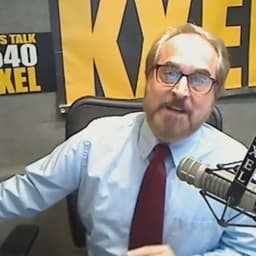
And as this 9 o'clock hour of KXEL Live and local kicks off on a Thursday, that's when you're hearing a conversation we recorded yesterday afternoon for convenience of schedules with Iowa's Third District Congressman, the Honorable Zach Nunn.
Congressman, thanks so much for taking the time.
Well, Jeff, thanks for taking time with me.
And I want to thank all the islands who are making the trek to my district here in Des Moines for the great Iowa State Fair.
We have been out there every day doing everything from taking our daily allotable calorie intake.
I think we took an entire month in on the first day of the Fair, Jeff.
The show in livestock with my kids, their 4-H, just got a blue ribbon in the sheep showing contest here with my 11-year-old yesterday.
So she has been just working her tail off.
I know so many kids across Iowa do.
It's just a blessing to get to see the best of all 99 counties wrapped up in 11 days of the State Fair.
Well, you cover a lot of territory walking across the fairground.
You got to keep the food intake, the calorie intake up.
So that's that's all OK.
But as the host congressman, you get to literally host folks from around the country.
And I think we've documented, I don't know, seven or eight folks from the administration, a few others in there as well.
This has been that food on a stick really brings them in from DC.
You can't say no to a good pork shop.
And I think that that should be the new Iowa motto here because you're absolutely right, Jeff.
We've been able to have everybody from the Treasury Secretary coming in talking about
Trump accounts and young investment.
We had Doug Collins, the VA secretary, join me to talk with veterans about legislation.
We helped champion the largest true pay increase in history on our watch and making sure we're taking care of our veterans who are coming home on his watch.
And we really showcased Iowa has been doing this right.
There's a lot the nation could learn from our VA hospitals and our nursing and medical staff here.
We most recently had in the secretary of war, we talked about, you know, Iowa
Just suffering one of the most tragic aspects of this.
More gold star parents created this year than any other state, but standing and wrapping our arms around these families.
We were able to give a scholarship to our military children here in the area.
We are building a house through our foundation.
to help a double amputee who was involved in an accident while serving a roadside bomb to be able to have an 88 compliant home.
And then the secretary and I talked about, you know, the loss of two of our own.
Sergeant Torres Tovar and Sergeant Howard who died in an ISIS strike, but also with the Iowa Air National Guard did on targeting to be able to strike back through Operation Hawkeye Strike that killed those extremists that took the lives of two of our sons.
We talked about what I was able to get into this year's National Defense Authorization Act.
Those are really key aspects.
We got in more provisions than almost any other member of Congress, and it helps everything from artificial intelligence being developed at Iowa State University that we can use for dual-use technology, military drones, but also precision agriculture drones, as well as hopefully bring a flying mission back to Des Moines at our airport here with the 132nd Fighter Wing, something else we were able to get in.
So we're able to showcase a lot of the great things in Washington,
But I think what they all enjoyed was being able to come to Iowa and just see islands at their very best.
for you being able to showcase the best that Iowa has to offer.
And in addition, they do other things.
We spoke with Secretary Collins live on the program Tuesday as he was on his way to the Iowa Veterans' Home, et cetera.
They get a big picture.
They're not just coming in for a quick afternoon and gone.
They're actually doing a number of things on the ground, not just the fair, not just appearing with you.
That's right.
In fact, we've made sure that not only do they get the fair experience, which is fun, but we also want to be invested in our communities.
I'll highlight this with our Health and Human Services Secretary, Alex Adams.
His portfolio deals with things like foster care and how adoption can work here in the United States better.
I put him in front of 100 pastors who were leading on something called the Church Ambassadors Network.
This is a really keen way that, you know, something that I've been deeply involved in in my and my wife's life is fostering and adopting two young kiddos here in Iowa.
The process is not easy, and the secretary heard first hand that in Iowa we went from having 8,000 kids in foster care
Through working with communities of faith, like our churches and our religious organizations, finding and pairing them up with families who were able to and want to take on these kiddos, we've cut the foster care waitlist in half from 8,000 down to 3,500.
I helped lead legislation that would put $5,000 through credit directly to families who want to foster to adopt so they can get through that initial hurdle.
It's not just bringing on a kid, it's getting through the courts and getting through the process and doing the medical.
There's a huge cost to families who want to foster and some of them just don't have those kind of startup funds.
So working together, we also highlighted something that we feel very strongly here in Iowa can be a pathway to success.
is getting families involved, not just on the adoption, not just in the foster care process, but what happens the day after they become a forever family.
And that's having a community of faith wrapped around them to be able to help.
One of the things I was really happy to hear the Health and Human Services Secretary talk about why he was on the ground is Iowa really seems to be leading in this in a way that other states are not.
And so we're going to take Iowa's model of this faith-based wraparound, of this helping foster families up to the federal level.
We've even got Melania Trump interested in some of the things we're doing, including our Home for Foster Youth Act.
It would help alleviate up to one in four foster youth who become homeless
after leaving the system and utilize vouchers that are already available in HUD to help them get on their feet and be successful both in a skill set, in a career, but also not find themselves homeless just because they've aged out of the foster home system.
And the one that I'm really happy about here, we were able to showcase our Fight for Families Act to make a federal adoption tax credit that would be fully refundable.
So when that adoption day comes, they come at over $30,000 or half of the overall cost.
Directly back into that family and for so many families that makes adoption a reality versus just something they want to do is they're trying to foster
and one of the things that is Interesting to me About everything you've just said it's one thing to advocate It's another to have lived it and therefore know firsthand What would help people the stories you've heard from others similarly situated?
Again the the two that you adopted into your family a couple of years ago I mean that is a game changer I presume when it comes to crafting applicable legislation in essence any of us can craft legislation But legislation that actually will work you've got to experience it or have a good insight that many would not have otherwise
Well, Jeff that is so well said I think you're exactly right being able to put you know
Secretary, cabinet-level officials in front of people who have real lived experience with this matters.
Whether it was talking about how we help a veteran in rural Iowa, Secretary Collins from the VA, look at mobile centers of deploying therapists in the back of converted ambulances to a private setting, but a rural area where the therapist comes to the veteran and helps them where they need it, or telehealth medicine to be able to renew a prescription.
The same is true on the foster care side.
You know, talking to families inspired us, we saw a grandmother trying to adopt her own grandkiddos, and the court cost along with $10,000.
And she was forced with this horrible dilemma of, do I mortgage my home to be able to bring my kiddos in, or do I let them go into foster care because I can't afford the cost?
No family member.
Nobody who wants to adopt should be put in that impossible situation when we have hundreds of thousands of kids across the country.
were trapped in a foster care system that could be alleviated if we could just get government and bureaucracy out of the way, still keep those kids safe.
And as we heard from a number of social workers here in Iowa, for every kiddo they can help find a family, that's $100,000 that they're not paying to foster care center or basically an orphanage that they can put back into helping that kid be far more successful.
further down the road.
And so we haven't asked for a single new penny.
This is all money reinvested by getting kids into families.
That's the kind of stuff you're not going to find from a government report.
You only hear from talking directly with Iowans, seeing how it works for a family, and seeing the return on investment on that kiddo, being able to join a forever family.
Iowa 3rd District Congressman, Republican Zach Nunn joining us for our monthly visit here on News Talk 1540 KXEL.
We have the
great fortune of being able to talk with folks from NFIB and SBA on a regular basis.
That's the National Federation of Independent Business, Small Business Administration.
You were sitting right there with them earlier today as you and I are talking on Wednesday.
Folks are hearing it Thursday, but talk about this small business roundtable and what you heard from folks.
And again, it wasn't just a matter of people from Washington or the federal government talking at
Business owners, it was business owners being able to share stories.
Well, this is the really exciting part.
We're talking about what folks have been able to do with more of their hard-earned cash back in their pocket.
And I'll tell you, Jeff, they're invested in their family, they're invested in their family farm, and they're investing in Main Street.
That is the way to grow an economy.
You and I both know this.
NFIB has been a great partner in helping us say, let's just roll back some of the red tape.
It's one of the reasons I was able to move forward.
protect small businesses from excessive paperwork act which in its title alone just showcases how much paperwork has hit small businesses you know at the beginning of my uh... term here in congress the federal government was showing up and finding small businesses five hundred dollars per day per infraction if they haven't gotten their paperwork filled out correctly insane uh... punishment and really became kind of a fine and female by the federal government
to effectively just flee small businesses, because the big guys were all taken care of.
They had in-house legal, they had it covered.
But for a mom-and-pop shop, for a family farm, for a home office that was in LLC, my wife works from home as a small business, they had to file all this themselves, and the cost was over $5,000.
The intent was noble.
Let's go after shell companies and shut them down.
And we know there's about 40,000 shell companies in America today, but let's target them.
Instead, the Biden-era administration targeted 32 million small business owners and put unbearable costs on them.
So I was privileged to have NFIB not only back me in this corner, we moved the legislation forward with the administration to shut that down and say, let's target the bad guys, let's not presume that every small business in America is one of the bad guys.
And that moved forward and it's freed up so much time, but also resources to reinvest.
You know, I'm really honored, Jeff, that, you know, just this week I was endorsed by the chamber.
We've had the small business administrator out here, Kelly Lefler, who's highlighted our work in this area.
And now, NFIB today, showcasing what small businesses are doing with this.
I'm also privileged.
We were honored with, you know, the top three most bipartisan member of Congress by a nonpartisan group for just the legislation we passed.
But I will say this, it's more than just the rankings or the endorsements.
It's the fact that here in Iowa,
We actually show up and work with Iowans on delivering for them.
I've got, you know, 95 bills through the House of Representatives.
I've got 27 bills that have already been signed into law by both President Trump and by President Biden.
And can't believe our rural housing bill was so good, it passed without the president being assigned at all because it had a veto-proof majority.
The reality is this.
To put that in perspective, the person who had my seat before me, the Democrat, has three bills in her entire four years in Congress.
We've already passed 27, and there are 27 bills that are direct reflections of Iowa's priorities.
That's the kind of fight we want.
That's what we want delivered in Washington.
Work with both sides is great.
That's wonderful.
But most importantly, deliver for the people who sent us there to do the work.
Get stuff done.
That's right.
It's really what it comes down to.
I have to ask in our remaining minute or so, you mentioned the blue ribbon.
How many, uh, how many did your daughter's father pick up in his 4-H career?
I'm just curious.
I don't
know.
You know what?
I have seen so many kids out there doing so great, uh, and this is the exciting part.
It's my daughter's first blue ribbon, her first year, uh, showing at the 4-H level.
They all just came out of Clover Kids.
Our three little ones are still showing goats and sheep there.
But I got to give a huge shout out to the older kids who have helped mentor her and really turned her in from a girl who was, you know, good with livestock to somebody now who just really embraces it.
You know, doing the shearing, doing the shower, doing the fluff that goes particularly with those feet.
Anybody who's showing cattle or sheep know this, there's an art to it.
And it's a fun thing to get to see that happen.
And we did it all the way
The sad chapter also comes after the ribbon of letting the livestock go and they go on to their next chapter too, but that's important for kids to learn.
That's how things work on the farm.
So the answer is none.
You never did win a... You just answered the question perfectly except I wanted to know if...
Yeah, never a success.
There we go.
A lot of it,
Tim, but never a winner.
That's exactly right.
My grandfather still reminds me of my poor sheep-showing skills.
Well, it's good to know that there is a blue ribbon winner in the family.
We need at least one.
That's right.
Well, congratulations to her.
And Congressman, thanks for the time.
As always, we will do it again next month, if not before.
Jeff, it's a privilege.
Thanks so much.
We'll see you soon.
Have a good fair, everybody.
Congressman Zach Nunn.
Now there's a blue ribbon in the family.
He called in from Des Moines yesterday afternoon so you could hear the conversation now on a Thursday.
A news talk 1540 KXEL where Iowa comes to talk.
I'm pleased to welcome on the news line Adam Finnegan.
Mr. Finnegan is the author of a book released a few years ago entitled The Sleeper Agent, The Rise of Lime Disease, Chronic Illness, and the Great Imitator Antigens of Biological Warfare.
Named listed on the book is A.W.
Finnegan.
Adam Finnegan, good morning and thank you for taking the time, sir.
Thank you for having me on.
Now I understand from your biography
The book you wrote about Lyme disease, that has to do with the fact that you yourself contracted that, is that correct?
Tell me about that journey, please.
Yeah, so I got Lyme disease.
My mother had it.
I had been familiar with some of the information in the book.
I mean, the book's actually about a lot more than Lyme disease.
I just kind of made Lyme disease the center of it.
It's about the entire biological warfare race with biological weapons that have to do with flow.
incapacitating agents that don't kill you but slowly tire, exhaust and overwhelm.
And that's very important because of what happened in COVID and our reason for this conversation today is the fact that a senior advisor to Dr. Anthony Fauci by the name of David Morins has pleaded guilty to federal
conspiracy charges, this had to do with hiding emails and trying to avoid federal freedom of information act requests.
Okay, so that's the story that people have heard about.
That's serious stuff.
There are connections, though, are there not with what you've discovered and what you made as the focus of the book, The Sleeper
Agent.
And I did have a chapter on COVID at one point, but I ended up taking out because my manuscript was just way too long and I wanted to focus on some of the older stuff that have to do with a guy named Eric Traub.
He discovered how these things work.
And SARS in the COVID vaccine kind of worked the same way.
It induces this condition called immune tolerance, which is
basically immune deficiency chronic immune deficiencies and They were looking at it as a defense strategy, which is crazy because it makes absolutely no sense to do that when you look at what's in my book and the history on that so Yeah, it's very much related.
Okay.
Well, let's let's drill down into that because I'm when did you contract Lyme
disease?
2016,
I believe.
Okay, so and the reason I asked it that way rather bluntly is you had already experienced this as the world then discovered COVID-19 and I'm guessing again as these so-called experts are talking about things, I'm imagining you're sitting there saying this doesn't make sense.
Yeah.
And so that's what really drove all of this.
I mean, what were some of the immediate red flags for you in real time, if you will, that led you to say, this is a fraud.
This is a scam.
Yeah, so I was writing my book back in 2017, and I was just deep into the research by the time COVID came around.
So I had already been working on it every day for many years, and I had learned of this condition.
Through a Lyme disease group, somebody taught me about, and then when I started looking into this guy, Eric Traub, I discovered he was the one who discovered it.
And it was like the backbone of his biological weapons.
He was trying to induce these slow chronic diseases that also brought mental problems, neurological disorders, and cancers as well.
It's very diabolical when you look at the history of it.
And then I started to find that they were actually looking at it as an acceptable form of immunity.
Their idea is that if we take out the immune system, they won't have these fatal reactions.
That's the idea.
Because a lot of times the immune response drives inflammation, and so they see it as, OK, the immune system is what causes these fatal diseases.
But I don't know if that's necessarily true.
I think it's just that the immune system is engaged in a very
heavy fight against an invader.
But as far as using it as an acceptable form of immunity, it makes absolutely no sense because the history of it just shows some of the worst things you can imagine.
Like I said, cancer, skyrockets, also chronic disease and neuropsychiatric and neurological disorders.
So, you know, I found a paper, Disease Tolerance as a Defense Strategy.
Disease Tolerance is another term for immune tolerance.
And it was funded by Bill and Melinda Gates Foundation and NIA.
And I realized they're actually looking at this as an acceptable form of immunity.
And they're gonna, you know, and when I started to look at the COVID vaccine,
I realized that it stimulates the immune receptors that bring on this immune tolerance, so it definitely looks like they were trying to induce it.
And that's why they started saying, oh, it's not going to stop the infection, but it's going to stop severe disease, because we're suppressing the immune system.
But it makes absolutely no sense, because then what you're going to have is this flood and avalanche.
Those three things the chronic disease neuropsychiatric and neurological disorders and cancers and that's exactly what we're seeing
So they had to know going in that's the bottom line they had to know going in that what they were Recommending I was gonna say prescribing.
I don't mean it that way what they were recommending what the narrative that they fought so hard to keep pure they knew
of the dangers, I have to assume that they promoted that to cover up the origins of the original COVID disease.
Well, they, yeah, I mean, they definitely knew the dangers, especially with the vaccine.
I mean, there's absolutely no way they couldn't.
I mean, if somebody like me can look at this and say that,
And I was speaking out before they even rolled it out.
I was telling people through emails, they're not going to be able to make these two shots, flatten the curve, two shots.
It's not going to work.
And it's going to cause a lot of harm.
And now that's what we're seeing.
So there's no way they couldn't have known that this was coming.
And I've looked into Anthony Fauci's history.
He knows exactly.
I mean, his whole career is built on the foundations of this.
He knows exactly what this is.
And the other thing is we had a guy at the FDA who approved COVID vaccine.
His name is Konstantin Chumakov.
And in my book, I talked about his father.
His father was a bio weapon here for the Soviet Union.
And he was meeting with Eric Trubb in the 1940s.
This guy, his father, actually teamed up with Albert Sabin to make the oral polio vaccine at a time when they were our enemy country.
It just doesn't make much sense.
But when you read the sleeper agent, you understand all of that backstory.
And then to see that his son, to see that this guy, MP Chumakov's son, Constantine, was running vaccine safety and review at the FDA.
It's a huge red flag.
having somebody with that kind of background, uh, approving vaccines that'll be given to all of America is a really, uh, disturbing, um, fact.
The book is entitled the sleeper agent, the rise of Lyme disease, chronic illness, and the great imitator antigens of biological warfare.
Adam Finnegan, the author, how difficult was it for you?
to get the book published and what kind of backlash was there because at the time this was published at the end of 2023, there's still, and well, to this day, there is still plenty in the formerly mainstream media who are buying into the narrative, doubling down on it to cover up their own complicity.
But I'm just wondering how hard it was for you to get this story out in the way that you wanted to.
So it was actually pretty easy for me because I I knew of the publisher that I was going to use beforehand and the guy that wrote the introduction to my book John Loftus He was a he was a federal prosecutor and a Nazi hunter who had published a book with him beforehand So he took on that book from the very beginning.
I didn't start going to any of these other publishers.
I knew they would say no But Chris at trying day I work for trying day now, too
He was very much on board from the very beginning, so I got lucky with that.
A lot of the story actually comes from a high-level biodefense source that I met through John Loftus, who has to remain anonymous, but he gave me a lot of the clues of what to look into, and then he basically wrote a memo.
the story and then I took it and I said okay I'm gonna look into this and see if there's any truth to it and I found that there absolutely was and I was able to back up what he was saying.
So as we connect all of these dots and it's good that there are good independent publishers out there who who are not not afraid and we've talked with a few others on this program especially with this topic.
So you've got this one guy
this morons who enters a plea of guilty, the more serious charges are thrown to the side.
You know, in essence, they get one little guilty play that I think has up to a five year prison sentence, but given his age, his record, et cetera, you know, is he the fall guy for other
Others who have done even more heinous things or or you know is is is he the The guy who's just taking the rap and and others who have engaged in more sinister behavior They're just walking away scot-free with the hope that America will say well there.
We got a guy.
Yeah That's probably the case I would say I mean Anthony Fauci just denies any knowledge of what the guy did
But then the other thing is there's a lot of, actually there's a lot of biodefense laws that protect a lot of these actions too.
I mean, not what this guy did.
That obviously wasn't protective, but there's actually a lot of biodefense laws, especially when it comes to testing vaccines on the public that, you know, they knew could be potentially harmful.
There is a lot that protects them as long as they say that they're protecting against biological weapons agents.
And or just calling it research activity.
It's it's under title 50 1520 But Yeah, I would say that uh Yeah, this guy took the lesser charge I mean that's kind of common in any criminal case is that they they put something much bigger over your head and say well if you cop to this We'll give you this
sure
But the timing of all of this, especially after Fauci's testimony or non-testimony before Congress, et cetera, that's just kind of interesting.
So when people hear this conversation, when people read your book, The Sleeper Agent, what do you hope comes from it?
I mean, as we look for it in terms of how do we stop bad things from happening,
or stop this kind of stuff from happening again.
What do you hope people are able to do with this information?
My hope is that it will shine a light on this entire story and show that, you know, from the very beginning, they were this dishonesty is not something new with COVID.
This has been going on a long time.
I mean, a lot of cover ups.
hiding information from the public, especially on the immune tolerance phenomenon that Eric Traub discovered.
They basically just left it out of Western immunology as it relates to infectious disease.
So this has been something going on a long time.
This is just kind of like the culmination of all of that is kind of being thrown right in our face.
So my hope is that the public will learn, especially I talked about those biodefense laws in the book.
I talked about so many aspects of this.
And especially I talked about that guy, Constance and Schumacher's father.
So when you see that his son is running vaccine safety and review, I mean, it's very, it's very eye opening.
The sleeper agent is the name of the book subtitle the rise of Lyme disease chronic illness and the great imitator antigens of biological warfare Adam Finnegan is the author on the cover a double you Finnegan and you get it wherever you get your good books I'm looking at Amazon you get it wherever you get your books these days mr. Finnegan Thank you so much for this exhaustive research and Putting it together in this book and talking with us about it.
I appreciate it greatly sir and wish you all the best
Had a great time
Take good care now.
And Adam Finnegan, the author of The Sleeper Agent, joined us live on the news line on News Talk 1540KXEL, where Iowa comes to talk.
News talk 1540 KXEL where Iowa comes to talk back to school time.
We've talked about that in a few different contexts in recent weeks.
We're going to talk about it in the context of sports at Hawkeye Community College right now with Ethan Crawford, director of athletics and recreation at Hawkeye Community College.
Thanks for being back with us.
Yeah, thanks,
Tim.
Thanks
for having
me.
What's the most exciting part of this time of year
for you?
Well, we got a lot of kids back on campus, so I mean the energy just...
comes up another level at this time of year.
We've had athletes back primarily in men's women's soccer and volleyball since really the middle to end of July when we had some move-ins for them, living over at the, the elevate apartments, formerly the Hawkeye Towers.
So we've had a lot of move-ins and then now it's just been those two, three day practices on campus.
So you got a lot of vibrancy back in the gym, out in the fields.
And then schools starts on Wednesday.
So it's, you know, exciting time.
The kids are going to have an adjustment.
Everybody loves preseason because all you have to do is sport.
and then once you get into the school year, then they start realizing what it is to be a student athlete.
So exciting times, busy times, but it's nice to have that vibrancy back on campus and feel that energy again.
For folks who went to high school, obviously, or who went to one of the larger colleges out there, they might think about fall sports and football as the thing that comes to mind first.
What's life like when there is no football team to kind of coalesce some of the atmosphere and some of the enthusiasm for an athletic program?
Yeah, for us, it's really that the volleyball, the men's women's soccer teams, you know, we have men's women's golf, we have men's women's cross country, softball will be going into scrimmages, wrestling starts in October, track and field indoor starts in the fall too.
So we get a lot of sports in the fall that are outside of your traditional football that still bring a lot of kids to
campus, um, and also provide something for the general students to come out and support and watch and feel like they're a part of something.
So, um, you know, our, our head to head sports, our volleyball, that's where you're probably going to draw the most attendance on campus and, and really be able to pack the gym and those type of things.
So we're, we're really excited about that volleyball team this year.
Um, they've really been able to, to level up in the recruiting class.
Um, we have Chris Mahi, who's our head coach and she's going into her fourth season.
So this is her third true recruiting class for herself.
Um, her and her.
My husband, Kalani, owned the CIA, the Club Iowa Juniors Club here in town.
So they work with high-level athletes all year round, and they know the best of the best.
So they've really been able to bring in some great recruits this year, and even bring in some great recruits for 2027.
So we're looking to get back in that top three within the conference, back to fighting for those conference championships, and hopefully some national burst with volleyball.
Talking with Ethan Crawford, director of athletics and recreation at Hawkeye Community College with the start of the autumn semester, of course that means fall sports and sports generally back on college campuses like Hawkeye.
And which sports go into this year with some tailwinds after good things last year?
Yeah, so last year we had a really great year in terms of some individual success.
Our men's women's wrestling program is only two years old after last year.
We'll be going to our third season this year.
Our women's wrestling program has really excelled in those first two years.
We had Allison Crum formerly from East Buchanan over in Winthrop, Iowa.
She is our first two-time All-American, so fifth place both years.
We had three other All-Americans in Maya Kurth, Lamuna Garisho, and Mackenzie Arons.
Unfortunately, three of those have graduated.
We're bringing back one with Labuno.
But we're really looking forward to what they've brought in for this year for the recruiting class.
We also had a bowling All-American last year.
It was our best individual finish.
He placed third overall in the country at Nationals.
And then we had another All-American for indoor track and field in Riley Goddard.
So things were going really good last year.
We're just looking to level up this year.
Some big turnarounds this year is probably going to be our men's soccer program.
We brought in a new coach, Jorge Sierra.
He formerly coached at Southeastern Community College down in Burlington and was part of their national championship team back in the 2019-2020 era.
Um, and he's just been a great recruiter.
Um, we have about 50 to 55 student athletes on our men's soccer program between our varsity and our JV.
Uh, and this year what they've been able to bring in, uh, has really, really stepped things up for us.
Um, they've got some great preseason results when they've gone out and competed against, you know, Grandview and Briar Cliff.
And, you know, we're getting winning results or ties and draws, um, against a lot of these four year varsity programs.
So we're really excited about the men's soccer program.
I think they'll be able to make a deep run this year.
I mentioned the volleyball program and then also our women's soccer program year after year.
They're fighting for that conference championship and they just keep reloading.
We graduated a large sophomore class last year, but the coaches got out there and they brought in another 15 to 18 freshmen from all over the world.
So we got some really, really great talent this year that we hopefully will make another deep run.
Well, let me come back to women's wrestling because there's been news about women's wrestling.
It seems like every year across college sports from being a sanctioned sport to landing at a place like Iowa, Iowa State now has a program that's waiting in the wings.
Hawkeye in some ways is in on the ground floor or very near to the ground floor on this wider trend.
What's that meant compared to some of the other programs that have started at Hawkeye that had to catch up with the other teams that they were joining in their sports?
Yeah, for sure.
I mean, women's wrestling specifically, like you said, it's been so new to the realm in terms of being sanctioned.
It's been around for a long time on the national stage with freestyle, but with getting sanctioned by the Iowa Girls Athletic Association in Iowa and being folk style.
We see a lot of transition, so a lot of girls that
need to learn the freestyle because in college we wrestle freestyle.
So a lot of our girls that haven't done that as they've developed, we're trying to transition to that so that they are successful on the mat in the first year.
But like I said, we've really been able to make an impact in that first year and that second year of the program, looking to do that again in this third year.
So, you know, we were...
in the first two years ranked in the top 10 in the country right away.
So we've really been able to formulate a great wrestling program here right in the Waterloo community, right?
Where really wrestling originates from too.
I mean, we have such strong wrestling on both the men's and the women's side.
So it was really a natural segue to bring that sport in for us.
And we've seen some of that success quicker than we've seen in some other sports where you have schools that have had it for, you know, 15, 20, 25, 30 years, whatever it may be across the state.
Most of these programs are something
within the last decade.
So we've been able to catch up a lot quicker and have a lot more success right away.
Talking with Ethan Crawford, director of athletics and recreation at Hawkeye Community College on the verge of a new school year and a new fall sports season for the Hawkeye Red Tails programs, it's an interesting time to be involved anywhere in athletics with all the changes that are happening at the top of the NCAA pyramid.
And even though Hawkeye doesn't have a football program,
How do you see some of these reverberations that really are involving football at SEC and Big Ten schools rattling around and affecting your day when it comes to some of what is different today about college sports than it was not too long ago?
Yeah, I mean, it's an ever-changing landscape, especially for Division I. And we see a lot of the trickle-down effect, and some of that is unintended consequences, and some of those things we don't even know yet.
You know, the NIL and the revenue sharing, we don't see as much of.
We do have some kids that get offered smaller NIL deals, and they can't accept those at our level.
The revenue sharing isn't something that we really need to worry about at this point in time.
The five for five is something that has just been announced by the NCAA within the last few months.
And that could have some trickle-down effect on us, especially for our international students.
We have, you know, I mentioned the Men's Women's Soccer Program.
Between those two programs, we have 70-plus international students.
A lot of our internationals, when they come in, are coming in at 19, 20 years old.
So we're only seeing them, where if they're going to transfer to a D1 or D2, they might not have that eligibility.
But for the rest of it, with the five for five, I don't believe it's going to affect us too much for the tradition.
And
just for reference, that five for five is in reference to five years of eligibility where in the past it had been more prototypical four years.
Yeah, so in the past it was more of the, you had four years of eligibility within five years to do.
You also had, you know, red shirts that you could have in there.
You had medical red shirts that would come in if you had injuries.
They've wiped most of that off the table.
I believe there still are exceptions for, you know, religious or military or things along that line.
For the overwhelming, it's pretty much once you either start your first full-time semester in college, so let's say a traditional Iowa student.
is going to a school, they will start their first full-time semester, that starts their eligibility clock, or after your 19th birthday, that starts your eligibility clock.
So like I mentioned, those international students that are coming to us, you know, when they're 20 or they're 21, because their educational system's a lot different than ours, most of the time they're finishing what we would consider high school at 16 or 17 years old, and then they go into more of an upper secondary school, and then they come to us after that point.
So it's probably gonna have the biggest effect on them.
I don't see it really affecting, you know, like I said, the traditional student in terms of what their normal path would be.
Now, if they have two years of injury at our level and they're competing, that's going to impact them because now they might only get two or three years at the next level as well.
So talking about international athletes and quite a few of those again on the soccer programs at Hawkeye.
How's that changed campus when it comes to thinking back to the pre-athletic years at Hawkeye or the early years before the soccer teams were established?
There couldn't have been too many.
international students on campus at
Hawkeye?
No, I mean, that's absolutely correct.
So, you know, the vibrancy on campus with what we've been able to bring with student-athletes is phenomenal.
The overall student-athlete body is about 350 student-athletes.
In 2015, when we first started sports, we had zero.
We just started with one program, brought in sports training at that time, had about 20 kids on the team, and now we have 17 programs with 350 student-athletes.
All of those students are full-time on-campus students, which
Traditionally, our college and most community colleges trend more towards part-time students.
People are there to go in a class.
Maybe they have a job.
They're maybe taking night classes.
So you're not getting that traditional atmosphere.
With student-athletes, we've been able to provide that.
And they're there year-round.
Specifically to internationals, we had a handful of them before we started athletics.
And now it's really boomed to where we're closer to about 80 that are on campus every year.
90% of those are student-athletes.
And it just brings a whole
different atmosphere to campus in terms of all the cultures that we bring.
Most years we're representing 14 to 20 different countries across the world that we're bringing on campus right into Waterloo, Iowa.
And it's a great learning experience for maybe the small town kid just like myself when I came from Winthrop, Iowa and to University of Northern Iowa.
I got to experience a lot of different people from different backgrounds from different cultures.
We're also able to provide that at Hawkeye Community College.
It's not just people in our surrounding service area.
We're bringing outside.
of our service area outside the state and even all around the world.
Ethan Crawford is Director of Athletics and Recreation at Hawkeye Community College.
Red Tails Athletics season is getting underway for the fall.
Ethan, thanks for stopping in to give us an update.
Yes, appreciate it, Tim.
Thank you.
This is the station where Iowa comes to talk.
News Talk 1540, KXCL.
And a return guest on the program, he is Pete SEP.
Mr. SEP is the president of the National Taxpayers Union, they're online, NTU.org.
Mr. SEP, Jeff Stein Infratod, good to talk to you again, sir.
Yeah, great to be here again.
Remind people who may not be aware, National Taxpayers Union, who are you folks and what do you do?
We're a nonprofit nonpartisan citizen group founded all the way back in 1969 to work for lower error simpler taxes less wasteful spending in government and Economic freedom at all levels
Well, that's no small agenda to be sure no I Wanted to talk to you today because of something called the Jones Act I will concede I had no idea what this was
And apparently President Trump got involved for a waiver of this.
Explain first of all what the Jones Act is and what did the president do recently?
Well, the official title of the act is the Merchant Marine Act of 1920.
So this is a more than 100-year-old law.
It's called the Jones Act because of the senator way back when who sponsored the bill.
And what it says is that
for any ships traveling between U.S.
ports, whether the East Coast or the West Coast inland between Hawaii and Alaska.
If cargo is traveling in a ship between two U.S.
ports, that ship must be U.S.
built, U.S.
owned, U.S.
crewed, and U.S.
flagged.
Now, that sounds like a great idea, but the effect of this law and
several other laws actually that create a whole network of merchant marine subsidies is the burden consumers and burden taxpayers.
They need to be changed to reflect modern reality.
So again, it sounds on the face of it like, and I'm not using this in the term, a lot of people use it.
It sounds America first right where we want to make sure that things are produced here and That we have Americans involved in construction etc Let's assume that there was a good reason for it to begin with and I don't know that there was but How is it that it is outdated these days?
What is it that needs to be done?
Because it seems like this waiver has been pretty successful
Yes, in fact, there have been, by my count, at least 20 waivers of these restrictions over the past 20 years, and the latest one being just the one that the president announced, a 90-day waiver on oil, gas, gasoline, and fertilizer products.
an oil terminal in Louisiana needs to ship something up to Spain or further up the east coast, the Jones Act will not apply, and a foreign flag vessel or a US vessel with a foreign crew or whatever can do that.
Well, if so many waivers keep getting granted in the name of helping consumers afford things and helping goods get shipped quickly,
Why in the world do we have this law in the first place?
That's a big question.
Well, the law was intended to maintain a strong, merchant marine fleet that was US based.
That hasn't worked.
There are fewer than a hundred vessels in the so-called Jones Act fleet that meet all those requirements I mentioned.
Meanwhile, thousands of vessels visit the United States every year and could provide faster shipment of goods
not only on the coast, but on inland waterways.
And this is a big deal.
When you take a look at the United States right now, about 2% of all traffic, all goods, travel on either barges or ships that are Jones Act compliant.
And in Europe, where you don't have these kinds of laws,
40% of freight travels that way.
And the result is we have a lot of freight spilling onto highways and wear and tear on bridges and roads that end up costing taxpayers.
So these spillover effects are very pernicious.
And of course, we haven't even gotten into the consumer costs yet.
Pete Sapp of the National Taxpayers Union is our guest live on the Patriot Mobile Newsmaker line on the Todd Starn Show.
Jeff Stein filling in for Todd today from the Liberty University studio.
So basically in order to avoid unnecessary restrictions on the waterways, the supply chain moves to ground-based and that's where we then have unanticipated or unnecessary wear and tear on infrastructure
And we all know how much construction is done on roadways in the summer because we all grouse about it.
That's not only an inconvenience and a problem for the transportation, but very costly to the taxpayers.
Yeah, exactly.
And when we think about it,
It is so expensive to build a ship here because of some of these Jones Act requirements.
I mean, if you have to find a U.S.
shipyard to build the Jones Act compliant vessel and you've got to pay a U.S.
based crew to do it, and you have to have U.S.
investors to put money into the ship, the costs start going up because you have very expensive union labor.
You have materials
that are actually costlier, in part because of tariff policies.
The steel gets costlier, and so the bottom line is it costs about five times as much to build a ship here for a variety of reasons than it does in other industrialized countries.
I'm not even talking about China.
You know, that's a slave labor economy.
I'm talking about our peers.
in the capitalist world, they can build ships much more cheaply.
And in mentioning consumers here, because of these requirements, because there are few ships available, it takes longer, it's costlier.
The cost to consumers of energy shipments on the East Coast alone due to these Jones Act type laws is almost $800 million extra annually.
So you can understand why the president suspended the Jones Act on shipments of fuel.
There are genuine costs as a result of these regulations.
Kudos to him for avoiding them.
But why don't we just do that year round without waiting for a waiver?
Current waiver expires, as you and I are speaking, in just a couple of days, correct?
Well, the.
Last waiver was going to expire in a couple of days.
The president has just announced that he will extend it another 90 days.
So that takes us to a couple of weeks before Thanksgiving.
Well, is this the sort of thing that an executive order would be helpful or is this yet another thing that Congress should be taking care of?
But we can't expect that they will.
Well, executive orders can certainly continue suspensions.
Now, there do have to be reasons for the suspensions.
National security is the one that's operating here because of the Iran conflict.
In the past, natural disasters, economic emergencies have been the justification.
Ultimately, though, Congress really does need to get involved.
There
are
bills to either repeal the Jones Act entirely or
to provide some relief, at least to what are called non-contiguous areas.
In other words, rate that travels between California and Hawaii.
That's subject to Jones Act restrictions, and it costs the average Hawaiian family about $1,800 extra a year.
There's a bill from Ed Case, a delegate Democrat from Hawaii,
and a
Republican from Guam of all places.
because they're affected by it, that would suspend the Jones Act permanently for traffic that is going back and forth between the territories and our coasts.
It's part of the Merchant Marine Act of 1920.
This section is called the Jones Act.
And again, now we've got the next suspension.
One more reason to suggest perhaps it's not needed.
at all.
National Taxpayers Union online ntu.org.
Pete Sep is president of NTU and he's been with us now on the Patriot Mobile Newsmaker Line.
Mr. Sep, thanks so much for taking the time.
I appreciate the information as always and have a great weekend.
You do the same, my pleasure.
But now we go to the Patriot Mobile Newsmaker line, and I'm pleased to welcome Dr. Kurt Maselli, Dr. Maselli is Chief Medical Officer at Do No Harm.
Dr. Maselli, thanks so much for taking the time.
How are you, sir?
I'm well.
Thanks for having me, Jeff.
Tell us first of all, do no harm.
Who are you, folks, and what do you do?
Absolutely.
We're an organization of over 50,000 people.
That's physicians, other health care providers, concerned citizens.
and that are really focused on getting identity politics out of medicine and keeping kids safe from this harmful gender ideology.
DoNoHarmMedicine.org is the website with all the good information you need.
DoNoHarmMedicine.org.
Now, yesterday on this program...
We were on the air just as this report was released from Health and Human Services titled, Wolves in White Coats, How Doctors and Hospitals Pushed and Profited from the Fraud of Quote Gender Medicine, unquote.
When this report was released, what in it, if anything, surprised you, Dr. Maselli?
Well, I'd say this report is another wake-up call.
It's another wake-up call for the medical establishment.
And it really goes a long way to aiming to protect kids from this harmful ideology.
And I think what we see is we try to get to answer the question of how did we allow this madness to occur?
How did we allow a system where we have kids who are vulnerable and confused about their gender?
How did we push them into puberty blockers, cross-sex hormones, and surgeries through this irreparable significant harm?
and it leads to three main things, and that's profit-driven without any ethical considerations, the pressure from medical society, the medical organization pushing this ideology, and the politics, particularly from the Biden administration, that was pushing, again, the WPATH, quote-unquote, standards of care, which just pushed kids into this medicalized pathway.
And I think one of the biggest takeaways for me was, again, hearing the stories of the detransitioners.
uh... and their eight stories that are told within that report and again just hearing what they've gone through and uh... the horrors of the medical system but medicine has done to them we need to do better than that we need to restore our ethics restore our principles make sure we do what's right in order to help these kids and uh... and and to do uh... that it was as soon as we can and i think that this report calls for us to uh... to come together to do right by the individuals that have been hard and to make sure that this harm doesn't continue to occur to kids
Now, for me as a layperson, I don't have a medical background.
It's one thing for these medical folks to have some sort of political agenda.
In other words, they're just horribly misguided and they're encouraging this sort of thing.
But when you then lay on top of it this huge profit motive that your organization, Do No Harm, revealed earlier this year as well,
Just because of the insurance coding, I mean, a lot of people are making an awful lot of money at the expense of young people and their health and safety.
It's tragic.
We created a database that looked at claims from 2019 to 2023.
And what you see there is nearly $120 million of claims related to these interventions on kids.
And we believe that that's an undercounting, because there's some hospitals and claims that we don't even have in our database that we weren't able to obtain.
It is a huge amount of money.
And when you look at it, and I think the report here from HHS does highlight it.
you look at the lifetime cost of medications anywhere from twenty five to seventy five thousand dollars you look at the cost of surgeries anywhere from a hundred two hundred and seventy thousand dollars and that doesn't include other interventions voice therapy air removals fertility preservation and it is nothing in terms of the psychological consequences that we brought upon an individual uh... it is a a tremendously lucrative industry unfortunately and and and for some it's it's created these
uh... into this this incentive to uh... to continue to treat in such a way that again our professional ethics should say no these are children we need to look at the evidence we need to recognize that the benefit is just not there and the harms are significant for these interventions and and that's what we have been a professional need to do and and you're right as well about the that the coding concerns that uh... you know that there's certainly evidence and reason to believe that some providers uh... may have diagnosed kids with physical conditions that that they don't even have
in order to push this scheme.
And that is obviously misleading and potentially fraudulent in nature.
And it's the reason why this report, particularly the appendix in it, is being forwarded to the Office of the Inspector General because it lists a series of hospitals where there are just these concerns of what happened in possible fraudulent coding practices.
The vice president sent a letter to the attorney general urging possible prosecution as you mentioned secretary Kennedy forwarding it to the inspector general I I'm just really struck by people who would code things a certain way Just to meet the outcome.
They're trying to get and the fact that There's enough of a paper trail or a digital trail here that you can really track it
That is going to open a lot of people's eyes.
My sense is that the report that do no harm released earlier this year set the table.
This new HHS report adds to it.
My fear is that there's a lot more, a lot worse to be revealed.
You're on the front line.
What do you think?
I think unfortunately that's true, and we even look at a simple code like precocious puberty, which is early puberty, so puberty that's happening in a kid who's six, seven, eight years old.
And here what we're seeing is that diagnosis is being applied to 13, 14, 15-year-old kids, again, in order to give them puberty bloppers, to get them paid for and to get them
to force them through those claims through the insurance and that that is just wrong and it's completely wrong and when you read the report you see that there are millions upon millions of dollars that are associated with such claims uh... and again that's just one diagnosis precocious puberty we know that endocrine disorder not otherwise specified as one that organizations such as Planned Parenthood of southeast pennsylvania and other organizations have had said that they've used in order to to meet the needs of insurance companies that they've used a diagnostic code for an endocrine disorder
when these conditions are psychological in nature in terms of the the struggle that one is going through with their gender dysphoria and again these are just a couple of the code there there's many concerns related to other code that have been used in i think you're right this is uh... an onion in many respects and we're just starting to to peel it and find just that the corruption that is under
I note from your biography, Dr. Maselli, that your board certified in both psychiatry and internal medicine.
So because of that expertise and what you just mentioned, treating as a medical issue, something that is actually psychiatric in nature, as you read through these, as you examine this, it must just be absolutely galling to you that others in the profession, quote unquote,
the way they're handling it, it's in quotes, are damaging people for life physically and mentally.
I mean, how widespread is this?
Are we beginning to believe?
It certainly is troubling and no doubt the vast majority of physicians and healthcare practitioners are good, honest people feeling the right thing each and every day.
But unfortunately, we have to also recognize the realities that are out there.
And again, in that database that we created to stop the harm database that do no harm put together, we saw that there were almost 14,000 children who were impacted by puberty blockers, cross-sex hormones, or surgeries.
And within that pool of kids, more than 5,700 kids had such surgeries, again, as minors.
And I think what really speaks to me is what the Assistant Secretary of Health said yesterday, and that's that psychiatry
Psychology, we need to provide competent and compassionate mental health care.
We should not be putting kids on this treadmill to medicalization of puberty blockers and cross-ex hormones and such.
What we need to do is to fully assess the individual to understand what's going on, the difficulties they're having, understand the trauma, the other psychiatric ailments that they might be struggling with, help them through those things because what we're finding is that many of these children are coming with lots of comorbid conditions
And instead, what they're being pushed in is this pathway that just leads to irreparable harm.
And we need to do much better in psychiatry and psychology and all of medicine.
And unfortunately, many of our medical societies are captured in such a way that they continue to push this affirmation model.
you know it's only the american society of plastic surgeons that as uh... it's really stood out in terms of playing out the evidence is isn't there for the intervention and we shouldn't be doing surgery by any means on children again this is the american society plastic surgeons and so uh... but they speak with a strong voice and they also acknowledge just again the the endocrine intervention that the the evidence is just not there for them so we need to go back to restoring our professional ethics
recognizing that our first responsibility is to do no harm and recognize that we can do more for these kids in terms of helping them through their troubles with appropriate psychological help and interventions and not again medicalizing them and making them lifelong patients.
It is tragic and in some cases we're learning criminal.
Dr. Kurt Miscelli of DoNoHarm, online donoharmmedicine.org.
Thank you for
Continuing this effort, this information effort, and I hope we talk again.
Appreciate it.
Thanks so much for having me, Jeff.
And as KXL Live and Local continues in this 8 o'clock hour on a Thursday, time for today's RFD 1540 conversation.
And for that, as per custom, we draw upon the insight of Dustin Hoffman, Supervising Editor, Lead Farm Broadcaster, Iowa Agribusiness Radio Network.
You hear their reports nine times each weekday here on KXL.
Dustin joins us here for this extended conversation Tuesdays and Thursdays.
One more time from the Iowa State Fair.
You had monsoon like range, you had tropical heat, you actually are having a good mid to end of the week weather run lately.
Yeah, that we are Jeff yesterday was just picture perfect until the Sun came out and it got a little hot pretty quick under that direct sunlight But today again, it was a little humid this morning, but it's been slowly letting up a little bit But again if that Sun comes out it might bake a little bit, but low 80s in middle of August I'm not gonna get too upset about that I don't start getting miserable until it hits like 85 and higher and so yes I know I'm in Iowa, but that's just part of the deal But yeah, it's been pretty good the turnouts a little quieter today and yesterday compared to what it was on Monday, but still quite a
few people out there.
And of course, the environmental awards are going on or should say went on yesterday, the Heritage and Century Farms.
Those are the ones going on today.
I know Secretary Nagy sustained an air conditioned stage all day and shake hands.
So, you know, that's that's always a good time.
A lot of great things still to come here at the Iowa State Fair as the last few days are getting close to wrapping up.
Well, you know, if his hand gets swollen from shaking so many hands, I bet he could still grip a milkshake cup and that'd be medicinal then.
kind of reduced.
Yeah, I think it does.
I don't know if health care health insurance covers that though.
So I have to finally get a prescription for that, but we'll have to talk to them and see how that makes that work.
So but yeah, otherwise it's been a great time here at the state fair.
If they're smart, the people in the first aid tent would have a deal with the milkshake vendors.
We have talked to a number of folks on the program this week at the national level who stopped by including the Veterans Affairs Secretary.
And since we've spoken, you had Veterans Day at the State Fair and a variety of other things.
What's been occupying your time lately?
Well, we've been doing a lot of interviews, whether it's about E-15, whether it is EPA, talking with us about some of the things they've got working.
You know, we've been talking about a whole host of things, talking with some of our charity's steer show of exhibitors.
We're going to get a chance to catch up with them.
You know, we've got all sorts of people.
Secretary, I'm sorry, Senator Ernst stopped by yesterday afternoon.
Of course, the Attorney General is coming by this afternoon to talk with Mark Magnuson.
We've got a whole host of people coming through here.
I swear, half the cabinet has been here already.
I know Secretary Hegseth has been here, Secretary Kennedy's been here.
It's been a really busy couple of days, but it is campaign season, so it's nothing to see those people, even if they're not running for office, coming out here to help support those that are.
And so that's been an interesting conversation as well, but we talked with USDA RMA Pat Swanson, she's of course Southeast Iowa producer, but also the RMA administrator there for USDA who talked with her about some of the programs they've got going on.
We've been talking about a whole host of topics.
just nothing short, even just on agriculture itself to cover here at the State Fair.
As folks are hearing this Thursday morning, you've got another solid four days left before this wraps up.
What are we looking forward to as the fair starts to wind down here?
Well, of course, we have the the sale champions coming up Friday or Saturday there and being a part of that.
Of course, we have always been a great supporter of that institution.
And of course, we've got a few more show judgements that are going to be happening as well.
So there's still lots to get through.
Still a lot of food to be eaten.
I am a little worried, though, Jeff, tomorrow, you know, Friday, I've got to bring my son the high school offensive lineman.
I'm thinking that I may have to take out a second mortgage to cover his food.
bills here at the Iowa State Fair.
Well you know maybe maybe you could work a deal where he helps in the tent and then Russell pay for his food.
I don't think we would have that kind of budget even if we did get a sponsor.
to cover all that but yeah yeah I'm looking forward to that and spend a little time with him there at the fair as well but yeah it's always a good time a lot of families out here a lot of people taking in as we're talking a lot of people circling around the super bowl and seeing he has been such a relaxed critter he's been so much fun to watch we've had a couple bowls in the past that sometimes they're a little bit anxious and it's understandable the amount of people that come through here but our current on Biggie he's uh he's very calm he's definitely been putting on a show to get attention
Uh, flipping hay in the air, kind of rolling around.
He doesn't seem to care if he wants to take a nap.
He takes a nap and he doesn't care who's around him.
So, um, he's been a pretty relaxed.
And in fact, uh, we had a reel up on our Facebook page of him, uh, taking a snooze when I hadn't decided when to wake up on Monday morning when I came in here.
And, uh, he was quite relaxed and, uh, yeah, he's been fun to be.
I have as a neighbor here this last couple of days.
from the J.K.
Farms there near State Center, as I recall, the Super Bowl this year.
With regard to some of the food now, again, you talked with Senator Grassley on the program.
He's a fan of the traditional staples.
I am sure that you and your colleagues there have certain places that you stopped.
Did you do anything more exotic this year?
Test a few things out in terms of food?
The closest thing I've gotten is the pastrami burger, but I still have a little bit of fare left to do a few things.
I mean, we've all been running around trying different things.
I know Terry, our intern, he tried a chicken plate, a Hawaiian chicken plate.
Mark has done, Mark's always pretty basic.
He does the pork chop on a stick and a few things, but he's been doing the caramel rolls every morning.
Riley's the one that does the gnocchi and the mozzarella sticks, and he tries as much new food as he possibly can.
And he's always been a big fan of some of those
more exotic things to try as well.
But I've been sticking to my staples, the pork burgers, the hamburgers, the beef sundae, things like that.
But I may have to sneak in something new here coming up just to try things out.
Maybe a little later on today I'll have to take a look and see what sounds good that I haven't tried yet.
Where can folks find the Iowa Agribusiness Radio Network on the fairgrounds now through Sunday?
We are right next to the Super Bowl, as I told you guys, he's our neighbor this year right next to the cattle barn entrance.
We can see him.
I can look at him right out the window right now as we're talking.
It's easy to find us on that west side of the cattle barn right next to the entrance to the Penning Roth Center and between that and the entrance to the cattle barn itself.
So easy to find here at the State Fairgrounds.
More reporting from the fair on Weekend Ag Matters this weekend.
We'll tell you when you can hear that program on KXEL in a moment.
Best thing that was a surprise to you so far, and again, we're barely midway through, four days remaining as folks are hearing this, but best thing that stands out is a bit of a surprise to Dustin Hoffman at the Iowa State Fair 2026 is what?
I'm going to tell you the thing that surprised me was the amount of how serious people take their bingo, calling State Fair bingo yesterday afternoon, seeing people with bingo team shirts and it's become quite the deal.
I remember, you know, you play bingo and you see sometimes that the American legions, you see a bingo night or something, but this was some next level bingo participation and people really get into it.
But you know, there's worse things you could get a group of people to be doing.
And so
I'd say that's been the pleasant surprise and like I said just something that blew my mind away that they were that into it but you know good for them and of course that all goes to a good cause half the pot goes to the Blue Ribbon Foundation and the other half course to the winners of those bingo games so definitely a good time but like I said way more serious than I ever remember bingo being when I played.
Well, we take stuff seriously at the state fair.
I mean, I don't care what it is.
We care about prizes, whether they're ribbons or just what did you get for winning the bingo?
You got half the pot.
So everything was a buck of card and then whatever the pot was, half of it went to the winner and the other half was a donation to the Blue Ribbon Foundation.
So yeah, it was good times and a lot of action out there.
All right, we'll let you get back to it.
Always appreciate the reporting from the fair.
You guys are busy all days of the fair, but that's why I really appreciate you taking time to slow down and have these conversations with us.
Dustin, thanks so much.
Enjoy the rest of the time.
We'll talk here for a review on Tuesday.
Sounds good, Jeff.
Dustin Hoffman, supervising editor, lead farm broadcaster Iowa Agribusiness Radio Network from the Iowa State Fair in Des Moines and again more reporting from the fair during weekend ag matters Saturday mornings at 6 or if you prefer or in addition Sunday mornings at 11 30 on News Talk 1540 KXEL where Iowa comes to talk.