Transcript
Fred Clark on Wildfire Smoke, the Woods, and Winning Wisconsin's 7th District
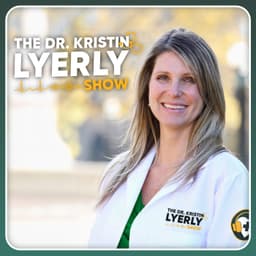
The Dr. Kristin Lyerly Show · Wed Jul 22, 2026

We are in the midst of this smoky, desolate forest fire environment for the third time in three years, I think.
I mean, parts of the state are seeing air quality readings that double what the record readings were just a couple of years ago.
Think about the millions of people who are recreating up north right now, who have gone north for a vacation to kayak or to fish or to just spend time with family.
You know, all those plans can go out the window or just
you know, not be the experience that people have saved up and invested to have because of this.
This is one of those things, it touches everybody.
And I think that in part that creates a moment where we can start to have real conversations.
Hello and welcome to the Dr. Kristen Lyrely show.
I am Dr. Kristen Lyrely and today I'm hanging out with Fred Clark.
He is a forester, a small business owner, a former state legislator, and now he's arguably the front-runner in a crowded Democratic field for Wisconsin's 7th Congressional District.
This is the seat up north that Tom Tiffany is vacating to run for governor, which means
But for the first time in a long time, it is an open seat.
It is in play.
And Fred has spent 35 years working in northern Wisconsin's forests and communities, serving the state.
He has built his campaign around a simple idea.
Congress has stopped doing its job and it's time to fix that.
I couldn't agree more.
So Fred, are you ready to get into it?
Let's go, brother.
Good morning.
Hey, before we talk about your campaign, can we just start by talking about what's happening in the sky right now?
We are recording on Friday.
We are in the midst of this smoky desolate forest fire environment for the third time in three years, I think.
Yeah.
Yeah.
I mean, parts of the state are seeing air quality readings that are double what the record readings were just a couple of years ago.
And you made a Facebook reel about it earlier today.
Were you seeing and thinking as you put that together, given your history and forestry and leadership and tourism and all of the things?
I'm sure you have a lot of thoughts.
And just think about the millions of people who are recreating up north right now, who have gone north for a vacation to kayak or to fish or to just spend time with family.
All those plans can go out the window or just...
You know not be the experience that people have saved up and invested to have because of this So this is one of those things it touches everybody and I think that in part that creates a moment where we can start to have real conversations Similar to the way that a couple of years ago up north we had a winter with almost no snow
and
Millions of people around us are all breathing the same smoke and their eyes are burning and their throat is sore and they're not going outside when they'd love to.
We're all experiencing that and that's creating space for us to share some understanding.
So it's, as you might imagine though, like anything related to climate change, it's up for grabs and you'll hear a dozen different interpretations of it.
A couple of years ago, Representative Tom Tiffany sent a letter to the Canadian Ambassador complaining about the bad form of the Canadians and allowing their wildfire smoked across the border and that we would have to breathe it and it was affecting our summer picnics and barbecues.
Completely misunderstanding the causes and the reality where some of these fires are occurring.
And Representative Tiffany thinks that
all forests will be better off if they're logged and healthier and will have less fires.
And I've been a forester my whole career.
I'm a big advocate for sustainable management, but the reality of what's happening right now is that in places like the boundary waters or places like Northern Ontario, these aren't places that even can be logged.
These are wetlands and small scattered.
trees with lots of other shrubby vegetation, and there's millions and millions and millions of acres of those areas that are roadless areas, that not only could you not get equipment in there to log them, but there's no money to be made.
So if you wanted to do anything there, it would be very, very expensive to do.
And so these are intractable problems that are made much worse by climate change, the severe extended droughts,
the record heat that we've experienced just this week makes any fires worse.
And this is, you know, it's the reality of our lack of investment to get away from fossil fuels.
But
Right, like the National Forest Service.
I had no idea before I ran for Congress myself how
much of the foresting or forestry industry is a huge part of our economy in Wisconsin.
And it's not just logging and creating products.
It is responsible forest management.
It all ties into the whole conservation movement, doesn't it?
and
Minnesota And I've spent a hundred years making investments to have those forests recover and and that involved good government involved taxpayers funding programs that get trees back on the ground and
and it involved building up an industry so that we really have had a pretty good balance of sustainable forestry and conservation working together for the last hundred years.
A lot of that's at risk right now with a changing climate and if we don't continue to make those investments we're going to go backwards
and
that'll hurt the economy and the jobs associated with our forest sector but it'll also mean our lands less healthy and less able to recover from
things like wildfires or windstorms or flood events that we know we're going to be experiencing more regularly in years to come because of a changing climate.
Yeah, we're definitely seeing that.
And the thing that I come back to, and this is the 7th congressional district, is where you are running.
is the origin of Earth Day.
This is where Gaylord Nelson was inspired.
He took John F. Kennedy on a flight over the Apostle Islands and just wowed him.
And this was all part of his, like he grew up in Clear Lake in this natural beauty, understanding how important all of this was for the origin of Earth Day to not be a place where we continue to recognize the importance of
conservation and the gentle balance of, as you said, forestry and tourism.
That's another piece of it.
And that's something that you've really worked hard at in your previous role in the legislature.
I so appreciate, Fred, that you get it.
You are not an industry guy.
You are not a tree hugger.
You recognize that there has to be that delicate balance.
And it all has to be recognized in the context of what's happening with our greater
climate?
And I believe that there'll always be debate, there'll always be controversy.
But by and large, the state of Wisconsin, because of some really good leadership, including bipartisan leadership in our legislature, and Republican and Democratic governors who understood the value of sustainable forestry and sustainable tourism, for the most part, we've struck that balance pretty well.
But
If we throw it all over in order to just open the door to a thousand foot deep holes in the ground for mines or just accelerating the pace of timber harvesting without the environmental considerations that are so important, we'll all lose in the end and the resource will be depleted.
And at the end of the day, the ability for our communities to sustain the prosperity they have today will be weakened and we can't afford to let that happen.
We sure can't.
I'm struck as you're talking about how similar this balance, this debate is to the new spicy debate about AI data centers.
and how we need this information and we need to continue moving forward and supporting the economy, but we can't do it at the peril of our neighbors, of the energy and the water and the conservation impact.
How do you feel about that, about the AI data center controversy, which seems to span both parties?
It doesn't really land with Republicans or Democrats.
It really seems to just be something that people are concerned about.
or the
People are intensely paying attention to data centers and they should be and we understand that you know right now we're looking at some of the wealthiest people who have ever lived and the wealthiest corporations that have ever existed are in a race to build out
computing power as fast as they can to try to capture the market for artificial intelligence.
That's really what we're looking at right now.
And
it used to be the case when Silicon Valley went through a bust, a bunch of people lost their jobs in Palo Alto.
Well, now it's a whole lot more than that.
And if this whole AI sector, which a lot of analysts would say is grossly inflated right now relative to the inherent profitability,
If we hit a bust with this, we could be sitting at 500 acre developments that are literally sitting empty not long after they were built.
That's the kind of risk we're facing right now.
So there's a role for federal government here.
There's a role for state government.
There's a critical need for local communities to have autonomy and transparency about how these projects are developed.
I'd like to see data centers regulated the same way we regulate a public utility.
that you have to prove a need for this thing and there's gotta be an analysis of the entire sort of sector across company lines so that we're not just seeing this race war that we'll all be paying the price for.
That's right.
So Fred, you did all this cool stuff and then you actually decided to retire.
back in 2022.
You moved up north, you're in Bayfield.
The goal was hunting and fishing and boating and relaxing.
And now you find yourself here just a few years later, thrust back into public life.
What was it that made you decide that retirement wasn't quite right for you right now?
It was, I know just, it was never my dream to go to Washington.
And, and
And to be honest with you, the prospect of that, it is what it is, and I'm willing to do it.
But the reason I decided to get back into this, if I peel away all the layers of fights about policy, I think we all deserve to have a federal government that's fundamentally moral.
And of course, it needs to follow the Constitution, which we're not doing right now.
But I think most...
offended by the lack of respect for human dignity that this administration has just celebrated in so many different ways, whether it's the way they have demonized trans people to create a political weapon, the way they've demonized immigrants in this country to try to make everybody believe that
immigrants would love nothing better than more than to rape your grandmother and you know steal your wallet and not only those things grossly untrue but so many people are suffering because of these decisions
and
forester in you was like, no, that's not how you hold it.
Not that that'll ever happen.
But you know, Kristen's celebrating the dismantling of the US Agency for International Development, then your physician.
I mean, the hundreds of thousands of lives around the world that have already ended because the United States government decided to pull the rug off from under.
all those programs and all those countries and all those relationships and let food and medicine rot in a warehouse while people starved or died.
We have to do better than that and that was really what drove me to make a decision to launch this campaign knowing that it's been a heavily conservative leaning district but like you and I talked before the show, running an effective campaign can do a lot of good for a lot of people whether you win or lose.
That's right.
I honestly believe the people in your district aren't necessarily hardcore Republicans.
I think they are hurting and I think that they want a representative who they really believe will be there for them.
Not politics, not somebody else's business.
They want somebody who gets them and who will serve them.
And you can look at the voting history and conclude, well, that's a Republican county.
Let's write that off.
Well, every time that's happened, we've lost the opportunity to not only bring voters to the table, but to really solve problems.
And there isn't a place I can go where I can't have meaningful conversations with people who have voted Republican before
and where I
And that's
I think that's part of the joy of living in a place like where you live or where I live in the Green Bay area because we don't live in a bubble.
We are surrounded by people with a lot of different opinions and all we need to do is get the conversation started and then we find that we care about so many of the same things like affordable gas and housing and good education for our kids and childcare, health care, all of these things we share so if we could just put our heads together and actually work toward the
and good, we all benefit from that.
All right.
And they say, well, I'm Republican.
So, you know, that should be the end of the story.
And I will often say to people, well, is it stamped on your birth certificate?
What would it take for you to vote for a Democrat?
And that'll actually start a conversation.
And so often, then we get to that point you described where we'll talk about what the Democratic Party used to be and why people think that it's lost its way.
And look, Democrats have to own our mistakes too, right?
So that's where that common ground starts to get built.
Let's dig into that a little bit because you have compared yourself to Rand Paul, interestingly, in terms of political style.
You're willing to work across the aisle rather than just towing the party line, and that's something that you have to do in the district where you live, but you also authentically do it, which is, it gives it that truth that people are looking for.
What does that look like in practice on an issue like health care costs or social security, the things that we all care about?
And I just want to note that in a television interview, I noted that I had respect for Rand Paul because I appreciated his principled consistency.
And I think he's one of the few Republicans in Congress who actually shows that.
I don't agree with a whole lot of what he
comes out on, but I respect the fact that he walks his talk.
And from the way I approach politics, and in my three terms as a state legislator, representing a district that was very mixed politically as well, not that different than the seventh CD, you have to do two things at once, okay?
And one of them is to be true to your values.
And I
I believe strongly in the role for government to make life better for everybody.
And
And that means we're going to have tough battles and intense fights about things.
One of my first big battles in 2011 was when Scott Walker came into office and I helped lead our caucus through the entire battle over Act 10 and public employee unions.
And if your listeners know, that was an intense time that mobilized hundreds of thousands of Wisconsin citizens.
And
boy, did I look for them.
I was there.
And God, it was at an amazing moment.
You know, three months before that, I'd been standing on a levee in the town of Montello with a failing dam with Scott Walker, who was then a candidate for governor.
And the district I represented, where we both made a promise together.
to get $10 million in the state budget to rebuild that dam for the community of Montello.
And to me, that just really highlights the fact that you need to be ready to, well, I'll put it this way.
You want to build a relationship with everybody because you never know when the opportunity will come to work together to do something that's important.
And it doesn't mean you'll agree on everything.
You may be...
fighting like hell on some other issue, but establishing those relationships is a really critical part of being a legislator.
And when you see, you know, Ro Khanna and Thomas Massie working together on releasing the Epstein files, well,
that's an
Yes.
You have to know where you can engage and then when to walk away.
And you have to understand that the fight belongs here, but your lives are here.
Yeah.
I served in the many assembly.
I'm mad at him that he denied me the opportunity to run against him But we won't agree on almost anything But there you go, I think that's that so that's the challenge especially important If you're I'm a Democrat.
I'm hoping to represent what's been for the last 15 years a conservative leaning district In order to do that
you have got to be willing to engage with everybody and build respect with people who will not agree with you on many things.
What's one place where you think the Democrats have really gotten this district wrong?
It's very easy for the Democrats to write off districts like yours and mine and not put any attention there.
Where is that one pain point that you think is the most significant?
Yeah, I think this seventh congressional district is one of the largest districts in the Eastern U.S., 26 counties.
And for a whole lot of people, they think of Northern Wisconsin as Wausau or Eau Claire.
And all of the territory north of there,
is almost flyover country.
So if you talk to voters, if you talk to Democrats in northern Wisconsin, they will tell you that for years the state party has not invested enough in organizing northern Wisconsin and recruiting quality candidates.
And we've had such an erosion of Democratic representatives at the state and local level that it's
sort of takes a long time to build that back up.
So, you know, seeing statewide candidates or even national candidates pay attention to rural Wisconsin and northern Wisconsin.
It really makes a difference in supporting those local races and the success of local candidates.
And that's what I would love to see the party direct more resources to.
They're promising to do that this year.
we are hoping to hold everybody's feet to the fire to make sure that happens.
Yeah, we've got to create a deeper bench and we've got to really, I think, lean into what these communities need because what you need in Hayward is very different than what you need in Madison.
So really focusing on the local people, the local concerns and helping to uplift these communities that are really struggling right now.
And one of the ways they're struggling is
Healthcare and I saw in the debate that you had with your opponents for the Democratic primary You have a pretty strong vision for where we go with healthcare in this country This of course is personal to me because I'm a doctor and I work in rural communities But Fred our system is so broken people can't get access.
There are no doctors.
There are no hospitals and they can't afford it How do we fix it?
and
as I this is and you know this because you've been a candidate You know you think you know a community until you run for office And then you go out and you have conversations with with the voters that you hope to represent That'll uplift you and inspire you and many of them will just leave you in tears.
Yeah
when you hear the stories of how people are living and how government affects the lives of people that you want to represent.
And there's no more dramatic way that that happens than with health care.
So as you pointed out, our rural health care network was already a very thin, thinly frayed blanket before 2025.
And you could tell
much better than I could.
All the flaws in the Affordable Care Act and the gaps in the holes in that system.
But the combination of the Affordable Care Act tax credit elimination and the coming 750, 800 billion dollar cuts to Medicaid nationally, that'll kick in at the end of this year.
Yeah.
And we've got critical access hospitals that are already marginally profitable, who depend heavily on Medicaid revenue, who may be forced to close clinics, providers leaving.
And that affects everybody, regardless of where you get your coverage,
right?
So so many
right?
Yeah, we've got a big bottleneck in our training system So we can open all these medical schools which we've done in Wisconsin in places like was on Green Bay and sending out medical students to a lot of like more rural communities with the hope that they'll go back and practice there
But then they have to go to residency training, and we only have so many residency training slots, because that number was limited by the Balanced Budget Act way back during the Clinton administration.
So yeah, we don't have enough doctors, and we don't have enough doctors, especially in these rural communities.
Which is, you don't think about that when you're thinking about our immigration policy, but it is 100% affecting us.
And it's not just the doctors, it's the other health care workers, it's the aides in nursing homes who are taking care of some of our most vulnerable friends and neighbors and relatives.
It's all connected Fred, isn't it?
It is.
It's one big blanket, a lot of connected dots.
people are feeling it and people are being touched by this in so many different ways.
And it's, you know, what's the Chinese maximum amount of crisis comes opportunity.
Yes.
So within this crisis, we need to number one, stop the bleeding.
And at least in the short term, we need to restore funding for Medicaid to
provide access for care for the people who need it the most.
And then
Everybody.
Every single person in this country needs healthcare.
Every single person in this country needs healthcare coverage.
When you were at this debate recently with your colleagues who are running, this is a crowded field.
It is kind of uncommon.
We're seeing this all across Wisconsin.
We're seeing people step up and there are competitive primaries in nearly every congressional district.
It's very exciting.
What is it, Fred Clark, that sets you apart from your competitors in the seventh congressional district?
Well, I'm the only candidate.
of either party who's had previous experience as any elected representative.
And I just want to be clear, that's not a prerequisite.
It's important experience, but many people come into Congress with different backgrounds and we should support that.
But this is not my first rodeo.
And I have a pretty good understanding of what it takes to win a very competitive district.
This is my fifth campaign for office.
And I've won three of the last four, and I'm hoping to win this one.
But you do that with a lot of shoe leather, a lot of miles on the road.
And here in a district like the 7 CD, a winning candidate has got to make a commitment to engage with everybody and be fearless about it.
And what I bring to this job right now is...
a recognition of this incredible pivotal moment that we're in as a country.
The future of our democracy is not assured unless all of us stand up and act to reclaim it.
And I want to be part of that reclaiming.
And the pathway to winning a district like this is to engage with as many people as you can, building trust, and also just being relatable.
So you're going to be all talking to people and helping them understand or have some assurance that you could actually understand their lives.
And we're not all a bunch of wonky Democrats that have 12-page playbooks that we want to read.
That'll
come later.
We keep those in the car.
So does this mean that we are going to see you out at a bar with an old-fashioned in your hand, giving a lot of you betches?
seems to be Tom Tiffany's approach.
I do a
It's our culture.
Yeah, I mean this is I remember going out with my so I'm in eastern Wisconsin going out with my great aunt in the farming community They call it the holy land just east of Lake Winnebago and I went to pick her up from the nursing home We went out for lunch and she took me to the tavern and at first I was shocked But then I realized we walked in and everybody said hey Irene this is just the place she'd been going her entire life It was the gathering place where people came to get a meal and to have a conversation.
It wasn't about drinking It was about being together.
So that's
the thing.
And I think that is something that differentiates you from Tom Tiffany.
Cause yeah, he can be in a commercial with an old fashioned, given all the you betches, but you are actually there for the conversation.
And it's so valuable and it's so enjoyable.
And, and if you think for a minute, all this is hard, I don't know this bar.
I don't know these people.
Well, you know what?
People in taverns are overwhelmingly friendly and sociable and interested in having a real conversation.
Yeah.
And so, yeah, have at it.
I spent a lot of time last winter out on the ice, driving around on the ice, talking to ice fishermen,
ice
Not a lot of distractions either.
Right.
So the people of Northern Wisconsin are used to Tom Tiffany.
He's been around for a little while.
What are you going to do differently for them than what he has been doing?
Because they want change.
They want to see something different.
What does Fred Clark bring?
They absolutely do.
And a lot of people who know Tom Tiffany are not happy with the way he's represented this district.
I'll just say that.
often is very ideological in the things that he advances and pursues.
And that's often, even when there's overwhelming different opinions from the people that he's supposed to represent.
So where I'm different is that I am making a commitment to people, much like Russ Feingold did 20 years ago.
to show up in every community where it's possible, to have conversations, open conversations with as many people as possible, and to be a person who's willing to stand up and take the heat where it's needed, listen to all points of view.
And even when we have issues that not everyone's going to agree on, I want people to know that I'm taking positions that are well-informed, from which I've heard all sides,
that are gonna hopefully do the most amount of good for the most amount of people.
And I think when people even don't agree with you, if they believe that you have done that work, it buys you a lot of support and people's willingness to accept differences.
That's leadership, doing hard things, but for the right reasons.
Yeah, that's right.
Damn.
If there is one thing
that you want the people of Northern Wisconsin to know about Fred Clark.
What is it?
You know, it's that I love people and I love the stories and I think that I'm somebody who's committed to finding the unified values that almost all of us share in small communities.
you know, if you've lived and worked in small communities, people know this.
Everybody's got to work together in a small town to help run the ambulance crew
or to
to
You can't afford to not talk to your neighbors because it's the only way things are going to work in that town.
And I think if we can build on that understanding, I want to take that spirit to Washington.
And I know that sounds
Very sort of high-fluten polyanis, but but I think people are hungry for that.
They're so tired of the extremism and And so what I'm committed to is an honest respectful dialogue with everybody that I represent and and That's what I want people to know I
think people are thirsty for human connection
I think when COVID happened and everything was virtual and we were all isolated from each other and then all of this political divisions that was seeped in, it just made it so hard for us to have that human thing that makes us feel real and healthy and connected to each other.
Absolutely.
It's a newspaper in Managua that has traditionally been a very conservative newspaper and has not had a kind word to say about Democrats in years and years and years.
But their publisher, Greg Walker, is somebody that I've built a rapport with because I reached out to him early in this campaign and met with him multiple times.
that came out with an editorial last week about the Seventh Congressional District.
And the title is The Seventh District's Nowhere Nobody Candidates.
And in this editorial, in three of the four columns, they're just excoriating the four Republican candidates in this race and talking about why none of them are qualified.
And then this passage I just love, he writes,
But given the cast of bottom feeders in this Republican field, who could blame voters if they opted to take a second look at the Democrats?
That's almost an endorsement.
Fred, that says everything.
It says everything about your history, your approach, and your vision for the future.
I'm so grateful to you.
Thank you for taking the time to talk today.
Thank you for stepping up in a time where so much is at stake, and we need leaders like you to do the work that you're doing.
Yeah, once you're elected, let's do it.
It's a date.
You, me, Washington, DC.
But before we get there, listeners, our Wisconsin primary is August 11th, so mark your calendar.
It's coming so fast.
And get out and vote.
Make a plan to vote because your future does depend on it.
And if you found our conversation useful, please do take a couple seconds and leave a rating, leave a review, leave a comment, subscribe so that you never miss an episode.
And of course, you can follow me all week long at Dr. Kristen Lairly on all the channels.
I'm kind of everywhere.
So, with that, we'll see you next time.