
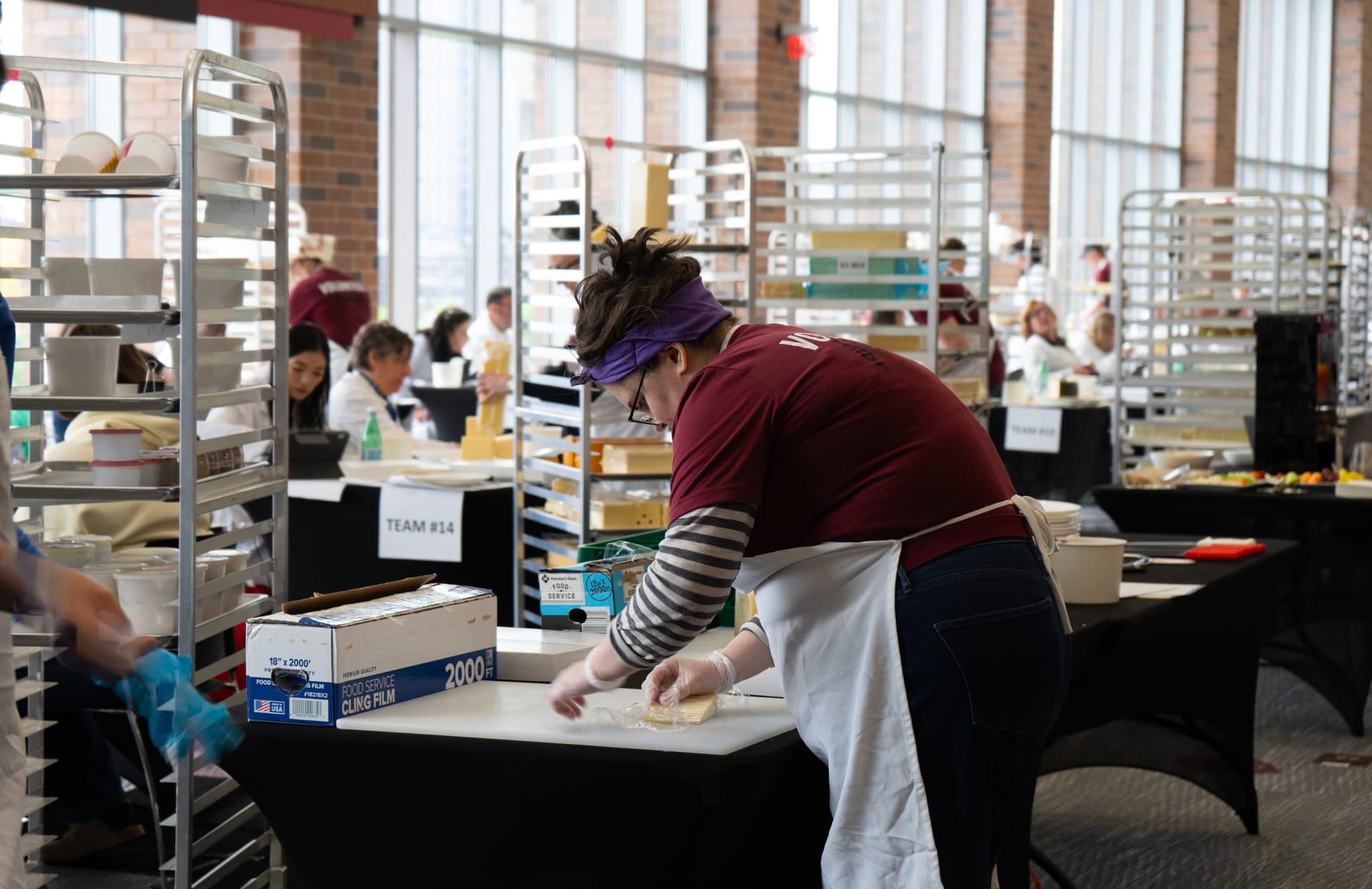


A football stadium is hardly where you’d expect to find fine artisanal cheeses. Yet each spring, Huntington Bank Stadium at the University of Minnesota hosts the American Cheese Society’s annual competition, judging the best cheeses made in the Americas. This year, MinnPost’s Taylor Canas and I got to attend.
My stomach began grumbling as soon as I stepped onto the stadium loading dock. An earthy, pungent aroma wafted from one cart; a sweeter, more buttery smell from another. At the main judging area on an upper deck, discerning cheese experts smelled, tasted, and chewed small bites, evaluating technical and aesthetic criteria.
The American Cheese Society was founded in 1983 by Frank Kosikowski, Cornell University dairy scientist and a godfather of the modern cheese industry. The group showcases cheese made with milk from North, Central, and South America. It’s headquartered in Denver but, since 2022, has held its prestigious Judging and Competition event in Minnesota.
The operation requires extreme precision. “The second we receive it, we temp-check every single cheese that comes in,” said Tara Holmes, ACS’s executive director, as she toured Taylor and me around the event. If a cheese arrives warmer than food safety limits allow, staff initiate a triage process and contact the cheese maker to send a replacement.
Every cheese has a temperature that’s ideal for tasting. “We have a really complex log that we have to maintain,” Holmes said. “We pull the cheeses so they reach temp before they hit the judging table, because we want every cheese to be at its ideal state every time the judge is tasting it.”
The judging happened May 18-22 across 139 categories, including fresh unripened cheeses, blue mold, feta, smoked cheeses, washed rind cheeses and country-specific varieties. The experts evaluated more than 1,600 cheeses from nearly 200 producers, all seeking the coveted Best of Show.
This year’s winners will be announced at the ACS annual conference, July 7–10 in Louisville, Kentucky. Originally, the competition and conference shared the same venue. But for the past five years, Minnesota has hosted the competition while the conference location has varied.
For the past two years, the Best in Show has gone to Fromagerie la Station, a dairy farm and cheese factory in Compton, Québec – in 2025 for its Alfred le Fermier and in 2024 for its Raclette de Compton au poivre.
Afterward, “they sold out almost immediately,” Holmes recalled. “It can potentially be life-changing for some of these cheesemakers that no one’s really heard of.
The judging returns to Minnesota annually in part due to its central location. “As far as trucking in cheese or shipping in cheese, it made it a little more fair for folks that were not having to ship their cheeses from coast to coast,” she said.
Additionally, ACS has developed a rapport with the community. “The stadium staff, because of free cheese, love us, but we love the stadium staff too,” Holmes said.
Volunteers are at the heart of the event, running, packaging, cutting, judging, and wrapping cheeses. “What’s fascinating to me is how many people fly in to volunteer,” Holmes said. “They love cheese.” It’s a warm and welcoming group, she noted, adding that as a bonus, volunteers are able to take cheese home with them.
In some cases, volunteers work their way up the ladder, starting out as cooler captains or stewards before eventually becoming judges, which requires rigorous certification testing.
Zaski Blazek, a cheesemonger for Lunds and Byerlys, started as a runner, moving cheese from one location to the next, and hopes to take the Certified Cheese Professional exam this summer. “I’ve been studying for two years,” Blazek said.
Liz Nerud, a Kowalski’s cheesemonger, said the certification process taught her how to evaluate cheeses and translate those sensory experiences into actionable words.
“It’s important for the judges to put their observations into language, which is hard, and describe to the cheesemaker what they are perceiving in the cheese,” Nerud said. “And then give them feedback, so that they can go back with their cheese and improve their product.”
While Nerud has served as a judge in the past, more recently she has volunteered in the donation room, where workers prepare cheeses for nonprofit organizations such as Loaves and Fishes.
“It’s a lovely place to be without the pressure of judging, which is quite a thing, because you are holding people’s hearts and souls in the palm of your hand,” she said.
Kari Skibbie, who chairs ACS’s Judging and Competition Committee, has been involved with ACS for 15 years. Like many, the Wisconsonian got into it because she loves cheese.
Cheese “makes people happy,” Skibbie said. “It’s just an amazing food that really helps us all enjoy life a bit more.”
The judging process includes three main steps, she said. First, judges take a good look at the cheese, including the rind and how it’s packaged. Then, they cut or slice it and take in its smell. Finally, the judges taste the cheese.
Taylor and I got to try out some of the cheeses ourselves, and as I tasted each one, I imagined how I’d evaluate it. One soft cheese melted at room temperature – a delicious gooey mess with a funky smell. Another brie-like cheese seemed to have been shot through with a blue fungus. And I loved the hickory smell of one of the goudas.
“You’re not just eating it,” Skibbie said. Instead, judges ruminate on the cheese’s different notes — its bitters, its layers. “It’s like a circus in your mouth.”



