


WILLMAR, Minn. — A recent antitrust settlement casts light on how food industry consolidation is contributing to rising grocery prices across Minnesota and the nation.
The U.S. Justice Department and attorneys general from Minnesota and other states accused agricultural data company Agri Stats in federal court of sharing “sensitive” information among competing meat processors.
Under the a settlement announced last month, the company will be prohibited from that type of dealing, which led to a three-fold increase in margins for turkey processors between 2013 and 2016, for example, according to the complain, which mentions Tyson, Sanderson Farms, Cargill, Butterball and JBS.
The lawsuit was filed in federal court in Minnesota by the U.S. Justice Department and attorneys general from Minnesota, California, North Carolina and Tennessee.
“It is illegal for rival businesses to conspire with one another to reduce competition by fixing prices or reducing production,” Minnesota Attorney General Keith Ellison’s office said in a May 7 news release announcing the settlement.
“Agri Stats broke that law by collecting incredibly detailed price, sales, and production information from meat processors and sharing it with their rivals across almost the entire industry,” the release continued. “Meat processors then weaponized that data, leading to higher chicken, pork, and turkey prices on families across America.”

The settlement dealt credence to claims that consolidation is one of the culprits behind the high cost of groceries. More than a third of the grocery stores in Minnesota, for instance, are among the largest chains in the country.
Besides Minnesota, plaintiffs in the lawsuit included the attorneys general of California, North Carolina and Tennessee, as well as the U.S. Justice Department.
Food industry consolidation
Sean Carroll, policy director for the Minnesota-based Land Stewardship Project, said the lawsuit and subsequent settlement “is unfortunately a very telling example of the consolidation happening all throughout our food and our farming systems.”
Carroll said Ellision “is maybe the strongest advocate for antitrust and consolidation work in the entire country,” noting that his solicitor general, Elizabeth Odette, is the chair of the multi-state antitrust task force for the National Association of Attorneys General.
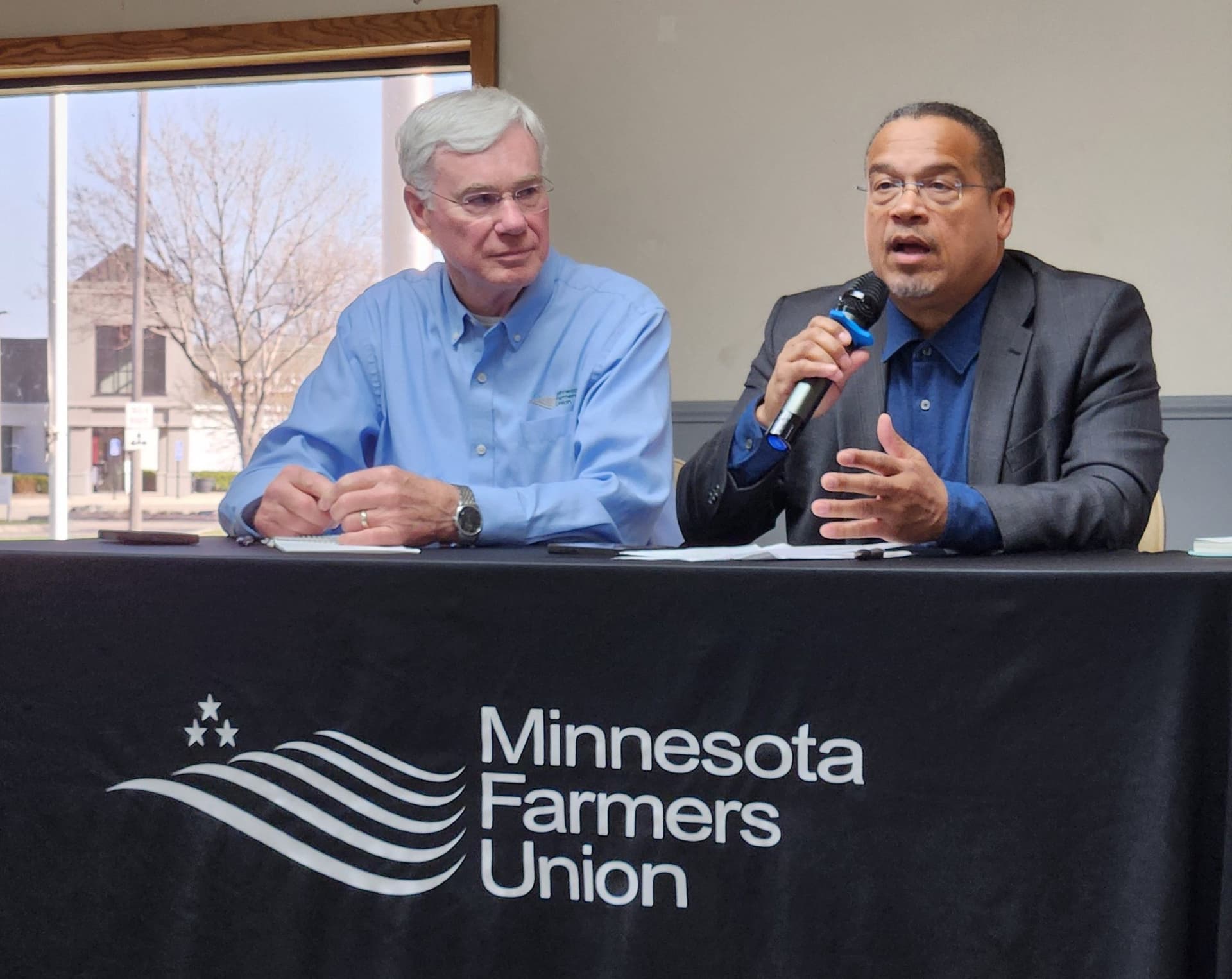
Earlier this year, at a meeting in Willmar hosted by the Minnesota Farmers Union, Ellison said food “is one of the focuses of our office because it’s not a rural-urban issue; it’s an everybody issue. It continues to cause problems for people’s budgets, and we should have more choices.
“You may even have less choices than you can see because different labels are owned by the same company,” he said. “For companies that are trying to prevent competition, we want to try to get at that.”
Consolidation has made that more challenging, Ellison said. “We’re trying to work on having more local markets that hopefully will cause some of those companies to lower prices,” he said.
Related content: Many Minnesotans already live miles from the nearest grocery store. What happens if it closes?
Justin Stofferahn, antimonopoly director for the Minnesota Farmers Union, told MinnPost in an email that four multinational meatpackers control 54% of poultry processing, 66% of pork packing and 85% of beef packing nationally. Locally, such consolidation can be even more extreme, he added.
Though Minnesota has many independent grocery stores, 37% are among the 10 largest chains in the country, such as Walmart and Target, according to data compiled by the Institute for Local Self Reliance, Stofferahn said. He said Minnesotans are paying more than 30% more for groceries than they did in 2020 while farmers have seen their share of each dollar spent on food drop to 15.9%.
“While inflation has been a significant driver of rising prices across the economy, the grocery sector has seen price increases that go beyond what inflation alone can explain,” states the Center for Responsible Food Business. The organization cited a 2022 Federal Trade Commission report that found food and beverage retailers hiking prices and boosting profit during the Covid pandemics, with grocery prices rising 21% in the last three years and major chain revenue spiking to 36%.
The report also noted that the pandemic also prompted some larger firms to consider buying manufacturing suppliers, potentially further concentrating certain supply chains.
Chains and ‘dollar stores’
In March 2025, a bipartisan group of Minnesota lawmakers introduced HF 2149, the Consumer Grocery Pricing Fairness Act. “This is a state version of the federal Robinson-Patman Act, which prohibits ‘predatory pricing’,” Rep. Steve Elkins, DFL-St. Paul, said in an email. The 2026 session has adjourned and the bill remains in the House Commerce Finance and Policy committee.

“Many other states already have their own versions, which the federal government stopped enforcing starting during the Reagan years,” Elkins said. “These laws require sellers to offer the same prices to everyone, unless differences in prices reflect cost saving from economies of scale.” A similar bill passed the New York state Senate on May 12.
“The perceived problem that we’re trying to solve is that of a chain store coming into a rural community, cutting prices to put local retailers out of business, and then raising prices as soon as all the local retailers have been put out of business,” Elkins said. “The ‘dollar stores’ are often cited. When they put the local grocery store out of business, the result is often a local ‘food desert’.”
Related content: U of M survey of rural grocery stores
U.S. food price growth has averaged 2.6% per year over the past two years — 2023-2024 and 2024-2025 — according to the Economic Research Service (ERS) of the U.S. Department of Agriculture. Overall food prices were predicted to rise 2.9%, according to the ERS — faster for beef and veal, fish and seafood, fresh vegetables, processed fruits and vegetables and other foods.
“People are talking about it,” said Paul Roisum, a grocery store employee at Cash Wise Foods in Willmar, when asked about rising food prices. “If something gets too expensive, they just don’t buy it.”
Supplements to standard grocery stores include farmers markets and farm-to-table outlets. The Minnesota Farmers Market Association provides an interactive map showing information about local markets. The Minnesota Department of Agriculture lists “authorized farmers’ markets” here.



