


There was a story on television the other day about a woman of 95, two years older than me, who could perform one of those cunning somersaults in the water as she turned swimming laps in the pool. She had won a lot of medals swimming in competitions and no doubt swam faster than me.
I’m quite proud of the kilometre I swim in my local pool every morning, but, to my surprise, I did not feel envious of this woman’s swimming accomplishments—I was simply impressed. I wondered, do I no longer possess any sense of rivalry, of competitiveness?
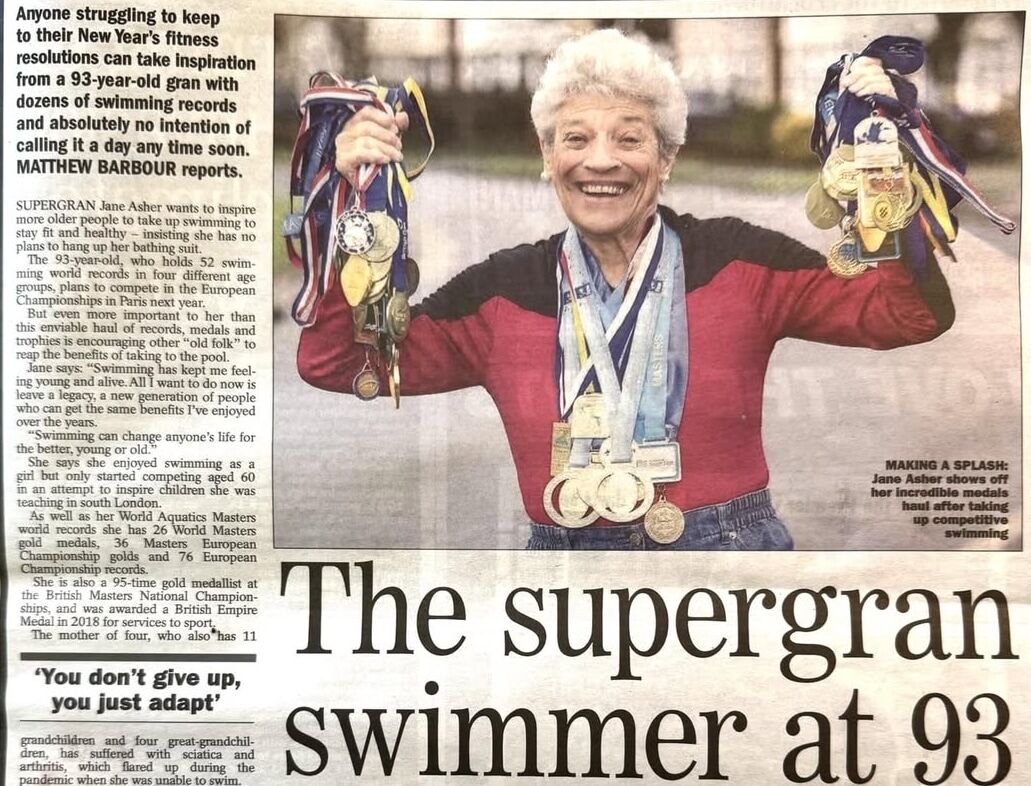
It didn’t seem as though the 95-year-old had lost those tendencies. Had I changed? Most of my contemporaries, with whom I may have been in some sort of competition, are now dead or seriously unwell. Perhaps I am too preoccupied with doing the few things I can still do to worry that other people may be doing them better.
I have a sister three years younger than me, for instance, who is better at nearly everything: walking, hearing, driving, remembering and, above all, cooking. I feel nothing but relief about that. Admitting to one’s incapacities becomes a new kind of pleasure, a respite. Now, it’s a matter of not getting worse at things.
I have to remind myself that being 93 is nothing much these days. Centenarians are ten a penny, as we say here in England. Anita Lasker-Wallfisch, who survived Auschwitz by playing the cello in the orchestra there, is 100, and remembers every detail of those times, which she recently made plain in an interview with Philippe Sands in the Observer. And David Attenborough, whose one hundredth birthday is about to be celebrated nationally on May 8, is still making films about wildlife, this time in London’s parks and back gardens.
“Beyond compare” has become a poetic cliché, which scans more melodically than “incomparable,” or some other appropriate compliment. But perhaps another meaning is that a time comes when we are beyond comparing ourselves with anyone else. Beyond competition, beyond any hope or expectation that we will somehow triumph. Our efforts to stay upright, coherent and in possession of at least some of the geographical information essential to our getting about, occupy us to such a degree that someone else better able to do those things ceases to worry us. We may even admire and attempt to emulate them.
I consider my middle years as organised not so much by efforts to outdo others as driven by the need to keep up. I have too much time now. I had far too little in those days. I feel an oddly distant sympathy for that younger woman who was myself, and all those like her, who fed and watered a husband and children, tried to render her home habitable, held down a full-time job, managed the bones of a social life, and even read a book or two and wrote about them. A little of the solitude and boredom I know now would have been golden to her.
An old friend reminds me that we’re lucky to be alive. His father was shot down at 28 in the Second World War. We are lucky, though another friend is tired of it all and wants to bow out after a fourth great grandchild is born in the summer.
We all regret the British government’s inability to get a law through Parliament that allows us to choose when we die if our lives become too difficult to bear. I’m not sure that I’d make use of such an enabling law if it existed, but then again I’m not yet in need of that awful word “care.” I do sometimes need help with carrying things, and although I’m grateful for lifts, I’d like to go on feeling in control of at least some of it. Accepting one’s dependence on other people isn’t easy. I walk with the stick my husband Karl carefully chose and bought for himself in a magical shop that deals only in sticks and umbrellas. I could, just, walk without the stick, but I’m fond of it and it often means I’m offered seats in buses and trains.
Bette Davis, the film star, first observed that “Old age ain’t no place for sissies,” though its invention has now been claimed by others. Indeed, it isn’t a place for sissies. But what age is? I think of the parents of those Iranian children killed by American bombs in their school on the first day of the war. I think of Ukrainians lying awake at night waiting to be bombed. I think of the decimated families in Gaza, who have nowhere to live, and the Palestinians in the West Bank waiting for their farm and land to be snatched from them. What courage those people must have. They’re no sissies.
When I was younger I had almost no time to read newspapers or watch television. Now, I’m addicted to the news, horrifying as most of it is. I am out of the world in so many ways, living on its edge. Yet I willingly let myself be bombarded by the pictures and stories we’re presented with. The world’s protagonists and the journalists who tell us about them are usually younger than my children, a generation whose parents may barely have been born when I listened (rather reluctantly) to the radio with my father about how the war with Hitler was going and even, occasionally, consented to read The Times or the News Chronicle about a world I barely knew.
Perhaps what old people like me need is a project. We need to pretend, at least, that we have a future, even if it’s a short one. More importantly, we need to hope that the world has a future, that our children and grandchildren will inhabit a world that is being seriously and properly looked after.
Even in old age it may be possible to feel a sort of whispery hope that decency will prevail.
Jane Miller writes the “From the Old Country” column for Barn Raiser. Born in 1932, Miller lives in London. She is the author of the critically acclaimed Crazy Age: Thoughts on Being Old (Virago) and most recently In My Own Time: Thoughts and Afterthoughts (Virago), a collection of her “From the Old Country” columns published in In These Times. Miller, a graduate of Cambridge, first worked in publishing, then as an English teacher in a London comprehensive school and finally as a professor at the London University Institute of Education.
Have thoughts or reactions to this or any other piece that you’d like to share? Send us a note with the Letter to the Editor form.


