
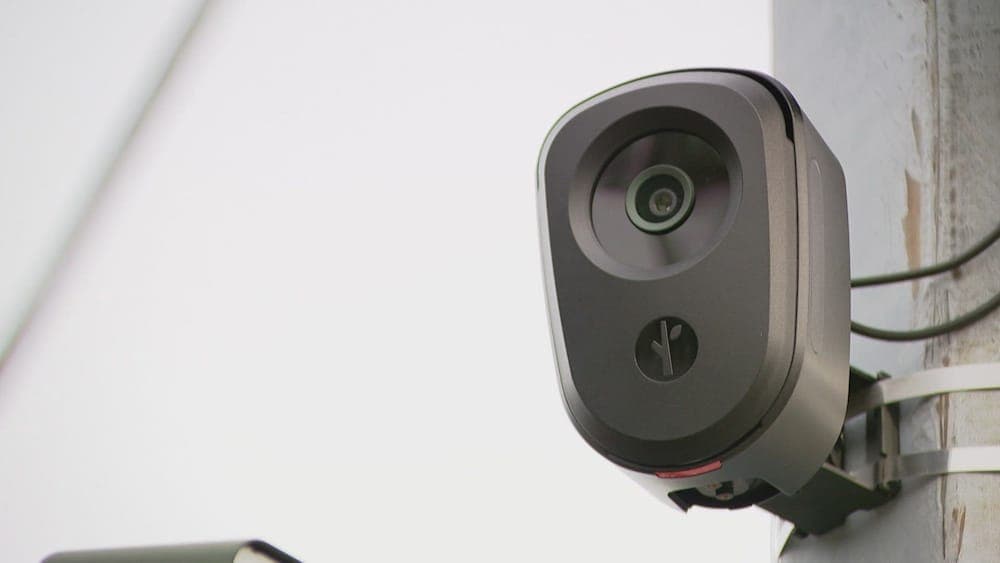


Last fall, off-duty Menasha Police Officer Christian Morales allegedly searched the Appleton Flock Camera files seven times to locate his ex-girlfriend, using a “welfare” check as his rationale. In Milwaukee, a police officer allegedly used Flock’s system to track the location of two people nearly 200 times, entirely for personal reasons.
Such abuses as well as concerns about insufficient guardrails to protect against them, a lack of transparency from Flock Safety representatives and concerns about data sharing and civil rights have convinced the city of Appleton to discontinue use of the Flock Automated License Plate Reader system. ALPR uses cameras and software to automatically capture, analyze, and store vehicle and license plate information.
The decision to end the program was announced by Mayor Jake Woodford in a press release.
Flock Safety was offered to the Appleton Police Department in 2022 on a trial basis, with no vote by the Appleton Common Council required. Alder Denise Fenton and Alder Katie Van Zeeland are drafting a Surveillance Policy to close that loophole.
“We want to close the loophole about these trials,” said Fenton. “If the police department applies for a grant for something, the Council has to approve it. If the fire department applies for a grant for EMS equipment, the council has to approve it. I would like this to be expanded beyond surveillance technology. If the police department gets equipment from the federal government, we have to approve it. We want to approve before purchasing any technology.”
The issues
The Oshkosh Common Council recently voted not to renew its contract with Flock Safety. Oshkosh Police Chief Dean Smith said he found out that Flock cameras do indeed create “heat maps”, patterns of movement for vehicles, despite claims to the contrary made by Flock.
“Examples of illegitimate use of Flock data by personnel in other departments with access to the system reinforce accountability concerns that are not under the City of Appleton’s control as a customer,” said Woodford. “Recent events in a neighboring community have also raised questions about the accuracy of information Flock Safety provides to its customers.”
Appleton has a contract with Flock that runs through 2028 and city leaders are exploring legal options for ending the relationship.
One of the benefits of the system is that access spans jurisdictions, making the fight against crime more efficient. Although Flock Safety says cities control their sharing settings, it has turned out that data has been shared more broadly, including with federal agencies. Reporting has also revealed searches carried out by local officers across the country on behalf of ICE for immigration purposes.
Recently, Appleton has limited its Flock data-sharing to law enforcement agencies in northeast Wisconsin. Although the Appleton Police Department has rigorous policies and procedures concerning Flock cameras, those same standards cannot be guaranteed by other jurisdictions that have access to Appleton’s data.
“Where people’s rights are concerned, we don’t want sloppy,” Fenton said. “We need to be buttoned up. I believe that APD is doing what they’re supposed to be doing. However, they’re sharing data with agencies that I absolutely believe are not doing what they’re supposed to.”
The American Civil Liberties Union considers searchable histories of every vehicle to constitute a “warrantless search.” They also cite the “mosaic theory,” which holds that collecting location data over time can reveal details of a citizen’s life, such as doctor visits, places of worship, or attendance at political rallies. They contend this violates the Fourth Amendment.
State Representative Lee Snodgrass (D-Appleton) has personal experience with the benefits of ALPR, but cautions about a more balanced approach.
“I support the Appleton decision to end their use of Flock cameras,” she said. “While traffic surveillance cameras can provide valuable safety and investigative data, in order for a citizen’s right to privacy to be upheld, there must be strictly defined data-sharing guidelines in place. Personally, the use of Flock cameras has helped in a threat investigation, tracking an individual’s travel into my neighborhood. So there is another side to the issue from which I have personally benefited.”
The balancing challenge
The technology is here to stay. The challenge facing Appleton is to find a system that preserves the crime-fighting benefits of ALPR while protecting the community’s civil liberties.
Flock cameras and those of other companies are widely used across Wisconsin and the country to help solve cases, recover stolen property, and locate missing people. They automatically capture, analyze, and store vehicle and license plate information. They do not use facial recognition or track speed or traffic violations. Many municipalities, schools, businesses, and private individuals use ALPRs.
Will Freeman, a Colorado-based activist, runs the DeFlock.me crowdsourcing website, which has mapped the location of more than 95,000 automated license plate readers across the country, of which approximately 75,000 are Flock cameras. There are over 2,500 ALPRs active across Wisconsin. Flock Safety CEO Garrett Langley has referred to DeFlock as “terroristic.”
All APD policies are linked on the city website under Policies. There is also a transparency portal available (sourced by Flock), which gives information about data sharing, number of searches, and policies.
“Protecting the rights of our citizens, while still letting the police department use what is a valuable crime-fighting tool, that’s our ideal hope,” said Fenton.


