
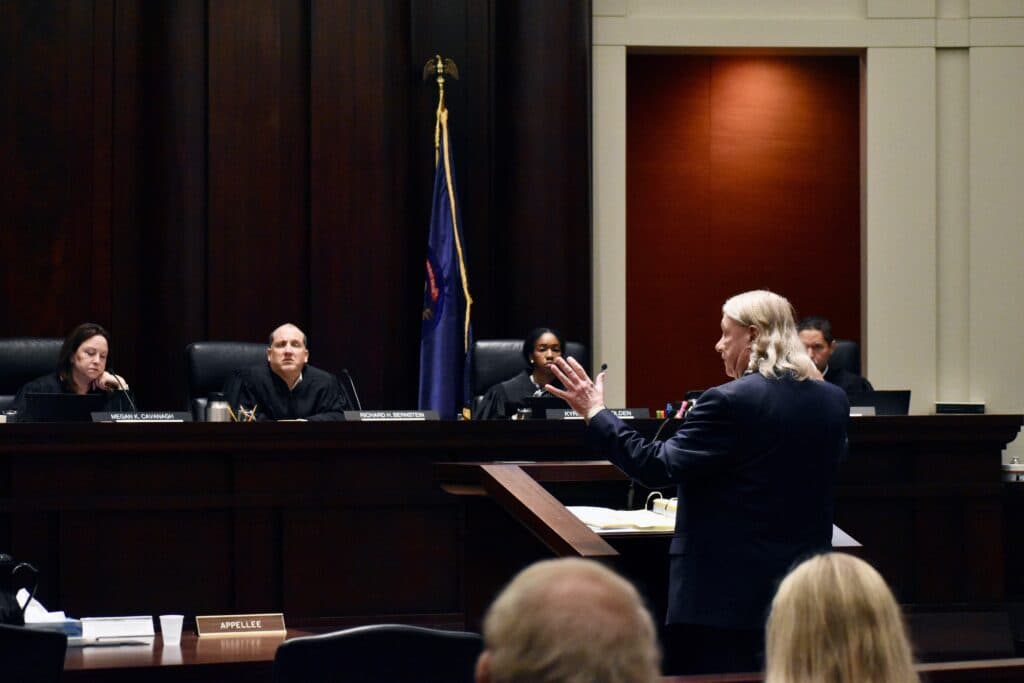


Attorneys for the Michigan Senate and the House of Representatives duked it out before the Michigan Supreme Court Wednesday morning, with the fate of nine bills from the 2023-24 term at stake.
Justices of the high court heard oral arguments in Michigan Senate v. Michigan House, which saw the upper chamber of the Michigan Legislature and its Majority Leader Winnie Brinks (D-Grand Rapids) sue the lower chamber and its Speaker Matt Hall (R-Richland Township).
The case involves nine bills that originated in the House and were passed by both chambers before the 102nd Legislature ended in late 2024. The bills, however, were not presented to Gov. Gretchen Whitmer before the end of the session or immediately afterward. At that time, the House was controlled by Democrats and led by former House Speaker Joe Tate (D-Detroit).
When the Republican caucus took over the chamber’s majority in the following 103rd Legislature, and Hall became speaker, the new majority refused to present them. Some of the bills were Democratic priorities and involved issues important to the labor movement. Hall has maintained that he did not have a duty to present bills that originated in a previous legislative session. Brinks has scoffed at that argument, noting her and the Senate’s belief that bills must be presented after they are passed by both chambers.
The Court of Claims dismissed the complaint and a request for mandamus relief — or rather, a request for the court to compel action from the House — against the wishes of the Senate. The lower court, however quixotically, offered no guidance on whether the bills should have been presented, citing the separation of powers in the Michigan Constitution. The Court of Appeals then ruled that the lower court should have granted mandamus relief for the Senate.
Hall appealed, and the issue came before the high court on Wednesday.
Separation of powers, bicameral legislative process at stake
Kyle Asher, an attorney with the Dykema law firm and counsel for the House Republican Caucus, argued that although the Michigan Constitution may require the Legislature to present the bills, it says nothing about what happens if it does not do so. Asher also argued that the Court of Claims invoked key separation of powers concerns that could shake the legislative process at its core.
“While I won’t phrase it exactly that way, I do want to lead with my chest on that point and be clear, the judicial branch lacks authority to force the Legislature to carry out a legislative process, whether or not that process is set out in the Constitution,” Asher said. “At the same time, I want to be equally clear that we’re not coming here today to thumb nose at the courts, and that hasn’t been our position on this entire case. We’re here with the genuine belief that we’re right on the merits, that the 103rd House lacks a clear legal duty to present the 102nd Legislature’s leftover bills.”

Had the 103rd House done so, Asher said that act, in and of itself, would have violated the Constitution.
“The Court of Appeals’ ruling that every bill that’s passed must be presented effectively bars the Legislature’s long-standing practice of vacating enrolled bills,” Asher said. “Its ruling that internal legislative disputes like this are justiciable, that this court has the final say on legislative processes, will open the courthouse doors to future disputes and relegate the Legislature from a co-equal to an inferior branch of the judiciary.”
Mark Brewer, an attorney with the Goodman Acker law firm and counsel for the Senate Democratic Caucus, argued that a panel of Court of Appeals judges from across the political and philosophical spectrum unanimously concluded that the House did have a constitutional duty to present the bills in question.
“Yet now, the House claims that all four of those judges are somehow clearly erroneous in their legal analysis and their conclusions, and they asked this court to exercise its discretion to reverse the Court of Appeals,” Brewer said. “We asked the court to exercise its discretion to deny the application for leave and allow these bills to be presented to the governor so that the hundreds of thousands of Michigan public employees, creditors, residents of the city of Detroit, who’ve been deprived of the benefits of these bills for nearly a year and a half, can finally enjoy those benefits.”
Brewer went on to ask the high court to take a step back and see the big picture: Hall’s actions, he argued, were anti-majoritarian tactics, and if allowed to succeed, would “unilaterally and drastically change Michigan’s bicameral Legislature.”
“In this state, for example, the Legislature will no longer be a body in which the majority rules in both houses when it comes to legislation,” Brewer said. “A single legislative leader can simply refuse to send to the governor any passed bill, even bills passed by overwhelming majorities. This will permit a legislative leader to have their own pocket veto, which, under our Constitution, is reserved exclusively to the governor.”
Brewer added that Hall’s chamber, in the entire history of the Legislature, was the first to pull such a tactic. It also follows the former Republican House and Senate’s tactics in the “adopt and amend” cases — involving initiative petitions that were adopted and then gutted in the same legislative session and prevented those laws from taking effect — which Brewer said the high court also rejected. He asked justices to do the same.
Justices appear to push back on House arguments
Justice Elizabeth Welch noted that the 102nd Legislature did present 88 bills from the session as it ended, so why not the nine?
Asher said those bills were presented before the 103rd session convened, whereas the bills at the heart of the case would have been presented afterward, if the Senate arguments prevail.
Welch again pushed firmly on Asher’s premise, asking him if he would acknowledge that, up until the argument being made on Wednesday, that the Constitution appears to require that all bills passed must be presented.
“We have several examples where it happened after a Legislature had convened or adjourned,” Welch said.

Asher responded by noting that the Senate cited five judicially unchallenged instances, and that the House does not dispute that as fact. Asher did, however, invoke an Idaho Supreme Court decision that dealt with similar circumstances. The Gem State’s high court said it had to determine the constitutionality of the concept known as presentment, showing that the constitutional guidance was not so cut and dried.
“There is no indication anywhere I’ve seen where it’s ever been contemplated that a prior legislature’s bills will be passed by a new legislature,” Asher said.
Welch again asked about Brewer’s argument regarding a pocket veto, essentially allowing a single legislator the power to knock off a bill before it becomes law simply because they do not like its content.
Asher said yes, that could be done, especially if there were ample mechanisms to allow that bill to be considered or a new leader to be compelled to get it processed or taken up as new legislation again.
“But that’s not what we have here,” Asher said. “The whole theory that this is anti-majoritarian, I do want to push back on that. A majority of the 103rd Legislature has not voted in favor of these bills, has not acted on these bills, has not done anything with these bills. So, if anything, forcing this new Legislature to present these bills is what’s anti-majoritarian here.”
Justice Kimberly Thomas also chimed in about the nature of the work. She posited that this bill presentment was not necessarily “business” of the Legislature, as the “business” of the process to pass them had already been completed, leaning into Brewer’s argument that presentment is not a political act, but rather a ministerial one.
Asher said it was business, because in his view, presentment was the final act of a legislature in its work to move bills across the finish line.
Activists, Dems call on high court to move bills to Whitmer’s desk
Prior to the hearing, members of Michigan’s labor movement gathered outside of the Michigan Hall of Justice in downtown Lansing, showing unity as they asked justices of the high court to get the bills to Whitmer.
“The sanctity of the Michigan Constitution and the separation of powers in our state hinge on the outcome of this case,” said Ron Bieber, president of the Michigan AFL-CIO. “We are not only fighting for the workers impacted by the stalled bills, but also for the rule of law in Michigan. There are no kings in Michigan or America. We urge the Michigan Supreme Court to follow Michigan’s constitution.”
State Sen. Sue Shink (D-Northfield Township) said that part of the blocked legislation would provide state corrections officers with the retirement “they deserve and address staffing shortages that contribute to unsafe conditions in our prison facilities.”

“By blocking these bills, House Republicans are not only failing their constituents and workers statewide, they are turning their backs on those who sacrifice every day to make our communities safer,” Shink said.
State Rep. Mai Xiong (D-Warren) also spoke at the rally. She sponsored House Bill 6058 of 2024, which would have helped lower health insurance costs for public employees.
Xiong called the legal battle wasteful and placed blame for the crisis at the House Republicans’ chamber door.
“Michigan workers show up every day to work hard on behalf of our state. It’s time Matt Hall and House Republicans do the same,” Xiong said. “Their actions speak louder than words: they don’t believe that Michigan workers deserve to earn a decent living. … This lawsuit has now cost Michigan taxpayers $300,000 in legal fees to defend Matt Hall’s unconstitutional actions. That is truly shameful leadership.”
Hall, in a recent press conference, pushed back on his Democratic colleagues’ assertions that he had a duty to present the bills.
“Our hope is that the Michigan Supreme Court will see that this has been a year and a half now, and to go back in time and force Joe Tate to present these bills to the governor … It’s unfortunate,” Hall said. “But we’re not presenting them because the body voted. You saw that the entire body voted to instruct us not to present those votes. At what point in time does presenting bills from the past end?”


