
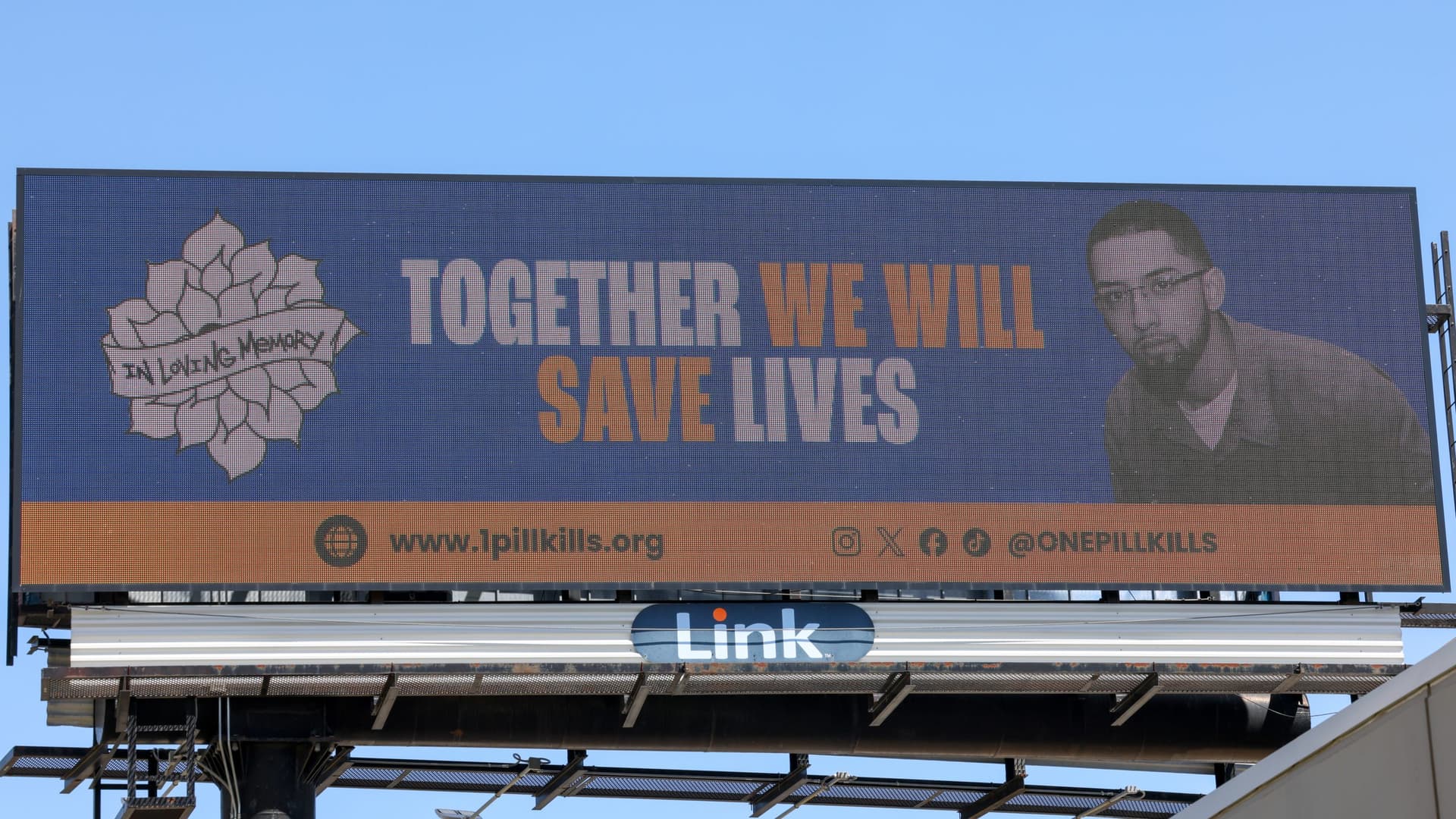


Isaac Solis knows all too well how taking a pill bought off the street can lead to tragedy.
His son Isaac Solis Jr., known as “Bubba,” died in 2019 after taking what he thought was the prescription drug Percocet.
Instead, it was a counterfeit pill laced with fentanyl, a synthetic opioid that can kill in trace amounts

Since then, he’s been on a mission to help prevent others from losing loved ones through his “One Pill Kills” awareness campaign.
His message is being amplified in time for Fentanyl Awareness Day, observed nationally on April 29, through three billboards that feature his son. The billboards direct residents to the 1pillkills.org website and social media pages, and include the message: Together We Will Save Lives.
“It’s about spreading awareness obviously that even one pill can kill you, one line can kill you,” Solis said. “If one family sees it and reaches out to their loved one and one life is saved, that’s our goal.”
Two of the billboards can be seen off of Interstate 94 near West Becher and South Fourth streets, and the other is a north/south display on South 27th Street and West Morgan Avenue. The billboard near West Becher will be up for eight weeks and the one on West Morgan for four.
Solis’s campaign has utilized several billboards over the years to increase community awareness on fentanyl.
The message on the first billboard, he said, was very aggressive.
“Our grief was a bit more raw at that time,” Solis said.
Another billboard featured photos of individuals who lost their lives to fentanyl.
“Eight families put their angels up there,” he said.
Drop in overdose deaths
Fentanyl has fueled the opioid epidemic nationally and a rise in overdose deaths.
The drug had devastating impacts on Milwaukee County, which experienced multiple years of record high drug overdose deaths in the 2010s and 2020s. Those totals peaked at 674 in 2022 and 667 in 2023, according to data from the Milwaukee County Overdose Dashboard. Most of the deaths were caused by fentanyl alone or in combination with other substances.
Since then, the number of fatal overdoses has fallen. Last year 387 died, with 236 of those cases involving fentanyl.
County Executive David Crowley credits increased funding for opioid prevention and collaboration for the decrease.
“Thanks to the investment of opioid settlement dollars, increased access to free harm reduction supplies, and efforts to eliminate the stigma surrounding substance use disorder, fewer people are dying of overdose, which means more opportunities for treatment, recovery and a path forward,” Crowley said in a statement.
Fentanyl still a major problem

While Solis said the drop in fatal overdoses is great, it’s also concerning.
“The troublesome part is we don’t know what amount of people are addicted to fentanyl and using it daily,” he said. “There’s a lot of work to do.The closer we get to zero deaths, the better.”
He said fentanyl products continue to evolve and get more potent, and that it can be in powder or liquid form, and even in vapes.
“It can be hidden in something but you can have no idea what,” Solis said. “There’s always a threat of it being in any type of drug.”
Working together
Like Crowley, Solis credits collaboration for the progress made in addressing the opioid epidemic. He partners regularly with Team HAVOC, a grassroots South Side group.
Rafael Mercado, founder of Team HAVOC, said Solis’ story and “One Pill Kills” message is having an impact.
“He does a lot to bring awareness by way of billboards, social media and pop-ups,” Mercado said. “He has lost a son to this, so he knows firsthand the pain and suffering a family goes through and the ripple effect of addiction on a family.”
Solis also partners with Samad’s House, a Milwaukee-based sober living home and behavioral health clinic dedicated to supporting women. He said he’s working with Tahira Malik, founder and chief operating officer of Samad’s House, to help organize a Walk for Lives event on July 11. Walk for Lives is a nationwide movement to raise awareness about those who died from fentanyl.
Solis said he wishes he could do even more but knows that ending the fentanyl crisis won’t happen quickly.
“The problem didn’t happen overnight,” he said. “It’s not gonna be any one group, not any one solution. Together we will save lives.”

Jonathan Aguilar is a visual journalist at Milwaukee Neighborhood News Service who is supported through a partnership between CatchLight Local and Report for America.


