
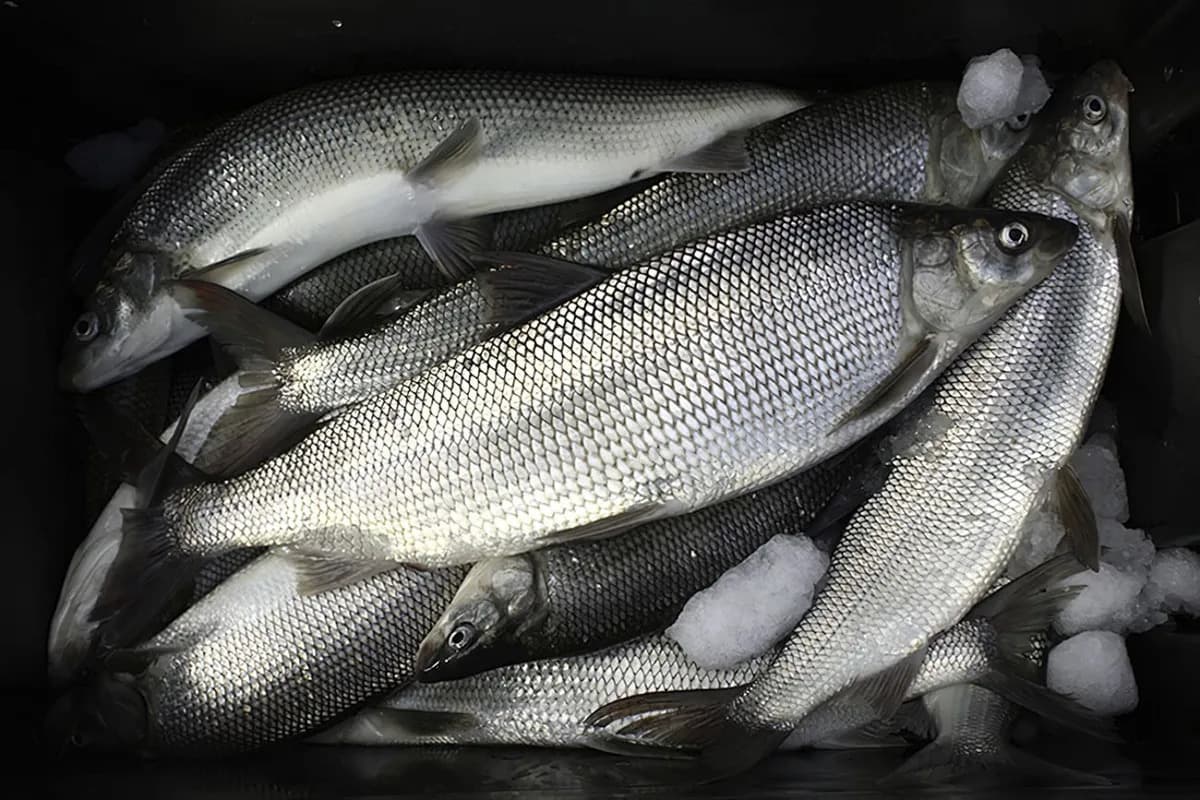


- As invasive mussels kill off whitefish in the lower Great lakes, lawmakers are considering whether to fund a last-ditch fish rescue effort
- The concept is to pull fish from the lakes and breed them in captivity in hopes of keeping bloodlines alive long enough to quell the mussel invasion
- One lawmaker credits Bridge Michigan with raising attention to the issue
As lake whitefish teeter on the brink of collapse in the lower Great Lakes, Michigan lawmakers are considering investing in a last-ditch effort to save the iconic species before it’s too late.
An appropriations bill under consideration in the Democrat-controlled state Senate would allocate money to the Michigan Department of Natural Resources for a rearing and stocking program aimed at “supporting lake whitefish stock recovery.”
The line item includes a $100 allocation, which state Sen. John Cherry, D-Flint, described as a placeholder number pending further deliberations about how much money — if any — to devote to the effort.
“It could potentially be now or never for some of those genetic stocks,” Cherry said, noting that some whitefish bloodlines in lakes Michigan and Huron could vanish within years.
Budget deliberations are in their early phases and proposals from Gov. Gretchen Whitmer and the Republican-led House of Representatives do not include funding for whitefish.
State Reps. Ken Borton and Ann Bollin, who lead committees overseeing the DNR budget in the House, did not return calls from Bridge Michigan seeking comment.
The House approved a $76 billion budget last week that would cut DNR funding by $36.3 million. Whitmer’s budget proposal would increase DNR funding by $63.5 million.
The Senate could pass its version as soon as this week, setting up further negotiations as the two chambers face a September deadline to pass a unified budget.
The funding effort follows extensive reporting on the whitefish collapse in Bridge Michigan over the past year.
“Quite frankly, your guys’s reporting was helpful in highlighting the issue,” Cherry told Bridge. “Otherwise, I think a lot of folks wouldn’t be aware of it.”
The fish are a revered symbol of the Great Lakes and the No. 1 commercial catch for what remains of the region’s once-robust commercial fishery.
Ecosystem changes wrought by invasive quagga and zebra mussels have transformed the Great Lakes, devastating whitefish populations and prompting fears that the species could virtually disappear from lakes Michigan and Huron.
The mussel invasion is considered among the biggest threats to the Great Lakes in history.
Michigan’s collapsing whitefish
Bridge Michigan senior environment reporter Kelly House spent months examining the near-collapse of whitefish in the lower Great Lakes. Here are the stories we’ve tackled so far:
- Michigan’s iconic whitefish are disappearing
- Collapse erodes a bit of state’s identity
- 407 Michigan species on brink amid historic die-off
- Fish’s fate hinges on bid to kill mussels
- Research starved of funds as whitefish vanish
- Lake Superior survives the crisis — for now
- Time for a Noah’s Ark strategy?
- What are your whitefish memories, Michigan?
- Can whitefish learn to love rivers to survive?
- Experts: ‘We can’t regulate ourselves’ out of whitefish crisis
- Your whitefish questions answered
- Whitefish crash has Michigan fishers on the brink: ‘It makes you want to cry’
- Michigan lawmakers seek $500M to save whitefish
- Green Bay is a whitefish a refuge. But for how long?
Yet Bridge found that, while the US government has spent mightily to combat other threats, the fight against mussels has received a comparative pittance: less than $1 million annually, or about a penny for every dollar devoted to guarding the Great Lakes against invasive carp.
In the wake of that reporting, US Reps. Debbie Dingell and Tim Walberg cosponsored legislation that aims to devote $500 million to mussel control research over the next decade.
State funding for whitefish recovery is likewise limited amid budget constraints and a DNR funding structure that prioritizes game species like salmon and trout ahead of primarily commercial species like whitefish.
At current funding levels, mussel control research may take decades to achieve a breakthrough. The lower lakes’ whitefish “don’t have the time to wait,” said DNR fisheries chief Randy Claramunt.
So tribal, state, federal and university officials have been discussing ways to raise whitefish in captivity until the Great Lakes are hospitable enough for them to thrive again.
The effort likely would involve both a hatchery stocking program and an effort to establish captive whitefish populations for future breeding efforts.
“Who has facility space? Who can do something if funding is available? What could we do without having to build a new facility?” Claramunt said. “That’s what we’re all looking at right now as a stopgap measure to buy us time before we lose some of these stocks.”
There are 18 genetically distinct whitefish populations in lakes Michigan and Huron, 14 of which are considered imperiled.
“The other four that were considered stable are now at risk of declining,” Claramunt said.
That includes stocks in Green Bay, which was once considered a rare stronghold for Great Lakes whitefish.
So far, most recovery efforts have been small-scale, led by tribal natural resources agencies with limited budgets and staff. But as stocks have dwindled, whitefish advocates have increasingly pushed for bigger, bolder rescue efforts.
For each population rescued, Claramunt said, it would cost between $200,000 and $300,000 annually to collect spawning fish from the lakes, raise their offspring for stocking efforts, and hold some adults in captivity for future breeding.
The DNR may have space in its hatchery facilities to rescue up to three populations, Claramunt said. It’s possible other tribal, government or university agencies could lend more space.
“We’re concerned that a genetic rescue is necessary, and if we don’t do it as soon as possible … that these stocks will be lost,” Claramunt said.
Michigan has a long history of rescuing species under threat, Cherry said, from wild turkeys to moose. It has also had failures, such allowing the passenger pigeon to be hunted to extinction.
“We have an opportunity right now to figure out which direction we want to go,” Cherry said. “The direction of the passenger pigeon, or do we want to go the direction of the turkey?”


