
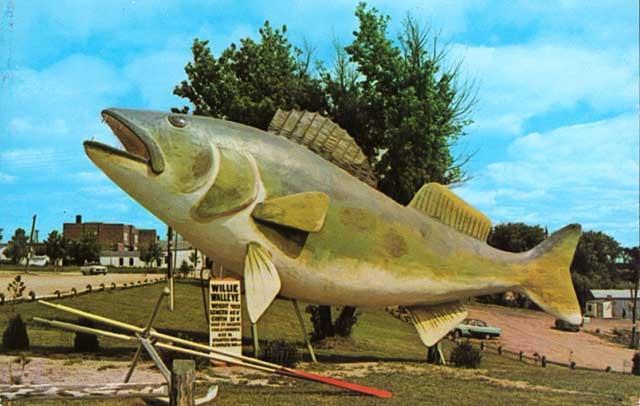


On the opening day of Minnesota’s fishing season in 1965, the Minnesota Legislature selected walleye as the state’s official fish. While walleyes are neither the state’s biggest fish nor its most abundant, they are consistently ranked as Minnesotans’ favorite.
Walleyes are the largest members of the Perch (Percidae) family. They are typically brownish yellow or olive green in color, with a white belly and two transparent dorsal fins. The tail bears a distinctive white smudge on its lower edge. A walleye’s most noticeable feature, however, is its eyes. Like cats, skunks, raccoons and deer, walleyes have a reflective layer of tissue behind their retinas, known as the tapetum lucidum (bright tapestry) that helps them see well in the dark.
The fish are known by many names, including walleyed pike, yellow pike, yellow pikeperch and yellow pickerel. Their Dakota names include hoištázi (yellow-eyed fish), hopháthankáda (big-headed fish) and howakaŋ (sacred fish). Their Ojibwe name is ogaa and their scientific name is Sander vitreus. “Vitreus,” Latin for “glassy,” is another reference to the fish’s eyes. “Sander,” the German word for walleye, represents the theory that walleyes originated in Europe and reached North America by crossing the Bering Isthmus during the Pliocene Epoch. The ancestors of today’s walleyes are believed to have dispersed throughout much of North America after passing through the Rocky Mountains to the Great Lakes and Mississippi River Basins.
In the 1600s, when Ojibwe and other Anishinaabe people arrived in the Upper Midwest, they found an abundance of walleyes in the area’s lakes and rivers––enough to sustain themselves year round. They regarded walleyes as a sacred gift from Gitchi Manitou, the Creator and believed that the fish, with their glow-in-the-dark eyes, symbolized knowledge, illumination and guidance.
White settlers arriving from Europe in the 1800s relied on fishing as a primary food source during their first years in Minnesota. During World War I and World War II as well as the Great Depression, fishing provided sustenance for low-income Minnesotans. After opening in 1917, the Red Lake Nation Fishery (the first commercial walleye fishery of its kind in the US) supplied food to soldiers as well as the home front and by 1929 the business was fully operated by the Red Lake Band of Chippewa Indians on the Red Lake Indian Reservation.
In the post-war economic recovery of the 1950s and ’60s, anglers became less interested in fishing for subsistence and more interested in sport fishing, competing to see who could land the biggest fish, the most fish, the wildest fish. Walleyes were an ideal sport-fishing target due to their large size and their abundance in Minnesota. On average, a walleye caught in Minnesota is about three to six years old, weighing in at a little over one pound and measuring between twelve and twenty inches. Left to mature, male walleyes can live fifteen to twenty years, approaching a trophy-sized weight of nearly ten pounds and thirty inches in length. Female walleyes are larger and live longer, potentially reaching forty inches at twenty-five years.
Fishing for walleyes is often described as a challenging puzzle, requiring different combinations of bait and tackle, depending on the weather, depth of water, time of year and time of day. The fish tend to feed at dawn and dusk, when they can see their prey in the low light of their tapetum lucidum, but their prey can’t see them. When hooked, they dive fast and deep and they’re fierce fighters with sharp teeth.
Most walleyes served in Minnesota pubs, restaurants and fairground booths are caught and processed in Canada. With the exception of Red Lake Nation Fishery, commercial fishing for walleyes is largely restricted in Minnesota in order to protect walleye populations, honor treaties and support recreational fishing.
In 1996, biologists studying walleyes in Red Lake found that the population had collapsed after years of overfishing. Knowing that the lake needed time to recover, a Red Lake’s fishermen’s cooperative voted to suspend all commercial gillnet fishing for the season. A year later the Red Lake Tribal Council halted hook-and-line fishing and in 1999 it banned all fishing on Red Lake. With fishing shut down, a restocking effort began and some thirty million walleye fry were released into the lake. Restocking was repeated in 2001 and 2003. By 2006, the lake reopened ahead of schedule with an estimated population of 7.5 million walleyes.
Bibliography
Chef’s Resources. Walleye Culinary Profile.
https://www.chefs-resources.com/fish/walleye-culinary-profile
Connor, Jack. “Even 6-year-old Enjoys Walleye Success.” Minneapolis Star, May 19, 1965.
——— . “Fishing Even Better Second Day.” Minneapolis Star, May 17, 1965.
Enger, John. “Two Things That Changed Walleye Fishing in Minnesota.” MPR News, September 8, 2015.
https://www.mprnews.org/story/2015/09/08/walleye-history
“Fitting Honor for the Walleye.” Minneapolis Star, May 29, 1965.
Hebel, Ryan. “Understanding the Walleye Growth Rate: A Comprehensive Analysis.” Cobham River, Manitoba, Canada, December 8, 2023.
https://fishingmanitoba.com/understanding-the-walleye-growth-rate/#toc_Walleye_Growth_Rates_Understanding_the_Basics
“It’s Official—Walleye Reigns as ‘State Fish.” Minneapolis Star, May 22, 1965.
Martin, Nick. “Red Lake, Green Future.” Patagonia, July 2020.
https://www.patagonia.com/stories/planet/activism/red-lake-green-future/story-89564.html
Minnesota Department of Natural Resources. The History of Fishing in Minnesota.
https://files.dnr.state.mn.us/education_safety/education/minnaqua/leadersguide/front_matter/history_of_fishing_minnesota.pdf
Minnesota Department of Natural Resources. Fishing Tournaments.
https://www.dnr.state.mn.us/fishing/tournaments/index.html
Minnesota Department of Natural Resources. “Minnesota Fishing Regulations.” Minnesota Department of Natural Resources, 2026.
https://files.dnr.state.mn.us/rlp/regulations/fishing/fishing_regs.pdf
Murray, Alison M., and Julien D. Divay. “First Evidence of Percids (Teleostei: Perciformes) in the Miocene of North America.” Canadian Journal of Earth Sciences 48, no. 11 (November 2011): 1419-1424.
Red Lake Department of Natural Resources. Red Lake Fisheries Program: Giigoonyikewin.
https://www.redlakednr.org/fisheries
Shave, Ed. “Mille Lacs in ‘Champion Form;’ Walleyes Strike Hard.” Minneapolis Star, May 17, 1948.
Sisiṭuŋwaŋ Waḣpeṭuŋwaŋ Daḳota Iapi Wiċoiye Wówapi: Sisseton Wahpeton Dakota Lexicon. Hoistazi.
https://www.swdakotadictionary.com/dictionary/detail/carp?1711
Swiers, Autumn. “Minnesota’s State Fish Is Delicious, But At Risk.” Tasting Table, October 30, 2024.
“The Story of How the Biggest Walleye Ever Caught in Minnesota Is Coming Home.” Boreal.org, May 25, 2022.
https://www.boreal.org/2022/05/25/400862/the-story-of-how-the-biggest-walleye-ever-caught-in-minnesota-is-coming-home
“State Fish of Minnesota: The Walleye.” Gopher Historian, Fall 1965, 11–13.
www.lrl.mn.gov/webcontent/leg/symbols/walleyearticle.pdf
Van Oosten, John, and Hilary J. Deason. “History of Red Lakes Fishery, 1917–38, with Observations on Population Status.” Special Scientific Report, United States Department of the Interior, Fish and Wildlife Service, 1957.
https://spo.nmfs.noaa.gov/sites/default/files/legacy-pdfs/SSRF229.pdf
Wisconsin Shipwrecks. French Canadian Fishing.
https://wisconsinshipwrecks.org/wisconsinsmaritimeresources/FrenchCanadianFishingAndIndigenousFishing.html#:~:text=In%20addition%20to%20trading%20goods,to%20form%20a%20V%20shape
Wood, Drew. “How the Governor’s Fishing Opener Came to Be.” Mpls.–St. Paul magazine, May 21, 2020.
Related Resources
Primary
Dolan, Jamie, Ian Record, Miriam Jorgenson and Eileen Briggs. All Stars Profile: Red Lake Walleye Recovery Program | Red Lake Band of Chippewa Indians. Harvard Kennedy School, Project on Indigenous Governance and Development, Honoring Nations, 2013.
https://indigenousgov.hks.harvard.edu/sites/g/files/omnuum6806/files/hpaied/files/red_lake_profile.pdf
Kraker, Dan. “Why Walleye Is Minnesota’s ‘Holy Grail of Fish.’” MPR News, September 2015.
https://www.mprnews.org/story/2015/09/08/walleye-icon
Minnesota Department of Natural Resources. Ice Fishing for Walleye.
https://www.dnr.state.mn.us/gofishing/ice-fishing-walleye.html
Quinn, Steve. “The World of Walleyes.” In-Fisherman, August 23, 2016.
https://www.in-fisherman.com/editorial/the-world-of-walleyes/153609#:~:text=Ichthyologists%20believe%20the%20ancestors%20of,than%20a%20million%20years%20ago
Secondary
Apple, R. W., Jr. “Don’t Look for Walleye In a Place Called Wobegon.” The New York Times, May, 2002.
Kvalevog, Toby. “Revolutionize Your Walleye Fishing: Expert Tips and Cutting-edge Technology From Leisure Outdoor Adventures.” Leisure Outdoor Adventures, January 30, 2025.
https://leisureoutdooradventures.com/posts/revolutionize-your-walleye-fishing-expert-tips-and-cutting-edge-technology-from-leisure-outdoor-adventures/#:~:text=Advanced%20Sonar%20Systems,Identify%20schools%20of%20walleye
Risku, Michael. Following the Fish: A History of Commercial Fishing Along Minnesota’s North Shore. St. Paul: Minnesota Historical Society Press, 2026.
“Top Five Big Lakes to Fish in Minnesota: A Guide for Anglers.” OnXFish, December 17, 2024.
https://www.onxmaps.com/fish/blog/best-lakes-to-fish-minnesota
Web
Braunschweiger, Amy. “The Real Walleye Capital of the World.” Rust Belt magazine, February 8, 2019.
https://beltmag.com/real-walleye-capital-midwest-world-braunschweiger
Brosdahl, Brian. “Technology Advancements and No-Fail Fall Walleyes.” Midwest Outdoors, September/October 2025.
https://midwestoutdoors.com/fishing/technology-advancements-and-no-fail-fall-walleyes/#:~:text=With%20advancements%20in%20fishing%20technology,adjustments%20to%20make%20them%20bite
Explore Minnesota. Minnesota’s Best Roadside Attractions.
https://www.exploreminnesota.com/road-trips/minnesota-roadside-attractions
Explore Minnesota. Minnesota Tourism Matters.
https://mn.gov/tourism-industry/assets/mn-suitcase_tcm1135-720180.pdf
Explore Minnesota. Where to Go Walleye Fishing in Minnesota.
https://www.exploreminnesota.com/outdoors/fishing/where-to-go-walleye-fishing-minnesota#:~:text=Minnesota%20has%20many%20lakes%20with%20walleye%2C%20including,Lake%20of%20the%20Woods%20*%20Rainy%20Lake
Kaiserzander. Profile–Zander.
https://www.kaiserzander.de/en/zander/#:~:text=The%20zander%20describes%20a%20species,to%20large%20parts%20of%20Europe.&text=The%20zander%20inhabits%20deep%20lakes,mostly%20stays%20near%20the%20bottom
Lake of the Woods Minnesota. Willie Walleye—The Biggest Catch.
https://lakeofthewoodsmn.com/willie-walleye-the-biggest-catch
RoadsideAmerica.com. Walleyed War of the Walleye Capitals.
https://www.roadsideamerica.com/story/30409#:~:text=Baudette%2C%20Minnesota:%20The%20largest%20tribute,Baudette%20Angles%20for%20Trademark%20Rights
US Department of the Interior, Indian Affairs. “Fish, Wildlife and Recreation: Authority and Responsibilities.” In Indian Affairs Manual. U.S. Department of the Interior, Indian Affairs, February 13, 2017.
https://www.bia.gov/sites/default/files/dup/assets/public/raca/manual/pdf/idc2-060922.pdf