

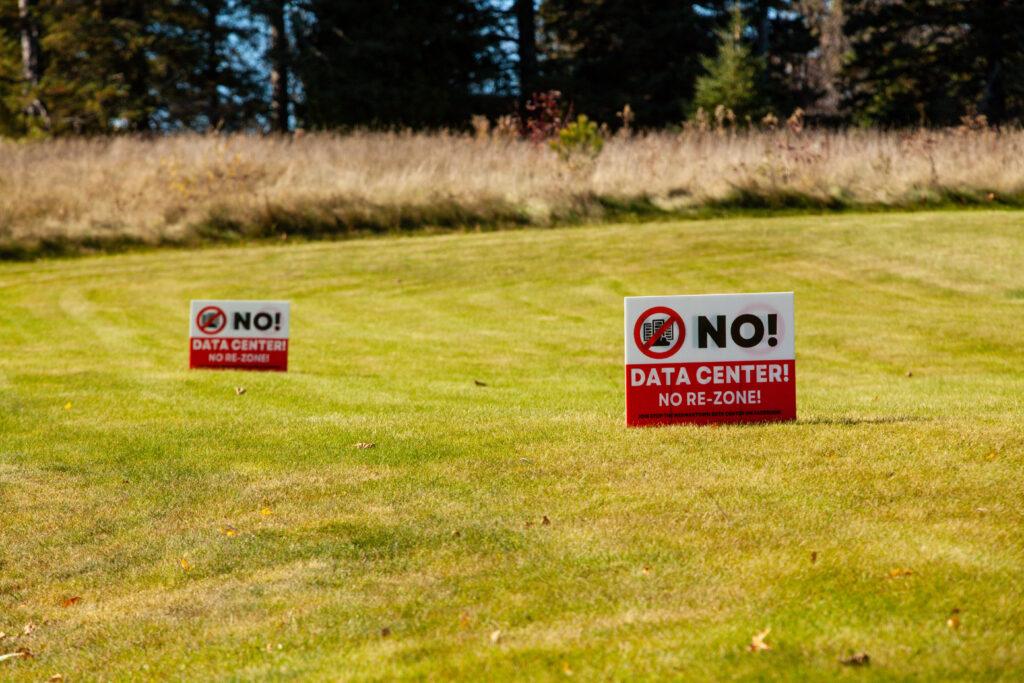


The Nobles County Board rejected a zoning change this month sought by a Bloomington-based developer hoping to build a big computing facility near Worthington in southwest Minnesota. It’s the latest sign that communities’ increasingly vocal opposition to data centers — in big cities and small towns — is more than just noise.
At the national level, the data center debate pits proponents who say the U.S. must do all it can to win an AI arms race with China against skeptics concerned about rising utility bills, environmental damage and widespread white-collar automation.
Locally, the debate looks a lot like clashes over other big real estate developments, with pro-business groups touting generational economic development opportunities on one side and residents concerned about noise, traffic, water use, air pollution and secretive dealmaking on the other. Opponents say the larger scale of those potential impacts warrants special scrutiny, however.
“There’s a total lack of meaningful process when it comes to these ‘hyperscale’ data centers…it’s a real glaring mismatch,” Sen. Jen McEwen, DFL-Duluth, said in an interview, using the industry term for centralized data centers that can cover hundreds of acres and consume more power than a medium-sized city.
The computing hubs Google is planning near Rochester and in Hermantown, near McEwen’s district, would fit that description if they’re fully built out. Such large, resource-intensive facilities have local impacts on par with heavy industry, McEwen said. She’s the lead sponsor of a Senate bill that would freeze data center permitting for about two years to give time for the state to study the industry’s impacts and decide how to regulate it.
“For opening a mine, we have a whole series of checks and balances for what we do in order for those permits to be issued and then to open and operate,” she said.
Though local officials broadly support the Hermantown and Pine Island projects, several Twin Cities suburbs have tightened zoning rules for data centers or imposed temporary construction bans to allow time to study their impacts. At the Capitol, McEwen’s bill and a bipartisan measure that would prohibit nondisclosure agreements between tech companies and local governments or their representatives are among several that would constrain data center development. The bills take a harder line than compromise legislation Gov. Tim Walz signed last year.
It’s unclear which Minnesota proposals, if any, will pass the closely divided legislature in the closing weeks of a largely unproductive session. The debate risks dividing groups that have historically found a home in the DFL tent, with unionized building trades and the clean energy industry in favor of continued data center development facing off against environmental groups and big-business skeptics.
But widespread opposition in Republican-leaning areas like southwest Minnesota and the southern Twin Cities exurbs — local examples of organized pushback against more than 270 projects nationwide — suggest a bipartisan backlash is brewing.
In Nobles County, Bloomington-based Geronimo Power — a subsidiary of the Canadian infrastructure giant Brookfield Asset Management as of last year — tried to front-run opponents’ concerns. It revealed itself as the project’s developer early on and eschewed nondisclosure agreements with local officials as it sought zoning approvals. It also put up a website describing the project in more detail than Google has yet revealed about its Minnesota proposals and addressing concerns around energy costs, water usage, traffic, noise, land use and more.
In an interview with the Reformer before the board vote, Geronimo Power president and CEO Blake Nixon said his company had nothing to hide.
“Transparency is harder because you invite people who range from concerned to negative (on your project)…it slows things down, but you get a better outcome,” he said.
That didn’t happen. The Nobles County Board voted 3-2 on April 21 to deny a zoning change the 640-acre project needed to proceed.
It’s unclear what the board’s decision means for the project. In a statement to the Reformer after the vote, Nixon said his company had “listened and learned from local leaders and community members in Nobles County” and would consider “alternative options, including some other communities that have expressed interest” in hosting a data center.
Dave Serrano, a Worthington-based software architect who supported the project, told the Reformer he was disappointed and a bit confused by the backlash. It’s evidence, he said, that people want to reap the benefits of an increasingly digitized society without encountering the real-world infrastructure behind it.
“I thought this was a no-brainer for Nobles County…I learned a lot in the last few weeks,” he said. “In retrospect, it feels like people thought we were building a petroleum refinery there.”
Serrano said Geronimo’s 400-megawatt data center would have been a “generational” investment for a part of Minnesota long dependent on agriculture and industrial food processing.
By Geronimo’s estimates, the project would have created more than 1,000 construction jobs and at least 85 permanent jobs while seeding a $10 million charitable fund and boosting countywide property tax receipts by $12.8 million annually — a 39% jump from the status quo. The nearby wind, solar and battery energy storage projects Geronimo said would power the data center — and which will move forward even if the computing hub isn’t built, it says — would likely create additional construction jobs and tax revenue across a wider area.
Many of those jobs would go to skilled tradespeople: carpenters, pipefitters and especially electricians.
“I’ve got more than 400 members on the bench right now and just one of these projects would put the majority of them back to work,” said Kyle O’Neill, political coordinator for the International Brotherhood of Electrical Workers Local 292.
O’Neill’s Minneapolis-area local doesn’t cover Nobles County, but a project of that scale would likely pull in labor from across the region. One hyperscale data center requires about four professional sports stadiums’ worth of electrical work, he said.
Echoing Serrano, he decried what he called “propaganda” influencing local and state officials’ thinking — especially around the amount of water used to cool chips. Newer data center designs recycle much of their water or use cooling fluids other than water.
Promises of job creation or responsible resource use weren’t enough for the Nobles County Board. Nor do they assuage data center skeptics in the legislature, who say the issue comes down to trust.
Sen. Erin Maye Quade, DFL-Apple Valley, cosponsored the NDA ban and permitting moratorium bills. Her district neighbors a Meta hyperscale facility under construction in Rosemount. She said she doesn’t buy big tech companies’ promises to use water, energy or anything else responsibly. They’ve already walked back ambitious climate goals, she said, so why wouldn’t they renege on data center plans that no longer suit their needs — leaving municipalities and utility ratepayers holding the bag for overbuilt infrastructure?
Utilities are generally permitted to spread the cost of infrastructure investments broadly among their customers. It’s increasingly common for data center developers and tech companies to pledge to cover the full cost of the upgrades needed to serve them, however. Google has done so for both its Minnesota data centers.
But accurately assessing those costs is difficult in practice, and electricity rates have risen sharply in several states with high concentrations of data centers. The correlation — real or not — sparked a political backlash that propelled Democratic gubernatorial candidates in Virginia and New Jersey to wider-than-expected margins of victory last November.
“Whatever a corporation ‘commits’ to means nothing to me because they can back away from those commitments. I don’t trust big tech at all,” Maye Quade said.
Experts who study data center development say the local government officials who do most of the heavy lifting on data center permitting — and their constituents — are right to take a ‘trust but verify’ approach.
Last month, the American Association for the Advancement of Science put out a set of “key questions” for state and local officials to ask developers and operators. Those questions range from the general, like the data center’s intended use (AI training, data storage, crypto mining, and so on), anticipated noise levels during operation, and whether the developer is willing to enter a community benefits agreement; to the more particular, like its primary power source, cooling configuration and where it expects to draw its water.
And because not all proposed data centers get built, utilities and state utility regulators have a parallel role to play in protecting ratepayers, said Kate Stoll, an AAAS project director who helped develop the question set.
“Sometimes data centers will make more (grid connection) requests than they ultimately use, so utilities need to weigh those forecasts and decide how much they need to build up,” Stoll said on an April 22 webinar on data center siting.
While “certainly ‘no’ is an option,” the people responsible for determining whether data centers get built in their communities have more power to shape the process than they may realize, Lauren Withycombe Keeler, an Arizona State University professor who specializes in sustainable development, said on the webinar.
In other words, she said, there’s an opportunity to lean into the building backlash without reflexively denying every proposal.
“There are a lot of things communities can do in permitting a data center, in allowing a data center to be in the community, (in directing) the data center…a wide range of (benefits) that communities can pursue instead of just saying no,” Keeler said.