

Finding Hope Through Restorative Justice Post Incarceration
Apr 23, 2026, 7:31 AM CT


Share
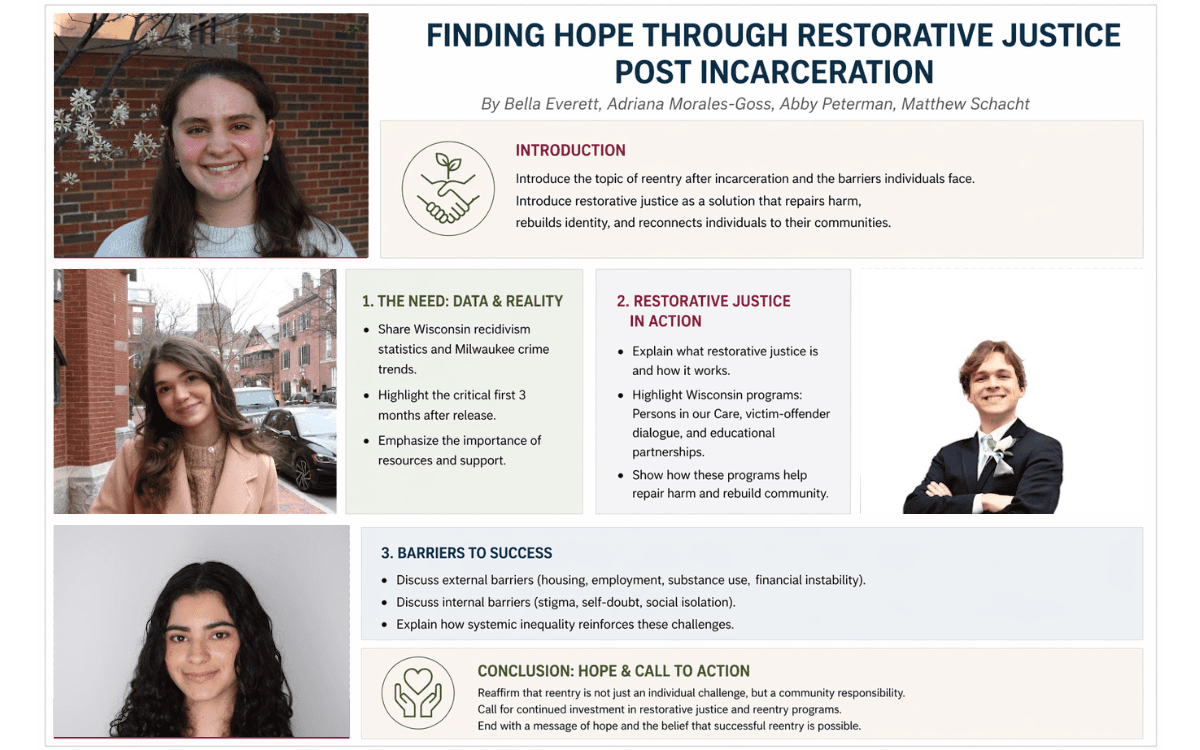
Reentry after incarceration is often framed as a matter of individual responsibility. However, reentry is influenced by stigma, systemic inequality, and social norms. A psychological framework known as the labeling theory suggests that individuals are formally labeled as “criminal,” that identity can become internalized and reinforced through social interactions, and an increased likelihood of recidivism. These processes are further reinforced by systemic discrimination, seen in housing, employment, and social exclusion. Because of these overlapping barriers, successful reentry requires additional support, such as incorporating resources to repair harm done, rebuild identity, and reconnect individuals to their communities.
All of these practices and more can be achieved through restorative justice practices.
The Milwaukee Police Department latest annual report states that Milwaukee saw a 15% decline in Part I Crimes, but an increase in non-fatal shootings (11%), homicides (1%), and carjackings (7%) in 2021 (Norman, 2022). In 2022, there was a decrease or plateau in the major crime categories highlighting there is space for reforms (Norman, 2022). This could be accomplished with a foundation in restorative justice to combat recidivism and promote a successful reentry.
The Wisconsin Department of Corrections reports that from 2012–2015 the recidivism rate was 32.6% for incarcerated individuals, meaning that 32.6% of individuals reoffended during their first-year post-incarceration (Launch Initiative to Support Reentry Success, 2019). The data shows that the first three months upon release are the most critical timeframe for potential reoffending and reincarceration (Launch Initiative to Support Reentry Success, 2019).
This critical window highlights the value in adequate resources upon reentry. Restorative justice practices could promote this.
The Wisconsin Department of Corrections “Persons in our Care” program helps foster reentry. This program has seen a 95% success rate, meaning members smoothly transitioned from incarceration to society without reoffending (Heath, n.d.). This high success rate validates the need for new initiatives to aid current practices. And more importantly, when supported, successful reentry is possible. Thus, challenging the idea that recidivism is nearly inevitable.
The Wisconsin Department of Corrections uses and defines restorative justice as an involvement between victims, offenders, and communities working together to repair harm that has been caused to the victim. In this communal effort, offenders have an opportunity to repair harm they’ve caused via reversing the spillover effect (Kite et al., 446). The spillover effect refers to violence affecting an entire community. Communication held among the victim, offender, and community is essential to combating recidivism and rebuilding community.
Using this lens, we can further elaborate on the effectiveness of reentry practices utilized in the Criminal Justice System in Wisconsin and identify programs that can be added to support their efforts. For example, the Wisconsin Department of Corrections explains the victim-offender dialogue, where offenders can offer apology letters to take steps toward healing the communal relationship that’s been damaged. Additionally, Marquette’s Educational Preparedness Program offers higher education for both Marquette students and currently/formerly incarcerated individuals in the Racine Correctional Institution. The goal of the Educational Preparedness Program is finding collaboration, breaking down barriers, and creating pathways between all corners of the Milwaukee Community.
While continuing to advocate for reentry programs and restorative justice practices, it is also important to simultaneously expose the barriers to success individuals’ post-incarceration face. The period right after incarceration is often the most challenging, as individuals face immediate issues like substance use, housing, and financial instability. They later reported further barriers after that period of social isolation, finding stable housing, and stable employment. (Hoffman et. al, 2023) These external barriers reflect systemic inequalities that go beyond individual control, reinforcing the idea that reentry is shaped by structural conditions.
Previously incarcerated individuals face both internal and external barriers. When asked in interviews, individuals’ post-incarceration developed internalized stigma about themselves. They reported believing that they would only amount to low paying “bad” jobs, had low expectations/goals for themselves, avoided opportunities because of fear of rejection, and sometimes hid their criminal background. All these factors led them to social isolation and even avoided old friends and family members due to the shame they felt towards themselves (Sinko et. al, 2020).
These findings highlight that reentry is not a simple process. Instead, individuals face a combination of external and internal barriers that restrict success. The “bootstrap” mentality is ingrained in our culture and pushes the belief that success comes purely from individual effort (Kite et al., 219). Although, that mentality can easily be debunked through education about confounding factors that create barriers to individual success. Thus, it is crucial for society to shift toward radical empathy, recognizing the structural and psychological challenges individuals face rather than blaming them for their circumstances.
Restorative justice offers a meaningful alternative by addressing harm, rebuilding identity, and community connections. Programs like the Persons in Our Care initiative and educational partnerships demonstrate that when individuals are supported instead of stigmatized, successful reintegration is not only possible, but likely. Embracing restorative justice will enhance the success seen in these programs and bridge the gaps in the Criminal Justice System. Restorative justice helps create a more equitable system that prioritizes healing, accountability, and opportunity for all.

Want More Local News?

Civic Media
Civic Media Inc.
The Civic Media App
Put us in your pocket.