
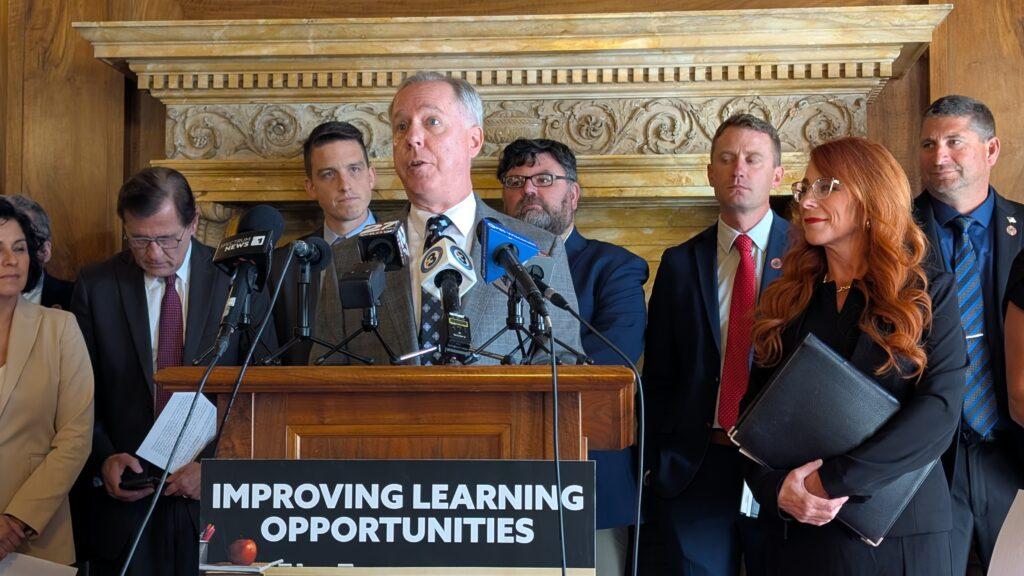


Republican lawmakers want a lawsuit challenging the state’s school funding formula as unconstitutional dismissed, according to court filings.
The lawsuit challenging Wisconsin’s current school funding system was filed in February by Law Forward, a public interest law firm, in Eau Claire Circuit Court. The progressive legal group filed it on behalf of a group of school districts, parents, teachers, students and two advocacy organizations, the Wisconsin PTA and the Wisconsin Public Education Network (WPEN). The suit argues that the state Legislature is not fulfilling its constitutional obligation to provide a “sound basic education” under the current school funding formula.
GOP lawmakers, including Assembly Speaker Robin Vos (R-Rochester), Senate Majority Leader Devin LeMahieu (R-Oostburg) and members of the Joint Finance Committee, called the lawsuit “meritless” in their filing and said that the majority of questions asked in the lawsuit have been previously answered in previous court cases, including in the state Supreme Court’s Vince v. Voight decision. That 2000 lawsuit found that the state’s school funding formula was constitutional.
“For all of plaintiffs’ sky-is-falling assertions, the school finance system that plaintiffs challenge here is the same system that the Wisconsin Supreme Court upheld against similar (indeed, mostly identical) constitutional claims in Vincent v. Voight,” the filing states. “That system, Vincent explained, complies with the Wisconsin Constitution because it affords every student the opportunity to obtain a constitutionally adequate education. The Supreme Court reached this conclusion notwithstanding various complaints relating to test scores, school facilities, teacher staffing, and the like — complaints that are materially indistinguishable from those that Plaintiffs raise here.”
The lawmakers said the plaintiffs in the suit are asking the judiciary to take over the Legislature’s constitutional role in determining funding for primary and secondary education, even as the Legislature has fulfilled its constitutional responsibilities by enacting a comprehensive school finance system for the state’s public schools.
The new lawsuit argues that declines in student proficiency for Wisconsin’s reading and math test scores are the result of declining investments in schools. It also argues that the growth of the state’s school voucher programs, which use state money to cover the cost of private school tuition, have contributed to declining funding for Wisconsin public schools.
The lawsuit asks the court for a declaration that the Legislature hasn’t fulfilled and cannot “shirk” its constitutional obligation to fund schools at a sufficiently high level to “ensure that every Wisconsin student has an equal opportunity to obtain a sound basic education that equips them for their roles as citizens and enables them to succeed economically and personally in a tuition free public school where the character of instruction is as uniform as practicable.” It calls for the current funding system to be ruled invalid.
Jeff Mandell, co-founder of Law Forward, called the motion to dismiss a “predictable attempt to avoid accountability” in a statement.
“We filed this lawsuit because families, educators, and communities across Wisconsin are seeing firsthand that the current system is not meeting that promise — forcing schools to rely on referendums, widening inequities, and leaving too many students without the resources they need,” Mandell said. “We maintain that this case deserves to be heard and are confident that the court will agree.”
The lawmakers also argue in the filing that the five school districts named in the suit, including the Adams-Friendship Area School District, the School District of Beloit, the Eau Claire Area School District, the Green Bay Area Public School District and the Necedah Area School District, should be dismissed from the case, arguing that they lack standing to challenge the constitutionality of the school finance system as a political subdivision of the state.
The lawmakers argue that the issues the plaintiffs pointed to in the lawsuit are not sufficient evidence of the state not upholding its constitutional obligation.
The lawsuit specifically points to the increasing reliance of Wisconsin school districts on asking voters to help them keep up with operating costs by increasing local property taxes through ballot measures (with varying results) as well as the decline in the state’s special education reimbursement rate.
The state currently picks up a little more than one-third of special education costs, despite the state budget promising to cover 42% of costs this year. The Necedah Area School District, which recently failed to pass a referendum in April, has diverted all of its revenue from its previous operational referendum requests, about $6.6 million, to its special education fund. Meanwhile, the special education reimbursement rate for private voucher schools is 90%.
“The Wisconsin Constitution makes clear that localities are expected to cover a significant portion of the cost of funding public schools,” the Republicans’ filing states. “That some school districts have had to use some of their own general education funds to cover the costs of special education is not constitutionally significant in the absence of any plausible allegations that any student has been deprived of the opportunity to obtain a sound basic education. And as for districts’ need to use referenda to exceed the revenue limits here, this too is constitutionally irrelevant.”
The Legislature appropriated more than $7 billion in school aid in the 2024–25 fiscal year, the Republican filing noted.
Democratic lawmakers on the Joint Finance Committee submitted their own filing, which was supportive of the lawsuit.
“A constitutional promise is not optional,” the lawmakers wrote. “Wisconsin children cannot receive one level of educational opportunity in communities that can raise and pass local referenda and another in communities that cannot.”
The lawsuit also lays out how the state’s private-school choice system, which was launched in the 1990s and has grown exponentially over the years, has contributed to the erosion in funding for public schools. There are four distinct school voucher programs in the state: the Wisconsin Parental Choice Program, the Milwaukee Parental Choice Program, the Racine Parental Choice Program and the Special Needs Scholarship Program. Wisconsin is paying about $700 million this year for more than 60,000 students to participate in the voucher programs.
Republican lawmakers rejected the assertion that the choice programs are related to the lawsuit’s claims.
“This is a baseless attempt to tar these longstanding, alternative educational offerings that are both highly effective and extremely popular across the State,” the lawmakers stated.
The Wisconsin Institute for Law and Liberty on behalf of parents and School Choice Wisconsin Action are also seeking to intervene in the case as are parents represented by EdChoice Legal Advocates, a school choice litigation firm.