
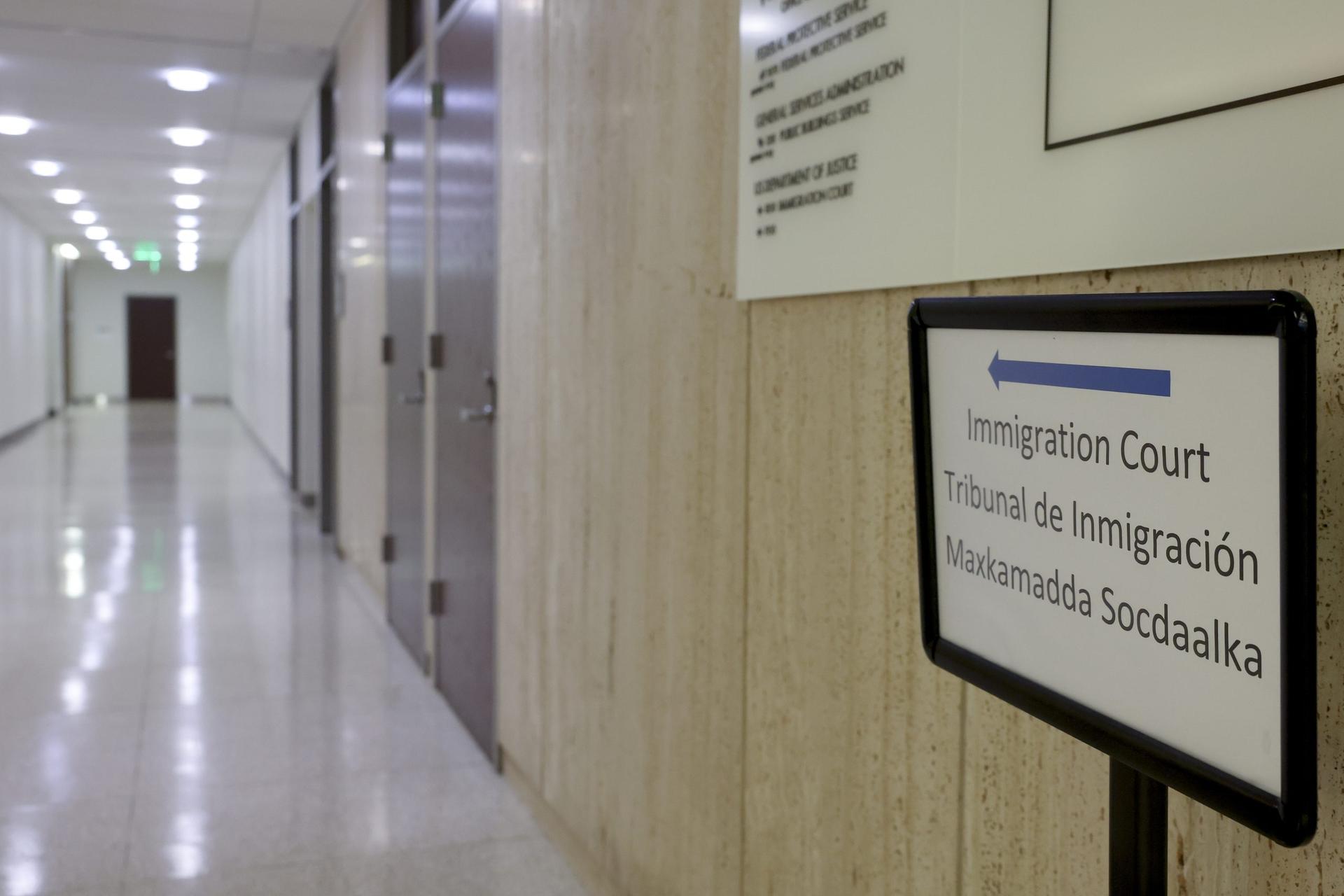


A federal judge in Washington, D.C., heard arguments last week from a Minnesota-based group that says the Fort Snelling immigration court is violating federal regulations and the First Amendment by restricting access to court proceedings.
Over 4,000 Minnesotans have been detained since Operation Metro Surge, according to figures from the Deportation Data Project. Most of those cases will be processed at the Fort Snelling court, either virtually from detention centers in Minnesota and elsewhere, or in-person.
The lawsuit brought by the Advocates for Human Rights says the federal immigration court has prevented volunteer observers from witnessing these and other proceedings, leaving the public in the dark about the court’s actions, which include high-stakes decisions on deportation and asylum cases.
The case has national, as well as regional, implications. A successful injunction is expected to apply to all of the country’s immigration courts. The Advocates hope it will return predictability to how courts function – a departure, they say, from the inconsistent and unexplained rules that have characterized Trump 2.0.
“It’ll really depend on the scope of the injunction,” said Madeline Lohman, the group’s advocacy and outreach director. “Hopefully we will at least be getting verbal notification for why courtrooms are being closed. So even if we can’t be in more hearings we will know why we aren’t allowed in those hearings.”
“Then we can evaluate – not just we, the organization, but we, the people – can evaluate whether that seems like a legitimate use of court privacy protections or not.”
Immigration courts are not regular courts under the government’s judicial branch. They are part of the executive branch, housed within the Justice Department’s Executive Office of Immigration Review. The leaders of that office and of the DOJ, along with the assistant chief immigration judge at Fort Snelling, are named defendants.
The Advocates began their immigration court observer program at Fort Snelling in 2017, after Trump instituted a travel ban from seven majority-Muslim countries in the first weeks of his first term. After campaigning on an overtly anti-immigration message, the observer program was seen as a check on any potential abuses of the courts to fulfill his campaign promises.
Until Trump’s second term, access had been routine and cooperative, they say. Since early last year, though, observers have found themselves outside locked doors, stuck in online video conferencing waiting rooms, and wondering what new rule will be posted on a wall or proclaimed by a guard. Some days, entire blocks of cases are marked closed; others proceed with some semblance of normalcy.
The one constant, according to observers at the court this month who declined to give their names, has been the inconsistency.
What are the laws on observing immigration court proceedings?
The short answer is that federal law says immigration court hearings are presumptively open to the public.
A Justice Department regulation from 1987 states plainly that all hearings shall be open to the public, with narrow exceptions: when space is limited, with the press given priority; to protect a witness, a party, or the public interest; at the request of an abused spouse; or when a case involves a protective order.
Those exceptions were established through a formal public notice-and-comment process – the standard mechanism for binding federal rules. That matters, because the Justice Department cannot abandon or rewrite those rules without going through the same process again. A memo, a fact sheet, or a guard’s verbal instructions don’t constitute a new regulation.
Advocates for Human Rights argues the restrictions at Fort Snelling don’t fit any of those exceptions – and that the government has never claimed they do. That failure, they say, is itself the violation: not just breaking the rules, but not even invoking their own safety valves.
The lawsuit also invokes the First Amendment. A 2002 Sixth Circuit ruling, Detroit Free Press v. Ashcroft, held that the press and public have a constitutional right of access to immigration court proceedings – and that closing a hearing requires specific, on-the-record findings that closure is essential and narrowly tailored, the same bar that applies to closing a criminal trial. In its responses before the suit was filed, the government did not argue that any exception applied to any specific hearing. It said only that closures may be necessary “for a variety of reasons.”
When reached for comment, a spokesperson for federal immigration courts said the office “declines to comment on litigation-related matters.”
How has court observation changed?
For eight years, Amy Lange knew what to expect when her volunteers walked into the Bishop Henry Whipple Federal Building. The court posted the day’s docket each morning. Observers could walk into any courtroom without checking in. The unofficial attitude, she said, was summed up in three words from the previous administration: “You are welcome.”
That changed in early 2025.
“They are not conforming with the regulation,” Lange said, “and not trying to pass a new regulation or change the regulation.” What followed was a patchwork of informal directives – signs on courtroom doors, instructions from guards, a September 2025 document Lange described as “guidelines without force of law” – that progressively narrowed what observers could see and when.
Courtroom doors began locking. Signs appeared declaring hearings closed, sometimes citing confidentiality rules that didn’t apply to the cases behind the door – sometimes referencing cases from the day before, never taken down. Observers who stepped out during a recess found themselves locked out for the rest of the session. Some were told they couldn’t leave even for a bathroom break.
Before 2025, Lange estimated her observers attended roughly 99.5 percent of master calendar hearings – the routine scheduling sessions that make up the bulk of court activity. Starting that March, closures multiplied. By October, entire dockets were shut without notice or justification. At the worst points, no observers were admitted for an entire day.
“We want to make sure that if a hearing is closed, it’s case by case,” Lange said. “The judge is evaluating that particular circumstance and that particular case. Closing a case can be done at their discretion – but they need to exercise their discretion. The only way you know that is if they explain: this is why.”
Why is court observation important?
When someone faces removal in an immigration court, they have no constitutional right to a lawyer. According to Lange, when a respondent has an attorney, roughly 40 to 50 percent agree to have an observer present. When they don’t – navigating a system designed by lawyers, in a language that may not be their own, facing consequences that can mean permanent separation from family or return to a country they fled – that figure climbs to around 80 percent.
“People in court feel less alone during a complex and frightening process, which they navigate often without legal counsel,” said Michele Garnett McKenzie, AHR’s executive director. “We provide a witness to decisions that will seriously impact their safety, family togetherness, and ability to leave detention.”
Observers, Lange said, function as a conscience – not intervening, not advocating, just watching. Attorneys have told her they help de-escalate tension on both sides. “They’re being witnessed doing something not comfortable to them either,” she said.
“If nobody is there to see that constitutional and due process protections are being implemented, and they aren’t being arbitrary or biased, how do people trust the court?”