
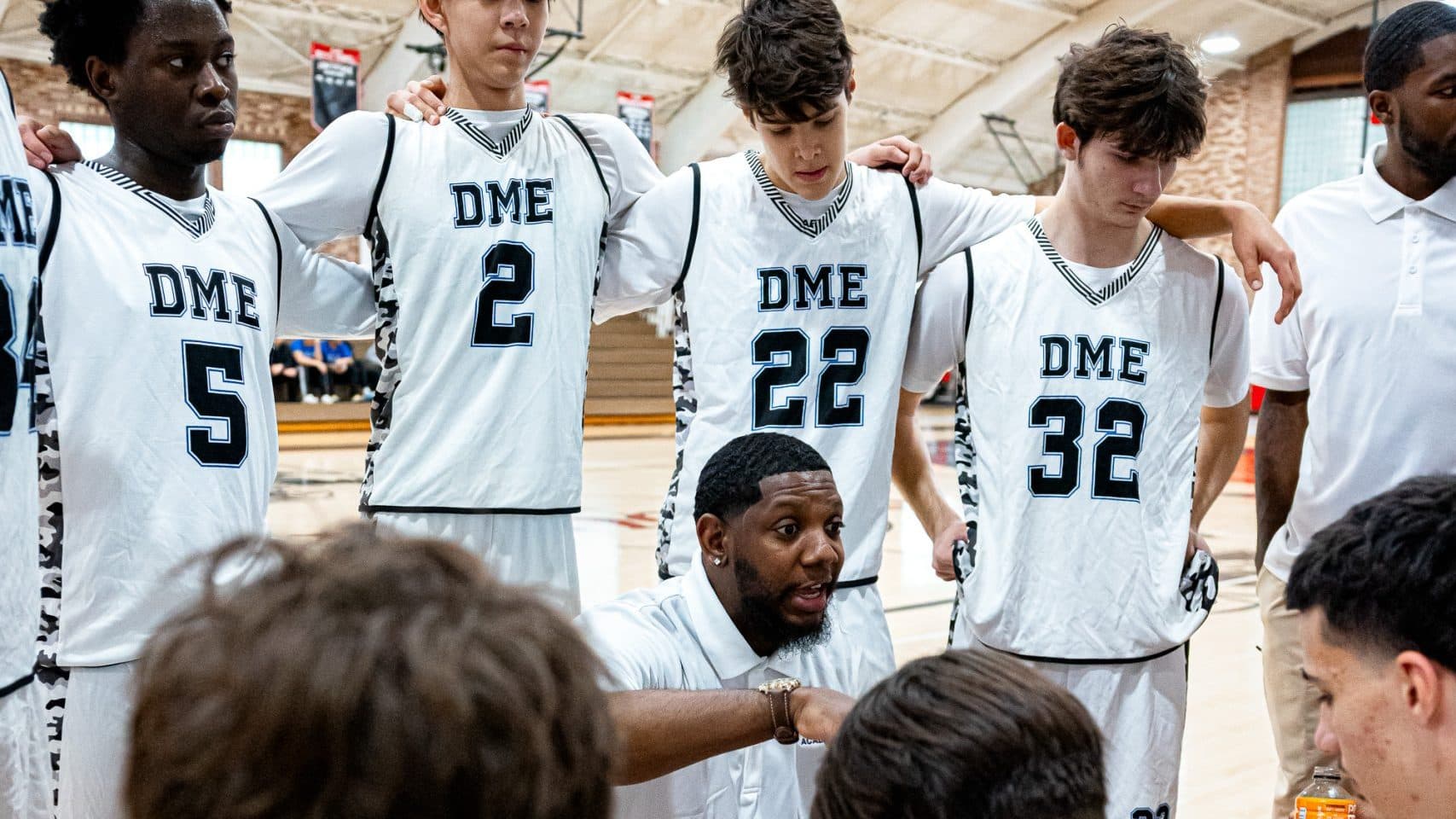
Source: Provided by Chuck Smith
Q&A: Coach Chuck Smith on NIL, Wisconsin recruiting classes and working with NBA players

Apr 17, 2026, 5:38 PM CT


Share
Chuck Smith, an educator by trade, built a career off developing young people into premier basketball players, but even better people.
The Milwaukee native has led multiple basketball programs, including Kingdom Prep Lutheran High School, Homestead High School, Bryant & Stratton College, and DME Academy Wisconsin National Prep School. But he also has created elite squads on the AAU circuit, leading teams for NBA players and Milwaukee area natives Kevon Looney and Tyler Herro.
Smith, 35, sat down with Drake Bentley of the Milwaukee Courier/WNOV on April 16 to discuss his career and his hopes for the future of basketball in Wisconsin.
Here is a Q&A of the interview lightly edited for clarity:
Bentley: I saw you recently on “Basketball Immersion” program. You were talking about how, Mark Pope, who was obviously a Kentucky legend, won a championship there in the 90s, played for the Bucks for a little bit. You said it was an inspiration for you, for some of your schemes. How did Pope inspire you?
Smith: I worked for an organization, an AAU organization by the name of Chapman Basketball Academy, ran by a coach and mentor of mine, Joe Chapman. And Joe’s a really brilliant offensive mind, and Mark Pope basically has this continuous pick and roll motion offense that he runs. And that is something that I wanted to do early on in my coaching career. I just didn’t have the background knowledge or the exposure to high level offenses or to other great coaches out there. And Joe Chapman kinda exposed me to this Mark Pope offense. He doesn’t really run it much now at Kentucky, but when he was at BYU with guys who were less athletic, guys that couldn’t get off the ground as much, but really high IQ thinkers, this was an offense that really helped those type of guys be able to get downhill, be able to get open shots, and so on and so forth.
Bentley: Is there anyone else in the coaching ranks, whether college or NBA, that you kinda draw inspiration from?
Smith: Joe Mazzulla (Boston Celtics), Tiago Splitter (Portland Trail Blazers), Steve Kerr (Golden State Warriors), Billy Donovan (Chicago Bulls), Mike Brown (New York Knicks). A couple of Milwaukee guys as well inspire me — DeMonte Bynum (Martin Luther High School) and Ben Hailey (Messmer High School).
Bentley: Let’s get into Mazzulla a little bit. He’s kind of a villain in these parts. What about Mazzulla is appealing?
Smith: Mazzulla goes outside of basketball to help with his on court performance as a coach. He’ll go study coaches in the Champions League for soccer. He’ll go the UFC. He’ll go watch baseball coaches. I’m a teacher by trade, I taught for eleven years. Mazzulla works with this education juggernaut by the name of Doug Lamothe. Mazzulla adapts education strategies to his players. He understands that not one player thinks the same. He tries to integrate all different types of learning within his philosophies, within his practice plans, within his lesson plans, and so on and so forth that he does on the court.
Bentley: Is that something you do as well, drawing on other sports?
Smith: Yes. I watch a lot of football, specifically cornerbacks and wide receivers. Seeing how the receiver tries to get off the line when a cornerback jams him. It’s kinda like when a point guard has the ball and he has a pesky defender guarding them. How can he still be physical but break that contact and get that aggressive defender off of him so that he can get us into our offense?
Bentley: Let’s get into your background. You played college basketball in Arizona for a little bit and then you went to MATC. Shortly after that you went to Kingdom Prep and you built that program from the ground up.
Smith: I’m a believer and it was all God. I was originally supposed to go to a junior college at Mississippi and play basketball. So my dad drove me down there for thirteen hours. And long story short, the school had my financial aid package messed up. The dorm situation, housing situation wasn’t the best, and the whole situation just blew up. So, basically, we drove thirteen hours down there for nothing. So back to Square 1, I decided not to go to school there. Now school starts in about two weeks, so I’m trying to scramble, trying to figure out where I can go? I have family in Phoenix, Arizona. It’s some junior colleges around. I’ll try to walk on. So they pinpointed me to a school, Mesa Community College. I walk on there, red shirt there for a year, get bigger, get stronger, get faster. And then I decided to come back home just to be around my family. My dad had ended up getting sick. I had a grandfather that was sick, and I had an uncle who had just got out of prison, who had prostate cancer. So my mom is kinda like the caretaker person in our family. So she took my grandfather in. She took my uncle in, and she needed a little more help. I came back home, attended MATC, and I played there for a year under a guy by the name of Randy Casey, kinda who I model my coaching style after. He’s a tenacious, crazy, maniacal, results driven coach, and he does not allow you to be average. I learned so much, but I’ll be honest, the way he coached wasn’t for me. It kinda took my confidence away, but that’s because I wasn’t used to tough coaching. So mind you, in the midst of all of this stuff happening, I’m taking care of my uncle, taking care of my grandfather, and I’m just a little lost. So grades are slipping. I’m not doing what I need to do in the classroom. And long story short, I get kicked off the team. And from there, I started trying to figure out what I wanted to do with my life. I was always good with kids, grew up in the Boys and Girls Club, helped out my senior year working with six to eight year olds. Maybe I’ll go into teaching or something like that. I ended up connecting with a guy who told me about a program called Center for Urban Teaching. It’s a nonprofit and they run a six week summer school program every summer, and they try to help grow young teachers or people that are interested in seeing if this is the field for them. I did five internships for five straight summers. Through this internship is where I met the founding principal for Kingdom Prep who brought me in as the recruitment director at Kingdom Prep and also as the head founding basketball coach where I did that from 2018 to 2022.
Bentley: You mentioned your coach was aggressive. There’s a lot of talk about coaches that are somewhat aggressive or kind of pushing players too much and it’s kind of a sign of the times that we live in that that was more acceptable in the 80s and the 90s. What do you make of the Dan Hurley types?
Smith: There’s not one cookie cutter solution to coaching. When you find what’s best for you, I think you should do it to the fullest or the highest capacity that you can. Dan Hurley comes from a coaching background. His dad was an amazing coach with all of those great teams at Saint Anthony in New Jersey. So I say if you’re gonna be aggressive, do it to the highest capability that you can, and he’s currently doing that. Now for me, I was kinda the same way, but I’ve pulled back a little more. I just didn’t have an identity. For a lot of young coaches, and I still consider myself a young coach, I’m only 35. I think a lot of us look at theDan Hurleys and the Bobby Knights and we try and emulate them, while never having an identity or finding a niche for ourselves. So for me, I kind of took the teacher approach. I taught English. If a kid doesn’t know how to write a five sentence paragraph, it’s not my job to yell at them to figure it out. It’s my job to teach them how to do that. I wanna be more of a teacher. When I yell or I scream or I get aggressive, I want that aggressiveness to mean something to them. They should want to maximize their potential. Sit back, give them a framework that they can build on and trust the framework and trust the schemes that I’ve put into play that these young guys can find solutions and take ownership of anything and everything that we’re doing on the court.
Bentley: You eventually found your way to Bryant & Stratton College. While there, registered a historic 29 wins and the highest GPA in school history. Why is it important for these young student-athletes to not just be good at sports, but also have academic skills?
Smith: Higher education isn’t for everybody, but being a lifelong learner is. Some guys just don’t like the classroom setting or don’t find the teacher relatable enough. Some guys also just don’t have that grit to fight through that mental toughness that’s required within the classroom. But being successful academically helps build your confidence. We’re trying to encourage our guys to get good grades because on paper, due to the transfer portal and coaches seeking out these older players and so on and so forth, you really have to stand out as a junior college transfer. I found the first thing coaches ask is what’s his GPA? Because let’s say we can’t offer him a full ride, we potentially can find academic money for him, or grant money through his academics that could help supplement what they’d be able to give him through a full ride scholarship. It’s a big point. We want to push our guys to be great in every area of their lives. Sometimes we’re competitive as basketball players, but we’re not competitive as people. I don’t say player development, I say people development. I wanna develop young men and young women holistically. Jamal Crawford had a quote. He said, if all I’m remembered for is being a good basketball player, then I failed with the rest of my life. I want our young people to be competitive basketball players, but I also want them to be competitive in their work field. I want them to be competitive as future husbands, right to be the best that they can be, competitive sons, competitive grandsons, and so on and so forth. I want them to take that competitive nature that they have on the court, and I want them to find ways to use that same competitive nature and apply it holistically to every area of their lives.
Bentley: What players from Wisconsin have you had a chance to work with that went on to the NBA?
Smith: Jalen Johnson (Atlanta Hawks), Brandin Podziemski (Golden State Warriors), Anthony Black (Orlando Magic), AJ Johnson (Washington Wizards), Keifer Sykes (formerly Indiana Pacers). But my first pro client I ever had was Mike Taylor, who’s from Milwaukee, was the first player ever drafted from the developmental league. Mike has done a really good job of not allowing basketball to define who he is and really talk like entrepreneurship and all of that good stuff. Mike is somebody who has started his own nonprofit where he works with kids after school, through arts, through sports, and so on and so forth. Mike also is a guy through his foundation I helped him do basketball pop ups. During COVID, Mike had this idea to do pops at various parks so we could train kids for free. He started his own 3-on-3 tournament at McGovern Park. So just seeing somebody like that, being a client of mine, somebody that trusts me with his career and his livelihood, seeing him implement all of those things outside of being an athlete, man, it’s been phenomenal. I also have players that went on to start businesses. Hopefully players notice and start diversifying their portfolios and look beyond just being a on court basketball player because, I mean, that career typically only lasts four to five years for some guys.
Bentley: What AAU teams have you led?
Smith: I started with Chapman Basketball Academy for about three years. Then last year, I had a really great year with a Team Herro, 16u team. We went 20-1, and made it to a final four at Nike Peach Jam. Had the number one offense in the country for the last five years, the only team that had a better offense was the Boozer Twins, when they were playing in Florida. I’ve since moved on to Kevon Looney’s team. I just kinda wanted to give back to the city a little more. With Herro, it’s a really great organization, he’s an amazing young man, but now I have an opportunity to help a lot of inner city young guys. I’m in more of a Milwaukee based AAU organization on a circuit. I’m at a point where I just wanna help Milwaukee be catapulted on a global scale through this organization. That’s where my conviction and my heart lies at the moment.
Bentley: What’s it been like seeing the work of Looney and Herro’s foundations?
Smith: It’s been phenomenal, and I think it also goes back to when we were talking about players and not just letting basketball define them. I think I’ve had the opportunity to have a hands-on approach seeing exactly what that looks like in real time, especially for a guy like Tyler Herro who’s worth close to $200 million. Being around a high level multimillion organization like that was life changing. Seeing all of the golf outings that he has, all of the camps that he puts together for kids, and all of the stuff that his family does to try to better the community, not just in Milwaukee, but in Wisconsin as well. I think it’s been really transformative seeing that, and just having the opportunity to serve in capacities for guys like Herro and guys like Looney. Especially with Looney being an MPS grad and seeing the hope he gives people during his camps. The work is changing lives in the community. As a native, from 23rd and Brown and 49th and Garfield, it’s special to see.
Bentley: What is the makeup of that Looney team?
Smith: We are retaining nationally ranked players because you have to win in order to keep sponsorships and deals. It mimics college basketball. So we have a mix of players. We got four players from Michigan. We got a player from Minnesota. We got a kid from Cameroon who plays for me at DME Academy. We got a kid from the Green Bay area, And then we got a Milwaukee kid, and we got a Madison kid. So our group is very diverse as far as state wise, but once you get in the thick of it, you start to notice it’s kinda the same type of dynamics. My Michigan kids are from Detroit. My Minnesota guy, he’s from Minneapolis. And you start to realize Milwaukee, Detroit, Minneapolis, where these inner city kids all have the same struggle.
Bentley: You’ve helped organize camps for Herro, the Milwaukee Bucks and Marquette University. You are currently helping plan a camp for Looney this summer. What is the structure of those?
Smith: We are really trying to get kids better. Some parents treat it like a daycare because we have their kids for a week during the workday, but it’s not. We want to make kids better players. But we have the right coaches. I learned a lot from Shaka Smart. When kids first walk into a Marquette basketball camp, there’s a red carpet laid out, and they have about 10 to 12 coaches outside clapping really loud and cheering kids on as they walk into the camp. And a kid sees that it’s 7:30 a.m. in the morning they light up because you’re the one affirming them. You’re letting them know that expectations won’t drop. This camp is going to be one of the most highly energized, well run camps that you’ll ever attend in your life.
Bentley: What did you make of the matchup between Tyler Herro and Kon Knueppel in the NBA play-in?
Smith: First off, those are two really good coaches in Erik Spoelstra (Miami Heat) and Charles Lee (Charlotte Hornets). That game kind of had a March Madness feel to it and I think people will slowly start to catch on. This is how it is in Euroleague games. The refs were a little loose with the whistle but in the last two minutes, we saw some of the most amazing after timeout plays that you could see, not only from the Hornets, but from the Heat as well. When you are playing a one game scenario, people don’t see the behind the scenes work that all of these coaches are preparing for this one opportunity. So we see a game winning play, but it probably took a coach a 300 clips on film crafting the perfect play to get LaMelo Ball down hill. But also working on your transition defense, which was really important because Miles Bridges got the game saving block.
Bentley: How did your program, Skills over Politics, come about?
Smith: I began training players for free at Kingdom Prep. I trained over 150 clients and 35 of those guys were playing Division I basketball and 10 of those guys professionally. I just wanted to create a product with some buzz. Carry that into COVID and I was the only one with an open gym so guys at Wisconsin and Marquette are hitting me up. Next thing you know I’m working out players from Marquette, UW-Milwaukee, UW-Green Bay. A YouTuber by the name of Tristan Jass recorded an open gym session and changed my life forever. Got connected with Jalen Johnson after that. My network grew. I went from just training guys to now helping navigate them with their agency deals and what schools they wanna go to. So for me, it’s just sometimes the political agendas that people have that get in the way sometimes of how skilled people are. Due to the political agendas, you don’t really get to see how masterful a lot of people are at their crafts, and that’s across the board, not just sports. So I wanted to create a lifestyle slogan or a brand that could translate holistically to any and everything.
Bentley: What do you tell your players about navigating the NIL space?
Smith: I mean it’s a cash cow out here now. You’re telling a kid that he can get 4 to 5 million dollars a year just playing collegiate basketball. Some guys are making more money than rookies are making on the rookie deal in the NBA. So, for me, it’s all about fit and opportunity. The money will always be there, but, like, the goal should always remain the goal. If your goal is to play professional basketball then let’s find a school and let’s find a fit that’ll get you there. I helped a player, Jose Perez, navigate his NIL deals when he went to West Virginia. In that instance, it’s about fit and opportunity and thinking long term depending on what you want your finished product to be.
Bentley: In general do you support the NIL changes?
Smith: I support it 100%. I think looking back at all of the people who didn’t get to benefit off their name, image, and likeness, I think I think it’s important that guys now are able to do that, especially with the rise of social media, and schools being able to use different outlets to brand players. I think it’s important that people are able to make money off their names. Now I do think there eventually should be a cap put on it or a union started. At what point are these donors gonna scale back a little bit and say, we gotta come up with a strategic plan. If a kid is making $4 million and the head coach is only making a million, it’s gonna be hard to coach. I just think a cap needs to be put on it, but I’m all for guys making money off their name, image, and likeness for sure.
Bentley: These upcoming recruiting classes in Wisconsin are pretty good, right?
Smith: Yes. In 2027 you have Dooney Johnson, Donovan Davis, Deuce McDuffie, Jack Kohnen, Kager Knueppel, Zeke Jones, Tref Rademaker, Jalen Brown, I can go on and on. There’s for sure 15 to 20 of those guys that can play Division I basketball. In 2028, it’s a good class but not as deep at 2029 and 2030. This incoming freshman class, this group of kids is really, really good. They’ll be on the cusp of what this 2027 group did. There is just something in the water. These players have size, they are tall. I think generationally they have some God given gifts that other players don’t have.
Bentley: What’s next for basketball in this neck of the woods?
Smith: I’ll tell you where my heart is. We gotta grow coaches. There aren’t that many young, hungry coaches eager to coach at a high level. And what I mean a high level, I mean being varsity coaches or coaching in college or even coaching in the NBA, which is where I wanna be one day. I just don’t think a lot of guys want to do that at a high level. Some say they wanna do it, but I don’t think they understand professionalism. But I also don’t think they understand the work that it takes to coach at a high level. Even in high school, 24 games, your preparation is super important. Your scouting is super important. How you recruit and go get kids is important. I also think it’s educating parents more, on this whole NIL landscape and helping them understand that agents are gonna start coming even younger now.
Drake Bentley is an award-winning investigative journalist who has worked for the Milwaukee Journal Sentinel, Wisconsin State Journal, Newsweek, Heavy and The Sporting News. He is a northside Milwaukee native, former political staffer and graduate of the University of Wisconsin-Whitewater and the University of Nebraska.
Want More Local News?

Civic Media
Civic Media Inc.
The Civic Media App
Put us in your pocket.
