
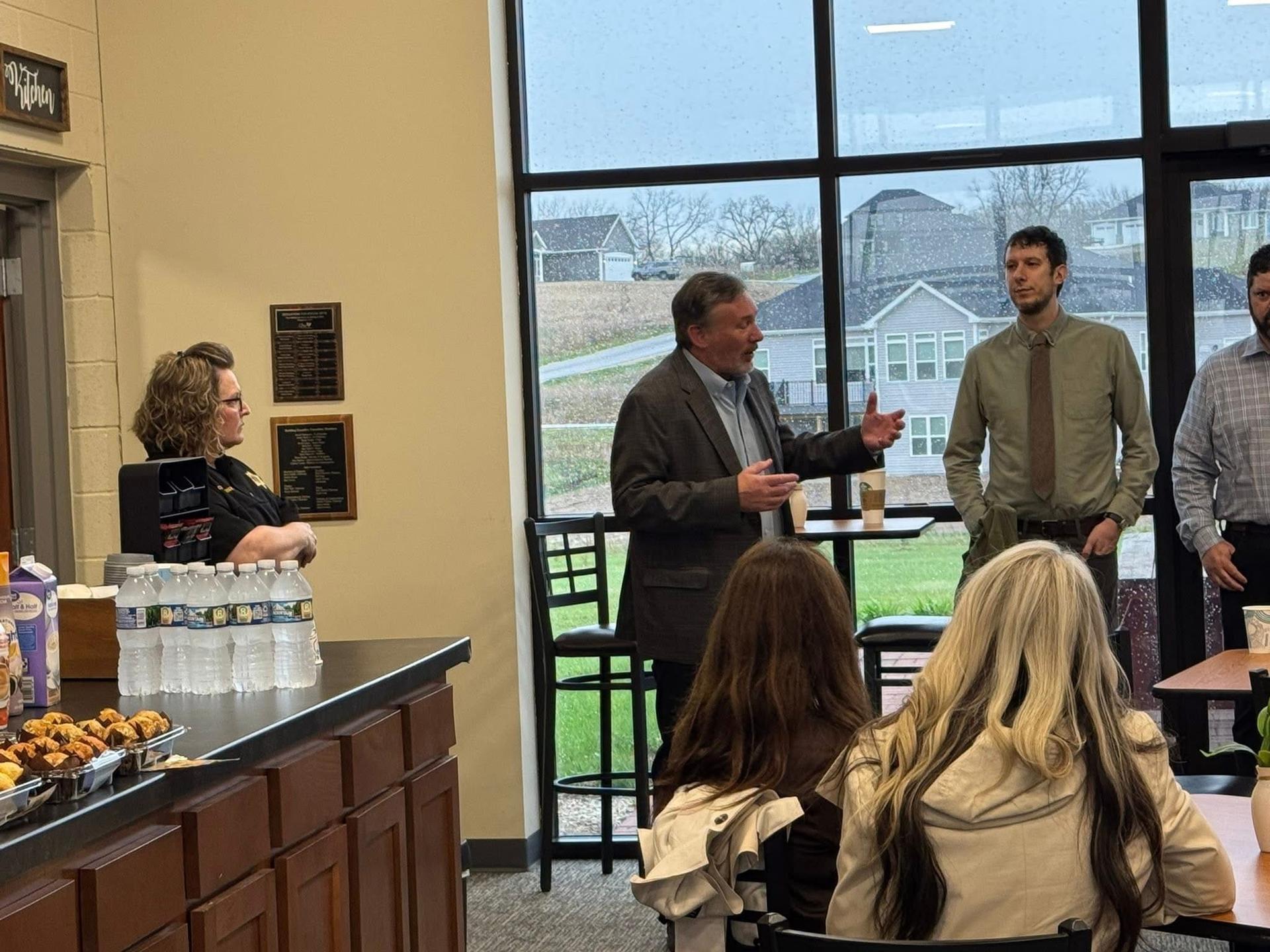


Racine County Executive Ralph Malicki brought several department heads to Burlington for a community listening session designed to close a long-standing gap between the eastern and western halves of the county and to hear directly from residents about the issues that matter most to them.
The event took place at 8 a.m. Wednesday, April 15, Grace Church on Plank Road. Approximately 30 residents attended.
The April 14 event drew residents, municipal leaders and community members to an open forum where county officials fielded questions on everything from housing affordability and road funding to fire department consolidation and workforce retention.
“There’s 200,000 people in Racine County, and many of them want these people’s time at any given moment,” said Tom Roanhouse, former county board supervisor who introduced the session. “For them to be here, and you get to ask them anything you wish, is a real treat.”
Bridging the Racine County I-94 divide
A central theme of the evening was the county’s push to function as a unified whole rather than two communities divided by I-94. Malicki has made outreach to the county’s western municipalities a priority since taking office.

He has enlisted Pastor Melvin Hargrove and a network of faith community leaders to build relationships across the county. This is not as a social justice initiative, Malicki said, but as a grassroots effort to foster connection.
“If the faith community can’t do it, then something is wrong,” Hargrove said.
He added that county outreach workers have been meeting with veterans organizations and nonprofits on the west end and finding that many residents are unfamiliar with what the county’s Human Services Department actually offers.
“We’re finding a major disconnect,” Hargrove said. “How do we make sure that the services Human Services actually provides are being extended out here in the best way possible?”
Housing affordability a top priority
Malicki described housing affordability as one of his most pressing projects, framing it not as a question of subsidized housing but of workforce housing accessible to young professionals and working families.
“I’m talking about houses that are affordably priced, so our kids can come back to our county and live here,” he said, citing a target range of roughly $300,000.
Travis Richardson, the county’s data director, backed the urgency with demographics.
By 2032, Racine and Kenosha counties combined are projected to add approximately 32,000 jobs. By 2040, roughly two in five county residents will be at retirement age, and that will continue climbing. Over the past 15 years, the county added about 500 residents while gaining an estimated 6,200 jobs, meaning a significant share of the workforce is commuting to work rather than living locally.
“Over the next two decades, we’re going to lose about 30,000 people in the county, projected,” Richardson said.
Malicki and Richardson both noted that much of the housing policy lever rests with municipalities, not the county. Zoning rules, minimum lot sizes, conditional use permits and public hearing requirements all affect how quickly and affordably housing can be built.
Road funding frustration
Public Works Director Roley Behm outlined a structural challenge that has strained the county budget for years: Wisconsin counties maintain state highway infrastructure under a routine maintenance agreement, but the state controls how much work is authorized each year. When the state reduces its work order, counties are left paying to retain a workforce they cannot fully deploy.
“We have 60 employees that do road work, and over half of them are allocated to the state,” Bein said. “There’s certain years where the state will say, you know, we had a lot of snow up north, so you can’t be doing that work. Well, the problem is we have to pull from our own county levy to keep these employees busy.”
Malicki added that state-mandated services across county departments such as the sheriff, courts, human services, and roads are funded by the state at roughly 20 cents on the dollar.
“The state tells us we have to do all these things, but they pay for about 20% of it,” he said. “That rubber band only stretches so far.”
Mental health facility, opioid response
Richardson highlighted a bright spot in the county’s public health picture. Opioid overdose numbers have been declining, he said, driven in part by county investments in mental health clinicians and naloxone access.
A new mental health facility under construction on Taylor Avenue is expected to open later this year and will include a residential substance use treatment center, the first of its kind within roughly 40 miles.
Fire and EMS consolidation on the horizon
Malicki said consolidation of fire and EMS services is one of the clearest opportunities for tax savings, though he was emphatic that it must come from municipalities, not be imposed by the county.
He pointed to a recent county policing contract as a model: Sturtevant recently moved from a full-time police department costing $2.1 million annually to a county contract, saving more than $700,000 per year or over $3 million across the five-year contract term.
Richardson noted that the Wisconsin Department of Revenue offers an Innovation Grant that can fund consolidation and consortium models, with up to $30 million available over three years prioritizing police, fire and EMS services.
Another grant round is anticipated next year. A small number of municipalities in the Waterford area have begun preliminary conversations about consolidating EMS services, though those talks are early-stage.
“It’s got to be bought into,” Malicki said. “If people don’t buy into it, that’s not going to work.”
Grant writing, workforce and IT
Capt. Carrie Madrigal of the Racine County Sheriff’s Office credited Richardson’s department with securing more than $13 million in grants for the county, including over $400,000 toward a replacement patrol boat for Lake Michigan where the sheriff’s office patrols more surface water area than land.
HR Director Sarah Street described the county’s workforce challenges as similar to those facing local businesses: hiring and retaining qualified workers across a wide range of roles, from attorneys and mental health professionals to 911 dispatchers and road crew. A long-overdue salary study passed roughly a month ago and will be implemented later this summer or early fall.
“There really is such a wide variety of jobs that are available and opportunities that are available at the county,” she said.
Street also noted that the county has held health insurance premium increases to single digits for several years and flat in at least one recent year while adding proactive benefits including county-covered cardiac calcium score screenings. The program launched after a county deputy died of a heart attack on the Fourth of July several years ago.
“There is so much going on at the county, and trying to help employees feel that sense of purpose — that their work really does make a difference,” she added.
Malicki also acknowledged the county is working to fill an IT director position, noting the role requires someone capable of working across departments and interfacing with professionals at the county and state level.
No additional listening sessions have been scheduled yet. Residents with questions for county departments can visit racinecounty.com.