
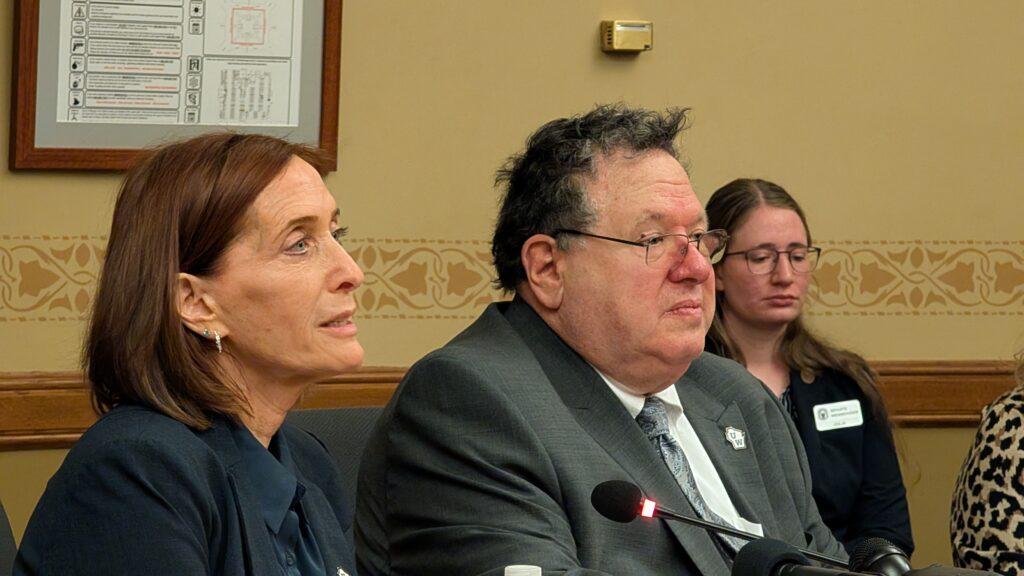


A state Senate committee put off taking action despite threats from lawmakers to fire unconfirmed members of the University of Wisconsin Board of Regents after two regents shared more details Thursday about the decision to fire former UW President Jay Rothman.
While the regents were legally prevented from sharing specific details about the firing, they said, they described their sense that Rothman moved too slowly to act on pressing issues including developing a UW policy on artificial intelligence.
The UW Board of Regents voted unanimously in a virtual meeting Tuesday to fire Rothman, who had refused to leave his position voluntarily. The decision took effect immediately and the the search for the next leader has already begun. Rothman, who will get six months of severance pay, told the Associated Press after the vote that he was “blindsided” by the ousting but wasn’t going to challenge it.
Republican lawmakers had come to the defense of Rothman after the news broke about the effort to oust him. Sen. Patrick Testin (R-Stevens Point) said lawmakers should reject the regents’ nomination if they fired Rothman without cause. The Senate Technical Colleges and Universities committee quickly scheduled Thursday’s public hearing and executive session on the consideration of the nominations of the ten unconfirmed Gov. Tony Evers’ appointees, including Bogost and Nixon.
Sen. Rob Hutton (R-Brookfield) said at the start of Thursday’s meeting that the decision required an explanation.
“Transparency is the foundation of public trust, and when decisions are made without explained justification, it further erodes confidence, not just to the Board of Regents, but in the institution itself,” Hutton said, adding that lawmakers could provide oversight of state entities. “We are faced with a sudden leadership shake-up at risk, creating instability at a time when the chancellor turnover is high and our flagship university is losing its CEO.”
Regent President Amy Bogost and Regent Timothy Nixon said that Rothman had been told about the changes the regents wanted to see. Their decision to let him go, they said, was not made lightly and came after he failed to make those changes. They also said that his decision to take his complaints public was harmful to the UW system.
Bogost has served on the Board for the last six years, including as president since 2024. Nixon has served as a regent for the last two years. Neither has received a confirmation hearing, which has become standard procedure for the Republican-led Senate, which has left most Evers appointees unconfirmed.
Until the meeting, the regents hadn’t given any additional details about the decision to fire Rothman, other than that the decision came after an annual review was conducted by Bogost and that Rothman was “not without notice” and the process was not “sudden.”
Evers stood behind the regents’ decision in a statement released during the meeting, saying the choice was their and that they decided to make a leadership change, “nothing more, nothing less.”
“Republican lawmakers should resist their temptation to turn this into a political conversation, because it isn’t one,” Evers said. “The UW Board of Regents is not supposed to be an extension of any politician or political party. The Regents are responsible for doing what’s best for our UW System, and they should be able to do their jobs without political interference from elected officials.”
Evers also warned it would be a “mistake” if the lawmakers used it as an opportunity to fire people and that that would “jeopardize our continued bipartisan work this session.”
“It’s pretty simple: I trust that the Regents are doing what is best for students, faculty, staff, and our UW System — lawmakers should, too.”
At the start of the hearing, Bogost told lawmakers that she would be as transparent with them as she legally could.
“President Rothman knows exactly what he is doing. He is a sophisticated professional who understands that personnel matters are confidential,” Bogost said. “The confidentiality surrounding his evaluation was not arbitrary… It is what law requires and is what our obligation is to these universities, and yet, President Rothman, who understands all of this, has chosen to use that constraint as a shield — making public statements, he knows I cannot deny, and framing a narrative he knows I cannot correct.”
Rothman was a Milwaukee lawyer and CEO of the law firm Foley and Lardner before being chosen to serve as the UW president in 2022.
Bogost told lawmakers that she would also be willing to walk the committee through the details of the conversations held in closed session with Rothman and the decision to fire Rothman if he waived his confidentiality.
Sen. Brad Pfaff (D-Onalaska) asked why Bogost thought he hadn’t waived his confidentiality.
“I believe that his objective is to be able to get his narrative out and be one-sided…He knows the truth, and he understands what this is all about, and we were hoping that he would move on,” Bogost said. “To do the media circuit that he’s on denigrates our wonderful universities, and that makes me really sad, because I know that he worked tirelessly for the universities, and I really was hoping to celebrate his past accomplishments… it’s unfortunate that he’s taking that path.”
Before firing Rothman, the regents had offered him the opportunity to resign. Rothman refused, saying he hadn’t been given clear reasoning for his firing and that he thought he had accomplished a lot during his tenure as president.
Nixon also said offering at-will employees the option to leave voluntarily is standard procedure within the UW system and in private businesses. As an example, he noted former Gov. Tommy Thompson, who served as interim president of the system between 2020 and 2022 and voluntarily stepped down from the position. He also noted James Langdon, who, according to WisPolitics, wrote in an email that Rothman fired him in a similar way from his position as vice president of administration.
Nixon added that the same practice applies to corporate CEOs, who are routinely let go by companies that don’t want to harm their brands. “You try not to have these public blow-ups, alright, and so nothing here in my mind [is] unusual, and not only that, it follows UW practice.”
In a statement, Rothman said his recent evaluation from Bogost was “overwhelmingly positive.” However, during the hearing, Bogost said that when giving reviews it is typical to “give at least four positives to every negative,” which is what happened with Rothman.
“He was very disheartened by those… I was surprised. These were things that we tried to work on. It was not sudden,” Bogost said. “Mr. Rothman knows that it was ongoing situations that we had many discussions with him about.”
Bogost said there is not an evaluation document, but that she took notes and delivered the evaluation in person to Rothman.
Bogost said Rothman was the right person to lead the UW system as it sought to deal with a tough financial and operational situation. During his time as president, Rothman oversaw the “right-sizing” of campus budgets and the closure of campuses. Nixon said when it comes to other accomplishments Rothman has touted, he is “a bit like the rooster crowing and then taking credit for the sunrise after.”
As the UW system is addressing other pressing issues, the regents said Rothman was too slow to act.
Nixon noted that U.S. News and World Report ranked the 50 most innovative universities in the U.S., and the only Wisconsin school on the list was Marquette University.
“Thank God, one higher education institution in the state has made the list,” Nixon said. “Change is not Mr. Rothman’s strong suit, yet change is what we desperately need.”
Nixon said there was a “lack of urgency” coming from Rothman, adding that coming from a law background he tends to move deliberately to ensure that every i is dotted and every t is crossed.
As an example, Nixon said the regents started asking for a system-wide policy on artificial intelligence in November, but they still had not received one.
“We can’t take a year and six months to decide and think about every single issue. This is no different than moving on to a new quarterback — no matter what you thought of the previous quarterback or what they did,” Nixon said.
Nixon said he had also spoken with Rothman about reassigning some of the over 500 employees who work for the UW system administration to campuses, but there had not been changes.
Sen. Rachael Cabral Guevara (R-Fox Crossing) thanked Nixon for giving the committee some concrete reasons for its decision rather than staying in the “gray zone.”
The regents said that the timing of the decision was partly the result of state budget negotiations and the implementation of the state budget. In the most recent state budget, the UW system received a boost in state funding, which came as a result of negotiations between Evers, Democratic and Republican lawmakers and advocacy efforts from UW stakeholders. Republican lawmakers had initially sought a cut to the UW budget.
At the end of Thursday’s hearing, the committee delayed its vote on whether to recommend confirming the nominees.
Hutton told reporters afterwards that there was more information the senators needed to consider and it would have been “premature” to vote. He said that he wants to see more documents related to Rothman’s evaluation and hear from more of the regents.
“Based on some of the information we requested from the board president, really thought that was beneficial to receive that information, let the committee go through that a little bit more, maybe ask some additional questions before we go to exec[utive session],” Hutton said, adding that Bogost was “very willing” and “cooperative” when it came to providing information.
Hutton said that there would need to be a conversation with the Republican caucus leadership on whether the full Senate, which has adjourned for regular session work, will come back to take a long-delayed vote on the regents’ nominations.